BEMS for Smaller Buildings $6 Billion Growth from 2014 to 2022

The market for building energy management systems (BEMS) for small and medium-sized commercial buildings is expanding as building owners and managers demand more energy savings and easier ways to manage energy use in their facilities, notes Navigant Research.

Source: www.achrnews.com

>” […]“Lower expenditures on energy management in the small and medium-sized building market, along with the lower penetration of advanced controls and building management systems, has limited the penetration of BEMS in this sector,” said Noah Goldstein, research director with Navigant Research. “Given the increasing importance of energy savings, however, BEMS are poised to be a tool that enables savings in both cost and carbon emissions in small and medium buildings.”

The most rapid growth in the BEMS market for smaller buildings, according to the report, is expected to occur in Europe and Asia Pacific, where new construction and regulation are promoting the installation of BEMS equipment and in turn creating demand for associated services and software. In the North American market, BEMS sales are expected to be concentrated in software, driven by utility and regulatory initiatives that promote energy efficiency and building energy reporting. […]”<


See on Scoop.itGreen Building Operations – Systems & Controls, Maintenance & Commissioning

DOE Proposes Major Energy Efficiency Changes for Commercial Air Conditioners

The White House announced a number of commitments to energy efficiency this morning, not the least of which is a proposed energy efficiency standard for rooftop air conditioners that could produce the largest electricity savings under any U.S. appliance efficiency…


image courtesy of http://akbrown.com/?page_id=278

Source: switchboard.nrdc.org

>”[…] NRDC strongly applauds today’s White House’s efficiency and clean energy announcements which come the same week that a new energy-savings standard became effective for refrigerators and freezers, with the majority of models cutting their energy use by 20 to 25 percent, thanks to a 2010 consensus recommendation to the Department of Energy (DOE) from refrigerator manufacturers, efficiency advocates, consumer groups and states.

According to the White House, the rooftop air conditioner proposed standard announced would help cut carbon pollution by more than 60 million metric tons, and could save consumers nearly $10 billion on their energy bills through 2030.  […]

The announcement follows significant groundwork by DOE in this product category, including DOE’s High Performance Rooftop Unit Challenge, a competition among manufacturers to produce efficient cooling units that cut their energy use almost in half and are still affordable in the commercial and industrial real estate space. DOE worked with members of its Commercial Building Energy Alliances (CBEA), which includes many large commercial building owners, to create a challenge specification that rooftop air conditioning manufacturers could meet. As part of the challenge, CBEA members, including Target, Walmart, Macy’s and McDonald’s, expressed strong interest in potentially purchasing high-efficiency roof-top units, helping to drive buyer support for the challenge levels. Manufacturers Daikin McQuay and Carrier succeeded in producing rooftop ACs that met the challenge specifications and resulted in substantial energy reductions.

Also included in today’s announcement are further savings from building energy codes. DOE will issue its final determination that the latest commercial building energy code – ASHRAE 90.1-2013 – saves energy compared to the previous version. Once DOE issues a positive determination that the new code saves energy compared to the previous code, individual states will consider the code for adoption leading to energy savings in new buildings and major retrofits in those states. DOE will also issue its preliminary determination on the latest residential energy-saving building code – the IECC 2015. DOE estimates that the updated commercial building standards will reduces energy bills for states and the federal government, while cutting emissions by 230 million metric tons of carbon dioxide through 2030.  […]”<

See on Scoop.itGreen Building Design – Architecture & Engineering

California Real Estate Assn’ Educates Members on Building Energy Performance & Benchmarking

In California, brokers are at the heart of every non-residential sale or lease. Can the AIR organization get them on board with benchmarking?

Source: www.greenbiz.com

>”Commercial buildings are some of California’s largest energy- and water-guzzlers. With 58 percent of the state locked in the highest category of drought, many commercial property owners are seeing increased utility bills, and with a new building energy benchmarking and disclosure law on the books, building owners seek energy efficiency solutions as a common-sense way to ease some of the pressure. One key trade association in California, the AIR Commercial Real Estate Association, is taking the lead by educating its members on the benefits of energy efficiency.

AIR, founded in 1960, is a regional commercial real estate brokers association with more than 1,700 members across southern California, and is one of the nation’s largest organizations of its kind. It’s recognized across the U.S. for its ever-expanding library of sample lease forms, which members use to stay updated on industry and lease language trends — several of which now include sustainability. When California’s energy benchmarking law, AB 1103, went into effect in January, AIR responded by creating sample energy disclosure lease and sale addenda (PDF) and began educating its members on these new tools.

Brokers are in the thick of it

The law states that any time a non-residential building owner finances, sells or leases a whole building, the property owner is required to use Energy Star portfolio manager to benchmark the building and provide the Energy Star rating and supporting consumption information to the lender, buyer or tenant in the transaction. As brokers are central to every aspect of a commercial transaction, their participation is essential for the law to have its intended effect. AIR’s lease and sale addenda effectively address these energy disclosure requirements in one document, providing real estate professionals, building owners, tenants and attorneys with a framework template for compliance with the regulation.

Brokers hold the key to increasing stakeholder awareness, potentially boosting compliance rates, benchmarking data quality and ultimately better building performance and energy management — and educating the community about new regulations and tools is essential to unlocking this potential.”<

See on Scoop.itGreen & Sustainable News

CEC Delays Energy Benchmarking and Disclosure Requirements 2 Years for Smaller Buildings


>”[…]Compliance with AB 1103 is not suspended, and will continue to be required, for the sale, lease, or financing of buildings over 10,000 square feet that are otherwise subject to the regulations based upon occupancy type.

Significant barriers to compliance with AB 1103

An Emergency Rulemaking Action requires a description of specific facts justifying the immediate action. In justifying the two-year delay, the CEC explained that several stakeholders had expressed concerns about significant barriers to compliance with AB 1103. The CEC noted the following factors in justifying the two-year delay:

  • Some utilities have required tenant consents before releasing utility usage data despite letters sent from the CEC to utilities in July 2013 prohibiting such requirement. This requirement to obtain tenant consents significantly increases compliance costs.
  • Smaller utilities have expressed concerns with their ability to comply given limited staff and resources.
  • The Portfolio Manager platform and software has experienced significant technical problems.
  • The expansion in scope to smaller buildings would increase the number of compliance requests received by utilities, impeding their ability to address barriers to compliance.
  • Smaller building owners may lack the expertise, resources, or capacity necessary to overcome current barriers to compliance without incurring undue expense.
  • Based on initial disclosure data following the January 1, 2014 implementation, it became apparent that “the required disclosures were not being made for the majority of transactions for which they were required.”
  • The development of best practices approaches is lowering compliance costs and paving the way to greater compliance. The additional two years will facilitate lower costs and higher compliance rates before further expanding the program to smaller buildings.”<

See on Scoop.itGreen Building Operations – Systems & Controls, Maintenance & Commissioning

Google invests $145 million in new 82MW Southern California solar power plant

Advanced Controls Devices for HVAC in Buildings shows growth

Worldwide revenue from advanced HVAC controls is expected to grow from $7 billion annually in 2014 to $11.7 billion in 2023, according to a new report

Source: www.businesswire.com

BOULDER, Colo.–(BUSINESS WIRE)–Heating, ventilation, and air conditioning (HVAC) in commercial buildings typically accounts for roughly 40% of total building energy consumption. While advancements have been made in the efficiency of HVAC equipment, the actual energy consumption of HVAC equipment depends largely on their operation – which can be made much more efficient and less energy-intensive through the application of advanced HVAC controls. […]

“The drive to reduce energy use in commercial buildings has put a spotlight on improving the efficiency of HVAC systems, and HVAC controls retrofits offer a compelling value proposition through reduced energy consumption in existing buildings.”

[…]

New building certification and benchmarking regulations are driving faster retrofits of controls in existing buildings, according to the report, and changing how automation is designed into new buildings. The wider adoption of open standards for controls functions (such as BACnet), and of communications based on the Internet Protocol (IP) suite and Ethernet connectivity, is expected to help bring advanced HVAC technology to a wider market.

[…]

See on Scoop.itGreen Building Operations – Systems & Controls, Maintenance & Commissioning

US Company Deploys Aqueous, Lithium-Ion and Flow Batteries for Grid Storage

“Batteries must do more than just work—they have to scale.”

Source: www.greentechmedia.com

>”[…] The startup is a software developer and system integrator that has attracted investment, personnel and a growing roster of turnkey energy storage projects.

[…]

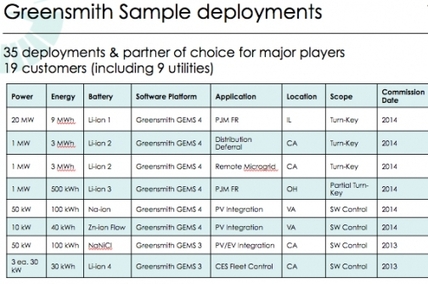
Companies like the 30-employee Greensmith are winning energy storage projects not because they are building better batteries but because they are writing software that integrates batteries with inverters and allows energy storage to work with the grid at scale. Greensmith works with a variety of battery chemistries from different vendors, as well as multiple inverters and power electronics partners.

New battery technologies and projects

Amongst other technologies, Greensmith is using Aquion Energy’s sodium-ion battery. The Pittsburgh, Penn.-based Aquion says its technology can deliver round-trip energy efficiency of 85 percent; a ten-year, 5,000-plus-cycle lifespan; energy storage capacity optimized to charge and discharge for multi-hour applications; and perhaps most notably, a price point of $250 per kilowatt-hour.

In April, Aquion closed a $55 million Series D venture capital investment, bringing total investments and grants to more than $100 million. New investors Bill Gates, Yung’s Enterprise, Nick and Joby Pritzker (through their family’s firm Tao Invest), Bright Capital, and Gentry Venture Partners joined previous investors Kleiner Perkins Caufield & Byers, Foundation Capital, and Advanced Technology Ventures in the round. Aquion is already producing its 1.5-kilowatt-hour S10 Battery Stack units, as well as an 18-kilowatt-hour system that combines twelve of its S10 units.

Greensmith is also using ViZn Energy Systems’ zinc redox flow battery energy storage technology. ViZn aims to produce a 80-kilowatt/160-kilowatt-hour system housed in a 20-foot shipping container, as well as larger systems. Other flow battery firms include American Vanadium, EnerVault, Primus Power, Imergy and ZBB Energy.

The CEO of the firm told GTM that Greensmith is developing a hybrid system using both the Aquion and ViZn storage chemistries.

Since its 2006 founding, Greensmith has deployed 30 battery energy systems for eighteen different customers, nine of them utilities, and is aiming to have 23 megawatts of systems under management by year’s end. […]”<

See on Scoop.itGreen Energy Technologies & Development

School to Combine Solar PV Modules with Battery Storage in Belgian Pilot Project

“Such an energy storage and distribution system can offer a great value, certainly for schools”, says Bert Dekeyzer of npo iD, the organization behind the ‘School of the Future’.

Source: www.solarserver.com

>'”During weekends a school consumes almost no electricity. The energy produced by the solar panels is stored in the batteries. On Monday morning there is a peak consumption: then all the computers and machines are turned on, which requires quite a lot of electricity. If the solar panels supply too little at that time, the batteries can provide the remaining energy. Moreover, a study showed that the energy consumption of a school does not stop after four o’clock in the afternoon. Schools are increasingly used in the evening for sports activities and evening classes. Also in this situation, the batteries can play their part.”

PV, storage combination offers a solution for a possible power shortage

In addition to an optimal and economic usage of solar power, the system can provide a solution for a possible power shortage in Belgium. Because of problems with the Belgian nuclear power plants, various municipalities could get disconnected from the electricity grid. In case of a power disruption, a traditional solar installation does not work anymore. The inverter of a traditional system switches off automatically because of a power failure. The owners of solar modules also have no electricity at that time, and in addition they suffer losses of the power output and any feed-in tariffs from their solar panels during the outage.

The storage system provides a solution. Such an installation combines solar modules with battery storage and intelligent software: if the grid fails, the system provides uninterrupted power for the user from the solar modules and/or batteries. […]”<


See on Scoop.itGreen Building Design – Architecture & Engineering

Province Calls for Renewable Energy Storage Systems Demonstration Projects

Most of the new systems will be able to turn on a dime, storing and releasing energy almost instantaneously to help balance out the supply and demand over the course of a day

Source: www.theglobeandmail.com

>”Ontario has embarked on a quest to find the holy grail of renewable energy – an effective means to store the power generated by intermittent wind and solar installations.

The province’s Independent Electricity System Operator (IESO) recently chose five companies who will build a dozen demonstration projects designed to capture and release energy. That would allow the electricity grid to react to fluctuations in power production, which are becoming more significant with the addition of renewables whose output varies depending on how the wind blows and sun shines.

[…]

The technologies that will be tested include advanced batteries, systems that store power in the form of hydrogen, and even flywheels that hold energy as kinetic energy in a spinning rotor.

Bruce Campbell, president of the IESO, called storage facilities a “game changer” for a grid that was designed to produce electricity at exactly the same time it is consumed. “Energy storage projects will provide more flexibility and offer more options to manage the system efficiently,” he said.

The test projects will be distributed at various locations around the province, and will be connected to different parts of the grid to see how effectively they can help balance supply, demand and other transmission issues.

Among the suppliers are Hydrogenics Corp., which will test a hydrogen storage system, and Hecate Energy and Canadian Solar Solutions Inc., which will use various battery technologies. Convergent Energy and Power LLC will test a flywheel that converts electricity to kinetic energy stored in a rotor. Dimplex North America Ltd. will install thermal systems in apartments in Hamilton, Ont., that store electricity as heat in special bricks, releasing it later when the building needs to be warmed.

Rob Harvey, director of energy storage at Hydrogenics, said his company’s test system will incorporate an advanced electrolysis system that uses electricity to split water into hydrogen and oxygen. That hydrogen can then be used in a fuel cell to generate electricity when needed. Coupling the fuel cell and the electrolyser means power can be effectively stored for any length of time and dispatched as needed.

If the tests are successful, Mr. Harvey said, this could be a significant new line of business for Hydrogenics, which now makes hydrogen-producing systems for industrial customers, as well as fuel cells, which are essentially engines that use hydrogen as fuel.”<


See on Scoop.itGreen Energy Technologies & Development

Maintaining High Performance HVAC Control Systems for Cost Savings in Building Operations

The performance level of a building is directly related to the performance level of its control systems. You cannot manage a high performance building without high performing control systems.


Source: www.automatedbuildings.com

>”We rely on control systems to monitor and manage our building systems. For the most part it’s been assumed that once the control system is installed and configured it will work for years with little attention and minimal maintenance. Some systems may be trouble-free, but the majority of them will need regular attention and maintenance. Over time hardware will fail, software parameters and versions change and slowly the control system will “drift” from its original configuration and performance.

The role of control systems is somewhat undervalued. When you examine the most complex system in most buildings, the HVAC infrastructure, you find that it’s the HVAC control system, not the HVAC equipment, which produces the most operational issues and is the leading cause of inefficient energy use. Lawrence Berkley National Laboratories examined 60 buildings and found the highest frequency of common problems with HVAC was in the control system. Texas A&M research determined that of the operational and maintenance measures that could produce significant energy savings, 77% of the savings were from correcting control problems.

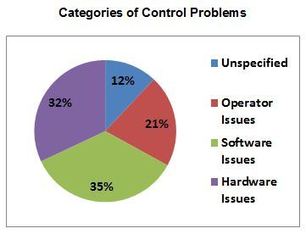
Maintaining a high performing control system involves regular maintenance, software and data management and organizational policies. The issues that can cause problems with a building control system are the same challenges all of us have had at one time or another with our computer or smartphone: problems related to software, hardware, communications networking and “user” mistakes. What follows is an overview of some of the typical control system issues and recommendations as to how to keep it performing at a high level.”<

See on Scoop.itGreen Building Operations – Systems & Controls, Maintenance & Commissioning