Climate change & Global warming: IPCC issues warning to Governments

See on Scoop.itGreen & Sustainable News

Call to ‘stop dithering about fossil fuel cuts’ as expert panel warns entire globe is affected

Duane Tilden‘s insight:

>The scientists’ warning – the most comprehensive and convincing yet produced by climate scientists – comes at a time when growing numbers of people are doubting the reality of global warming. Last week, the UK Energy Research Centre (UKERC) published a survey showing that the proportion of British people who do not think the world’s climate is changing has almost quadrupled since 2005.

Asked if they thought Earth’s climate was changing, 5% of respondents said “no” in 2005, a figure that rose to 11% last year and reached 19% this year.

But as the IPCC report underlines, scientists are becoming more and more certain that climate change poses a real danger to the planet.

Many believe the disconnection between popular belief and scientific analysis has been engineered by “deniers” explicitly opposed to the lifestyle changes – including restrictions on fossil fuel burning – that might be introduced in the near future.

“There are attempts by some politicians and lobbyists to confuse and mislead the public about the scientific evidence that human activities are driving climate change and creating huge risks,” said Stern.

“But the public should be wary of those who claim they know for certain that unmanaged climate change would not be dangerous. For they are not only denying 200 years of strong scientific evidence – the overwhelming view of the world’s scientific academies and over 95% of scientific papers on the subject – but they are often harbouring vested interests or rigid ideologies as well.”

The report will be discussed this week by political leaders meeting in Stockholm. The study – the work of more than 200 scientists – outlines the physical changes that are likely to affect Earth’s climate this century.<

See on www.theguardian.com

Global Warming – Paused or Peaked? – draft U.N. report

See on Scoop.itGreen & Sustainable News

OSLO (Reuters) – A “hiatus” in global warming so far this century is partly caused by natural variations in a chaotic climate and is unlikely to last, a draft United Nations report by leading climate scientists says.

Duane Tilden‘s insight:

>The fact that temperatures have risen more slowly in the past 15 years despite rising emissions of greenhouse gases has emboldened sceptics who challenge the evidence for man-made climate change and question the need for urgent action.

But the IPCC draft reports do not project any long-term respite. Instead, they forecast a resumption in the warming trend that is likely to cause ever more heatwaves, droughts, floods and rising sea levels. […]

“There are a number of explanations (for the hiatus), any one of which might be correct,” said professor Myles Allen of Oxford University, who contributed to the IPCC draft. “That is very different from saying:’We have no idea what’s going on’.”

The drafts say that a reduction in warming for 1998-2012 compared to 1951-2012 is “due in roughly equal measure” to natural variations in the climate and factors such as “volcanic eruptions and the downward phase of the current solar cycle.”<

See on news.yahoo.com

Energy from tides and currents: Arranging underwater Tidal Sails

See on Scoop.itGreen & Sustainable News

In the long sprint to find new sources of clean, low-cost power, slow and steady might win the race — the slow-moving water of currents and tides, that is.

Duane Tilden‘s insight:

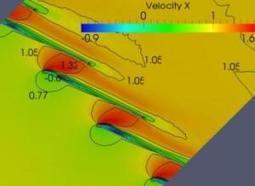
>The system, developed by a Norwegian company called Tidal Sails AS, consists of a string of submerged blades or sails, connected via wire ropes, angled into the oncoming current. The rushing current generates large lift forces in the sails, and as they are pushed along through a continuous loop, they drive a generator to produce electricity. […]

In their analysis, the researchers found that the maximum amount of power could be generated using blades with a chord length (the width of the blade at a given distance along its length) equal to the separation between each individual blade, that are positioned at about a 79 degree angle relative to the oncoming current, and that move at a speed about one and half times faster than the current.<

See on www.sciencedaily.com

UK government rejects current Severn tidal barrage plans

See on Scoop.itGreen & Sustainable News

Ministers say major changes must be made to the scheme if it is to be revived and given serious consideration

Duane Tilden‘s insight:

>Concerns over the impact of such a barrage on marine life played a major part in the rejection, with the government agreeing with MPs that better studies were needed to establish the effects on fish.

The response was: “It is for the developers to do the necessary work to prove that their design is ‘fish-friendly’ and will not jeopardise the UK’s obligations under the water framework directive and habitats directive. Such studies will need to take account of the wide variation in vulnerability of different fish species arising from to their different morphology, physiology and behaviour.”

The government said Hafren would need to provide much more detailed, credible evidence of the proposal, including a study of the environmental impacts and information on turbines, as well as information on allaying fears of flooding that could be worsened by any barrage. The coalition said it would consider the proposal further if this information was provided, but added that legal hurdles would mean the consortium’s current proposals were likely to be subject to delay.

Ministers reiterated their view that there should be no firm commitments of public financial support – in the form of the “strike price” of a premium for low-carbon power that has been confirmed for wind power and is expected soon for nuclear energy – for tidal barrage schemes until 2019 at the earliest.<

See on www.theguardian.com

Water Energy Nexus: A Literature Review

See on Scoop.itGreen Energy Technologies & Development

Water-Energy Nexus: A Literature Review provides readers with an overview and analysis of the policy, scientific and technical research on the connections between water and energy. This review is a comprehensive survey of the literature from the academic, government and nonprofit sectors, organized around the water and energy life cycles.  It examines research and policy from energy use across the water and wastewater sectors, as well as water across the various components of the energy sector.
See on waterinthewest.stanford.edu

The Dark Side of Efficiency

zsturm's avatarInnovation in Business, Energy, and Environment

By Peter Brooks

In at least three of the cases we have studied so far (Maersk, Groom, Wal-Mart) efficiency was the one thing everyone seemed to agree on.  Investments in greater resource efficiency (energy, water, space) that cost less than future benefits are no-brainers; a company can save money while also preserving precious, finite resources (to say nothing of the safety, regulatory, aesthetic, and morale benefits of finding and fixing inefficiencies) and that is unequivocally a good thing.

Unfortunately there is a dark side to efficiency: it can be more destructive to the environment and speed the withdrawal and consumption of natural resources than if the investment were never made.  In the late 19th century, an English economist, William Jevons, made the startling discovery that technological improvements that increased the efficiency of coal-burning, led to an increased consumption of coal.  To put it another way, greater efficiency was used…

View original post 473 more words

Revisiting The North American Hydropower Opportunity

See on Scoop.itGreen Energy Technologies & Development

It is no secret that many renewable energy advocates are not in favor of large hydropower.

Duane Tilden‘s insight:

>[…] there exists a threat that is even more worrisome to endangered species, a threat that has the potential to cause destructive flooding and destroy ecosystems: climate change.  […]

Perhaps that’s why in May of this year, the World Bank reversed its stance on large-scale hydropower. Whereas the major international development bank was once a staunch opponent of large-scale hydro, recognition that developing regions like Africa and Southeast Asia desperately need power have forced it to reconsider.  The world needs energy to lift people out of poverty and building more fossil fuel-fired electricity plants will only serve to exacerbate the problems already associated with climate change. Hydropower is an answer.

Maybe it is time for the renewable energy industry to take a second look at hydropower development. The clean energy it can provide is a vast improvement over the dirty energy we get from fossil fuels. Hydropower already meets about 8 percent of U.S. electricity demand and with improved technologies that already exist the National Hydropower Association (NHA) estimates that we can double the amount of energy we get from hydropower without building any more dams.<

See on www.renewableenergyworld.com

Boston Leads Ranking of Energy-Efficient U.S. Cities by ACEEE

See on Scoop.itGreen & Sustainable News

A new ranking highlights Boston’s achievements in conserving energy as the Senate debates a bipartisan energy efficiency bill.

Duane Tilden‘s insight:

>ACEEE graded 34 cities for their efforts in five areas: buildings, transportation, energy and water utility programs, local government operations, and community-wide initiatives.  […]

The cities’ leap forward in energy-efficiency efforts has been a stark contrast to the slow movement on Capitol Hill, where the Energy Savings and Industrial Competitiveness Act of 2013, authored by Sen. Jeanne Shaheen (D-New Hampshire) and Sen. Rob Portman (R-Ohio) has been struggling to move forward.

The bill, […] would require the federal government—the nation’s single largest energy consumer—to update government buildings to improve energy efficiency, institute electricity-saving measures for government computers, and make it easier for agencies to switch to electric and natural-gas-powered vehicles. It also would provide training for workers in how to build more energy-efficient buildings for the private sector, and help finance private-sector renovations for energy efficiency. […]<

See on news.nationalgeographic.com

Japan to Switch Off Nuclear Power, With No Firm Date for Re-Start: Sci Am

See on Scoop.itGreen & Sustainable News

Japan is set to be nuclear power-free, for just the third time in more than four decades, and with no firm date for re-starting an energy source that has provided about 30 percent of electricity to the world’s third-largest economy.

Duane Tilden‘s insight:

>Kansai Electric Power Co’s 1,180 MW Ohi No.4 reactor is scheduled to be disconnected from the power grid late on Sunday and then shut for planned maintenance. It is the only one of Japan’s 50 reactors in operation after the nuclear industry came to a virtual halt following the March 2011 Fukushima disaster.

Japan last went without nuclear power in May-June 2012 – the first shutdown since 1970 – a year after a massive earthquake and tsunami triggered reactor meltdowns and radiation leaks at the Fukushima facility. The country’s nuclear reactors provided close to a third of the electricity to keep the $5 trillion economy going before the Fukushima disaster, and utilities have had to spend billions of dollars importing oil, gas and coal to make up for the shortfall. […]


IMPORT BILL

Japan consumes about a third of the world’s liquefied natural gas (LNG) production, and will likely boost LNG demand to record levels over the next couple of years. LNG imports rose 4.4 percent in volume to a record 86.87 million tonnes, and 14.9 percent in value to a record 6.21 trillion yen ($62.1 billion) in the year through March.

Imports are likely to rise to around 88 million tonnes this year and around 90 million tonnes in the year to March 2015, according to projections by the Institute of Energy Economics Japan based on a mid-scenario that 16 reactors will be back on-line by March 2015.<

See on www.scientificamerican.com

Coal Power: One Percent Of U.S. Power Plants Produce 12 % Of U.S. Carbon Emissions

See on Scoop.itGreen & Sustainable News

The disproportionate greenhouse impact of a small portion of U.S. power plants shows how damaging inefficiency and inertia can be.

Duane Tilden‘s insight:

>That one percent is actually 50 plants, all of them coal-fired. In fact, America’s single dirtiest power plant — Georgia Power’s Plant Scherer — dumped over 21 million metric tons (MMT) of carbon dioxide into the atmosphere in 2011. That’s more than all the energy-related emissions produced by the state of Maine that year.

And the disproportionate contribution of the dirtiest plants to greenhouse gas emissions continues on down the scale: in 2011, half of all the power sector’s carbon emissions came from the 100 dirtiest plants (98 of which are coal-fired). And 90 percent of all those emissions came from just the 500 dirtiest power plants. That’s out of almost 6,000 electricity generating facilities — renewable and fossil-fuel-powered alike — in the country.<

See on thinkprogress.org