Kinder Morgan files for Trans Mountain pipeline expansion to triple capacity

See on Scoop.itGreen & Sustainable News

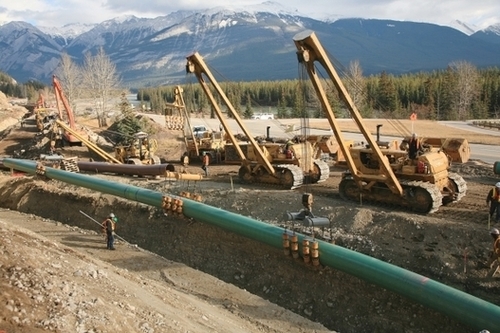
A second pipeline proposal to transport oil to Asia was officially launched on Monday when Kinder Morgan filed a project application for its $5.4-billion Trans Mountain expansion.

Duane Tilden‘s insight:

>The project would nearly triple oil capacity to 890,000 barrels annually and bring about 400 more tankers a year into Burrard Inlet (up from about 80) if it is approved by the National Energy Board and subsequently by the federal government.

The 1,150-kilometre pipeline will carry diluted bitumen from the Alberta oilsands, starting in Edmonton, through Jasper and across B.C. to the company’s Westbridge Terminal in Burnaby.

Kinder Morgan says nearly three-quarters of the proposed expanded pipeline’s length across most of the province will follow the existing right-of-way where the pipeline was first built in the 1950s. About 17 per cent of the route, and virtually all the way through the Lower Mainland west of Fort Langley, will deviate from the current line, but would follow other existing utility corridors or infrastructure.

Kinder Morgan is promising enhanced tanker safety in its more-than-15,000-page submission, and says it is continuing discussions with First Nations, whose support is critical to large infrastructure development projects in B.C.

The twinning of Kinder Morgan’s existing pipeline has already seen years of pushback from First Nations, environmentalists and community groups concerned about the potential for spills along the pipeline and from tankers. Both Vancouver and Burnaby’s city councils have voiced opposition to the project.

The project would create about 90 permanent jobs, and employ 4,500 people at the peak of construction.<

See on www.vancouversun.com

Critical lack of long-term radioactive waste storage as Japan finalizes energy policy

See on Scoop.itGreen & Sustainable News

The United States’ top nuclear regulator said Friday that atomic energy users, including Japan, must figure out how to ultimately store radioactive waste.

Duane Tilden‘s insight:

>Japan has no final waste repository, not even a potential site. The U.S. government’s plan for building a repository at Yucca Mountain in Nevada has been halted by strong local opposition due to safety concerns.

“In the nuclear community, we of course have to face the reality of the end product — spent fuel,” Macfarlane told reporters.

She urged countries that are contemplating or embarking on a nuclear power program to formulate back-end plans at an early stage.

The new policy under Prime Minister Shinzo Abe’s pro-nuclear government is pushing to restart as many reactors as possible if deemed safe under the new, stricter safety standards that took effect this past summer. The new policy, whose draft was discussed Friday by a government panel, is also expected to stick to Japan’s shaky fuel cycle program despite international concerns about the country’s massive plutonium stockpile.

Japan is stuck with 44 tons of plutonium at home and overseas after unsuccessfully pushing to establish a fuel cycle, with its fast breeder reactor and a reprocessing plant never fully operated. Experts say Japan’s plutonium stockpile poses a nuclear security threat and raises questions over whether Japan plans to develop a nuclear weapon, which Tokyo denies.

Japan also has more than 14,000 tons of spent fuel in cooling pools at its 50 reactors, all of which are offline. Some pools are expected to be full in several years, and are expected to be moved to a dry cask facility just completed in northern Japan.<

See on www.ctvnews.ca

Obama approves border-crossing pipeline carrying corrosive fracked gas diluent to Alberta Tar-Sands

See on Scoop.itGreen Energy Technologies & Development

But the pipeline has problems with stress corrosion cracking. Is it safe to expand?

Duane Tilden‘s insight:

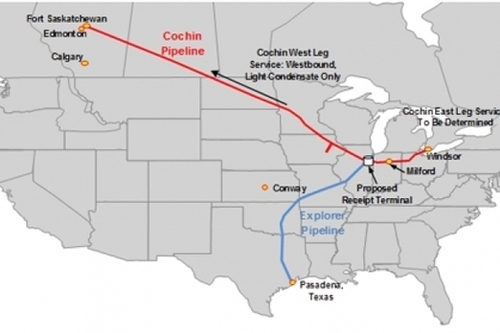
>Kinder Morgan Cochin LLC is now allowed to reverse and expand to build a 1,900-mile proposed pipeline to transport gas produced by hydraulic fracturing of the Eagle Ford Shale basin in Texas north into Alberta. It would carry gas condensate that is used to dilute the bitumen in the tar sands. The extra-thick oil produced in the tar sands needs to be cut with 30 per cent condensate so it can be carried, according to the Financial Post.

The Cochin pipeline has had some safety issues in the past, however. Last year, the National Energy Board sent Kinder Morgan a letter regarding Stress Corrosion Cracking (SCC) failure in the U.S. back in 2003. At the time, the U.S. Pipeline and Hazardous Materials Safety Administration (PHMSA) issued an order imposing a 20 per cent pressure restriction on the pipeline. Kinder Morgan later voluntarily imposed a further restriction on the operating pressure and received approval to increase  the operating pressure of the pipeline in US to 6895 kPa (1000 psi) in March 2012.<

See on www.vancouverobserver.com

Renewable Geothermal Power – a Vast & Untapped Energy Resource

See on Scoop.itGreen Energy Technologies & Development

There are no plans for new coal plants to be built in the United States. This opens doors for the geothermal industry possibly more than ever before in U.S. history.

Duane Tilden‘s insight:

> Geothermal energy is a renewable source of electricity that has the same important baseload qualities […]  (of coal for) electric power generation in the U.S. at a fraction of the cost.

“Baseload is always better,” […] “[I]t assures a steady revenue stream which is much better for financing.”For a nation that’s thinking to the long term, geo plants are:

Firm. They can run 24 hours a day regardless of extraneous conditions.Flexible. Geothermal’s flow can be load following or allow for imbalance, can provide a spinning reserve or a non-spinning reserve, and works well as replacement or supplemental reserve.

Falcone says of geothermal’s flow options: “By being able to load follow, geothermal can be reduced during low need time and increased without much effort. There is no need to store power that cannot be used. The price of power can be kept lower than other renewables since more of it is sold than the intermittent power sources like wind and solar.”

Falcone adds, “There are now efforts to marry solar with geothermal so that extra power can be produced during sunny peak hours.

“There is no need to invest in fossil fuel to create heat in order to generate power, so the environment is better off.”But today’s solicitations for renewable energy in Western states tend to ignore these unique benefits of geothermal power. Additional long-term analysis shows geothermal plants are:

Small. Geothermal-impacted land in 2030 is expected to be around 7.5 km2/TW-hr/yr, as opposed to 9.7 .5 km2/TW-hr/yr for a coal plant.Hardy. Long-lasting geothermal plants include those at The Geysers in California (since the 1960s) and at the Lardarello field in Italy (since 1904).<

See on www.renewableenergyworld.com

Kyocera Opens Japan’s Largest Offshore Solar Power Plant

See on Scoop.itGreen & Sustainable News

The Kyocera Corporation just opened a 70 megawatt solar power plants off the southern coast of Japan.

Duane Tilden‘s insight:

>Kyocera partnered with six other companies to develop the solar plant, which is located in the Kagoshima Prefecture. The company hopes that this latest offshore venture will set a precedent for a cleaner Japan, especially in light of the 2011 Fukushima disaster. The solar plant is designed to inspire and encourage Japan to make the switch to more renewable energy sources.

The Kagoshima Nanatsujima Solar Power Plant was made possible in part because of Japan’s revised feed-in-tariff (FIT) program, which was restructured in July, 2012 to better accommodate solar energy. The adjusted FIT plan requires local utilities to purchase 100 percent of the power generated by solar plants that produce more than 10 kW.<

Read more: Kyocera Opens Japan’s Largest Offshore Solar Power Plant | Inhabitat – Sustainable Design Innovation, Eco Architecture, Green Building

See on inhabitat.com

The China Water Crisis: A Global Catastrophe or Wasteful Use?

See on Scoop.itGreen & Sustainable News

Learn how the China water crisis will have significant impact on the balance of the world if not reversed, and how you can help, in this WaterFilters.NET post.

Duane Tilden‘s insight:

>The New York Times reports:

Beijing has placed its faith in monumental feats of engineering to slake the north’s growing thirst. The South-North Water Transfer eventually aims to pipe 45 cubic kilometers of water annually northward along three routes in eastern, central and western China. All three pose enormous technical challenges: The eastern and central routes will be channeled under the Yellow River, while the western route entails pumping water over part of the Himalayan mountain range.

The estimated cost of $65 billion is almost certainly too low, and doesn’t include social and ecological impacts. Construction has already displaced hundreds of thousands, and issues the like possible increases in transmission of water-borne diseases have not been properly studied. But Beijing’s calculus is political: It is easier to increase the quantity of water resources, at whatever cost, rather than allocate a limited supply between competing interests.  […]

A recent article by The Economist states:

“The Chinese government would do better to focus on demand, reducing consumption of water in order to make better use of limited supplies. Water is too cheap in most cities, usually costing a tenth of prices in Europe. Such mispricing results in extravagance. Industry recycles too little water; agriculture wastes too much. Higher water prices would raise costs for farms and factories, but that would be better than spending billions on shipping water round the country.”

Economically supporting Chinese regions and corporations that commit to better water usage and sustainability practices may help to change the mindset of many within this nation’s government or industries.  In turn, this could lead them towards exploring more realistic initiatives experiencing success in other parts of the world.<

See on blog.waterfilters.net

GE seeks to Clean up Fracking’s Dirty Water Problem

See on Scoop.itGreen & Sustainable News

GE has demonstrated technology aimed at addressing one of the biggest challenges with fracking: water pollution.

Duane Tilden‘s insight:

>Concerns about water pollution and other environmental issues related to fracking have led some places, including France and New York State, to block the process. As fracking increases in dry areas and places that lack adequate treatment and disposal options, pressure to block it could grow.

“Water-treatment technology is going to become more and more critical as the industry moves forward,” says Amy Myers Jaffe, executive director of energy and sustainability at the University of California at Davis, and a new member of a GE environmental advisory board. She says the continued use of fracking depends on the “industry getting its act together to do it in an environmentally sustainable way.”

Better water-treatment options could change the way oil and gas producers operate by making it economical to treat water at fracking sites instead of trucking it long distances to large water-treatment facilities or disposal wells. The technology is specifically targeted to places such as the Marcellus shale, one of the largest sources of shale gas in the U.S., where wastewater is far too salty for existing on-site treatment options (see “Can Fracking Be Cleaned Up?” and “Using Ozone to Clean Up Fracking”).

Each fracking well can require two to five million gallons of fresh water, which is pumped underground at high pressure to fracture rock and release trapped oil and gas. Much of that water flows back out, carrying with it the toxic chemicals used to aid the fracking process, as well as toxic materials flushed from the fractured rock.

Producers currently reuse much of that water, but that involves first storing it in artificial ponds, which can leak, and then diluting it, a step that consumes millions of gallons of fresh water. Eventually they can’t reuse the water any more so they need to ship it, often over long distances, to specialized treatment and disposal locations. Transporting the wastewater is expensive, and it comes with a risk of spills. At disposal sites, the wastewater is injected deep underground in a process that can cause earthquakes.

The new technology would make it unnecessary to dilute the wastewater, or transport it for treatment or disposal. […]<

See on www.technologyreview.com

BP battles for billions in latest Gulf Oil Spill pollution trial

See on Scoop.itGreen & Sustainable News

HOUSTON/LONDON (Reuters) – BP will battle to hold down fines that could hit $18 billion in a new phase of the Gulf of Mexico trial that will rule on how much oil it spilled in 2010 and judge its efforts…

Duane Tilden‘s insight:

>POLLUTION FINES

BP says 3.26 million barrels leaked from the well during the nearly three months it took to cap the blowout at the Deepwater Horizon rig; the U.S. government says it was 4.9 million. Both those totals include 810,000 barrels that were collected during clean-up and which Barbier has agreed to exclude.

This month, BP’s lawyers questioned the government’s figure. “United States experts employ unproven methods that require significant assumptions and extrapolations in lieu of … available data and other evidence,” they said in a filing.

They have also sought to convince Barbier that if the company is to be found guilty, it should amount to only “negligence” and not “gross negligence” – a crucial distinction since the latter carries much higher maximum penalties.

Under the Clean Water Act, negligence can be punished with a maximum fine of $1,100 for each barrel of oil spilled; a gross negligence verdict carries a potential $4,300 per barrel fine.

If the court judged the spill to have been 4.09 million barrels – the government estimate less oil recovered – the price of negligence could reach $4.5 billion. Gross negligence, in the costliest scenario, could run to $17.6 billion.<

See on www.reuters.com

U.S. Nuclear Power Closures Signal Wider Problems for Industry

See on Scoop.itGreen & Sustainable News

A string of plant closures, project cancellations and other setbacks has raised new doubts about the future of nuclear power in the United States, but there’s disagreement about whether the retrenchment will be limited and temporary or the…

Duane Tilden‘s insight:

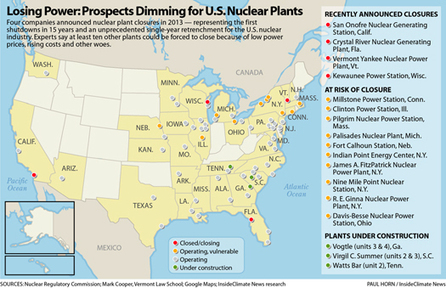
>The blows to nuclear power’s prospects have come on many fronts, but it was the surprising spurt of plant closures that laid bare the industry’s worsening plight. The plant shutdowns are the first to hit the U.S. nuclear power market in 15 years, and the retirements don’t bode well for many of the nation’s 99 remaining power reactors.

Analysts say economic woes make at least 10 other plants vulnerable enough to follow suit. Almost all of those are among the nation’s 47 “merchant” nuclear plants, which, unlike regulated plants, operate in open markets and have to beat out other power suppliers to win customers and long-term supply contracts. The especially vulnerable facilities cited by analysts are at greater risk for closure because their power is too expensive to sell profitably in wholesale markets or because their output is too small or too unreliable to support rising operating and retrofit costs.<

See on insideclimatenews.org

Ex-Halliburton Official Charged With Destroying Evidence In Gulf Oil Spill Disaster

See on Scoop.itGreen & Sustainable News

The the latest twist in an ongoing legal battle following the explosion that killed 11 people and resulted in the largest oil spill in U.S. history.

Duane Tilden‘s insight:

>Attorney General Eric Holder said in a statement: “Halliburton and one of its managers have now been held criminally accountable for their misconduct, underscoring our continued commitment to ensuring that the victims of this tragedy obtain justice, and to safeguarding the integrity of relevant evidence.”

U.S. District Judge Jane Triche Milazzo of the Eastern District of Louisiana also noted that Halliburton self-reported the misconduct and cooperated with the investigation. Badalamenti was charged with a “bill of information,” which often means that the defendant is cooperating with prosecutors.

Rig owner Transocean and BP were both criminally charged for the disaster, but Halliburton was not — these charges are just related to the post-spill review.

Even though the spill happened more than three years ago, residents in the area still feel the effects. The 170,000 workers hired to help clean up the oil spill are at an increased risk of getting cancer, leukemia, and other serious illnesses. And on Thursday, BP sued the state of Louisiana to block its order to remove abandoned anchors the company used to deploy oil spill booms during cleanup efforts.<

See on thinkprogress.org