Climate Change Will Cause More Energy Breakdowns, U.S. Warns

See on Scoop.itGreen & Sustainable News

The national power supply is increasingly vulnerable to severe weather, according to a new Department of Energy study.

Duane Tilden‘s insight:

>The effects are already being felt, the report says. Power plants are shutting down or reducing output because of a shortage of cooling water. Barges carrying coal and oil are being delayed by low water levels in major waterways. Floods and storm surges are inundating ports, refineries, pipelines and rail yards. Powerful windstorms and raging wildfires are felling transformers and transmission lines.

“We don’t have a robust energy system, and the costs are significant,” said Jonathan Pershing, the deputy assistant secretary of energy for climate change policy and technology, who oversaw production of the report. “The cost today is measured in the billions. Over the coming decades, it will be in the trillions. You can’t just put your head in the sand anymore.”<

See on www.nytimes.com

UK Energy Efficiency Requirements and Business

See on Scoop.itGreen & Sustainable News

Proposals for an Energy Savings Opportunity Schemes have been published by the UK Government that will make it compulsory for large companies to undertake energy audits.

Duane Tilden‘s insight:

>An ESOS assessment would undertake a review of the total energy use and energy efficiency of the organisation, including the measurement of an energy intensity ratio (e.g. energy use per employee or per unit of output) and, as appropriate, considering the variation in energy use over time within key buildings, key industrial operations, and key transport activities (exempting de minimis energy use).

The review would need to be proportionate and sufficiently representative “to permit the drawing of a reliable picture of overall energy performance” of the organisation and present clear information on potential savings, which identify and quantify cost-effective energy savings opportunities.

These should be, wherever practical, based on life cycle assessments (LCA) instead of simple payback periods (SPP), as the former are more realistic.

All procedures for doing this are outlined under the international standard for energy management, ISO 50001, with which all energy and facility managers are encouraged to become competent.

The Government has come under sustained criticism recently for failing to do enough to promote energy efficiency.<

See on theenergycollective.com

Cambridge Plans Massive Energy Efficiency Retrofit

See on Scoop.itGreen Building Design – Architecture & Engineering

This medieval English city is investing $1.5 billion for energy upgrades for the entire city.

Duane Tilden‘s insight:

>It’s one thing to build super-energy-efficient new homes and offices – it’s another matter entirely to bring ancient buildings up to par. But the medieval university city of Cambridge, England, plans to do just that with a $1.5 billion retrofit program.

The newly launched Cambridge Retrofit Project aims to reduce carbon emissions from buildings 30% before 2050 through a massive, city-wide retrofit scheme.  […]

While the primary goal is reduced energy consumption and carbon emissions, the program also aims to build up local businesses, create warmer homes and increase the value of properties.

Energy savings alone are expected to be worth $2.3 billion and the city’s carbon footprint, currently 830,000 tons a year, is expected to fall 1% a year, eventually reaching 500,000 tons a year as a result of the retrofit program.<

See on www.sustainablebusiness.com

Swansea Bay hydrokinetic project continues moving forward

See on Scoop.itGreen Building Design – Architecture & Engineering

Energy development group Tidal Lagoon Power Limited has reached a significant milestone in the development of a massive hydroelectric power project with the announcement of three design, build and deliver agreements.


Duane Tilden‘s insight:

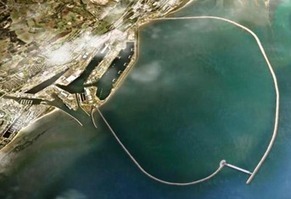
>[…]According to TLP, the US$966.5 million project will consist of a 6-mile-long, 35-foot-high semi-circular sea wall that will enclose an area west of Swansea Marina.  The wall would be dotted along its length with a number of hydro turbines, giving the project a cumulative capacity of around 250 MW.

Each of TLP’s three partners adds a unique quality to the project’s development, the company said.  Costain will work in developing and managing the schedule for pre-construction and construction phases, developing construction methodology for civil engineering works including turbine and sluice structures, access routes and complex temporary works, including temporary bund for construction turbine housing.

Meanwhile, Atkins will provide engineering design and geotechnical expertise. TLP said this includes “designing both the turbine house and the innovate breakwater bund wall, which uses a combination of giant tubular sand bags protected by armor made up of different sized rocks.”

Last, Van Oord is developing construction methodology suitable for the harsh off-shore conditions in Swansea Bay.  The Swansea is the first tidal lagoon power project envisioned by TLP, which said in May that it is considering a similar project off Wales’ north coast. As much as 10,000 MW of tidal lagoon power potential in the United Kingdom, the group said. […]<

See on www.hydroworld.com

Formal consultation commences on the world’s first purpose built tidal lagoon | Specification Online

See on Scoop.itGreen Building Design – Architecture & Engineering

The formal consultation process has started on the world’s first purpose built tidal lagoon for Swansea Bay, with public exhibitions taking place at 18 locations around the Swansea Bay area until August 5.

Duane Tilden‘s insight:

>The proposed tidal lagoon will have a rated capacity of 240 Megawatts (MW), generating 400GWh net annual output. This is enough electricity for approximately 121,000 homes.

In addition to generating electricity, the £650 million development will also provide visitor facilities and other amenities including art, education, mariculture and sporting/recreational facilities. The seawall is expected to be open to the public during daylight hours for walking, running, cycling etc, though access will be controlled in extreme weather.

LDA Design, the project masterplanners and landscape architects for Swansea Bay Tidal Lagoon, has completed the coordination of exhibition material for the public exhibitions. As part of the formal consultation for the proposed Development Consent Order (DCO) application by Tidal Lagoon (Swansea Bay) plc (TLSB), a new, virtual 3D programme has been prepared, which shows the proposed lagoon in the context of Swansea Bay.  <

See on specificationonline.co.uk

Scottish tidal power potential less than estimated, still Viable – new Study via Reuters

See on Scoop.itGreen Energy Technologies & Development

* Pentland Firth could generate maximum of 1.9 GW of power* 1 GW seen more realistic, vs prior estimates of 10-20 GW

LONDON, July 10 (Reuters) – Proposed tidal turbines in Pentland Firth, which separates…

Duane Tilden‘s insight:

>New research led by the University of Oxford suggests, however, that the maximum that Pentland Firth could produce would be 1.9 gigawatts, with 1 GW a more realistic target.

That is far below previous estimates of 10 GW to as much as 20 GW. […]  The study was less optimistic about the firth’s potential because it took into account factors such as how many turbines it would be feasible to build, how they would interact with each other and variations from tidal cycles.

“Our study provides the first robust data about how much energy it would be feasible to extract,” said Thomas Adcock, lead author of the report and fellow in engineering science at Oxford University.

Pentland Firth could still generate power equivalent to almost half of Scotland’s annual electricity consumption, which amounted to 37 terrawatt hours in 2011, Adcock added. […]<

See on www.reuters.com

Is Scotland’s Pentland Firth the World’s Best Site for Tidal Power

See on Scoop.itGreen Energy Technologies & Development

Tidal streams could bring large amounts of energy within a decade if government support is available, study says

Duane Tilden‘s insight:

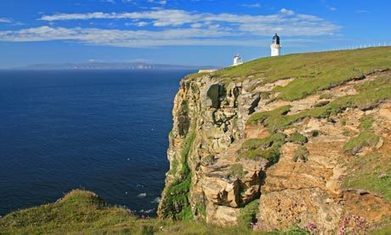
>The world’s best site for tidal power, the Pentland firth, could provide half of Scotland’s electricity, according to the first robust estimate of its potential. The tidal streams, which surge through the firth at five metres per second, could bring large amounts of renewable energy in reach within a decade if enough government support is available, said the Oxford University engineer behind the new study.

From Anglesey to the Severn estuary to Portland Bill, the UK has the greatest potential for generating predictable, clean energy from tidal channels. Turbines are already operating at Strangford Loch in Northern Ireland and prototypes are being tested in the Menai Straits off Anglesey.

But the Pentland firth is the greatest resource. “It is almost certainly the best site for tidal stream power in the world,” said Thomas Adcock, at Oxford University, who led the new work published in the journal Proceedings of the Royal Society A. The water flow is rapid there because the tide shifting from the Atlantic into the North Sea is forced through a narrow eight-mile channel.<

See on www.guardian.co.uk

Demand for DC Brushless Motors to increase over 50% in Transportation Sector by 2017

See on Scoop.itGreen & Sustainable News

Automotive systems are becoming increasingly electrically-driven and electric motor manufacturers are benefiting.

Duane Tilden‘s insight:

>“[…] Increasing sales of plug-in electric vehicles, which have powertrain and chassis systems that are electromechanically-driven, are expected to provide greater growth potential for brushless DC motor shipments than for brushed DC motors.

[…]

Although DC brushed motors usage is expanding with the increasing number of electromechanically-driven powertrain and chassis systems, DC brushless motor shipments for powertrain and chassis applications are expected to outpace those of DC brushed motors twofold from 2012 to 2017. The respective average annual growth of DC brushed and DC brushless motor shipments from 2012 to 2017 is expected to be 3.5 percent and 7 percent according to IMS Research. <

See on www.imsresearch.com

World Solar PV Market To Hit 45 GW In 2014, Deutsche Bank Forecasts

See on Scoop.itGreen & Sustainable News

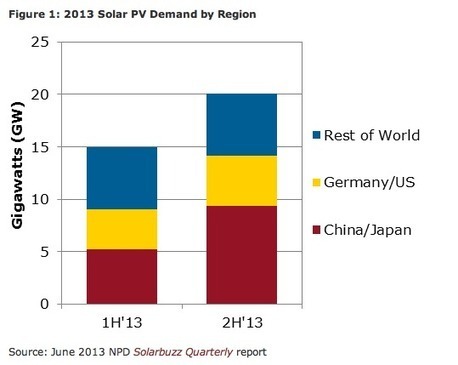
Deutsche Bank is the latest to upgrade its forecasts – for the second time in as many months – predicting that the 2014 global solar market could jump to 45 GW, after rising to 38-40 GW in 2013.

>Deutsche’s analysis is more bullish than an NPD Solarbuzz report last week that forecast solar PV demand for calendar 2013 to reach a record high of 35.1 GW, after a strong second half that would result in 20 GW being installed. In March, the research group predicted full year demand of just 31 GW.

NPD Solarbuzz analyst Michael Barker said the market was still in transition (from older markets such as Europe to newer ones in Asia), and would continue to rely on four key countries for the bulk of demand – Germany, China, Japan, and the US – which accounted for more than 60% of demand in the first half.

It said China and Japan alone would account for 45% of global demand in the second half, up from just 10% three years ago.<


Sustainable Heating and Cooling of Buildings | Leonardo ENERGY

See on Scoop.itGreen Energy Technologies & Development

In many non-residential buildings across Europe, the energy consumed for heating and cooling is more than half the total energy consumption of the building. This is not inevitable. The introduction of simple design concepts and currently available technologies can lead to significant reductions in the energy consumption, operating costs, and carbon emissions of both new and existing buildings.

See on www.leonardo-energy.org