Are Virtual Power Plants the Next Generation in Electrical Utilities?

Germany’s energy giants are lumbering behind the rapid advance of renewable energy. They might stay afloat for a while, but they don’t seem flexible enough to achieve a turnaround, says DW’s Henrik Böhme.

Source: www.dw.de

>” […]  Decentralization is the buzzword. And the power required elsewhere, say, for street lights, electric motors, or the bakery nearby will be largely generated through renewables. Even large industrial compounds will be in a position to generate enough electricity for their own needs.

Nuclear power stations will all have been switched off by then, with only a few coal-fired or gas-fired plants still in operation. One way or another, Germany’s power landscape is bound to undergo dramatic changes.

That’s been obvious for a couple of years now. But the German utilities’ age-old business models don’t seem to be working anymore. All they know is big and heavy – they’re used to nuclear and coal power stations guaranteeing billions in profit, year-in year-out, and they seemed to secure their earnings without any trouble. And then they grew fat and began making mistakes.  […]

Then came the Fukushima nuclear disaster four years ago, leading to the German government’s decision to phase out nuclear energy completely by 2022. That dealt a severe blow to Eon, RWE and co. which hadn’t really understood the thrust of the country’s energy transition anyway.

The utilities in question are now frantically trying to rescue what they still can. They’re cutting away some of the fat. Costs are being cut, employees are being laid off and selected divisions are being jettisoned. The companies have rediscovered private clients by offering them networking technology.

But people don’t trust those giant, de facto monopolist firms anymore. Younger companies can do the same just as well, and often far more efficiently. Take “Next Kraftwerke”, a Cologne-based start-up. They run a virtual power station where power is collected from many smaller facilities and redistributed in the process. This is pretty close to what a future energy supply system will look like.

According to Silicon Valley researcher Peter Diamandis, 40 percent of the world’s current biggest companies will have ceased to play an important role some 10 years from now. On current performance, among those to fall will most likely be Eon, RWE and others.”<
 

See on Scoop.itGreen Energy Technologies & Development

Vanadium Flow Battery Competes With Lithium and Lead-Acid at Grid Scale

The company claims LCOE [Levelized Cost of Energy] is less than half the cost of any other battery technology available.

Source: www.greentechmedia.com

>”[…]

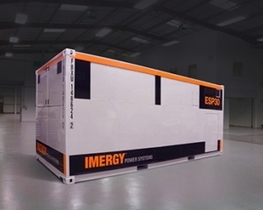
Imergy Power Systems just introduced its third-generation vanadium flow battery, claiming it offers a low-cost, high-performance energy storage solution for large-scale applications, including peak demand management, frequency regulation and the integration of intermittent renewable energy sources.

The ESP250 has an output power capability of 250 kilowatts and 1 megawatt of energy storage capacity. It’s suited for both short- and long-duration storage, with available energy ranging from two to 12 hours of output duration. The 40-foot batteries (each about the size of two shipping containers) are designed to be deployed individually or linked together for larger-scale projects. […]

Where Imergy has been able to edge out its competitors is on material cost. Vanadium is abundant but expensive to extract from the ground. Imergy has developed a unique chemistry that allows it to use cheaper, recycled resources of vanadium from mining slag, fly ash and other environmental waste.

With this chemistry, the levelized cost of energy for Imergy’s batteries is less than half of any other battery on the market right now, according to Hennessy. Vanadium flow batteries are orders of magnitude cheaper than lithium-ion batteries on a lifetime basis because they can be 100 percent cycled an unlimited number of times, whereas lithium-ion batteries wear down with use, according to the firm. Despite the compelling cost claims from Imergy, lithium-ion has been the predominant energy storage technology being deployed at this early point of the market. And very few flow batteries are currently providing grid services.

Imergy’s capital costs are lower than every other battery technology except lead-acid, Hennessy added. But he believes the company can hit that mark (roughly $200 per kilowatt-hour) by the end of the year by outsourcing contracts to manufacturing powerhouse Foxconn Technology Group in China. Delivery of the ESP250 is targeted for summer of 2015.

At this price, Imergy says the ESP250 offers an affordable alternative to peaker plants and can help utilities avoid investing more capital in the grid. Some might disagree with the claim that grid-scale storage can compete with fast-start turbines and natural gas prices below $3 per million Btu. But according to Hennessy, it all comes down to the application. Batteries can’t compete with gas at the 50-megawatt scale, but they can compete with gas at the distribution level.

“Batteries that are distributed have a huge advantage over gas, because when you buy gas down at the low end, you’re paying a lot more than $3 to $4 per MMBtu, because you’ve got to pay for all the transmission down to the small end,” he said.

Demand for cost-effective energy storage is growing as intermittent renewables become cheaper and come on-line in higher volumes. GTM Research anticipates the solar-plus-storage market to grow from $42 million in 2014 to more than $1 billion by 2018.

Imergy sees a ripe market in the Caribbean, parts of Africa and India, Hawaii and other places where the LCOE for solar-plus-storage is already competitive. As costs continue to fall, New York, California and Texas will also become attractive markets.”<


See on Scoop.itGreen Energy Technologies & Development

US Utilities #1 Priority is to Replace and Modernize Old Grid Infrastructure

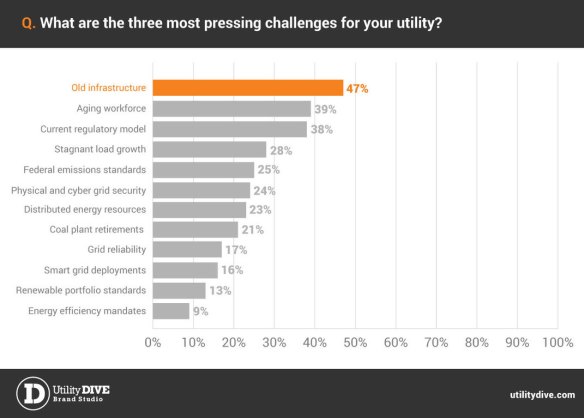
The State of the Electric Utility 2015 survey revealed that aging infrastructure is what troubles industry players most.

Source: www.utilitydive.com

>” Utility executives identified aging infrastructure as the number one challenge facing the electric industry, […] easily topping an aging workforce, regulatory models and stagnant load growth. In response, the industry is spending hundreds of billions to replace and upgrade infrastructure, rushing to meet consumer demand for higher quality power enabled by construction of a more modern grid.

“The last few years there’s been more of an emphasis on transmission and distribution, and the driver there has been the advent of all these new technologies that are trying to connect with the grid,” said Richard McMahon, Jr., vice president of energy supply and finance for the Edison Electric Institute, the electric utility trade organization. “There are also a lot of customer-driven desires utilities are trying to facilitate. There’s a lot of spending on metering automation, as well as at the distribution level, distribution transformers to accommodate distributed generation.”

Today’s grid may not be up to the task of reliably integrating high levels of renewables, distributed energy resources, and smart grid technologies, Utility Dive found. The American Society of Civil Engineers (ASCE) gave U.S. energy infrastructure a barely passing grade of D+ in 2013, at stark odds with the sophisticated grid management required by the rapid acceleration of utility-scale renewables, distributed resources and two-way devices.

“Distributed energy cannot be a profit center without the modernized grid infrastructure that’s needed for grid integration,” Utility Dive concluded in the report. […]

Outages on the rise

The American Society of Civil Engineers report that gave U.S. infrastructure a barely-passing grade pointed out that aging equipment “has resulted in an increasing number of intermittent power disruptions, as well as vulnerability to cyber attacks.”

Significant power outages rose to more than 300 in 2011, up from about 75 in 2007, and the report found many transmission and distribution outages have been attributed to system operations failures, though from 2007 to 2012 water was the primary cause of major outages.

“While 2011 had more weather-related events that disrupted power, overall there was a slightly improved performance from the previous years,” the report said. “Reliability issues are also emerging due to the complex process of rotating in new energy sources and ‘retiring’ older infrastructure.

ASCE said that for now, the United States has sufficient capacity to meet demands, but from 2011 through 2020 demand for electricity in all regions is expected to increase 8% or 9%. The report forecasts that the U.S. will add 108 GW of generation by 2016.

“After 2020, capacity expansion is forecast to be a greater problem, particularly with regard to generation, regardless of the energy resource mix,” the report said. “Excess capacity, known as planning reserve margin, is expected to decline in a majority of regions, and generation supply could dip below resource requirements by 2040 in every area except the Southwest without prudent investments.” […]”<

See on Scoop.itGreen & Sustainable News

Apple to Invest $2 Billion in Solar Farm Powered Data Center Renovation in Arizona

Apple plans to invest $2 billion to build a data center in Arizona in the location where its failed sapphire manufacturing facility exists, the state announced Monday.

Source: blogs.wsj.com

“> […] The company plans to employ 150 full-time Apple staff at the Mesa, Arizona, facility, which will serve as a command center for its global network of data centers. In addition to the investment for the data center, Apple plans to build a solar farm capable of producing 70-megawatts of energy to power the facility.

Apple’s investment is expected to create up to 500 construction jobs as well, the state said.

Apple said it expects to start construction in 2016 after GT Advanced Technologies Inc., the company’s sapphire manufacturing partner, clears out of the 1.3 million square foot site. The $2 billion investment is in addition to the $1 billion that Apple had earmarked to build scratch-resistant sapphire screens at the same location.

The investment comes a few months after GTAT filed for bankruptcy protection in October, citing problems with the Arizona facility. Shortly after its bankruptcy filing, GTAT said it planned to lay off more than 700 employees in Arizona.

In October 2013, Apple had agreed to build a sapphire factory in Mesa that GTAT was going to operate. At the time, Apple had said the new factory was going to create 2,000 jobs and move an important part of its supply chain to the U.S.

However, the project struggled to produce a consistent level of sapphire at the quality demanded by Apple. In the end, Apple did not use sapphire from the facility for its latest iPhones. After GTAT’s bankruptcy, Apple has said it was seeking ways to preserve the jobs lost at the Mesa facility.

Arizona’s governor said the state did not provide additional financial incentives to keep Apple in the state. For the original investment in 2013, Arizona provided $10 million to Apple to sweeten the deal for the company.”<

See on Scoop.itGreen & Sustainable News

Why Demand Response will shape the future of Energy

Matching supply to demand is crucial when it comes to energy — and this concept can help us do it.

Source: www.mnn.com

>” […] Our energy grid is not designed to put out a steady amount of energy throughout the day. Rather, it is designed to crank up or wind down depending on the amount of energy that’s being demanded by the markets.

That means there’s a baseload of generation that’s always on — churning out steady amounts of relatively cheap, dependable power night and day. This has typically been made up of coal and nuclear plants, which can produce large amounts of power but can’t be made to cycle up and down efficiently in the face of fluctuating demand. On top of the baseload, you have an increasing amount of intermittent sources as the world transitions to renewable energy technologies like wind and solar. And then, on top of these intermittent sources are so-called “peaking” plants, often running on natural gas and sometimes diesel or even jet fuel. These can be deployed at very short notice, when there’s either unusually high demand or when another source isn’t available (e.g. the sun isn’t shining enough for solar), but are expensive, inefficient and disproportionately polluting.  One of the most effective ways to meet this challenge also happens to be the simplest — reward people for not using energy when it’s in highest demand.

An old idea whose time has come
Demand response, as it is known by those in the industry, is really not all that new. Many utilities have offered cheaper electricity rates for off-peak hours, encouraging consumers to shift their habits and reduce the pressure on the peak. Similarly, energy producers around the world have partnered with energy-hungry industries to ask them to power down at times of high demand. What’s new, however, is an ever more sophisticated array of technologies, meaning more people can participate in demand response schemes with less disruption to their daily lives. […]

A more sophisticated approach
On the commercial side, demand response has been a strategy for some time because it took very little infrastructure to implement — just an energy-hungry business ready and willing to cut its consumption in times of need, and able to educate its workforce about how and why to do so. Here too, however, the concept is becoming a lot more sophisticated and scalable as technology allows us to better communicate between producers and consumers, and to coordinate the specific needs of the grid. And as distributed energy storage becomes more commonplace, consumers may not even have to modulate their overall use — but rather allow the utility to switch them to battery power when grid supply is constrained. […]

A huge potential to cut peak demand
A report from federal regulators suggests that U.S. demand response capacity had the potential to shave 29GW off of peak demand in 2013, representing a 9.9 percent increase over 2012. When the U.K.’s National Grid, which manages the nation’s transmission infrastructure, put out a call for companies willing to cut consumption at key times, over 500 different sites came forward. The combined result was the equivalent of 300MW of power that can be removed from the grid at times of need. And constrained by its rapid growth of renewables following the Fukushima disaster, Japan is now looking at shoring up its grid by starting a national demand response program in 2016. […]”<

See on Scoop.itGreen Energy Technologies & Development

Concentrated Solar Power Projects in 2014

“It was a good year for solar power in the USA, with over six gigawatts of photovoltaic (PV) capacity and more than one gigawatt of concentrated solar power (CSP) being added in 2014, bringing the nation’s total solar power capacity to more than 17 gigawatts. That’s a 41% increase in solar power capacity in just one year…”  Source: www.engineering.com

>” Photovoltaic vs Concentrated Solar Power

Photovoltaic technology converts light directly into electricity. PV panels produce DC, which needs to be converted to AC before being placed on the grid. PV panels work best in direct sunlight when they’re pointed perpendicular to the sun’s rays, but they also work reasonably well in diffuse light, even when not pointed directly at the sun. This makes them inexpensive and suitable for rooftops, since solar tracking isn’t required. PV also works in climates that aren’t particularly sunny; Germany gets less sunlight than the northern US, and yet it has a large portion of its power generated by PV.

Concentrated solar power, on the other hand, requires direct sunlight and solar tracking. CSP focuses the sun’s energy and uses the resulting heat to create steam that drives a traditional turbine generator. Even better, the heat can be stored – usually in the form of molten salts – so the CSP plant can generate electricity even when the sun isn’t shining. Because CSP relies on direct sunlight, it’s most suitable for very sunny locations like the American southwest.  […]

US Concentrated Solar Power in 2014

These five major CSP plants went online in 2014 (give or take a few months – one went live in late 2013):

Gila Bend, AZ is the home of the Solana parabolic trough power plant, which provides 250 MW of power to residents of Arizona. The turbine It went live in October of 2013. Spanning 1920 acres, the solar farm includes over two million square meters of reflective troughs and two tanks of molten salts, which provide up to six hours of thermal energy storage. If the stored energy is depleted and the sun isn’t shining, the turbine can be powered by natural gas as a backup.

The Genesis power plant in Blythe CA generates 250 MW of power using a parabolic trough array consisting of more than half a million mirrors. Unlike the Solana plant, Genesis includes no storage or backup fuel. Brought online in April of 2014, designers expect it to generate about 600 GWh of energy each year.

Probably the most famous CSP plant in the US, and the largest of its kind in the world, is the Ivanpah Solar Electric Generating System in Ivanpah Dry Lake CA, about 50 miles south of Las Vegas NV. Its three power towers fired up in February 2014, and the facility now produces 377 MW of power. Its annual production is expected to exceed one terawatt-hour. Ivanpah includes natural gas as its backup, but has no on-site storage.

About 270 miles northwest of Ivanpah is the Crescent Dunes Solar Energy Project in Tonopah, NV. Originally planned to go online in late 2014, the start date has been pushed back to January of 2015. When operational, this 110 MW power tower should produce nearly 500 GWh per year. Crescent Dunes uses molten salt to store heat, allowing it to generate power for ten hours without sunlight.

The Mojave Solar One facility came online in late 2014 and now generates 250 MW of electricity. Located about 100 miles northeast of Los Angeles CA, this parabolic trough array feeds a pair of 125 MW steam turbine generators. The plant should produce about 600 GWh per year. […]”<


See on Scoop.itGreen Energy Technologies & Development

Electricity storage becomes priority as solar and wind energy cost keeps dropping

“And the cost of solar power is declining amazingly. Austin Energy signed a deal recently that a solar farm is selling at 5 cents a kilowatt-hour. A recent study by Lazard gave a cost of 5.6 cents for solar and 1.4 cents for wind power (with current subsidies) or 7.2 cents for solar and 3.7 cents for wind without subsidies. Natural gas came in at 6.1 cents and coal at 6.6 cents. The Solar Energy Industries Association claims that in the Southwest electricity contracts for solar energy have dropped 70 percent since 2008.”

Peter Spitz's avatarchemengineeringposts

imgres The rapid advances in the use of solar and wind energy – more in Europe, but now also gaining momentum in the U.S.- has put electricity “storage” front and center. That is because there is no solar production at night and little on cloudy days, while strong winds are unpredictable in most locations. So, the best “model” for these renewable energy sources is to generate as much as possible at favorable times and to “store” excess production for periods when solar and wind energy supply are low.

And the cost of solar power is declining amazingly. Austin Energy signed a deal recently that a solar farm is selling at 5 cents a kilowatt-hour. A recent study by Lazard gave a cost of 5.6 cents for solar and 1.4 cents for wind power (with current subsidies) or 7.2 cents for solar and 3.7 cents for wind without subsidies. Natural gas came in at…

View original post 303 more words

Snohomish PUD’s Energy Storage Initiative

Lightweight ‘solar cloth’ photovoltaics for Integration with Building Structures

A Cambridge start-up believes its flexible solar panelling solution could fundamentally change the landscape of solar installation in the commercial sector.

The Solar Cloth Company’s award winning flexible thin film photovoltaics (FTFP) are a few micrometres thick and can be integrated into flexible and lightweight tensile structures called building integrated photovoltaics (BIPV). In doing so, they provide an alternative to traditional photovoltaic panels that are heavy and cumbersome.

Source: www.theengineer.co.uk

See on Scoop.itGreen Building Design – Architecture & Engineering

California’s PG&E Takes Grid Energy Storage to the Distribution Substation

California’s utilities are building a 1.3-gigawatt energy storage system, one piece at a time.

Source: www.greentechmedia.com

>” […] PG&E’s solicitation (PDF) is one of the first rounds from the 74 megawatts of storage projects the utility is set to announce by December. That, in turn, is part of the first procurement round for the state’s 1.3-gigawatt mandate for storage by 2021, which is requiring PG&E, Southern California Edison, and San Diego Gas & Electric to sign up about 200 megawatts of cost-effective grid storage by year’s end.

[…]

Some of these projects will be aggregating distributed, behind-the-meter batteries to help solve local grid needs. But PG&E’s substation RFO is aimed strictly at utility-owned and -operated battery systems — which makes sense, because PG&E is justifying its cost by showing how much it saves by not building or upgrading new substations.

[…]

PG&E’s cost-benefit calculation for these projects is fairly straightforward — subtract the cost of upgrading the substation from the cost of the battery system. Still, the duty cycle being asked of these energy storage systems (ESS) is pretty severe, according to the RFO:

“[T]his is defined as discharging the ESS from 100% state of charge (SOC) at guaranteed maximum power for the guaranteed discharge duration, then charging it to back to 100% SOC and subsequently discharging it at guaranteed maximum power for half of the guaranteed discharge duration, and finally charging it back to 100% SOC during the course of a single day. The ESS shall be capable of performing the guaranteed site specific duty cycle for up to 365 days per year excluding time for planned maintenance and/or forced outages.”

[…]

Asset or investment deferral of this kind is actually a significant route to market for existing battery-based grid storage systems, with projects around the world allowing stressed-out substations to keep operating for years longer by cushioning the peaks with stored battery power. In fact, PG&E has a 2-megawatt project in Vacaville that’s serving that purpose for a transmission substation.

But the new projects are some of the first targeting the medium- and low-voltage distribution grid, where the rules for batteries are different. California regulators are asking the state’s big utilities to come up with ways to value distributed energy assets — solar panels, batteries, plug-in vehicles, smart thermostats and other grid-edge systems — in their multi-billion-dollar, multi-year distribution grid investment plans.

PG&E didn’t disclose how much investment it’s hoping to defer with these new projects, or how much it planned to pay for them. But the numbers could be significant. In New York City, utility Consolidated Edison is proposing a plan to replace $1 billion in substation upgrades with a mix of energy efficiency, demand response, and distributed energy resources like rooftop solar and energy storage.”<

See on Scoop.itGreen Energy Technologies & Development