Organic Rankine Cycle (ORC) Heat Recovery Technology For Ships

The company has developed a marine Organic Rankine Cycle (ORC) system for waste heat recovery and power generation that could reduce fuel consumption by up to 10%.

Source: www.motorship.com

“> […] Enertime’s ORC system produces between 500kW and 1MW of electrical power depending on the available amount of heat. The unit is based on a tailor-made axial turbine and is specifically designed to work in the marine environment. The development work has involved shipyards, shipowners and a classification society, says Mr David.

“Compared to a steam power cycle, ORC systems need very low maintenance, display good part-load efficiency, high availability and can be operated without permanent monitoring,” he said. “Daily operation and maintenance can be carried out without specific qualification.”

The ORC system can work with any kind of heat source. The unit can recover heat from a number of different sources singly or in combination including low-temperature jacket cooling from engines, steam or thermal oil systems and pressurised hot water. Exhaust gas from engines or auxiliaries is the main available heat on board ships, and it can be collected through an exhaust gas heat exchanger and brought to the ORC unit using steam, pressurised water or thermal oil. […]

The ORC layout is flexible and the unit can also be installed as a retrofit where it is possible to adapt the layout of the machinery to specific constraints by splitting it on different levels, for example.

“This kind of system would be very interesting for bulk carriers, small to medium size oil tankers, ferry boats, small container ships… with payback time between two to five years,” […]”<


See on Scoop.itGreen Energy Technologies & Development

Retro-fit NYC Office Building Achieve’s LEED-EB Gold Rating

A $9 million retrofit that included $1.5 million in improvements that can be directly or indirectly linked to energy and water savings has elevated the building to a select group that includes 1440 Broadway, 498 Seventh Avenue and 345 Hudson Street.

Source: www.rew-online.com

>” […] Built in 1919, the 22-story tower with a block-through arcade of service shops for tenants, has undergone a plethora of changes to improve sustainability to achieve Gold Certification that include reducing water use by over 25 percent annually, saving over 536,800 gallons a year; recycling over 79 percent of ongoing consumable waste; recycling 100 percent of electronics waste; achieving Energy Star Label and Energy Star Scores of 86 and 83 in 2013 and 2014, respectively; and purchasing green power and carbon offsets from US-generated wind energy and landfill gas capture projects representing over 50% of the property’s two-year energy use

“The LEED-EB Gold Certification at 28 West 44th Street demonstrates APF Properties’ ongoing commitment to providing its tenants with a sustainable, modern and healthy environment in which to work,” said John Fitzsimmons, vice president/director of Real Estate Operations at APF Properties.

“Our overall goal is to achieve Energy Star and LEED Certification throughout our commercial office building portfolio in New York, Philadelphia and Houston.

[…]

LEED was developed to define and clarify the term “green building” by establishing a common standard of measurement — a benchmark for the design, construction, and operation of high-performance buildings.

To earn LEED certification, a building must meet certain prerequisites and performance criteria within five key areas of environmental health: 1) sustainable site development, 2) water savings, 3) energy efficiency, 4) materials selection, and 5) indoor environmental quality. Projects are awarded Certified, Silver, Gold, or Platinum certification, depending on the number of credits achieved.”<

See on Scoop.itGreen & Sustainable News

Energy Efficiency, Smart Buildings & Wireless Control Systems

Energy efficient technology and services for the building sector will double by 2022, according to a new report …

Source: www.climatecontrolnews.com.au

>”[…] Since buildings account for a large portion of national energy consumption, most of the governments in the Asia Pacific region have taken steps to promote energy management and energy efficiency in both new construction and existing buildings. […]

“With about 40 per cent of the world’s building stock, Asia Pacific represents a major portion of global real estate,” he said.

“Growing concerns about air pollution in Chinese cities, in particular, is expected to further drive investment in energy efficiency technologies to reduce China’s demand for coal-based electricity.

“The market for energy efficient buildings is expected to double in the next eight years, reaching nearly $92 billion in annual revenue by 2022.”

The largest segment of the energy efficient buildings market in Asia Pacific today is advanced lighting […]

“The commercial buildings sector in the region will experience a significant increase in the adoption of these products in the coming years,” Bloom said. Entitled“Energy Efficient Buildings: Asia Pacific”, the report examines the trends for energy efficient building technology and services in the Asia Pacific region.

It covers three main areas of technology – HVAC, energy efficient lighting, and commercial building automation – as well as the energy service company (ESCO) sector.

The convergence of building automation, information technology, and wireless communications is another area of growth identified by Navigant Research.

A separate report examines the state of the global wireless building controls industry, including global market forecasts for wireless node unit shipments and revenue through 2023.

Wireless controls can be used to link devices found in a variety of building systems, including heating, ventilating, and air conditioning (HVAC), lighting, fire and life safety, and security and access.

In addition, they often provide networked control in buildings or areas where wired controls are simply too challenging or expensive to install.

Worldwide revenue from wireless control systems for smart buildings is expected to grow from $97 million annually in 2014 to $434 million in 2023.  […]

While the adoption and deployment of wireless systems based on standard technologies and protocols, such as Wi-Fi, Zigbee, and EnOcean, are increasing, most wireless devices and control networks used today utilize proprietary, vendor-specific wireless communications technology.

That is likely to change as the demand for interoperability grows, according to the “Wireless Control Systems for Smart Buildings” report. “<

See on Scoop.itGreen Building Operations – Systems & Controls, Maintenance & Commissioning

ACEEE Recommends Demand Response as a Strategy to Conquer Peak Demand for Utilities

By Steven Nadel

” … a potential emerging trend that could have a large impact on many utilities: the reduction of the traditional mid-afternoon peak, and the growth of an evening peak. (Peak is the time when demand for power is highest.)”

Source: aceee.org

>” […] In many regions, evening peaks have been growing, as more consumers install air conditioners and operate them when they get home from work. But two other factors are augmenting this trend. First and foremost is the growth in consumer-owned photovoltaic systems. These systems generate the most power on sunny afternoons, which is about when the traditional early afternoon peak occurs. But when the sun goes down, extra power is quickly needed to replace this solar power.  […]

There are many ways to address the growing evening peak, including the following:

  1. Energy efficiency, particularly measures that reduce the evening peak such as efficient lamps, water heaters, stoves and ovens.
  2. Smart controllers that minimize energy use during the evening peak. To provide just one example, a smart refrigerator would not turn on the defrost cycle during this period and might even turn off the main compressor for a few minutes.
  3. Likewise, smart charging systems for electric vehicles could be used, such as a new system recently demonstrated by the Electric Power Research Institute (EPRI), working with a consortium of utilities and auto manufacturers.
  4. Expanded use of demand-response programs to lower the new peak (and coordination of these efforts with energy efficiency programs).
  5. Time-of-use rates and/or demand charges that raise the price of power use during peak times and a lower them at off-peak times.
  6. Use of energy storage at a system, community, or end-user level. Storage able to provide power for several hours could be very useful.Fast ramp-up generation to serve the evening peak and other times when renewable energy production plummets, for example when the wind dies down. Hydro is ideal, but fast ramp-up gas units are now entering the market.

In my opinion, the time of the peak will change in many regions. The shift will be gradual in most areas, so we have time to address it. Rather than trying to stop this change by restricting photovoltaic systems, we’ll be better off figuring out how to manage it, […]”<

See on Scoop.itGreen Energy Technologies & Development

The financial case for energy efficiency

“The report, Building the Future, has piled pressure on Ministers to act to fix Britain’s badly insulated homes. The report shows that a much more ambitious energy efficiency investment programme would pay for itself and significantly boost the UK economy.

The programme would add £13.9 billion annually to the UK economy by 2030, with GDP boosted by £3.20 for every £1 invested by the Government. A national scheme to make homes super-energy efficient would result in £8.6 billion in energy savings per year by 2030, an average energy saving of £372 per household. After taking into account loan repayments this would result in £4.95 billion in financial savings per year for Britain’s households.”

Grid Parity Is Accelerating the US Solar Revolution

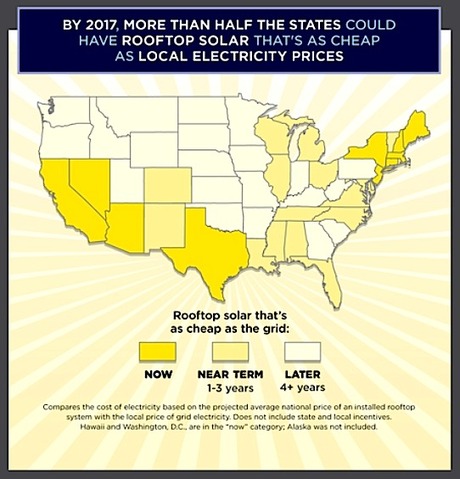
“Solar PV installations in the U.S. increased an impressive 485% from 2010 to 2013, and by early 2014, there were more than 480,000 systems in the country. That’s 13,400 MW, enough to power about 2.4 million typical American homes.”


Source: www.pvsolarreport.com

>” […] You can definitely see a correlation between electricity price and amount of solar installed, though there are exceptions. Kansas, for example, has fairly high grid prices but little solar — a testament to the fact that good policy is also a key ingredient in promoting solar. And Alaska is not exactly highly populated. For the most part, though, solar is flourishing in states with high electricity rates.

In some states like California, already one of the most expensive places for electricity in the country, residential rates will soon be going up further. Customers in the PG&E service area are looking at a 3.8% increase in electricity bills. Overall, electricity prices in the U.S. have been rising rapidly. According to the Energy Information Administration, in the first half of 2014, U.S. retail residential electricity prices went up 3.2% from the same period last year — the highest year-over-year growth since 2009. […]

The fact is, solar and other renewables just keep getting cheaper. We’ve noticed a number of stories debating this recently, many in reaction to an Economist article on how expensive wind and solar really are. But as Amory Lovins points out, the reality is that renewables are getting cheaper all the time, regardless of anyone’s arguments.

What does this mean? It means that grid parity is coming sooner than you might think […]”<

See on Scoop.itGreen Energy Technologies & Development

Net Zero Energy Buildings at Zero Cost

The Netherlands has found a way to refurbish existing buildings to net zero energy, within a week, with a 30-year builders’ guarantee and no subsidies.

Source: www.energypost.eu

>”Inside the house, the pounding rain stills to distant murmur. That’s thanks to the triple glazing, points out Ron van Erck, enthusiastic member of Platform31, an innovation programme funded by the Dutch government that brings together different actors for out-of-the-box thinking to crack intractable problems. One of its big successes to date is Energiesprong, an initiative that turns the building market on its head to deliver social housing with zero net energy consumption, i.e. no energy bill, at zero cost to the tenant and with no subsidies to the builder.

Starting off in 2010 with three staff, a €50 million budget and five years to come up with something to make buildings more sustainable, Energiesprong today boasts 45 staff and a deal with 27 housing associations and four big construction companies to refurbish 111,000 houses in the Netherlands. Total investment? €6 billion. The initial focus is social housing, but it’s already looking at the private market, care centres and commercial office buildings too.

How does the plan work? The basic trick is that tenants instead of paying their energy bills, pay a similar amount to the housing corporations that own the houses. With this money, the corporations pay building companies to retrofit the houses, which after renovation have net zero energy costs. The building companies have for this project developed ‘industrialised’ renovation procedures that are highly cost-effective. One important difference with existing renovation projects is that all elements that are needed for a successful move to zero-energy housing are brought together  in one plan.

Energy Post’s Sonja van Renssen met with manager Jasper van den Munckhof, to understand exactly what Energiesprong does, how it does it and why it will succeed – in the Netherlands and elsewhere.

Q: What was your starting point?

A: We started off with what we spend. The household energy bill in the Netherlands is about €13 billion. This money is available. If you spent it on a mortgage or payback on a loan of about 30 years [instead of energy], you have €225 billion to invest in the Dutch housing stock. This is substantial money: €30-40,000 per house to make it energy neutral.

“Retrofit wasn’t interesting – unless you were rich – but using the energy bill to fund it, no one had thought of that! A building and its energy system were developed as parallel, complementary but not integrated, entities.”

-Jan Kamphuis, BJW Wonen, a one-stop-shop for retrofits inspired by Energiesprong

The trick is, how to get this money flowing. We tried to imagine what owners would need to start investing. They buy kitchens and they don’t see this as an investment but good for their family. You need to get this focus on people and how they buy stuff, how they accept things. If you lose that focus and think it’s about financial arrangements, you won’t find a solution.

Q: So what will make people spend money on retrofits?

A: It needs to be very well done, like if they buy a car, they buy a decent one. It has to be fast – the problem with retrofitting (vs. buying new stuff) is that it’s usually a lot of trouble, dust and hassle. So we said one, the retrofits have to be done within a week. Two, it has to be affordable: ideally the cost to the tenant before and after should be equal. That means the energy bill converted to the mortgage or extra rent has to cover the full cost of the retrofit. Three, it has to be attractive. It needs to be something you see. […]”<

See on Scoop.itGreen & Sustainable News

Efficient HVAC Systems

Gallery

This gallery contains 15 photos.

Originally posted on Energy Systems & Sustainable Living:
Heating, Ventilation and Air Conditioning systems (HVAC) controls the indoor climate by adding or extracting heat and adding or removing mass (e.g. water vapour and dust). To combat summer heat and winter…

Energy Efficiency Gains, Backfire & The Rebound Effect – A Problem?

“Every few years, a new paper comes out about the rebound effect and the issue receives some short-term attention. (When a consumer or business buys an efficient car or air conditioner, they may use their energy-efficient equipment a little more often or may spend some of their energy bill savings on things that use energy—these are examples of rebound effects.)  […]”

Source: aceee.org

>” […] we found that rebound may average about 20%, meaning that 80% of the savings from energy efficiency programs and policies register in terms of reduced energy use, while the 20% rebound contributes to increased consumer amenities (for example, more comfortable homes) as well as to a larger economy.  […]

E2e, a joint initiative of three universities, released a working paper entitled “The Rebound Effect and Energy Efficiency Policy.” In it, they discuss various types of rebound and ways to analyze it. Much of their data relates to gasoline and oil prices and consumer and market responses to changes in those prices. They find that for developed countries, “most… studies fall […] in the range of 5 to 25 percent” direct rebound effect (where direct captures consumer response but not whole-economy effects). In developing countries, where incomes are lower and impose constraints on miles driven and other energy-consuming behavior, the E2e paper finds the “most common range” is 10-40% demand elasticity (related to but not exactly the same as direct rebound). They also discuss macroeconomic effects, emphasizing studies that show rebound of 11 percent and 21 percent due to economic growth. By way of comparison, the ACEEE paper estimates 10 percent direct rebound on average for the United States, noting the first of the two economic growth studies. In addition, in the case of oil prices, the E2e paper discusses how improvements in fuel economy soften oil prices, which can lead to a 20-30% increase in global oil use due to these price effects. Bottom line: The E2e paper sees modestly higher rebound effects than the earlier ACEEE paper.  […]

Regarding electricity use, Breakthrough discusses how electricity use has risen more quickly than generating plant efficiency has increased. The authors call this backfire, even as they acknowledge that these trends are also affected by rising incomes, urbanization, changes in consumer preferences, and other socioeconomic and demographic trends. They provide no evidence on the relative importance of energy efficiency relative to these other factors. Furthermore, they seem to mix up energy efficiency and economic efficiency.[…]

Breakthrough released their new report with an op-ed in the New York Times. The op-ed goes several steps further than the report. First, applying its claims of lighting backfire from the 1800s, it claims that LED lighting, for which the most recent Nobel Prize in physics was awarded, will increase lighting energy use, particularly in developing countries. As I wrote in a letter to the editor of the Times, LEDs are about six times more efficient than incandescent lamps, so in order to reach the backfire point, the average purchaser would need to increase the amount of lighting they use by a factor of six. While such an increase may well happen among the poorest households in developing countries, it is unlikely to be seen in developed countries, or even among the middle class in developing countries.

The Breakthrough op-ed also claims that the International Energy Agency and the Intergovernmental Panel on Climate Change find that “rebound could be over 50 percent globally.” While technically correct, their claim takes the upper end of the ranges found in recent IEA and IPCC studies. For example, IEA states, “Direct rebound can range from 0% to as much as 65%. However, estimates tend to converge between 10% and 30%.” It would be much more accurate if the institute would cite the full range, instead of looking only at the extreme. Applying that logic, I could argue that IEA supports ACEEE’s 10% direct rebound estimate–at least 10% is within IEA’s most likely range of 10-30%. IPCC estimates get similar treatment from Breakthrough.

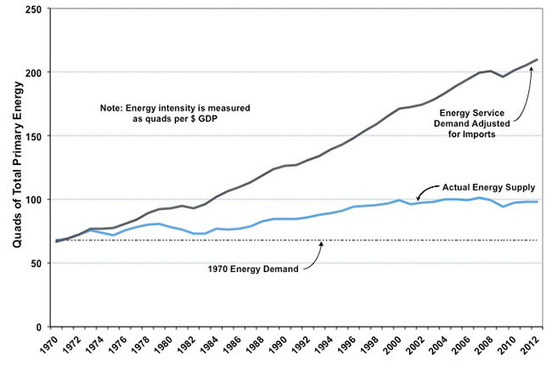
Bottom line: The E2e analysis is very reasonable, but Breakthrough appears to be more interested in exaggerating to make its case, rather than sticking to the facts. The truth is that for 40 years energy efficiency has had a dramatic effect on worldwide energy consumption. In the United States, if we were to use energy today at the rate we were in 1974, we would be consuming more than twice the amount that we are actually using. […]”<


See on Scoop.itGreen & Sustainable News

Multifamily Building Energy Efficiency: SLEEC Financing

This winter, ACEEE, in partnership with Energi Insurance Services, will host a second gathering of select members of the Small Lenders Energy Efficiency Community (SLEEC) in Washington, D.C. The initial SLEEC convening in October 2013 brought together small- to medium-size lenders to discuss strategies for expanding activity in the market for energy efficiency financing. Building off the success of that first meeting, the second SLEEC gathering will focus exclusively on financing in the multifamily sector […]

Source: aceee.org

>” […] The goal of the upcoming SLEEC meeting is to discuss how recent developments inform the lender perspective on the size, attractiveness, and viability of the finance market for multifamily efficiency. We chose to address multifamily this year because potential savings are phenomenal at an estimated $3.4 billion per annum, and multifamily has traditionally been characterized by the label “hard to reach” due to significant barriers to entry. Single-family residential, large commercial, and MUSH (municipal, universities, schools, and hospitals) markets pose fewer barriers and have therefore been easier to approach, while multifamily is a more complex market posing greater obstacles.

The first and most commonly cited obstacle is known as the split-incentive problem: Landlords and building owners don’t always have an incentive to pursue energy efficiency improvements since their tenants would be the ones benefitting from reductions in energy bills. The next most bemoaned roadblocks are a lack of information and lack of available capital. Landlords and owners are experts at running their buildings, but may be in the dark on energy efficiency. Utilities and many loan agencies, while knowledgeable about energy efficiency, lack experience interacting with tenants. The resulting information gap inhibits energy efficiency projects from getting off the ground. This problem is exacerbated by a lack of capital, especially in the affordable housing market, where many buildings owners hold 30-year mortgages on their property with only one refinancing opportunity after 15 years. Unless building owners and potential lenders can capitalize on this small window, many projects would not have another opportunity to finance efficiency improvements for another 15 years.

Despite these barriers, there are a number of successful initiatives that are poised for impact. Perhaps the most successful is Energy Savers, a Chicago-based partnership between Elevate Energy and the Community Investment Corporation (CIC) that has retrofitted 17,500 apartments since 2008.  […] Innovative programs such as these are paving the way for energy efficiency in the multifamily housing market.

A perceived lack of capital may be attributable to issues surrounding the valuation of energy efficiency from a building owner’s perspective that manifests as low demand. […] “<


See on Scoop.itGreen Building Design – Architecture & Engineering