The Ripple Effect of Energy Efficiency Investment

“The term “multiple benefits” has emerged to describe the additional value that emerges with any energy performance improvement. The benefits that occur onsite can be especially meaningful to manufacturing, commercial, and institutional facilities. Energy efficiency’s positive ripple effects include increased productivity and product quality, system reliability, and more. ”


Source: aceee.org

>” […]  Over the past few decades, researchers have documented numerous cases of energy efficiency improvements—almost always focusing exclusively on energy savings. Non-energy benefits are often recognized, but only in concept. ACEEE’s new report, Multiple Benefits of Business-Sector Energy Efficiency, summarizes what we know about the multiple benefits for the business sector. True quantification of these benefits remains elusive due to a lack of standard definitions, measurements, and documentation, but also in part because variations in business facility design and function ensures that a comprehensive list of potential energy efficiency measures is long, varied, and often unique to the facility.

To give some concrete examples of non-energy benefits at work: Optimizing the use of steam in a plywood manufacturing plant not only reduces the boiler’s natural gas consumption, it also improves the rate of throughput, thus increasing the plant’s daily product yield. A lighting retrofit reduces electricity consumption while also introducing lamps with a longer operating life, thus reducing the labor costs associated with replacing lighting. In many instances, monitoring energy use also provides insights into water or raw material usage, thereby revealing opportunities to optimize manufacturing inputs and eliminate production waste. By implementing energy efficiency, businesses can also boost their productivity. This additional value may make the difference in a business leader’s decision to pursue certain capital investment for their facility.

Meanwhile, energy resource planners at utilities and public utility commissions recognize the impact of large-facility energy demands on the cost and reliability of generation and transmission assets. By maximizing consumer efficiency, costs are reduced or offset throughout a utility system. So the ability to quantify the multiple benefits of investing in energy efficiency, if only in general terms, is an appealing prospect for resource planners eager to encourage greater participation in efficiency programs.

Unfortunately, our research shows that this quantification rarely happens, even though the multiple benefits are frequently evident. A number of studies offer measurement methodologies, anticipating the availability of proper data. When these methodologies are employed with limited samples, we see how proper accounting of non-energy benefits dramatically improves the investment performance of energy efficiency improvements—for example, improving payback times by 50% or better. Samples may provide impressive results, but the data remains too shallow to confidently infer the value to come for any single project type implemented in a specific industrial configuration. Developing such metrics will require more data.  […]”<


See on Scoop.itGreen & Sustainable News

New Boston Start-up Tracks Multifamily Residential Energy Efficiency “Score”

wego_screen_shotWegoWise Inc., which provides energy analytics to private property owners and public housing entities, last week launched WegoScore, a rating system that assesses buildings in three areas, energy, water and carbon and then spits out a score between one and 100.

Source: www.bizjournals.com

>” […] “We are focusing on a universal approach with meaningful reductions,” WegoWise founder and CTO Barun Singh said of the platform.

With the water crisis in California and with 39 percent of carbon dioxide coming from buildings, property owners and public housing agencies are making energy-saving retrofits and want to market what they’ve done.

Those buildings that reach a high rating are issued certificates and decals to let the world know they are more efficient. Maloney Properties Inc., a Wellesley-based real estate management, sales and construction firm with 350 buildings, is featuring its decal proudly. Other area companies include Peabody Properties in Braintree and Homeowners Rehab, based in Cambridge.

The score not only brings awareness to a building’s efficiency, it also provides a way for property owners to market the value of the work completed in their buildings to perspective tenants who are concerned about the environment, Singh said. And the stickers are a fun way to market their accomplishments.

After using WegoWise, Maloney Properties was able to find $2.5 million in 2014 retrofits and expects to save 10 to 20 percent on utility costs related to the retrofits annually. John Magee, an assistant facilities director at Maloney, said the real estate company has been looking for a way to market the value of its properties. And now, the WegoScore will enable it to do that.

With the $4.9 million in funding it has raised from Boston Community Capital, WegoWise was able to build a portfolio of 23,000 multifamily buildings covering more than 600 million square feet. With all of the data that WegoWise has collected since its launch in 2010, coming up with a rating system would be a simple solution, right? Not exactly, according Singh.

Launching WegoScore was an expensive and lengthy process for the 25-person company, he said. Before launching the rating system, Singh said he wanted to be sure that had enough data to come up with a score that was meaningful.

“The end result is a straight-forward algorithm,” he said.

The WegoScore is currently only available for multifamily buildings, according to the company. Scores will be refreshed on a weekly basis and stickers are awarded twice a year.

In addition to gaining interest from its existing customers, venture-backed WegoWise is also garnering the attention of other potential partners including banks, who could use the score as a way to get a sense of the building and decide whether or not to lend to them, and insurance providers that would make decisions based on the building’s efficiency score and other factors. […]”<

See on Scoop.itGreen Building Operations – Systems & Controls, Maintenance & Commissioning

Renewable Geothermal Power with Oil and Gas Coproduction Technology may be Feasible

The U.S. has been harnessing geothermal energy since 1960 and if recently announced research projects and startups are successful, even more geothermal power might soon be available.

Source: www.renewableenergyworld.com

>” […]  in the past, wastewater from oilfield production processes was viewed as a nuisance byproduct that needed to be disposed of. But new research has shown that much of the 25 billion barrels of this geothermally heated “wastewater” produced at oil wells each year in the U.S. is hot enough to produce electricity. It is estimated that many of the wells might have clean energy capacities of up to 1 MW.

Oil and Gas Coproduction in the US

In 2008, the DOE developed the first low-temperature geothermal unit in an oil field at the Rocky Mountain Oilfield Testing Center (RMOTC) in Wyoming. The well is producing energy and has a capacity of approximately 217 kW. RMOTC continues to test power units produced by Ormat Technologies and UTC/Pratt and Whitney Power Systems at the center and more than 30 oil firms have visited the center to learn about coproduction technology. The technology is also being implemented in Nevada, Mississippi, Louisiana, North Dakota and Texas.

In Nevada, Florida Canyon Mining Inc. is using the 220°F groundwater in a coproduction project that uses ElectraTherm’s 50-kW waste heat generators, aka “Green Machines” to generate electricity.

Energy can be harnessed at working oilfields and used to power them without interrupting their operation. A Gulf Coast Green Energy (GCGE) coproduction project at the Denbury oilfields in Laurel, Mississippi, is using this technique again with ElectraTherm Green Machines.  It replaced Denbury’s electric submersible pump and cut electricity costs by a third. GCGE has a second 50-kW geothermal natural gas coproduction project in Louisiana.

University of North Dakota was awarded $1.7 million through the DOE’s Geothermal Technologies Program to install a geothermal Organic Rankine Cycle (ORC) system at another oilfield operated byDenbury. For two years the plant will be used to develop engineering and economic models for geothermal ORC energy production. The technology could be used throughout the Williston Basin.

Liberty County Pilot Project

Texas is oil country, and the 4000+ dormant oil and gas wells speckled across the landscape provide a new, or perhaps recycled, frontier in geothermal energy production.  To tap some of that energy,Universal GeoPower CEO and petroleum geologist George Alcorn Jr. and his partner, Chris Luchini, a PhD physicist will use the $1.5 million in federal stimulus funds that they were awarded to bring geothermal energy to Liberty County, Texas. The company said that to prepare its DOE application, it worked with Southern Methodist University. The university has performed extensive research on coproduction and has found that it is applicable to an estimated 37,500 oil and gas wells in the Gulf Coast region.

Universal GeoPower’s pilot project is expected to be one of many that will recomplete the wells to produce low temperature, geopressured brine water. The brine will run through a commercial off-the-shelf turbo expander and an ORC binary generator.

Alcorn spoke recently at GEA’s global geothermal meeting in Washington, DC, offering a snapshot of the economic benefits of the process. “The lead-time to revenue generation is about 6 months, whereas traditional geothermal can take up to five years,” he said. “The wells already have known geothermal potential, and capital costs are dramatically reduced.”

Additionally, Alcorn noted, units are installed at existing oil wells, eliminating the need for investment in drilling, new roads or transmission lines. […]”<

See on Scoop.itGreen Energy Technologies & Development

$200m Demand Management Program Approved in NYC to Defer $1 billion SubStation to 2026

The NYPSC approved Con Ed of New York’s proposed $200 million Brooklyn/Queens Demand Management Program that would relieve overloads in the city.

Source: www.rtoinsider.com

>” […] Con Ed’s proposed Brooklyn/Queens Demand Management Program is consistent with the state’s “Reforming the Energy Vision” program to restructure the electricity market with greater reliance on technology and distributed resources, the commission said. “The commission is making a significant step forward toward a regulatory paradigm where utilities incorporate alternatives to traditional infrastructure investment when considering how to meet their planning and reliability needs,” the order states.

Commission Chair Audrey Zibelman added that because of the recent D.C. Circuit Court of Appeals decision striking down federal jurisdiction over demand response in wholesale markets, it’s important for state regulators to set market rules for that resource.

Con Ed said the feeders serving the Brownsville No. 1 and 2 substations began to experience overloads in 2013 and would be overloaded by 69 MW for 40 to 48 hours during the summer by 2018. A new substation, transmission subfeeders and a switching station would cost $1 billion, according to the company. The PSC accepted the company’s estimate of the DM Program’s costs and ordered a cap of $200 million.

The program would include 52 MW of non-traditional utility-side and customer-side relief, including about 41 MW of energy efficiency, demand management and distributed generation, and 11 MW of utility-side battery energy storage. This will include incentives to upgrade building “envelopes,” improve air conditioning efficiency of equipment, encourage greater use of energy controls, and establish energy storage, distributed generation or microgrids.

This will be supplemented by approximately 17 MW of traditional utility infrastructure investment, consisting of 6 MW of capacitors and 11 MW of load transfers from the affected area to other networks.  […]”<


See on Scoop.itGreen Energy Technologies & Development

Applying Intelligent Efficiency to the Transportation Sector

A new report from ACEEE, Energy Savings from Information and Communications Technologies in Personal Travel,estimates that aggressively incorporating a handful of ICT strategies could reduce energy consumption in transportation by almost 13% by 2030.

Source: aceee.org

>” […] Intelligent efficiency is the use of information and communications technologies (ICT) to improve the overall productivity and efficiency of a given sector.

In transportation, intelligent efficiency can affect the way we travel by providing us with real-time feedback and information on fuel economy, making it easier for us to use alternatives to driving such as public transit and bicycles, and by moving traffic away from peak travel times and consolidating travelers into fewer vehicles.

[…] The strategies discussed in the report include:

  • Car and bike sharing
  • Real-time transit information
  • In-vehicle feedback
  • Vehicle-to-vehicle communications and driver assist applications
  • ICT-based transportation demand management programs (TDM)

The report aims to provide readers with a sense of the relative magnitude of energy savings possible from these strategies, and is by no means a definitive overall estimate. ICT could be incorporated in many additional ways in the transportation sector. The strategies described here are simply the tip of the iceberg when it comes to implementation. Studies from Europe have shown that reductions could be as high as 26% if we consider the whole universe of strategies and options. […]”<

See on Scoop.itGreen Energy Technologies & Development

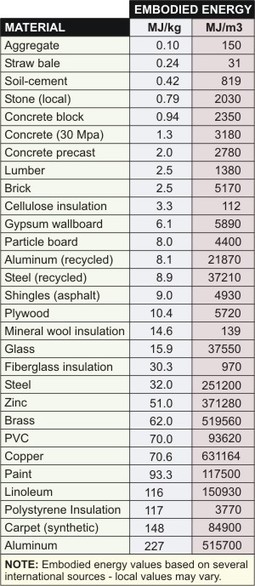
Embodied Energy – A Measure of Sustainability in Buildings & Construction

Embodied energy in building materials has been studied for the past several decades by researchers interested in the relationship between building materials, construction processes, and their environmental impacts.

Source: www.canadianarchitect.com

>” […]

What is embodied energy?
There are two forms of embodied energy in buildings:

· Initial embodied energy; and
· Recurring embodied energy

1.  The initial embodied energy in buildings represents the non-renewable energy consumed in the acquisition of raw materials, their processing, manufacturing, transportation to site, and construction. This initial embodied energy has two components:

  • Direct energy the energy used to transport building products to the site, and then to construct the building; and
  • Indirect energy the energy used to acquire, process, and manufacture the building materials, including any transportation related to these activities.

2.  The recurring embodied energy in buildings represents the non-renewable energy consumed to maintain, repair, restore, refurbish or replace materials, components or systems during the life of the building.

As buildings become more energy-efficient, the ratio of embodied energy to lifetime consumption increases. Clearly, for buildings claiming to be “zero-energy” or “autonomous”, the energy used in construction and final disposal takes on a new significance. […]”<

See on Scoop.itGreen & Sustainable News

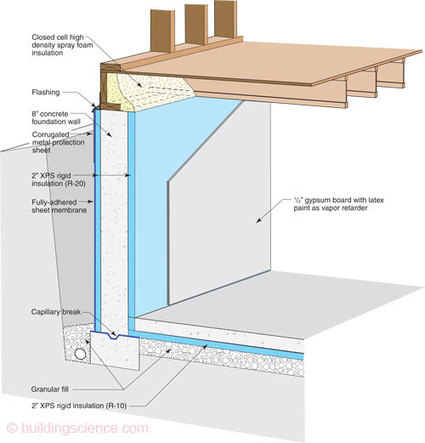
High-R20 Concrete Foundation Construction Diagram – Building Science

This construction strategy has an installed insulation R-value of R-20.

Source: www.buildingscience.com        >” […]


  • Dampproofing
  • 2″ XPS rigid insulation
  • Concrete foundation wall
  • 2″ XPS rigid insulation
  • 2″ XPS rigid sub-slab insulation
  • Gypsum board with vapor retarder paint
  • 2″ XPS rigid insulation under slab

Thermal Control:  This construction strategy has an installed insulation R-value of R-20 and has a predicted annual heating energy loss of 16.7 MBtus.

Moisture Control:  Two inches of XPS on the interior, connected to the thermal break at the slab edge, controls the interior vapor drive and capillary wicking to the interior so there are no moisture related issues from inward vapor diffusion or capillary wicking.

Constructability and Cost:  The interior of the insulated concrete form will require drywall or other thermal barrier to achieve the fire rating required by code. The gypsum board is very easy to attach to the plastic clips designed into the ICF. The drywall should not be painted, if it is not necessary, to allow maximum drying of the concrete. It may be easier and more practical to install a thin framed wall (e.g. 2×3 wood or steel framing) on the interior of the ICF to allow any necessary services to be run in the wall, and potentially more insulation.

Other Considerations:  Because the concrete is installed between two vapor retarding layers, it will take several years for the concrete to dry to equilibrium. Since additional interior vapor control should be avoided, no more than latex paint should be used on the interior surface of the drywall. […]”<


See on Scoop.itGreen Building Design – Architecture & Engineering

Climate Change, Carbon Reduction and Mitigating Natural Gas Use in the Electricity Sector

The Environmental Protection Agency’s Clean Power Plan offers states the opportunity to curb rising natural gas use in the United States and achieve steeper carbon-pollution reductions by investing more aggressively in renewable energy and energy efficiency.

Source: www.americanprogress.org

>” […] In the United States, electric utilities are the largest source of carbon pollution. Therefore, the reduction of power-sector emissions needs to be a central component of any meaningful climate mitigation strategy. In June, the Environmental Protection Agency, or EPA, released a landmark proposal to establish the first-ever carbon-pollution standards for the nation’s power plants.

This proposal, the Clean Power Plan, establishes a “best system of emissions reduction” based on four building blocks that combine to make the nation’s electricity system more efficient and less reliant on carbon-heavy coal-burning power plants. […]

One of the Clean Power Plan’s central elements is increasing the use of lower-carbon natural gas combined cycle, or NGCC, units to generate some of the electricity now produced by higher-carbon coal-fired power plants. States can use this approach to achieve relatively quick carbon-pollution reductions starting in 2020 while ramping up the deployment of programs that promote renewable energy and energy efficiency.

The EPA modeled two compliance scenarios to understand the costs, benefits, and potential energy-related impacts of the Clean Power Plan. This modeling suggests that the electricity sector’s natural gas consumption will increase sharply at the beginning of the Clean Power Plan’s implementation period as states shift power generation from dirtier coal-fired plants to cleaner-burning NGCC plants. The EPA also predicts that states will build new NGCC plants to replace retiring coal plants and to help meet their carbon-reduction targets.

By 2030, however, the EPA’s models forecast that more renewable energy and energy-efficiency programs will come online as states continue to implement the Clean Power Plan. Electricity generation from renewable sources will displace some generation from NGCC and coal-fired power plants. Energy-efficiency programs, meanwhile, will reduce electricity demand, slowing generation and curbing carbon pollution from the power sector as a whole. […]

While natural gas burns cleaner than coal, it is still a fossil fuel that releases carbon pollution. In addition, methane, a potent greenhouse gas, can escape throughout the natural gas production and supply cycle. For these reasons, several recent studies by prominent researchers have questioned whether natural gas can form the core of an effective climate mitigation strategy. […]

By acting decisively to implement ambitious renewable energy and energy-efficiency programs, states can help ensure that the United States does not overcommit to natural gas and that it continues on a path toward decarbonization of the economy. […]”<

See on Scoop.itGreen & Sustainable News

Scientists Discover New Form of Crystalline Order with High Potential for Thermoelectrics


InterlacedCrystalsSince the 1850s scientists have known that crystalline materials are organized into 14 different basic lattice structures. However, a team of researchers from Vanderbilt University and Oak Ridge National Laboratory (ORNL) now reports that it has discovered an entirely new form of crystalline order that simultaneously exhibits both crystal and polycrystalline properties, which they describe as “interlaced crystals.”

Source: www.energyharvestingjournal.com

>” […] The interlaced crystal arrangement has properties that make it ideal for thermoelectric applications that turn heat into electricity, they report. The discovery of materials with improved thermoelectric efficiency could increase the efficiency of electrical power generation, improve automobile mileage and reduce the cost of air conditioning.   “We discovered this new form while studying nano particles,” said Sokrates Pantelides, University Distinguished Professor of Physics and Engineering at Vanderbilt, who coordinated the study. “It most likely exists in thin films or bulk samples, but it has apparently gone unnoticed.”  […]

According to the researchers, the interlaced crystal structure may be just what is needed to optimize thermoelectric applications for power generation or cooling. Thermoelectric devices need a material that is an excellent electrical conductor and a poor conductor of heat. The problem is that materials like metals that are good electrical conductors also tend to be good heat conductors and vice versa. Defects and grain boundaries that retard heat flow also reduce electrical conductivity.   In addition to CuInS2, there is a large class of materials that should have similar interlaced structures. When made into thin films, they should be excellent thermoelectric materials, the researchers predict.   “We haven’t tested this yet, but we are confident that these materials have high electrical conductivity and low thermal conductivity…just what you need for thermoelectrics. The field is now wide open for scientists who can fabricate thin films and make thermoelectric measurements,” said Pantelides.”<

See on Scoop.itGreen Energy Technologies & Development

Energy Efficiency Key to Reducing Energy Waste and Consumption

Advocates say doing more with less power may be an even more critical weapon in the fight against climate change than renewable technologies.

Source: www.nytimes.com

>” […]

“Some people call energy efficiency low-hanging fruit. I would even say energy efficiency is fruit lying on the ground. We only need to bend over and pick it up.”

Realizing those energy savings would be a huge boon to the climate, ease illness-causing air pollution, reduce many nations’ reliance on fuel imports and increase competitiveness by lowering costs, the advocates say. It creates jobs in fields like upgrading buildings, and is generally cheaper than the alternative of constructing new power plants and buying more energy, they argue. […]”<

See on Scoop.itGreen & Sustainable News