US Senators back new bill pushing Energy Efficiency Legislation

See on Scoop.itGreen & Sustainable News

By SEN. JEANNE SHAHEEN and SEN. ROB PORTMAN | 7/29/13 9:25 PM EDT

For the past three years, we have worked together to develop the Energy Savings and Industrial Competitiveness Act, legislation that will go a long way toward making the United States more energy efficient and more economically competitive.

Duane Tilden‘s insight:

According to the Sen. Shaheen & Portman:

>Our bill curbs inefficient energy practices that cost the U.S. economy billions of dollars and millions of jobs every year. According to a recent study by the Emily Hall Tremaine Foundation, we waste an astonishing 86 percent of the energy we consume. Upgrading the energy efficiency of U.S. buildings alone could save $1 trillion over the next decade. Cutting down on energy waste represents an untapped resource that we have long ignored. Our legislation helps to change that.

Our bill promotes energy savings that Americans across the political spectrum can get behind. Energy efficiency has broad, bipartisan support from business, energy and environmental advocates alike, and the legislation we have developed helps to promote energy efficiency through a smart, pragmatic plan that can be implemented immediately.

There is one mandatory component to the bill: We are going to make Washington practice what it preaches. We’re going to make the federal government — the largest energy user in the country — adopt energy-saving techniques and best practices that make its operations more efficient. […]

These provisions will save money, make America more energy-independent and lower harmful emissions. For the private sector, the tools our bill deploys are entirely voluntary. This legislation will also not add to the deficit and its costs are fully offset.<

See on www.politico.com
Department of Energy – Energy Efficiency Standards Cost Less than Estimated

See on Scoop.itGreen & Sustainable News

Washington, D.C.—A new report released today by the American Council for an Energy-Efficient Economy (ACEEE) and the Appliance Standards Awareness Project (ASAP) finds that the U.S. Department of Energy (DOE) has been overestimating the impact that energy efficiency standards for appliances and other products have on their price tags.

Duane Tilden‘s insight:

>Today’s study, entitled Appliance Standards: Comparing Predicted and Observed Prices, looks at nine appliance standards that took effect over the 1998-2010 period and found that DOE overestimated price impacts in every case, usually by a wide margin. ACEEE and ASAP found that across the nine rulemakings, DOE estimated an average increase in manufacturer’s selling price of $148. On average the actual change in price was a decrease in manufacturer’s selling price of $12.

Estimates of the overall benefits of energy efficiency standards for consumers will likely have to be revised as well. In 2012, ACEEE and ASAP released a study estimating that standards for appliances and other equipment would save consumers more than $1 trillion cumulatively by 2035, even after subtracting estimated increases in product prices.

“Energy efficiency standards are proving to be an economic powerhouse, driving even more consumer savings than we realized,” said report co-author and ASAP Executive Director Andrew deLaski.<

See on www.aceee.org

Integration: Net-zero energy design | Consulting-Specifying Engineer

See on Scoop.itGreen Building Design – Architecture & Engineering

-ASHRAE has a goal: net-zero energy for all new buildings by 2030. What do engineers need to know to achieve this goal on their projects?

Duane Tilden‘s insight:

>As net-zero energy and low-energy design projects become more prevalent, engineers must be prepared to collaborate with all members of a project team including architects, energy specialists, lighting designers, builders, and owners in order to accomplish net-zero energy goals with little to no cost premium. Is this possible today or will it take another 10 or more years to get there?

There are many examples of completed projects demonstrating that not only is this possible, but it has been done in all regions of the country using readily available building products and common construction methods. So what’s the secret? It’s all about the design.<

See on www.csemag.com

Renewable Energy or Efficiency for the Data Center: Which first? #GreenComputing

See on Scoop.itGreen & Sustainable News

New advancements in green technology and design are making the idea of a green data center into a reality.

Duane Tilden‘s insight:

>Without doubt, the facility is a triumph of advanced environmental design and will serve as a template for future construction. Indeed, activity surrounding renewable-based data infrastructure is picking up, with much of it being led by the burgeoning renewable energy industry itself. VIESTE Energy, LCC, for example, has hired design firm Environmental Systems Design (ESD) to plan out a series of data centers across the U.S. that run on 100 percent renewable energy. A key component of the plan is a new biogas-fed generator capable of 8 to 15MW performance. The intent is to prove that renewables are fully capable of delivering reliable, cost-effective service to always-on data infrastructure.

The question of reliability has always weighed heavily on the renewables market, but initiatives like the VIESTE program could help counter those impressions in a very important way, by establishing a grid of distributed, green-energy data supply. In fact, this is the stated goal of the New York State Energy Research and Development Authority (NYSERDA), which has gathered together a number of industry leaders, including AMD, HP and GE, to establish a network of distributed, green data centers that can be used to shift loads, scale infrastructure up and down and in general make it easier for data users to maintain their reliance on renewable energy even if supply at one location is diminished. In other words, distributed architectures improve green reliability through redundancy just as they do for data infrastructure in general.

But not everyone on the environmental side is convinced that renewables are the best means of fostering data center efficiency. In a recent article in the journal Nature Climate Change, Stanford researcher Dr. Jonathan Koomey argues that without populating existing infrastructure with low-power hardware and data-power management technology first, data operators are simply wasting precious renewable resources that could be put to better use elsewhere. For projects like the NWSC and VIESTE, then, renewables may make sense because they power state-of-the-art green technology. But not as an industry-wide solution–renewables won’t make sense until hardware life cycles run their course.<

See on www.itbusinessedge.com

UK Shopping Centre goes zero Waste to landfill in a year

See on Scoop.itGreen & Sustainable News

As a new member of the National Recycling Star scheme, Clifton Down Shopping Centre received the Gold award for its recycling and waste management efforts and in recognition of its success in diverting all of its waste from landfill.

Duane Tilden‘s insight:

>The transformation in the centre’s waste management began with a full site audit to identify areas of poor practise within both its waste management and energy efficiency operations.  […]

As the shopping centre began to look at improving its waste management plan, it asked its tenants to start flat packing their waste cardboard, so it can be sent to the centre’s onsite compactor. Pre-flat packing waste cardboard has allowed the centre to double the amount of cardboard that can be collected by its waste contractor Smiths, while saving space in the services yard. This has cut the number of collections required, helping to save fuel consumption and CO2 emissions. All general waste produced by the shopping centre is sent to New Earth Solution’s mechanical biological treatment (MBT) facility at Avonmouth.

Clifton Down Shopping Centre has also been working to reduce its environmental impact by tackling its energy efficiency. New LED light fittings have been installed throughout the shopping centre, significantly reducing energy consumption and cost. The centre previously used old halogen lighting which consumed 14,994kW per annum, compared with the replacement LED lighting which consumes 2,998kW – an 80 per cent reduction. […]

The centre has also installed seasonal sensitive automatic doors at both entrances. These are programmed to close more quickly during winter months to minimise heat lose. This is switched during summer with doors remaining open for longer, allowing for cooler air to circulate the building. New electricity, water and gas monitors have been installed throughout the centre to measure consumption and identify areas of potential savings.<

See on www.e2bpulse.com

Wireless Transmission of Energy in Buildings – Building Automation

See on Scoop.itGreen Building Operations – Systems & Controls, Maintenance & Commissioning

Energy harvesting wireless technology becomes more attractive for OEMs as a basis technology for products and solutions that contribute to a building’s efficient energy management. The wireless modules gain their power from the surrounding environment…

Duane Tilden‘s insight:

>Energy harvesting technology enables batteryless automation devices and systems to make buildings more energy-efficient based on sustainable, resource-saving technologies that eliminate the need for batteries. […]

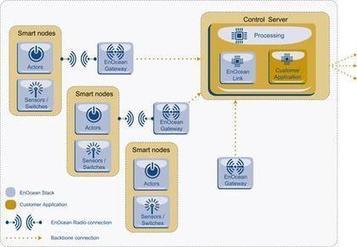
In a complex commercial building scenario, EnOcean Link can be implemented on a central device, like a control server, which controls the whole building, holds the automation intelligence, and can be physically located outside the building (in the cloud). Several gateways in the building record radio telegrams from thousands of distributed batteryless wireless sensors and relay receivers, and send back information or command data when needed. These gateways are connected to the control server by a backbone, which does not have to be based on EnOcean radio, or even be wireless. The middleware, located in the central unit, interprets all telegrams received by the gateways and provides them to the automation system.

High energy efficiency goals demand flexible automation systems for all kind of buildings that cover several areas. This particularly affects retrofit projects, where the intelligent control of energy consumption is the key factor for a building’s improved energy and carbon footprint. Energy harvesting wireless technology fulfills the demands for today’s and tomorrow’s automation and energy management systems. […]<

See on www.manufacturing.net

New Report: The Pulp and Paper Industry Can Save Jobs by Becoming More Energy Efficient

“The pulp and paper mill industry may be able to avoid large cuts in jobs by reducing energy costs.”

wklc's avatarWEST KOOTENAY LABOUR COUNCIL

http://inthesetimes.com   Saturday Jul 20, 2013 10:00 am

By Kari Lydersen

The pulp and paper mill industry may be able to avoid large cuts in jobs by reducing energy costs.   (Ann Baekken/ Flickr / Creative Commons).

The complex relationship between efficiency, productivity and employment has been debated at great length by academics and policymakers, who often come to widely differing conclusions about whether jobs will inherently be sacrificed as industry gets more efficient. A prime example is occurring in the U.S. pulp and paper industry, which, over the last decade, has seen productivity and exports grow, even as hundreds of mills closed and 100,000 workers—30 percent of the industry’s workforce—lost their jobs.

But a new report released last week by the environmental think tank World Resources Institute (WRI) proposes that by investing in overhauls that increase energy efficiency, thereby cutting costs on electricity and improving productivity, the country’s paper…

View original post 972 more words

Water in Crisis: A New Paradigm in Power Generation

See on Scoop.itGreen & Sustainable News

The US can affordably and sustainably meet its energy and water needs by pursuing a “renewables-and-efficiency” path, according to a new EW3 report.

Duane Tilden‘s insight:

>The current system of power generation in the U.S., according to EW3, “clearly cannot meet our needs in a future of growing demand for electricity, worsening strains on water resources, and an urgent need to mitigate climate change.”

What’s urgently needed, they assert, is a system of power generation that is much more resilient – one that is not only much less dependent on water, but one that can operate sustainably in a warming climate and, at the same time, help mitigate climate change. With the release of its second report, EW3 advocates making decisions today that puts U.S. society firmly on such a path. […]

EW3′s research team constructed two long-term scenarios in order to better understand and analyze the implications of decisions made today regarding electricity production in the U.S. in terms of water usage and greenhouse gas emissions.

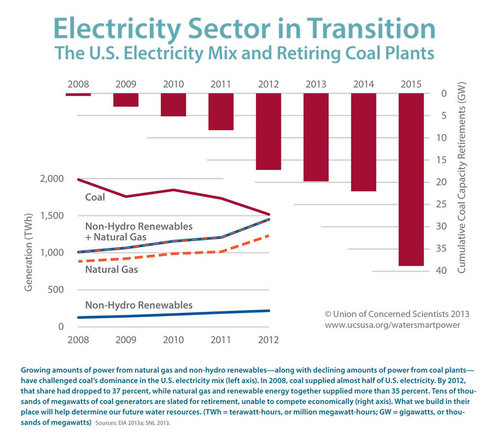
Pursuing a business-as-usual path that would see natural gas combustion growing to account for 60 percent of U.S. power generation in coming decades “would fail to reduce carbon emissions, and would not tap opportunities to safeguard water,” EW3′s research team found. In sharp contrast, both water usage and carbon emissions in the power sector would drop much further, and faster, under a “renewables-and-efficiency” scenario.

Under the renewables-and-efficiency scenario, both water withdrawals and consumption by the power sector would be less than half of today’s levels by 2030. By 2050, water withdrawals would be 97 percent below today’s levels while water consumption would drop 85 percent – nearly 80 percent below the business-as-usual scenario.<

See on www.triplepundit.com

China’s Coal-Fired Economy Dying of Thirst as Mines Lack Water

See on Scoop.itGreen & Sustainable News

Coal industries and power stations use as much as 17 percent of China’s water, and almost all of the collieries are in the vast energy basin in the north that is also one of the country’s driest regions.

Duane Tilden‘s insight:

>About half of China’s rivers have dried up since 1990 and those that remain are mostly contaminated. Without enough water, coal can’t be mined, new power stations can’t run and the economy can’t grow. At least 80 percent of the nation’s coal comes from regions where the United Nations says water supplies are either “stressed” or in “absolute scarcity.” […]

Geneva-based Pictet Asset Management’s $3.17 billion global water fund doubled its exposure to stocks offering water services in China to 10 percent since 2007.  […]

Beijing Enterprises has risen 55 percent this year to HK$3.10 and Deutsche Bank sees it reaching HK$3.20 within a year. China Everbright is up 81 percent to HK$7.10 and JPMorgan Chase & Co. estimates it will reach HK$7.60 by mid-October.

Severe Pollution  “The best opportunity is in industrial water re-use, and for the mining industry, it is of the utmost urgency,” said Junwei Hafner-Cai, a manager of RobecoSAM’s Sustainable Water fund. “Water that has been released from the coal mines and from petrochemical plants has resulted in severe pollution on top of the water scarcity.”

A shortage of coal because of the lack of water to mine and process the fuel may force China to increase imports, pushing up world prices, according to Debra Tan, director at research firm China Water Risk in Hong Kong. China, which mines 45 percent of the world’s coal, may adopt an aggressive “coal-mine grab” to secure supplies, said Tan.<

See on www.moneynews.com

Water Stress Threatens Future Energy Production

See on Scoop.itGreen Building Design – Architecture & Engineering

When we flip on a light, we rarely think about water.  But electricity generation is the biggest user of water in the United States.  Thermoelectric power plants alone use more than 200 billion gallons of water a day – about 49 percent of the…

Duane Tilden‘s insight:

>Large quantities of water are needed as well for the production, refining and transport of the fuels that light and heat our homes and buildings, and run our buses and cars.  Every gallon of gasoline at the pump takes about 13 gallons of water to make.

And of course hydroelectric energy requires water to drive the turbines that generate the power.  For every one-foot drop in the level of Lake Mead on the Colorado River, Hoover Dam loses 5-6 megawatts of generating capacity – enough to supply electricity to about 5,000 homes.

In short, energy production is deeply dependent on the availability of water.  And, as a report released last week by the U.S. Department of Energy (DOE) makes clear, as climate change brings hotter temperatures, more widespread and severe droughts, and lower river and lake levels, the nation’s energy supply is becoming more vulnerable. […]

One particularly interesting figure in the report compares the water requirements of seven different types of electric power facilities – nuclear, coal, biopower, natural gas combined-cycle, concentrated solar, photovoltaic solar and wind.  The last two come out as by far the most water-conserving electricity sources.  In contrast to the 20,000-60,000 gallons per megawatt-hour needed for nuclear and coal plants with “once-through” cooling systems, PV solar and wind require only negligible quantities.<

See on newswatch.nationalgeographic.com