Waste Heat Energy Recovery – ThermoAcoustic Refrigeration for Transportation Industry

Revisiting the Automotive ThermoAcoustic Refrigerator – ATAR

Diagram of Simplified ThermoAcoustic Engine

I wish to further investigate the idea of thermoacoustics for waste heat recovery processes.  Also, will in future look into latest developments in thermoacoustics, including any applications, studies, reviews or products and manufacturers.

In today’s new economy of energy efficiency, there are technologies available that are worth further investigation that can be utilized for improved performance.  Automotive air conditioning is one industry which could bear further scrutiny, where running compressors consume valuable fuel, decreasing the energy efficiency and increasing operating cost of a vehicle.

For professional drivers where fuel consumption increases will come out of pocket, the utilization of air conditioning is an important consideration.  The idea of using the waste heat in the exhaust system to provide the cooling energy necessary to provide air conditioning is a novel approach to improving vehicle efficiency and comfort.  The concept of thermoacoustic refrigeration is not new, and was previously reviewed by concerns of the ozone layer depletion and refrigerants, which ultimately lead to changes in the refrigeration and HVAC industries.

See original reference paper presented at 2005 Proceedings of Acoustics:  http://bit.ly/17qwTYK
Energy Management – Determining Load Factor to Maximize Control

See on Scoop.itGreen Building Operations – Systems & Controls, Maintenance & Commissioning

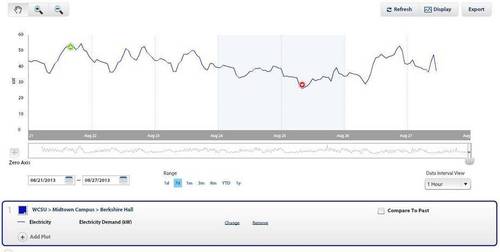
Understanding load factor is an important component to energy management and learning how to take control of your electricity use.

Duane Tilden‘s insight:

>Load factor is a ratio or percentage of the consistency of your electricity consumption – in other words, load factor is a way to answer the “how ‘spikey’ is your load?” question. The easiest way to understand your own load factor is by looking at your real-time energy data. Not only will your energy data indicate your load factor, but it will also highlight other important aspects of your electricity use over time that will enable you to make smarter energy management decisions.

While looking at your real-time energy data is the best way to accurately get your load factor, you can approximate it from your utility bill information. To manually find out your load factor, divide your total consumption (in kWh) by the number of hours in your billing period. Then, divide the result by your peak demand during the billing period, and the number you compute is your load factor. A load factor closer to 1, or 100%, indicates that you are using energy more evenly or consistently over time. It might also mean you are reducing your peak demand or otherwise avoiding spikes.<

See on energysmart.enernoc.com

Detroit Completes One of Nation’s Largest LED Parking Garage Retrofits – WSJ.com

See on Scoop.itGreen Building Design – Architecture & Engineering
Sixty-one Acres of LED Lighting will reduce garage energy-use by 80 percent; Entire property by 7 percent

Duane Tilden‘s insight:

>LED technology is one of the highest performing, currently available methods of lighting. Energy savings of 50 to 80 percent are common when compared to the lamps that are typically used in garages. LED lamps also have much longer operating lives, resulting in fewer materials and transportation resources needed over time. The MGM Grand Detroit LED retrofit, will save enough electricity to power more than 350 average homes per year. […]

Earlier this year, the company initiated a program to install 1,600 induction technology lighting fixtures covering 160 acres of open lot parking area at its resorts in Las Vegas. These lamps are ideal for the hot Las Vegas climate and will have an operating life of up to 20 years. An estimated 2.7 million kWh will be saved annually following the project’s completion.

Additionally, MGM Resorts recently announced the planned installation of one of the largest rooftop solar photovoltaic arrays in the world at the Mandalay Bay Resort Convention Center. The 6.2-megawatt installation will be MGM Resorts’ first commercial solar project in the United States and will generate enough electricity to power the equivalent of 1,000 homes.<

See on online.wsj.com

DOE Regulations: Energy Efficiency Improvements for Motors cause Industry Challenges

See on Scoop.itGreen Building Design – Architecture & Engineering

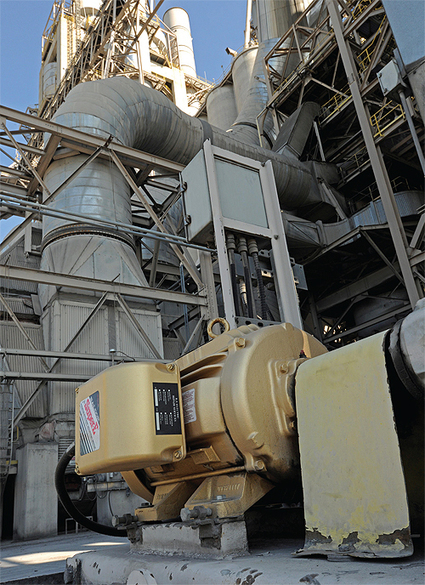
The United States has had efficiency regulations for industrial electric motors in place since October 1997, when the Energy Policy Act of 1992 (EPAct 92) set minimum efficiency levels for 1- to 200-hp general-purpose three phase motors. EPAct 92 was upgraded when the Energy Independence and Security Act of 2007 (EISA) went into effect in December 2010.

Duane Tilden‘s insight:

>Several years ago, the U.S. Department of Energy (DOE) conducted a technical study as to what could be done to raise the efficiency levels of “small” motors. After years of study and litigation, the Small Motor Rule was passed that covers two-digit NEMA frame single- and three-phase 1/3 through 3 horsepower motors in Open enclosures.

Although the Small Motor Rule seems simple, it has the effect of creating motors with much larger footprints, particularly on single phase designs where capacitor start/induction run motors may largely be discontinued in Open enclosures. In some cases, a TEFC motor may be more cost effective and smaller than an Open motor.

The DOE is presently conducting another technical study on “medium” AC induction motors of 1- to 500-hp. In their study, DOE is evaluating a possible increase in nominal motor efficiency of 1 – 3 NEMA bands (approximately 0.4 to 1.5%) above NEMA Premium Efficiency levels as defined in MG 1-2011 table 12-12. Although this sounds simple to do, such a motor redesign could entail new laminations, winding equipment and in many cases, new frames to fit the extra material. Some designs may not fit where existing motor designs of the same ratings fit today. This means that OEMs would need to redesign their machine if that is an issue and end users may have trouble fitting the new higher efficiency replacement motor into their equipment or existing envelope.<

See on www.designworldonline.com

Air Conditioning the World stresses Global Energy Supply

See on Scoop.itGreen Building Design – Architecture & Engineering

The United States currently uses more energy for air- conditioning than all other countries combined—a sobering statistic from Stan Cox of the Land Institute in Salina, Kansas.

Duane Tilden‘s insight:

>According to the U.S. Energy Information Administration, 87 percent of American households are equipped with air-conditioning, and the United States expends about 185 billion kilowatt hours of energy annually on residential cooling.  […]

Rapid increases in the ownership of air conditioners are already occurring in many developing countries. According to research by McNeil and Letschert, the percentage of urban Chinese households with an air conditioner jumped from less than 1 percent in 1990 to 62 percent in 2003. In 2010 alone, 50 million air-conditioning units were sold in China.  […]

[…] eight countries have the potential to exceed the United States’ yardstick of high air-conditioning usage, because of their warm climates and significant populations. Furthermore, the top three could surpass the United States by substantial amounts: India, China, and Indonesia by factors of 14, 5.2, and 3.1, respectively, if they adopt American standards of cooling.

[…] Several institutions have recently made major technical advances in the design of more energy-efficient air conditioners. For example, developments at the National Renewable Energy Laboratory suggest that efficiency improvements of 20 to 70 percent are possible compared to current models of air conditioners. Changes in housing design and urban planning are also needed […]<

See on www.americanscientist.org

MHI Completes Acquisition of Pratt & Whitney Power Systems

See on Scoop.itGreen Energy Technologies & Development

Tokyo, May 20, 2013 – Mitsubishi Heavy Industries, Ltd. (MHI) has completed its acquisition of Pratt & Whitney Power Systems, the small and medium-size gas turbine business unit of Pratt & Whitney (P&W), an aeroengine manufacturer.

Duane Tilden‘s insight:

>MHI has traditionally focused its gas turbine business on large-capacity, high-efficiency systems. With the addition of PWPS’s small and medium-size aero-derivative engines, MHI has expanded its power generation product portfolio and is able to offer customers a full product lineup.

PWPS’s aero-derivative gas turbines are highly acclaimed, especially for their emergency power generation applications, compact design, and rapid start-up time. More than 1,700 aero-derivative turbines have been delivered worldwide. Significant growth is anticipated in applications that require a flexible power source complementary to a renewable-energy power source. Robust market demand is also expected as small power sources for applications in emerging markets. PWPS’s main product has been the 30MW (megawatt) class machine. The company is developing an innovative 60MW class model, which is expected to significantly boost PWPS’s market share.

Turboden’s ORC turbines have the capability to generate power or supply hot water using a relatively low-temperature heat source such as biomass, factory waste heat or geothermal energy. The company has sold more than 300 units in 20 countries, primarily in Europe. In Japan, increasing opportunities are emerging to use ORC technology in biomass and geothermal applications, and MHI plans to significantly increase sales in those expanding markets.

MHI and P&W have been in a collaborative relationship in aeroengine production for many years. After the acquisition of PWPS, MHI will continue to collaborate with P&W in the supply of engine parts for gas turbines and development of new machines.<

See on www.mhi.co.jp

Applied Thermodynamics: Organic Rankine cycle – Wikipedia

See on Scoop.itGreen Energy Technologies & Development

Duane Tilden‘s insight:

We have all seen the Rankine Cycle engine, most typically as the inefficient steam locomotive.  The modern efficient designs use turbines to convert heat energy from two reservoirs of different temperatures to mechanical energy.

The Organic Rankine Cycle engine uses a fluid – vapor phase change other than water/steam and a wide range of compounds are available including proprietory mixtures.  These mixtures allow for the conversion to mechanical energy in a wide range of applications and temperatures.  Two such applications would be waste heat to energy and geothermal energy systems.

See on en.wikipedia.org

Industrial Energy Management – Contolling Demand & Energy Usage

See on Scoop.itGreen Energy Technologies & Development

Demand-control technology supports multiple approaches for taming energy costs without sacrificing production efficiency.

Duane Tilden‘s insight:

>Navigant Research argues that efficient energy management will soon be as important as product quality in determining manufacturers’ competitive position within their respective industries. That importance, according to Navigant, is reflected in the compound annual growth rate for industrial energy management software and services.

At its current growth rate, the global market for industrial energy management solutions will nearly double over the next 7 years, going from $11.3 billion in 2013 to $22.4 billion in 2020… <

See on www.plantengineering.com

Creating Value: Energy Retrofits for Buildings

See on Scoop.itGreen & Sustainable News

Buildings in the U.S. consume[…] 42 percent of the nation’s primary energy and 72 percent of its electricity. Much of that energy is needlessly wasted through inefficient design and operation.

Duane Tilden‘s insight:

>Rather than examine energy costs in isolation, our approach assesses how energy and sustainability improvements add value to all parts of a property or company. This approach is not revolutionary, but rather more comprehensive, applying industry-accepted valuation methods to the full set of retrofit value contributions, including saved energy costs, health and productivity benefits, reputation and leadership, and risk reduction.

Energy investment (and resultant property outcomes) should be treated as one of many factors that influence value, including location, tenant mix, quality of design, and more. Evaluating retrofits within the broader context of property/company value enables a logical, defensible calculation and assessment of a deep retrofit’s relative contribution to value. Previous attempts to value energy retrofits have ignored retrofits’ value contributions and overlooked standard approaches to valuing properties and companies.<

See on www.rmi.org

Jobs for the Future: Energy Efficiency creates Employment — ECEEE

See on Scoop.itGreen & Sustainable News

Energy efficiency initiatives create jobs, and normally very good jobs.  Recent analysis shows that between 17 and 19 net jobs can be created for every million euros spent.

Duane Tilden‘s insight:

>Jobs to improve energy efficiency in all end-use sectors are of high value.  Many require technical qualifications, such as engineering or architectural degrees.  Many require re-training from existing jobs. There will be a demand for financial specialists, construction engineers, behaviour specialists, project managers, auditors, data base managers, policy analysts and the like.  And these jobs are available to all, regardless of age or gender.

The hard work of creating these jobs begins once the Directive is finally approved.  The long-term policy framework needs to be in place and the funding and implementation strategy need to be well developed. But in the longer term, opportunity is knocking at the door, and it deserves a welcome mat.<

See on www.eceee.org