CHP will help reduce EU’s energy imports – European Commission – Gas to Power Journal – Gas to Power Journal UK

See on Scoop.itGreen & Sustainable News

Increased market penetration of energy efficient Combined Heat and Power (CHP) installations can help the EU reduce its energy imports and drive econo…

Duane Tilden‘s insight:

“Even if we disregard climate change, it would still be wise to stop spending as much as possible of the some €400 billion a year we spend on importing oil and gas. Instead, we should find ways to use European technologies and labor to get more efficient energy systems to decrease our fossil fuel imports,” he told delegates in a keynote opening address.

… the Commission has proposed €17 billion to go specifically towards energy efficiency projects including CHP. The effect of this, according to Hodson, is that “there is now a greater climate for regional authorities to build energy efficiency into their projects from the very beginning”.

See on gastopowerjournal.com

On-Site Utility – EuroSite Power Providing Savings to DoubleTree by Hilton – Cogeneration & On-Site Power Production

See on Scoop.itGreen & Sustainable News

LONDON, UK – EuroSite Power Inc., (OTCQB: EUSP) an On-Site Utility, offering clean electricity, heat, hot water and cooling solutions to hospitality, healthcare, housing and leisure centers in the United Kingdom and Europe is now operating a combined heat and power system supplying clean energy to DoubleTree by Hilton, Cambridge, UK.

Duane Tilden‘s insight:

EuroSite Power will produce clean energy in the form of electricity, heating and domestic hot water for each hotel at a price lower than The Ability Group’s previous and future energy suppliers. Because The Ability Group opted for the company’s On-Site Utility solution, each hotel pays only for the energy used and avoids all capital, installation and operating costs. EuroSite Power also handles all service, maintenance and repair meaning neither The Ability Group nor Hilton Worldwide need to provide manpower to support the energy equipment.

See on www.cospp.com

Whisky distilleries start powering biomass energy plant

See on Scoop.itGreen Energy Technologies & Development

A cluster of Scottish whisky distilleries have started supplying a new biomass energy plant with enough waste to power 9,000 homes.

Duane Tilden‘s insight:

The innovative Helius CoRDe energy plant was opened in Rothes, Speyside, this week to transform the by-products from the local whisky industry into power.

Adrian Bowles, Helius Energy CEO said: “This is renewable energy in action using innovative technology to provide enough power for 9000 homes, and produce animal feed using by-products from local whisky distilleries.

See on www.clickgreen.org.uk

Ceramic Fuel Cells receives German order for micro combined heat and power units – Proactiveinvestors (AU)

See on Scoop.itGreen Energy Technologies & Development

Ceramic Fuel Cells (ASX: CFU) has received a binding order for 60 integrated micro combined heat and power (mCHP) units from German energy service provider EWE.

Duane Tilden‘s insight:

Integrated mCHP generators combine fuel-cell technology and a condensing boiler to meet all electricity and heat requirements for single-family homes and small office buildings.

Operating this new fleet will demonstrate the latest product improvements that Ceramic and its development partner Gebrüder Bruns Heiztechnik GmbH have incorporated, including enhanced overall control and thermal efficiency.

See on www.proactiveinvestors.com.au

Is Gasification Better Than Incineration? Read: Global Markets for Gasifiers – WSJ.com

See on Scoop.itGreen Energy Technologies & Development

NEW YORK, April 15, 2013 /PRNewswire/ — Reportlinker.com announces that a new market research report is available in its catalogue:

Global Markets for Gasifiers

Duane Tilden‘s insight:

INTRODUCTION

Gasification is a centuries–old thermochemical energy conversion technology that has slowly achieved modernity over the decades. The technology is undergoing its third evolutionary surge. Fuel shortages in WWII spurred widespread adoption for vehicle fuels. The oil crisis 1973 spurred a re–evaluation and renewed development. Rising oil prices, globally increasing fuel demand, and overwhelming scientific evidence of climate change have spurred this last leg to full industrialization.

The central concept of gasification is that by raising carbon–rich materials to high temperatures in an oxygen–deficient containment, the material will break down thermochemically instead of burning. If the same material is combusted (burned), it emits carbon monoxide and a host of pollutants, besides being incompletely consumed. If gasified, the products are hydrogen (H2), carbon monoxide (CO) and carbon dioxide (CO2). This is synthetic gas, simply called “syngas.” It can be burned, captured, stored, or its molecules rearranged to form fuels and chemical feedstocks.

The process is moderately more efficient than incineration, has significantly fewer emissions and waste, and the syngas can be shaped into a myriad of products for power production, chemical industries, liquid fuels, and heat.

Feedstock for gasification can be coal, the organic components of municipal waste, industrial waste streams, chemical feedstocks, forestry residues, forest products and crop residues, medical waste, unrecycled plastic or, in the case of plasma gasifiers, almost any nonradioactive material.

A gasifier is the central component of a gasification plant. Surrounding it are the feedstock conditioning and delivery systems, oxygen, steam and air input systems, waste removal components, syngas cooling and cleaning systems, power plants, heat recovery units, Fischer–Tropsch molecule rearrangers, and so on. This report focuses on the markets for gasifier units that are in place and will be installed by application segment and geographic location through the year 2017.


See on online.wsj.com

GE links up with Coca Cola in Brazil – Cogeneration & On-Site Power Production (Combined Heat & Power)

See on Scoop.itGreen Energy Technologies & Development

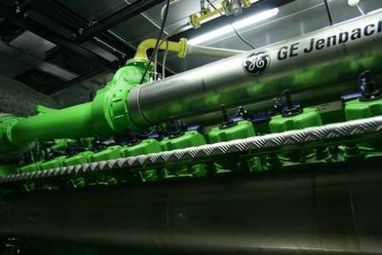
The 12 MW facility will provide all of the plant’s on-site heat and power needs. Brazilian energy company Light Esco will install three ecomagination-qualified Jenbacher J624 engines at the Andina Brasil-Coca-Cola bottling facility.

Duane Tilden‘s insight:

The power plant is expected to begin operating in November 2013 and will also produce cold water, carbon dioxide (CO2) and nitrogen to support the bottling operations.

By installing quadgeneration technology to recover food-grade CO₂, factories can reduce emissions by up to an additional 40 percent when compared to using separate power and heat generating equipment.

See on www.cospp.com

#Landfill methane-to-energy project gets national award – #Renewable #Energy

See on Scoop.itGreen Energy Technologies & Development

Lycoming County was one of seven places in the country to receive the U.S. Environmental Protection Agency’s award for excellence in landfill gas energy projects for 2012.

Duane Tilden‘s insight:

Yaw, who was present at Thursday’s presentation at the commissioners’ meeting, said he frequently became frustrated when driving by the landfill and seeing excess methane being flared off.

“We’re utilizing all of the landfill methane (now). We’re not flaring anything,” said Tucker.

The county’s waste gas-to-energy project produces enough electricity to power 4,000 homes a year and has the equivalent reduction of 80,000 barrels of oil a year, according to PPL Renewable Energy.

Donna Zickefoose, Allenwood Federal Correctional Complex warden, said the local institution is the first federal prison to be involved in such a project. She said it will save the prison $5 million during the next decade.

See on www.sungazette.com

US president aims to add 40GW to 82GW of installed CHP capacity by 2020

See on Scoop.itGreen Energy Technologies & Development

Low gas prices, state incentives, environmental regulations and the retirement of old power plants helps fuel rising investment in combined heat and power (CHP) installations in the US, according to a Department of Energy (DOE) and Environmental Protection Agency (EPA) report.


Duane Tilden‘s insight:

Obama’s CHP initiative

The 40GW CHP expansion goal is based on a 2012 Executive Order from Obama which encourages the Departments of Energy, Commerce, and Agriculture, and the EPA […] to coordinate policies in order to encourage investment in industrial efficiency measures such as CHP.

The installation of a further 40MW of capacity would save about 1 quadrillion Btu of energy annually, eliminate over 150 million metric tons of CO2 emissions and save energy users some $10 billion a year.

Shale gas revolution helps spur CHP growth

Currently about 8 percent of US power generation capacity and 12 percent of MWh generated annually comes from CHP, according to the DOE report, while 87 percent of CHP installations support manufacturing plants.

The recent US shale gas revolution has helped spur renewed interest in the sector, after investment in new CHPs slowed down between 2004 and 2005, mainly due to volatile gas prices and an uncertain economic outlook.

See on gastopowerjournal.com

TD Bank Announces Energy-Saving Monitoring Data For Net-Zero Store

See on Scoop.itGreen Building Design – Architecture & Engineering
TD reports that the first net-zero bank built in the United States is exceeding expectations according to first-year monitoring data.

Duane Tilden‘s insight:

TD Bank’s net-zero energy store opened on May 13, 2011. The U.S. Department of Energy (DOE) National Renewable Energy Laboratory defines a net-zero energy building (NZEB) as a residential or commercial building that produces and exports in a year at least as much renewable power as the total energy it uses.

[…] A NZEB has two key energy features: The building is constructed with energy-efficient technologies that significantly reduce its energy demand, and renewable energy sources supply at least as much energy as the building uses over the course of a year.

See on www.stockhouse.com

What Will Be the Next Technological Breakthrough in Energy?

See on Scoop.itGreen Energy Technologies & Development

What technological breakthrough is most likely in the next 10 years that could completely change the energy equation as we now see it?

Duane Tilden‘s insight:

Jeffrey Ball: Information Technologies to Increase Efficiency, and Solar Power Seem Promising

Predicting new-energy technological breakthroughs tends to be a fool’s errand. A decade ago, few envisioned the breakthrough that has most rocked the U.S. energy world: the one-two punch of fracking and horizontal drilling that has unlocked huge stores of shale gas from California to New York.

Right now, two broad areas of new energy technology seem particularly promising: information technologies that could spur major energy-efficiency improvements; and cheaper and more-reliable solar power. […]

Study after study has pegged energy efficiency as the lowest-cost way to curb fossil-fuel consumption and the resulting greenhouse-gas emissions. The problem has been figuring out how to unlock those efficiency improvements in the real world. Today, creative minds are at work developing electronic systems to track and display the energy use of institutional and individual consumers in ways that could make those users much more conscious both about how much energy they consume and about precisely what they could do to cost-effectively consume less. More information, in short, could equal less power.

See on online.wsj.com