Demand for DC Brushless Motors to increase over 50% in Transportation Sector by 2017

See on Scoop.itGreen & Sustainable News

Automotive systems are becoming increasingly electrically-driven and electric motor manufacturers are benefiting.

Duane Tilden‘s insight:

>“[…] Increasing sales of plug-in electric vehicles, which have powertrain and chassis systems that are electromechanically-driven, are expected to provide greater growth potential for brushless DC motor shipments than for brushed DC motors.

[…]

Although DC brushed motors usage is expanding with the increasing number of electromechanically-driven powertrain and chassis systems, DC brushless motor shipments for powertrain and chassis applications are expected to outpace those of DC brushed motors twofold from 2012 to 2017. The respective average annual growth of DC brushed and DC brushless motor shipments from 2012 to 2017 is expected to be 3.5 percent and 7 percent according to IMS Research. <

See on www.imsresearch.com

World Solar PV Market To Hit 45 GW In 2014, Deutsche Bank Forecasts

See on Scoop.itGreen & Sustainable News

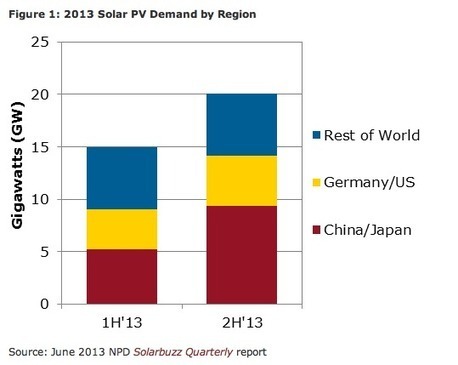
Deutsche Bank is the latest to upgrade its forecasts – for the second time in as many months – predicting that the 2014 global solar market could jump to 45 GW, after rising to 38-40 GW in 2013.

>Deutsche’s analysis is more bullish than an NPD Solarbuzz report last week that forecast solar PV demand for calendar 2013 to reach a record high of 35.1 GW, after a strong second half that would result in 20 GW being installed. In March, the research group predicted full year demand of just 31 GW.

NPD Solarbuzz analyst Michael Barker said the market was still in transition (from older markets such as Europe to newer ones in Asia), and would continue to rely on four key countries for the bulk of demand – Germany, China, Japan, and the US – which accounted for more than 60% of demand in the first half.

It said China and Japan alone would account for 45% of global demand in the second half, up from just 10% three years ago.<


Unclean at Any Speed – IEEE Spectrum

See on Scoop.itGreen Energy Technologies & Development

Electric cars don’t solve the automobile’s environmental problems

Duane Tilden‘s insight:

>Two dozen governments around the world subsidize the purchase of electric vehicles. In Canada, for example, the governments of Ontario and Quebec pay drivers up to C $8500 to drive an electric car. The United Kingdom offers a £5000 Plug-in Car Grant. And the U.S. federal government provides up to $7500 in tax credits for people who buy plug-in electric vehicles, even though many of them are affluent enough not to need such help. (The average Chevy Volt owner, for example, has an income of $170 000 per year.)

Some states offer additional tax incentives. California brings the total credit up to $10 000, and Colorado to $13 500—more than the base price of a brand new Ford Fiesta. […]

There are other perks. Ten U.S. states open the high-occupancy lanes of their highways to electric cars, even if the car carries a lone driver. Numerous stores offer VIP parking for electric vehicles—and sometimes a free fill-up of electrons. Mayor Johnson even moved to relieve electric-car owners of the burden of London’s famed congestion fee.

Alas, these carrots can’t overcome the reality that the prices of electric cars are still very high—a reflection of the substantial material and fossil-fuel costs that accrue to the companies constructing them. And some taxpayers understandably feel cheated that these subsidies tend to go to the very rich. Amid all the hype and hyperbole, it’s time to look behind the curtain. Are electric cars really so green?

It’s worth noting that this investigation was commissioned by the U.S. Congress and therefore funded entirely with public, not corporate, money.  […]

Part of the impact arises from manufacturing. Because battery packs are heavy (the battery accounts for more than a third of the weight of the Tesla Roadster, for example), […] Electric motors and batteries add to the energy of electric-car manufacture.

In addition, the magnets in the motors of some electric vehicles contain rare earth metals. […]

The materials used in batteries are no less burdensome to the environment, the MIT study noted. Compounds such as lithium, copper, and nickel must be coaxed from the earth and processed in ways that demand energy and can release toxic wastes. […]
See on spectrum.ieee.org

Energy Storage Systems for Solar and Wind Power Integration Will Total Nearly 22 Gigawatts of Installed Capacity from 2013 to 2023

See on Scoop.itGreen Energy Technologies & Development

June 26, 2013 More than 1,300 gigawatts (GW) of wind and solar power generation capacity are expected to come online in the next 10 years, creating an unprecedented amount of instability on the gri…

Duane Tilden‘s insight:

>“Several of the major markets for renewables, including Germany, Japan, and the United States, have enacted rules or legislation encouraging the adoption of energy storage systems for the purpose of integrating variable energy sources onto the grid,” says Anissa Dehamna, senior research analyst with Navigant Research.  “These market incentives come in various forms, including outright subsidies for ESS adoption, reforms that change how variable generation is compensated, and adjustments to connection requirements for variable power plants.”

In particular, changes to the compensation arrangements for variable power generation will have significant influence on the market for ESSs for solar and wind.  Compensation mechanisms have changed drastically over the past 10 years, according to the report, and many compensation schemes have grandfather clauses—meaning that older wind and solar systems have much different compensation rates and structures than newer systems coming online.<

See on www.navigantresearch.com

US team’s battery ‘breakthrough’

See on Scoop.itGreen Energy Technologies & Development

Researchers believe they have found a way to radically shrink the size of batteries while offering the same amount of power and faster recharges than at present.

Duane Tilden‘s insight:

>The scientists’ “breakthrough” involved finding a new way to integrate the anode and cathode at the microscale.

“The battery electrodes have small intertwined fingers that reach into each other,” project leader Prof William King told the BBC.

“That does a couple of things. It allows us to make the battery have a very high surface area even though the overall battery volume is extremely small.

A cross-section of the battery reveals the 3D-design of the research project’s anodes and cathodes

“And it gets the two halves of the battery very close together so the ions and electrons do not have far to flow.

“Because we’ve reduced the flowing distance of the ions and electrons we can get the energy out much faster.”<

See on www.bbc.co.uk

New Wyoming lithium deposit could meet all U.S. demand

See on Scoop.itGreen & Sustainable News

The U.S. currently imports more than 80% of the lithium it uses, with the silvery metal winding up in batteries from cell phones to electric cars.

Duane Tilden‘s insight:

“University of Wyoming researchers found the lithium while studying the idea of storing carbon dioxide under ground in the Rock Springs Uplift, a geologic formation in southwest Wyoming. University of Wyoming Carbon Management Institute director Ron Surdam stated that the lithium was found in underground brine. Surdam estimated the located deposit at roughly 228,000 tons in a 25-square-mile area. Extrapolating the data, Surdam said as the uplift covered roughly 2,000 square miles, there could be up to 18 million tons of lithium there, worth up to roughly $500 billion at current market prices.”

See on www.mining.com

NEMA Praises Introduction of Bill to Promote Energy Storage Technologies, National

See on Scoop.itGreen Energy Technologies & Development

April 25, 2013 – NEMA endorsed HR 1465, STORAGE 2013, which promotes adoption of state-of-the-art energy storage technologies, calling this legislation “carefully crafted” in its regard for entire range of energy storage technologies. …

Duane Tilden‘s insight:

“Energy storage is a key enabler of the Smart Grid and is transforming the way we think about electricity,” said NEMA President and CEO Evan R. Gaddis. “By getting us beyond the need to generate electricity at the same moment as it is used, energy storage delivers greater system efficiency, enhances reliability and resiliency, and fosters integration of renewable energy.”

STORAGE 2013 would offer a 30 percent investment tax credit for energy storage used in connection with the power grid, with no project eligible to receive more than $40 million, and the total program capped at $1.5 billion. For municipal utilities and electric cooperatives, the legislation would make energy storage eligible for new clean renewable energy bonds. To promote efficiency and distributed generation in the commercial and residential markets, the bill offers a 30 percent credit (up to $1 million) for onsite application of energy storage.

See on news.thomasnet.com

KW17 | IHS: Solar PV energy storage market to grow to USD 19 billion in 2017 – SolarServer

See on Scoop.itGreen Energy Technologies & Development

IHS Inc. (Englewood, Colorado, US) has released a new report which predicts that the market for energy storage to accompany solar photovoltaic (PV) generation will grow more than 100% annually to 7 GW in 2017, representing USD 19 billion in value.

Duane Tilden‘s insight:

Due to the energy storage subsidy, IHS expects Germany to play a leading role, as it did in the larger PV industry. The company predicts that 70% of installed storage in 2013 will be located in Germany.

IHS expects that if the program proves successful, other nations will pass similar subsidies. …

Market for storage with utility-scale PV as well

IHS also expects that storage will be used in larger PV systems, as connection requirements for PV become increasingly demanding. The company forecasts that utility-scale PV with storage will grow to more than 2 GW annually by 2017, led by Asia and the Americas.

See on www.solarserver.com

International Battery and Energy Storage Alliance Founded – Solar Novus Today

See on Scoop.itGreen Energy Technologies & Development

IPVEA and EuPD Research form International Battery and Energy Storage Alliance

Duane Tilden‘s insight:

The newly founded alliance plans to support and enable cooperation between companies from the fields of solar energy production, electrical energy storage and smart grid technologies. Together, the members of the International Battery and Energy Storage Alliance (IBESA) will create access to professional resources, market intelligence, new networks, and emerging markets. Over 70 members of the International PV Equipment Association (IPVEA) will immediately benefit from this strong partnership.

Alongside companies in the photovoltaic, battery and solar storage sectors, IBESA is also a valuable partner for energy providers, municipal utilities, installers, consulting firms and banks. …

Interested companies can contact the International Battery and Energy Storage Alliance directly in order to become members.

See on www.solarnovus.com

Lithium-polysulfide “Flow” battery helps solar and wind power the grid

See on Scoop.itGreen Energy Technologies & Development

Researchers from the U.S. Department of Energy’s (DOE) SLAC National Accelerator Laboratory and Stanford University have managed to design a low-cost, long-life battery that could enable solar …

Duane Tilden‘s insight:

The new Stanford/SLAC battery design uses only one stream of molecules and does not need a membrane at all. Its molecules mostly consist of the relatively inexpensive elements lithium and sulfur, which interact with a piece of lithium metal coated with a barrier that permits electrons to pass without degrading the metal.

When discharging, the molecules, called lithium polysulfides, absorb lithium ions; when charging, they lose them back into the liquid. The entire molecular stream is dissolved in an organic solvent, which doesn’t have the corrosion issues of water-based flow batteries.

“In initial lab tests, the new battery also retained excellent energy-storage performance through more than 2,000 charges and discharges, equivalent to more than 5.5 years of daily cycles,” Cui explained.

See on www.tgdaily.com