Swansea Bay hydrokinetic project continues moving forward

See on Scoop.itGreen Building Design – Architecture & Engineering
Energy development group Tidal Lagoon Power Limited has reached a significant milestone in the development of a massive hydroelectric power project with the announcement of three design, build and deliver agreements.


Duane Tilden‘s insight:

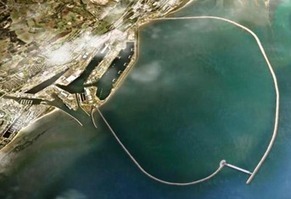
>[…]According to TLP, the US$966.5 million project will consist of a 6-mile-long, 35-foot-high semi-circular sea wall that will enclose an area west of Swansea Marina.  The wall would be dotted along its length with a number of hydro turbines, giving the project a cumulative capacity of around 250 MW.

Each of TLP’s three partners adds a unique quality to the project’s development, the company said.  Costain will work in developing and managing the schedule for pre-construction and construction phases, developing construction methodology for civil engineering works including turbine and sluice structures, access routes and complex temporary works, including temporary bund for construction turbine housing.

Meanwhile, Atkins will provide engineering design and geotechnical expertise. TLP said this includes “designing both the turbine house and the innovate breakwater bund wall, which uses a combination of giant tubular sand bags protected by armor made up of different sized rocks.”

Last, Van Oord is developing construction methodology suitable for the harsh off-shore conditions in Swansea Bay.  The Swansea is the first tidal lagoon power project envisioned by TLP, which said in May that it is considering a similar project off Wales’ north coast. As much as 10,000 MW of tidal lagoon power potential in the United Kingdom, the group said. […]<

See on www.hydroworld.com

Formal consultation commences on the world’s first purpose built tidal lagoon | Specification Online

See on Scoop.itGreen Building Design – Architecture & Engineering

The formal consultation process has started on the world’s first purpose built tidal lagoon for Swansea Bay, with public exhibitions taking place at 18 locations around the Swansea Bay area until August 5.

Duane Tilden‘s insight:

>The proposed tidal lagoon will have a rated capacity of 240 Megawatts (MW), generating 400GWh net annual output. This is enough electricity for approximately 121,000 homes.

In addition to generating electricity, the £650 million development will also provide visitor facilities and other amenities including art, education, mariculture and sporting/recreational facilities. The seawall is expected to be open to the public during daylight hours for walking, running, cycling etc, though access will be controlled in extreme weather.

LDA Design, the project masterplanners and landscape architects for Swansea Bay Tidal Lagoon, has completed the coordination of exhibition material for the public exhibitions. As part of the formal consultation for the proposed Development Consent Order (DCO) application by Tidal Lagoon (Swansea Bay) plc (TLSB), a new, virtual 3D programme has been prepared, which shows the proposed lagoon in the context of Swansea Bay.  <

See on specificationonline.co.uk

Scottish tidal power potential less than estimated, still Viable – new Study via Reuters

See on Scoop.itGreen Energy Technologies & Development

* Pentland Firth could generate maximum of 1.9 GW of power* 1 GW seen more realistic, vs prior estimates of 10-20 GW

LONDON, July 10 (Reuters) – Proposed tidal turbines in Pentland Firth, which separates…

Duane Tilden‘s insight:

>New research led by the University of Oxford suggests, however, that the maximum that Pentland Firth could produce would be 1.9 gigawatts, with 1 GW a more realistic target.

That is far below previous estimates of 10 GW to as much as 20 GW. […]  The study was less optimistic about the firth’s potential because it took into account factors such as how many turbines it would be feasible to build, how they would interact with each other and variations from tidal cycles.

“Our study provides the first robust data about how much energy it would be feasible to extract,” said Thomas Adcock, lead author of the report and fellow in engineering science at Oxford University.

Pentland Firth could still generate power equivalent to almost half of Scotland’s annual electricity consumption, which amounted to 37 terrawatt hours in 2011, Adcock added. […]<

See on www.reuters.com

Is Scotland’s Pentland Firth the World’s Best Site for Tidal Power

See on Scoop.itGreen Energy Technologies & Development

Tidal streams could bring large amounts of energy within a decade if government support is available, study says

Duane Tilden‘s insight:

>The world’s best site for tidal power, the Pentland firth, could provide half of Scotland’s electricity, according to the first robust estimate of its potential. The tidal streams, which surge through the firth at five metres per second, could bring large amounts of renewable energy in reach within a decade if enough government support is available, said the Oxford University engineer behind the new study.

From Anglesey to the Severn estuary to Portland Bill, the UK has the greatest potential for generating predictable, clean energy from tidal channels. Turbines are already operating at Strangford Loch in Northern Ireland and prototypes are being tested in the Menai Straits off Anglesey.

But the Pentland firth is the greatest resource. “It is almost certainly the best site for tidal stream power in the world,” said Thomas Adcock, at Oxford University, who led the new work published in the journal Proceedings of the Royal Society A. The water flow is rapid there because the tide shifting from the Atlantic into the North Sea is forced through a narrow eight-mile channel.<

See on www.guardian.co.uk

Three Types of Climate Action for Europe and Central Asia Region

See on Scoop.itGreen Energy Technologies & Development

Under current trajectories, the world is headed toward a world that will be 4 degrees warmer by the end of this century.

Duane Tilden‘s insight:

>[…] However, as we try to show in our recent publication, Growing Green: the Economic Benefits of Climate Action, strategic investment in climate action can benefit these countries in the medium- and long-terms – thus offsetting the negative consequences of these investments.

Above all, countries need to focus on three types of climate action: climate action as aco-benefit, climate action as an investment, and climate action as insurance.

This first area of climate action is simply a co-benefit of policies that make sense even if we were not concerned about climate change. These are things like supporting energy efficiency investments or restoring degraded soils to make agriculture more productive (while also increasing carbon storage in soils).

The second area is what we call climate action as an investment. This gets at the issue of how countries can benefit from greening their economies – doing well by doing good. What we have seen in the last few years is that new firms emerge in countries that have implemented ambitious green policies early and take advantage of the economic opportunities that have sprung from these policies. […]<

See on blogs.worldbank.org

Synthesis of Butanol: Towards a Better Biofuel

See on Scoop.itGreen Energy Technologies & Development

Researchers have developed a catalyst to convert ethanol into butanol with high selectivity, potentially allowing butanol to replace ethanol as a biofuel.

Duane Tilden‘s insight:

>[…] Because manufacturers can prepare ethanol from renewable sources, researchers consider the biofuel a good alternative to standard fossil fuels such as gasoline. Indeed, its production and use have increased remarkably in the last ten years; manufacturers now commonly add ethanol to gasoline fuels.

Despite this increased use, however, ethanol has several disadvantages. It has a lower calorific value than standard gasoline (19.6 vs. 32 MJ/liter); moreover, it is corrosive. For this reason, the maximum amount which can be added to standard gasoline is about 10 %; cars cannot use fuels with higher ethanol amounts without engine modifications.

Butanol: a Better Option

1-Butanol (CH3-CH2-CH2-CH2-OH), an alcohol with a longer chain, could be a better alternative to ethanol. Indeed, it has a higher calorific value (29.2 MJ/liter) and it is much less corrosive; because of this, manufacturers can add it to gasoline in higher proportions without engine modifications, and theoretically it could completely replace the gasoline. Moreover, its octane number is very similar to that of gasoline – 96 vs 91-99.

Despite these characteristics, however, we’re not yet using butanol in cars due to the difficulties in producing the alternative biofuel. […]<

See on www.decodedscience.com

Demand for DC Brushless Motors to increase over 50% in Transportation Sector by 2017

See on Scoop.itGreen & Sustainable News

Automotive systems are becoming increasingly electrically-driven and electric motor manufacturers are benefiting.

Duane Tilden‘s insight:

>“[…] Increasing sales of plug-in electric vehicles, which have powertrain and chassis systems that are electromechanically-driven, are expected to provide greater growth potential for brushless DC motor shipments than for brushed DC motors.

[…]

Although DC brushed motors usage is expanding with the increasing number of electromechanically-driven powertrain and chassis systems, DC brushless motor shipments for powertrain and chassis applications are expected to outpace those of DC brushed motors twofold from 2012 to 2017. The respective average annual growth of DC brushed and DC brushless motor shipments from 2012 to 2017 is expected to be 3.5 percent and 7 percent according to IMS Research. <

See on www.imsresearch.com

World Solar PV Market To Hit 45 GW In 2014, Deutsche Bank Forecasts

See on Scoop.itGreen & Sustainable News

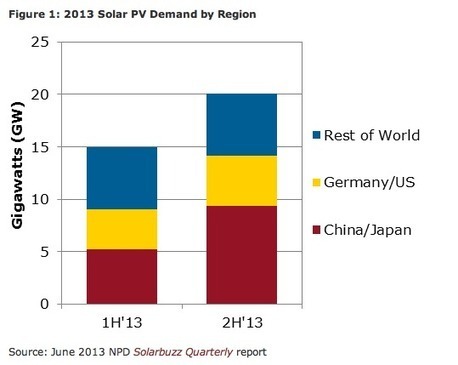
Deutsche Bank is the latest to upgrade its forecasts – for the second time in as many months – predicting that the 2014 global solar market could jump to 45 GW, after rising to 38-40 GW in 2013.

>Deutsche’s analysis is more bullish than an NPD Solarbuzz report last week that forecast solar PV demand for calendar 2013 to reach a record high of 35.1 GW, after a strong second half that would result in 20 GW being installed. In March, the research group predicted full year demand of just 31 GW.

NPD Solarbuzz analyst Michael Barker said the market was still in transition (from older markets such as Europe to newer ones in Asia), and would continue to rely on four key countries for the bulk of demand – Germany, China, Japan, and the US – which accounted for more than 60% of demand in the first half.

It said China and Japan alone would account for 45% of global demand in the second half, up from just 10% three years ago.<


Sustainable Heating and Cooling of Buildings | Leonardo ENERGY

See on Scoop.itGreen Energy Technologies & Development

In many non-residential buildings across Europe, the energy consumed for heating and cooling is more than half the total energy consumption of the building. This is not inevitable. The introduction of simple design concepts and currently available technologies can lead to significant reductions in the energy consumption, operating costs, and carbon emissions of both new and existing buildings.

See on www.leonardo-energy.org

Plan B Updates – 115: Peak Water: What Happens When the Wells Go Dry? | EPI

See on Scoop.itGreen Energy Technologies & Development

Peak oil has generated headlines in recent years, but the real threat to our future is peak water. There are substitutes for oil, but not for water. We can produce food without oil, but not without water.

See on www.earth-policy.org