Net Metering And Rooftop Solar For The Utility Of The Future

See on Scoop.itGreen Energy Technologies & Development

Net metering makes small-scale renewable energy, such as rooftop solar panels, more affordable by crediting the “distributed generation” owners for the excess energy they produce.

Duane Tilden‘s insight:

>Why the new focus on net metering?  The cost for rooftop solar panels has fallen 80% since 2008, including 20% in 2012 alone.  Installed rooftop solar energy has increased by 900% between 2000 and 2011.  As consumers install more rooftop solar panels and net meter them, utility revenues will decrease.

Net metering policies vary from state-to-state, including the amount of the payback for excess energy.  The most favorable policy for distributed generation owners is an excess energy credit equal to the full retail energy rate consumers pay for energy, i.e. the amount consumers are charged for using energy.  Most states use this measure.  However, utilities claim this prevents them from recovering their full costs and overpays distributed generation owners, unfairly shifting costs to other consumers.  Utilities say the credit should be equal to the utilities’ wholesale energy cost at the time of day when excess energy flows back to the grid.

Despite attempts by utilities to change net metering policies, state regulators are keeping these policies intact.  Earlier this month, the Idaho Public Utilities Commission rejected Idaho Power’s request to pay less than the full retail rate and to impose higher charges on net metering consumers.  Last month, the Louisiana Public Service Commission rejected similar requests by Louisiana utilities.  More recently, Arizona Public Service Company raised the issue in a ne[…]<

See on blogs.edf.org

Companies Fined for Greenhouse Gas (GHG) Emissions Reporting Errors | The National Law Review

See on Scoop.itGreen & Sustainable News

Nine companies were issued fines by the California Air Resources Board (ARB) for violating the State of California’s Mandatory Greenhouse Gas Reporting rule. The ARB adopted the reporting rule in 2007.

Duane Tilden‘s insight:

>The companies cited for violations were not concentrated in one industry sector.  Sources receiving fines included a refinery, a biomass generating plant, an oil and gas production company, a utility company, a lime manufacturing company, and a cement company, among others. <

See on www.natlawreview.com

Glut of Natural gas squeezes biofuel market

See on Scoop.itGreen Energy Technologies & Development

Farm Power Northwest has built five anaerobic digesters in Oregon and Washington in recent years, but the brothers who founded the company say the outlook for new projects has lost its luster.

Duane Tilden‘s insight:

>The Mount Vernon, Wash.-based company, founded by brothers Daryl and Kevin Maas, uses manure from dairy farms to create methane gas, then burns it in generators and sells the resulting electricity to power utilities.

[…]

While power utilities paid up to 9 cents per kilowatt-hour several years ago for digester-produced electricity, the rate has now fallen to 5 cents per kilowatt-hour, said Kevin Maas.

The reason is the price of natural gas — a common fuel for electrical generation — has plummeted as domestic production has skyrocketed. Natural gas is now trading at below $4 per thousand cubic feet, compared with nearly $13 per thousand cubic feet in 2008.

That’s because new technology known as hydraulic fracturing, or fracking, has greatly increased the amount of natural gas that can be economically extracted from the ground.

With the cost of natural gas so much lower, other energy feedstocks like biogas from digesters become less competitive, experts say.<

See on www.capitalpress.com

Integration: Net-zero energy design | Consulting-Specifying Engineer

See on Scoop.itGreen Building Design – Architecture & Engineering

-ASHRAE has a goal: net-zero energy for all new buildings by 2030. What do engineers need to know to achieve this goal on their projects?

Duane Tilden‘s insight:

>As net-zero energy and low-energy design projects become more prevalent, engineers must be prepared to collaborate with all members of a project team including architects, energy specialists, lighting designers, builders, and owners in order to accomplish net-zero energy goals with little to no cost premium. Is this possible today or will it take another 10 or more years to get there?

There are many examples of completed projects demonstrating that not only is this possible, but it has been done in all regions of the country using readily available building products and common construction methods. So what’s the secret? It’s all about the design.<

See on www.csemag.com

Renewable Energy or Efficiency for the Data Center: Which first? #GreenComputing

See on Scoop.itGreen & Sustainable News

New advancements in green technology and design are making the idea of a green data center into a reality.

Duane Tilden‘s insight:

>Without doubt, the facility is a triumph of advanced environmental design and will serve as a template for future construction. Indeed, activity surrounding renewable-based data infrastructure is picking up, with much of it being led by the burgeoning renewable energy industry itself. VIESTE Energy, LCC, for example, has hired design firm Environmental Systems Design (ESD) to plan out a series of data centers across the U.S. that run on 100 percent renewable energy. A key component of the plan is a new biogas-fed generator capable of 8 to 15MW performance. The intent is to prove that renewables are fully capable of delivering reliable, cost-effective service to always-on data infrastructure.

The question of reliability has always weighed heavily on the renewables market, but initiatives like the VIESTE program could help counter those impressions in a very important way, by establishing a grid of distributed, green-energy data supply. In fact, this is the stated goal of the New York State Energy Research and Development Authority (NYSERDA), which has gathered together a number of industry leaders, including AMD, HP and GE, to establish a network of distributed, green data centers that can be used to shift loads, scale infrastructure up and down and in general make it easier for data users to maintain their reliance on renewable energy even if supply at one location is diminished. In other words, distributed architectures improve green reliability through redundancy just as they do for data infrastructure in general.

But not everyone on the environmental side is convinced that renewables are the best means of fostering data center efficiency. In a recent article in the journal Nature Climate Change, Stanford researcher Dr. Jonathan Koomey argues that without populating existing infrastructure with low-power hardware and data-power management technology first, data operators are simply wasting precious renewable resources that could be put to better use elsewhere. For projects like the NWSC and VIESTE, then, renewables may make sense because they power state-of-the-art green technology. But not as an industry-wide solution–renewables won’t make sense until hardware life cycles run their course.<

See on www.itbusinessedge.com

UK Shopping Centre goes zero Waste to landfill in a year

See on Scoop.itGreen & Sustainable News

As a new member of the National Recycling Star scheme, Clifton Down Shopping Centre received the Gold award for its recycling and waste management efforts and in recognition of its success in diverting all of its waste from landfill.

Duane Tilden‘s insight:

>The transformation in the centre’s waste management began with a full site audit to identify areas of poor practise within both its waste management and energy efficiency operations.  […]

As the shopping centre began to look at improving its waste management plan, it asked its tenants to start flat packing their waste cardboard, so it can be sent to the centre’s onsite compactor. Pre-flat packing waste cardboard has allowed the centre to double the amount of cardboard that can be collected by its waste contractor Smiths, while saving space in the services yard. This has cut the number of collections required, helping to save fuel consumption and CO2 emissions. All general waste produced by the shopping centre is sent to New Earth Solution’s mechanical biological treatment (MBT) facility at Avonmouth.

Clifton Down Shopping Centre has also been working to reduce its environmental impact by tackling its energy efficiency. New LED light fittings have been installed throughout the shopping centre, significantly reducing energy consumption and cost. The centre previously used old halogen lighting which consumed 14,994kW per annum, compared with the replacement LED lighting which consumes 2,998kW – an 80 per cent reduction. […]

The centre has also installed seasonal sensitive automatic doors at both entrances. These are programmed to close more quickly during winter months to minimise heat lose. This is switched during summer with doors remaining open for longer, allowing for cooler air to circulate the building. New electricity, water and gas monitors have been installed throughout the centre to measure consumption and identify areas of potential savings.<

See on www.e2bpulse.com

Grasscrete Chosen as One of the Best Sustainable Building Products of GreenBuild

Grasscrete Chosen as One of the Best Sustainable Building Products of GreenBuild.

Natural Gas – Better than Coal, still not great

knightge's avatarrethink. renew. revive.

Natural Gas is enjoying a huge renaissance right now, with production sky-high, and prices low.  Everyone seems to be advocating for more implementation of natural gas electricity production, heating costs are down, and some are advocating for development of cars that run on compressed natural gas (I spent some time in Argentina, where many cars run on CNG, and it is cheap!)

President Obama even included natural gas as a major component of his energy/climate change speech.

It’s true that natural gas is much cleaner than coal, and gathering the resource is less damaging to the environment (no mining, but shale gas? not so good).  We must remember, however, that its use still pollutes.

And it can catch on fire and explode.  As this disaster reminds us:

Gulf rig partially collapses as fire rages

Natural gas disasters happen all the time, check out NaturalGasWatch.org for a comprehensive week-by-week list…

View original post 69 more words

Wireless Transmission of Energy in Buildings – Building Automation

See on Scoop.itGreen Building Operations – Systems & Controls, Maintenance & Commissioning

Energy harvesting wireless technology becomes more attractive for OEMs as a basis technology for products and solutions that contribute to a building’s efficient energy management. The wireless modules gain their power from the surrounding environment…

Duane Tilden‘s insight:

>Energy harvesting technology enables batteryless automation devices and systems to make buildings more energy-efficient based on sustainable, resource-saving technologies that eliminate the need for batteries. […]

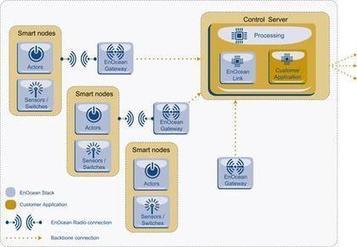
In a complex commercial building scenario, EnOcean Link can be implemented on a central device, like a control server, which controls the whole building, holds the automation intelligence, and can be physically located outside the building (in the cloud). Several gateways in the building record radio telegrams from thousands of distributed batteryless wireless sensors and relay receivers, and send back information or command data when needed. These gateways are connected to the control server by a backbone, which does not have to be based on EnOcean radio, or even be wireless. The middleware, located in the central unit, interprets all telegrams received by the gateways and provides them to the automation system.

High energy efficiency goals demand flexible automation systems for all kind of buildings that cover several areas. This particularly affects retrofit projects, where the intelligent control of energy consumption is the key factor for a building’s improved energy and carbon footprint. Energy harvesting wireless technology fulfills the demands for today’s and tomorrow’s automation and energy management systems. […]<

See on www.manufacturing.net

New Report: The Pulp and Paper Industry Can Save Jobs by Becoming More Energy Efficient

“The pulp and paper mill industry may be able to avoid large cuts in jobs by reducing energy costs.”

wklc's avatarWEST KOOTENAY LABOUR COUNCIL

http://inthesetimes.com   Saturday Jul 20, 2013 10:00 am

By Kari Lydersen

The pulp and paper mill industry may be able to avoid large cuts in jobs by reducing energy costs.   (Ann Baekken/ Flickr / Creative Commons).

The complex relationship between efficiency, productivity and employment has been debated at great length by academics and policymakers, who often come to widely differing conclusions about whether jobs will inherently be sacrificed as industry gets more efficient. A prime example is occurring in the U.S. pulp and paper industry, which, over the last decade, has seen productivity and exports grow, even as hundreds of mills closed and 100,000 workers—30 percent of the industry’s workforce—lost their jobs.

But a new report released last week by the environmental think tank World Resources Institute (WRI) proposes that by investing in overhauls that increase energy efficiency, thereby cutting costs on electricity and improving productivity, the country’s paper…

View original post 972 more words