Department of Energy – Energy Efficiency Standards Cost Less than Estimated

See on Scoop.itGreen & Sustainable News

Washington, D.C.—A new report released today by the American Council for an Energy-Efficient Economy (ACEEE) and the Appliance Standards Awareness Project (ASAP) finds that the U.S. Department of Energy (DOE) has been overestimating the impact that energy efficiency standards for appliances and other products have on their price tags.

Duane Tilden‘s insight:

>Today’s study, entitled Appliance Standards: Comparing Predicted and Observed Prices, looks at nine appliance standards that took effect over the 1998-2010 period and found that DOE overestimated price impacts in every case, usually by a wide margin. ACEEE and ASAP found that across the nine rulemakings, DOE estimated an average increase in manufacturer’s selling price of $148. On average the actual change in price was a decrease in manufacturer’s selling price of $12.

Estimates of the overall benefits of energy efficiency standards for consumers will likely have to be revised as well. In 2012, ACEEE and ASAP released a study estimating that standards for appliances and other equipment would save consumers more than $1 trillion cumulatively by 2035, even after subtracting estimated increases in product prices.

“Energy efficiency standards are proving to be an economic powerhouse, driving even more consumer savings than we realized,” said report co-author and ASAP Executive Director Andrew deLaski.<

See on www.aceee.org

Water-Smart Power: Strengthening the U.S. Electricity System in a Warming World (2013) | UCSUSA

See on Scoop.itGreen & Sustainable News

This report shows how the U.S. can build an electricity system that protects our water resources and dramatically reduces global warming emissions.

Duane Tilden‘s insight:

>The country stands at a critical crossroads. Many aging, water-intensive power plants are nearing the end of their lives. The choices we make to replace them will determine the water and climate implications of our electricity system for decades to come.

Today’s electricity system cannot meet our needs in a future of growing demand for power, worsening strains on water resources, and an urgent need to mitigate climate change.

[…]

Energy-water collisions are happening now, and are poised to worsen in a warming world

  • The heat waves and drought that hit the U.S. in 2011 and 2012 shined a harsh light on the vulnerability of the U.S. power sector to extreme weather, and revealed water-related electricity risks across the country.
  • When plants cannot get enough cooling water, they must cut back or completely shut down their generators, as happened in 2011 and 2012 at plants around the country.
  • Nationally, the 2012 drought was the worst in half a century. Amid soaring temperatures in the Midwest, several power plant operators got permission to discharge exceptionally hot water rather than reduce power output.
  • Electricity-water collisions are poised to worsen in a warming world as the power sector helps drive climate change. Extreme weather conditions that have historically been outliers are expected to become standard fare.<

See on www.ucsusa.org

Net Metering And Rooftop Solar For The Utility Of The Future

See on Scoop.itGreen Energy Technologies & Development

Net metering makes small-scale renewable energy, such as rooftop solar panels, more affordable by crediting the “distributed generation” owners for the excess energy they produce.

Duane Tilden‘s insight:

>Why the new focus on net metering?  The cost for rooftop solar panels has fallen 80% since 2008, including 20% in 2012 alone.  Installed rooftop solar energy has increased by 900% between 2000 and 2011.  As consumers install more rooftop solar panels and net meter them, utility revenues will decrease.

Net metering policies vary from state-to-state, including the amount of the payback for excess energy.  The most favorable policy for distributed generation owners is an excess energy credit equal to the full retail energy rate consumers pay for energy, i.e. the amount consumers are charged for using energy.  Most states use this measure.  However, utilities claim this prevents them from recovering their full costs and overpays distributed generation owners, unfairly shifting costs to other consumers.  Utilities say the credit should be equal to the utilities’ wholesale energy cost at the time of day when excess energy flows back to the grid.

Despite attempts by utilities to change net metering policies, state regulators are keeping these policies intact.  Earlier this month, the Idaho Public Utilities Commission rejected Idaho Power’s request to pay less than the full retail rate and to impose higher charges on net metering consumers.  Last month, the Louisiana Public Service Commission rejected similar requests by Louisiana utilities.  More recently, Arizona Public Service Company raised the issue in a ne[…]<

See on blogs.edf.org

Companies Fined for Greenhouse Gas (GHG) Emissions Reporting Errors | The National Law Review

See on Scoop.itGreen & Sustainable News

Nine companies were issued fines by the California Air Resources Board (ARB) for violating the State of California’s Mandatory Greenhouse Gas Reporting rule. The ARB adopted the reporting rule in 2007.

Duane Tilden‘s insight:

>The companies cited for violations were not concentrated in one industry sector.  Sources receiving fines included a refinery, a biomass generating plant, an oil and gas production company, a utility company, a lime manufacturing company, and a cement company, among others. <

See on www.natlawreview.com

UK Shopping Centre goes zero Waste to landfill in a year

See on Scoop.itGreen & Sustainable News

As a new member of the National Recycling Star scheme, Clifton Down Shopping Centre received the Gold award for its recycling and waste management efforts and in recognition of its success in diverting all of its waste from landfill.

Duane Tilden‘s insight:

>The transformation in the centre’s waste management began with a full site audit to identify areas of poor practise within both its waste management and energy efficiency operations.  […]

As the shopping centre began to look at improving its waste management plan, it asked its tenants to start flat packing their waste cardboard, so it can be sent to the centre’s onsite compactor. Pre-flat packing waste cardboard has allowed the centre to double the amount of cardboard that can be collected by its waste contractor Smiths, while saving space in the services yard. This has cut the number of collections required, helping to save fuel consumption and CO2 emissions. All general waste produced by the shopping centre is sent to New Earth Solution’s mechanical biological treatment (MBT) facility at Avonmouth.

Clifton Down Shopping Centre has also been working to reduce its environmental impact by tackling its energy efficiency. New LED light fittings have been installed throughout the shopping centre, significantly reducing energy consumption and cost. The centre previously used old halogen lighting which consumed 14,994kW per annum, compared with the replacement LED lighting which consumes 2,998kW – an 80 per cent reduction. […]

The centre has also installed seasonal sensitive automatic doors at both entrances. These are programmed to close more quickly during winter months to minimise heat lose. This is switched during summer with doors remaining open for longer, allowing for cooler air to circulate the building. New electricity, water and gas monitors have been installed throughout the centre to measure consumption and identify areas of potential savings.<

See on www.e2bpulse.com

Natural Gas – Better than Coal, still not great

knightge's avatarrethink. renew. revive.

Natural Gas is enjoying a huge renaissance right now, with production sky-high, and prices low.  Everyone seems to be advocating for more implementation of natural gas electricity production, heating costs are down, and some are advocating for development of cars that run on compressed natural gas (I spent some time in Argentina, where many cars run on CNG, and it is cheap!)

President Obama even included natural gas as a major component of his energy/climate change speech.

It’s true that natural gas is much cleaner than coal, and gathering the resource is less damaging to the environment (no mining, but shale gas? not so good).  We must remember, however, that its use still pollutes.

And it can catch on fire and explode.  As this disaster reminds us:

Gulf rig partially collapses as fire rages

Natural gas disasters happen all the time, check out NaturalGasWatch.org for a comprehensive week-by-week list…

View original post 69 more words

Energy Efficiency – Modems, routers & black boxes

See on Scoop.itGreen Energy Technologies & Development

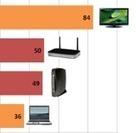
Your high-speed modem and router—those little blinking boxes that you use to stream video and get email—could be eating up as much energy as your TV, and twice as much as your laptop. What a waste.

Duane Tilden‘s insight:

How much energy does your cable modem consume?  Have you ever over-heated a router?

>At NRDC, we’ve worked with industry and government to help make home electronics more energy efficient, saving money for consumers and reducing carbon pollution from power plants. While we’ve made progress on cutting energy waste from televisions, computers, gaming systems and power supplies, until now, no one had looked at the energy use of devices like modems and routers.

It’s a good thing we did. There are 145 million of these small network devices in U.S. households. These seemingly insignificant little boxes are always on—and they consume more than $1 billion and 3 dirty coal power plants’ worth of electricity each year, according to a new analysis released by NRDC. […]<

See on theenergycollective.com

Innovations in waste water treatment processes to provide clean energy

See on Scoop.itGreen Energy Technologies & Development

The race is on to develop innovative, cost-effective ways to extract value from waste water instead of just dumping it, writes Sadhbh Walshe

Duane Tilden‘s insight:

>In a conventional treatment process, ammonia is converted back into nitrogen gas, a non-harmful gas which can be safely released into the atmosphere. The conversion process is expensive, however, and energy prohibitive.

What the Stanford team do, instead, is to use a less energy-intensive process to convert the ammonia into nitrous oxide (N2O), a powerful substance that is typically used to turbo-boost cars or fire rockets.

Normally, N2O is discouraged from forming because it is a harmful greenhouse gas, but when it is burned along with methane it becomes an energy source that can be used to power the treatment facility. According to Scherson, there is a double energy-saving benefit.

“Our process reduces energy input in nitrogen treatment and then the energy from nitrous oxide can potentially be used to power the plant making it energy neutral or even energy positive.”<

See on www.guardian.co.uk

China shortfall in processed Uranium puts pressure on Global Nuclear Fuel supplies

See on Scoop.itGreen & Sustainable News

BEIJING (Reuters) – The abrupt cancellation of a $6.5 billion uranium processing project in southern China has left Beijing with a headache as it tries to secure the fuel required to sustain an ambitious…

Duane Tilden‘s insight:

>China currently has 15 reactors with an aggregate installed capacity of 12.57 gigawatts (GW), but another 30 plants are under construction and due to go into operation between now and 2016, adding another 29 GW to the total.

Gaining more control over the global fuel supply chain is crucial to China’s plans to increase total nuclear capacity to 58 GW by 2020, and will require not only overseas acquisitions but also more enrichment capacity.

[…]

PROCESSING IMPORTS

While Beijing’s 2020 target for the amount of power to be generated from nuclear sources was scaled back after the Fukushima disaster in Japan, its 2030 target of around 200 GW remained intact. Analysts expect annual primary uranium demand to rise tenfold over the period to around 40,000 tonnes.

To meet that demand, CNNC and CGNPC have been exploring domestic uranium deposits, but a surge in imports is inevitable, and is expected to put pressure on global supplies.<

See on www.reuters.com

Congress and Light Bulb Regulation | The Energy Collective

See on Scoop.itGreen & Sustainable News

Light bulbs, as you may recall, have become a perennial excuse for certain federal legislators to whip up the conservative base, by railing again new federal energy efficiency standards.

Duane Tilden‘s insight:

Relamping projects have been an easy way to score energy efficiency gains in buildings since the 1990’s.  Inefficient incandescent light bulbs have given way to fluorescent tubes, compact fluorescent and now LED technology.

Within these stages of development each form of lighting have seen their own evolution.  The driving forces for these increases in lighting efficiency are economic starting back with the 1970’s energy crunch.

Taken from a blog on CFL development & history:

“In 1973-74 the oil crisis took place and lamp companies needed to reduce wattage in their linear (tube) lamps to compensate. Many people had four bulb fixtures and were removing two bulbs, to save energy, therefore dropping sales by half. This forced lamp companies to create energy efficient solution.

Ed worked on creating lamp with reduced wattage by adding krypton and a conductive tin coating inside. This helped lower the wattage from 40 to 35 watts but he wanted to get down to 30 watts. He continued to work and finally the wattage went from 35 to 34 and eventually 32 watts!”
http://bit.ly/149GANs

See on theenergycollective.com