Energy Storage Compared to Conventional Resources Using LCOE Analysis

In its first analysis of the levelized cost of storage, Lazard finds some promising economic trends.

Sourced through Scoop.it from: www.greentechmedia.com

“[…] “Although in its formative stages, the energy storage industry appears to be at an inflection point, much like that experienced by the renewable energy industry around the time we created the LCOE study eight years ago,” said George Bilicic, the head of Lazard’s energy and infrastructure group, in a release about the report.

Lazard modeled a bunch of different use cases for storage in front of the meter (replacing peaker plants, grid balancing, and equipment upgrade deferrals) and behind the meter (demand charge reduction, microgrid support, solar integration). It also modeled eight different technologies, ranging from compressed-air energy storage to lithium-ion batteries.

“As a first iteration, Lazard has captured the complexity of valuating storage costs pretty well. Unlike with solar or other generation technologies, storage cost analysis needs to account for not just different technologies, but also location and application, essentially creating a three-dimensional grid,” said Ravi Manghani, GTM Research’s senior storage analyst.

In select cases, assuming best-case capital costs and performance, a handful of storage technologies rival conventional alternatives on an unsubsidized basis in front of the meter. Using lithium-ion batteries for frequency regulation is one example. Deploying pumped hydro to integrate renewables into the transmission system is another.  […]

See on Scoop.itGreen Energy Technologies & Development

Alberta Energy Production And A Renewable Future

Author:  Duane M. Tilden, P.Eng  (January 14th, 2016)

Abstract:  Energy sources and pricing are hot topics world-wide with the Climate Change agenda leading the way.  Last year at the 2015 Paris Climate Conference long-term goal of emissions neutrality was established to be by as soon as 2050.  Alberta currently produces more atmospheric carbon emissions and other pollutants than any other Province in Canada, and in order to meet clean air objectives the energy sectors which consume & mine the natural resources of the Province will have to shift to non-polluting & renewable energy sources and be more efficient in energy utilization.  To achieve these goals new infrastructure will have to be built which will have the likely consequences of raising energy pricing as well as alter consumption rates and patterns.

Transportation

Transportation is a vital link in modern society, and often a personal vehicle is chosen as the main mode of mobility to work, leisure, & social purposes.  Cars and trucks also provide means of work and commerce & are essential to our way of life.  Most of these vehicles are fueled by gasoline, some by diesel, propane, and more recently the electric vehicle (EV) and hybrids.


GraphData Gas Price Comparison Canada

Graph #1:  Average Cost Comparison of Gasoline in Major Canadian Cities

In Alberta, using Calgary as a basis for comparison, it is apparent that pricing to consumers for gasoline is below nation-wide market averages when measured Province by Province, as demonstrated in Graph #1 (1). While if you live in Vancouver the cost is considerably higher, due to included carbon taxes and a transit levy among additional charges.  Additional means of moving growing populations efficiently have been seen by the development of LRT mass transit for the rapid movement of citizens to work, school, or social events.

Rapidly moving the large segments of the population in a cost effective manner is important to growth.  Buses are an important link in this mix as are cycling routes, green-ways and parks.  Changes in fuels for trucks, buses and trains by converting from diesel fuel to LNG will also provide for reductions in emissions while providing economic opportunity for utilization of the existing plentiful resource.  While EV’s show promise, the battery technologies for energy storage need further development.

Alberta Electricity Production

Alberta still relies on out-dated coal plants to generate electricity.  According to a CBC article coal provides power to 55% of homes in Alberta, and is the second largest contributor to emissions (2) and GHG’s to the Oil Sands projects.  However, it has been noted that the utility is reluctant to decommission recently constructed coal plants, until they have earned back (or are compensated for) their investment in capital costs.

local-input-wabamun-alberta-march-21-2014-a-giant-drag1

Photo #1:  Highvale coal mine to feed the nearby Sundance power plant (3)  

Photo credit:  John Lucas / Edmonton Journal

There are power purchase agreements in place, which may extend 50 to 60 years from the construction date of the plant (2).  It may be possible that the coal fired power plants could be converted to burn natural gas, which Alberta has in abundance, rather than be decommissioned.  However, this would still require the closure of the coal mines and mining operations currently supplying the existing power plants.  Also, combustion of natural gas will still release GHG’s into the atmosphere, while less than coal, they are not a total elimination of emissions.

Residential Energy Consumption

When comparing monthly residential electrical energy costs across Canada, using data obtained from a survey performed by Manitoba Hydro, we see that Edmonton and Calgary are in the lower middle range of pricing (4).  Variances in all regions will occur based on average home size, building codes and insulation requirements, heating system types and other factors.  Some homes may be heated with electric baseboard which will result in a higher electric bill while other homes may be heated using natural gas as a fuel.  Also household hot water generation can be by electric or gas-fired heater, so consumption of natural gas must be considered with electrical power usage to get a complete picture of energy consumption.

residential_1000kWhresidential_2000kWh

Charts #1 & 2:  Average Monthly Cost For Residential Electricity in Major Canadian Cities For Equivalent Usage in kWh (4)

Inspecting these charts it is proposed that a price increase of 10 to 20% to Alberta electrical energy consumers by a separate tax or fee to pay for a shift in technology would be reasonable when compared to other Canadian Cities.   Additional tariffs on natural gas consumption would also be recommended.  Such an increase would likely have a secondary benefit of creating an incentive for energy efficiency upgrades by home owners such as increased insulation, better windows and heating system upgrades. Such improvements would in turn lead to reduced demand at the source and thus to lower GHG & particulate emissions to the atmosphere.

Climate and the Proposed Energy Code

Energy consumption in populations is normalized in a number of ways, generally defined by habits and patterns.  We observe that in traffic as volumes increase early in the morning as commuters travel to work, and in the opposite direction as they head home in the evening.  Often people will attempt to “beat the traffic”.  This is an admirable goal in energy usage as well, for consumption of electricity will follow other such predictable patterns as people eat meals, shower, and perform other rituals that interface with electrical,  heating,  ventilating, elevators, water supply and disposal systems that form infrastructure and services provided by municipalities and utilities.

As these systems need to be energized and maintained, it is desirable to be able to predict and control the consumption and distribution of resources.  The greater of these is the electrical generation and distribution system.   Also, emerging technological advancements in energy efficiency such as CFL, LCD displays, computers, refrigeration, energy storage and more.  Advancements in co-generation, district energy systems, and other end use distribution of energy which provide economies of scale are also possible as strategies to obtain goals.Heating Degree Days - Lower Western Canada

Map #1:  Partial Map of Heating Degree Days for South-Western Canada (5)

Opportunities will exist for building mechanical system enhancements and upgrades as they may provide energy savings and cost reductions to users often calculated with a minimum nominal payback period of 5 to 7 years (and should be determined in every case).   The HDD map can provide a source of information which is used in energy models to determine predicted building energy costs when calculating payback periods to justify system upgrades or design decisions.  Obtaining and monitoring building energy consumption rates and year over year changes are important resources in determining where systems are running at below optimal rates and require replacement.

In new building construction the National Energy Code for Buildings 2011 (NECB) (6) has been adopted by Alberta (7) for all municipalities.  As there are higher HDD values attributed to Calgary and Edmonton as seen in the HDD Map of Western Canada, a requirement for stringent construction methods and materials to higher standards ensure new buildings meet carbon emissions reduction goals.

026

Photo #2:  Construction of Towers in Calgary with High Window to Wall Ratios 

Photo Credit: Duane Tilden P.Eng

Increased requirements in glass U-values and shading coefficients, maximum window to wall ratios (WWR) to reduce undesirable solar heat gain and heat losses, energy consumption and improve occupant comfort.  Buildings with excessive glazing are difficult to heat and cool, requiring sophisticated mechanical systems to offset poor performance by the building envelope.

Code mandated higher insulation values & better materials; moisture and heat control of the envelope through better design.  Higher efficiency requirements for mechanical systems; (fans & ducts, pumps & pipes, and wires & motors), lighting, controls, and other components of the building and it’s envelope.  Energy modeling should be performed of larger significant buildings to optimize operations in the design phase.  Commissioning of the building is integral to ensuring compliance throughout the project to it’s final phases at substantial completion and occupancy.

Renewable Energy

Renewable energy technologies including solar power and wind generation  have been gaining rapid adoption elsewhere in the world, while in Alberta (8) carbon based fuels currently provide over 80% of electrical power generation.   This has not been for a lack of wind and solar resources in Alberta but to be attributed to the large capital investments in fossil fuel resource extraction.  Other renewable technologies such as bio-mass, hydro, and geothermal may also be employed and should be investigated as alternatives to existing thermo-electric power plants.
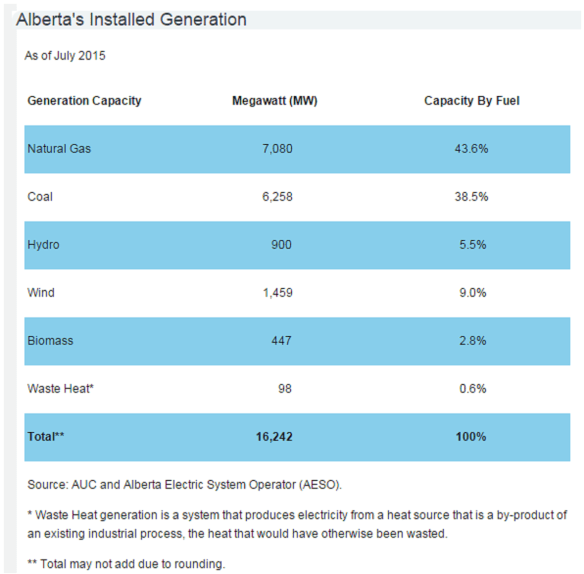
Alberta Energy Sources - 2015

Table #1:  Installed Electrical Generating Capacity by Fuel Source in Alberta (8)

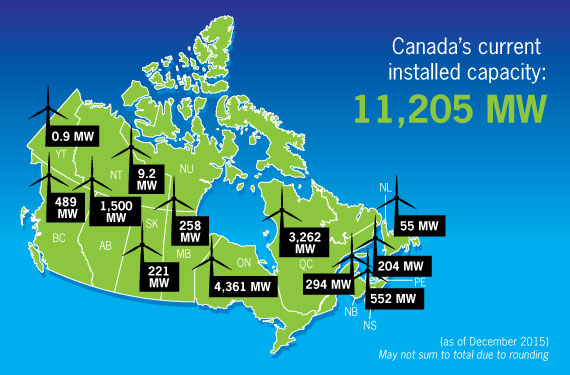
Currently, Alberta has the third highest installed wind power capacity in Canada behind Ontario and Quebec.  Wind energy not only represents a means to green the power production, it also will contribute jobs and income to the economy.  As one source of electricity and revenues is removed another source will fill the void.
installed_capacity_e-4

Map #2:  Installed Wind Power Capacity by Province in Canada (9)

While significant inroads have been made in Alberta for wind power which is already established as a major power source for the future, there is unrealized potential for the installation of solar power production.  It has been noted that a photo-voltaic installation in Calgary is 52% more efficient than one installed in Berlin, Germany.  Meanwhile, Germany has 18,000 times more solar power generation capacity than installed in Alberta (10).

alberta-germanytiltweb

Map #4:  Solar Resource Comparison for Alberta & Germany (10)

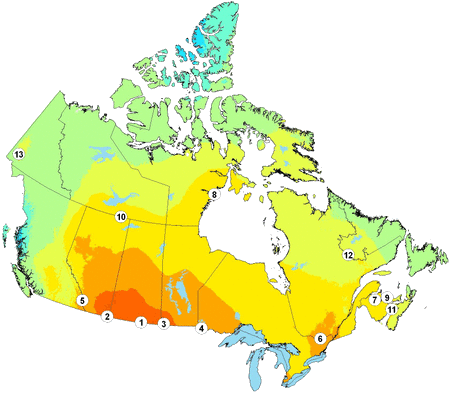
Alberta has significant solar resources, even during the winter when daylight hours are shorter. Lower temperatures improve PV efficiency, and properly tilted south facing panels optimize light capture, while the flat terrain of the prairies provide unobstructed maximum daylight.  Light reflection by snow on the ground would further enhance light intensity during the colder months.  Thus solar represents a relatively untapped potential source of significant electrical power for Alberta and an unrealized economic opportunity for consumers and industry.
hotspots_13

hotspots_leg

Map #5:  Solar Resource Map for Canada With Hotspots (11)

Energy Efficiency, Smart Grid & Technological Advancements

Renewable energy produces electricity from natural resources without generating carbon and particulate emissions.  Another method of controlling emissions is to reduce the amount of energy consumed by being more efficient with the energy we already produce.   We can achieve this by using higher efficiency equipment, changing consumer patterns of use to non-peak periods, use of Smart Meter’s to monitor consumer usage and to alert homeowners when there is a problem with high consumption which could result in higher bills than normal if the problem remained unreported.

There are other advancements in the electrical grid system which are on the horizon which will enable a utility maximize resources by such means as energy storage, micro-grids, demand response to name a few.  Also, property owners and businesses could be able to grid-tie private solar panel (PV) and storage systems to supplement the utilities electrical system with additional power during the day.

Summary

In order to meet the goal of atmospheric emissions neutrality as agreed to at the 2015 Paris Climate Conference Alberta is posed with making decisions on how electricity is to be produced in the future.  Eliminating coal power plants and replacing them with Renewable Energy power sources such as solar and wind power are proven methods to reducing GHG and particulate emissions as these power sources do not involve combustion and discharge of waste gases formed during the combustion process.  Coal combustion is well documented as a major contributor of GHG’s to the atmosphere.

To make the transition will require capital for financing to build new infrastructure.  Funding of these projects should be raised proportionally charged to users with increased rates.  These rate increases will provide further incentives to reducing energy consumption and thus air emissions.  Jobs will shift and employment will be created in new forms as the old is phased out and replaced with new technology.  These new systems will have to be designed, built and maintained while the workforce will require training in new methods.  There will be many new opportunities for growth and advancement resulting from the implementation of these changes to meet Canada’s International commitments.

References:

  1. http://www.nrcan.gc.ca/energy/fuel-prices/4593
  2. http://www.cbc.ca/news/business/coal-compensation-power-alberta-1.3321467
  3. http://edmontonjournal.com/business/local-business/albertas-commitment-to-phase-out-coal-fired-power-sparks-fears-of-job-losses
  4. https://www.hydro.mb.ca/regulatory_affairs/energy_rates/electricity/utility_rate_comp.shtml
  5. http://ftp2.cits.rncan.gc.ca/pub/geott/atlas/archives/english/5thedition/environment/climate/mcr4033.jpg
  6. http://www.nrc-cnrc.gc.ca/eng/publications/codes_centre/necb_2011_adaptation_guidelines.html
  7. http://www.municipalaffairs.alberta.ca/CP_Energy_Codes_Information
  8. http://www.energy.alberta.ca/electricity/682.asp
  9. http://canwea.ca/wind-energy/installed-capacity/
  10. http://www.greenenergyfutures.ca/blog/sunny-days-ahead-solar-alberta
  11. http://pv.nrcan.gc.ca/index.php?lang=e&m=r


Solar Array Added to Power Agricultural District’s Irrigation Systems

Tranquillity Irrigation District, which serves the water needs of the 10,750-acre agricultural community of Tranquillity in Fresno County, today announces plans to build a 1.8 megawatt ground-mounted solar tracker system that will provide enough electricity to meet 50 percent of the agency’s energy demand. Borrego Solar Systems Inc., a leading designer, developer, installer and O&M …

Sourced through Scoop.it from: www.borregosolar.com

“[…] Tranquillity will save a net $10 million over the 25-year term of its power purchase agreement (PPA)—a financing mechanism that enables customers to invest in solar without any upfront costs. The District will buy the energy produced from the system owner at a set price over the PPA agreement term.

“Solar was clearly the best use for our site, especially considering the savings we’ll realize for our residents through the PPA – it’s truly a win-win,” said Danny Wade, general manager of Tranquillity Irrigation District. “The reality is that we will continue to be plagued with limited water resources for the foreseeable future, and solar is a sustainable solution to help us deal with the resulting energy demand and cost increase due to the drought. Any water district in the state should be investigating whether solar works for them.”

Given the ongoing drought in California, the District has needed to use its wells more than it had pre-drought. As a result, more electricity is needed to power the pumps bringing water toward the surface. The District is trying to provide water to its landowners and the community of Tranquillity as efficiently and economically as it can. For example, the District recently received a $5 million grant from the California State Department of Health to build a necessary water treatment facility. The solar tracker system will be placed adjacent to the treatment facility on land already owned by the District. […]

In its first year of operation, the array will generate an estimated 3.3 million kilowatt-hours of electricity— enough to power approximately 450 homes. The installation will offset more than 760 metric tons of CO2 equivalents annually, which is the equivalent of taking 162 cars off the road for a year or the amount of carbon sequestered by 630 acres of mature U.S. forests each year.

ABOUT TRANQUILLITY IRRIGATION DISTRICT

Tranquillity Irrigation District was formed January 22, 1918, as a public agency designed to serve the local community with water supplies. It is the second oldest such agency in Fresno County. A Board of Directors elected from the community at-large governs the District. The District is approximately 10,750 acres in size and is located in the west central portion of Fresno County in the Great Central Valley of California. The District farmland produces a variety of commodities including: cotton (pima and acala), canning tomatoes, alfalfa for seed, sugar beets and almonds. Its principal community is the unincorporated town of Tranquillity.  […]”

See on Scoop.itGreen Energy Technologies & Development

Electric Vehicles Future Threatens OPEC

The oil cartel is living in a time-warp, seemingly unaware that global energy politics have changed forever

Sourced through Scoop.it from: www.telegraph.co.uk

“…OPEC says battery costs may fall by 30-50pc over the next quarter century but doubts that this will be enough to make much difference, due to “consumer resistance”.

This is a brave call given that Apple and Google have thrown their vast resources into the race for plug-in vehicles, and Tesla’s Model 3s will be on the market by 2017 for around $35,000.

Ford has just announced that it will invest $4.5bn in electric and hybrid cars, with 13 models for sale by 2020. Volkswagen is to unveil its “completely new concept car” next month, promising a new era of “affordable long-distance electromobility.”

The OPEC report is equally dismissive of Toyota’s decision to bet its future on hydrogen fuel cars, starting with the Mirai as a loss-leader. One should have thought that a decision by the world’s biggest car company to end all production of petrol and diesel cars by 2050 might be a wake-up call.

Goldman Sachs expects ‘grid-connected vehicles’ to capture 22pc of the global market within a decade, with sales of 25m a year, and by then – it says – the auto giants will think twice before investing any more money in the internal combustion engine. Once critical mass is reached, it is not hard to imagine a wholesale shift to electrification in the 2030s.  […]

A team of Cambridge chemists says it has cracked the technology of a lithium-air battery with 90pc efficiency, able to power a car from London to Edinburgh on a single charge. It promises to cut costs by four-fifths, and could be on the road within a decade.

There is now a global race to win the battery prize. The US Department of Energy is funding a project by the universities of Michigan, Stanford, and Chicago, in concert with the Argonne and Lawrence Berkeley national laboratories. The Japan Science and Technology Agency has its own project in Osaka. South Korea and China are mobilising their research centres.

A regulatory squeeze is quickly changing the rules of global energy.The Grantham Institute at the London School of Economics counts 800 policies and laws aimed at curbing emissions worldwide.

Goldman Sachs says the model to watch is Norway, where electric vehicles already command 16.3pc of the market. The switch has been driven by tax exemptions, priority use of traffic lanes, and a forest of charging stations.

California is following suit. It has a mandatory 22pc target for ‘grid-connected’ vehicles within ten years. New cars in China will have to meet emission standards of 5 litres per 100km by 2020, even stricter than in Europe. […]

In the meantime, OPEC revenues have crashed from $1.2 trillion in 2012 to nearer $400bn at today’s Brent price of $36.75, with fiscal and regime pain to match.

This policy has eroded global spare capacity to a wafer-thin 1.5m b/d, leaving the world vulnerable to a future shock. It implies a far more volatile market in which prices gyrate wildly, eroding confidence in oil as a reliable source of energy.

The more that this Saudi policy succeeds, the quicker the world will adopt policies to break reliance on its only product. As internal critics in Riyadh keep grumbling, the strategy is suicide.

Saudi Arabia and the Gulf states are lucky. They have been warned in advance that OPEC faces slow-run off. The cartel has 25 years to prepare for a new order that will require far less oil.

If they have any planning sense, they will manage the market to ensure crude prices of $70 to $80. They will eke out their revenues long enough to control spending and train their people for a post-petrol economy, rather than clinging to 20th Century illusions.

Sheikh Ahmed Zaki Yamani, the former Saudi oil minister, warned in aninterview with the Telegraph fifteen years ago that this moment of reckoning was coming and he specifically cited fuel-cell technologies.

“Thirty years from now there will be a huge amount of oil – and no buyers. Oil will be left in the ground. The Stone Age came to an end, not because we had a lack of stones.”

They did not listen to him then, and they are not listening now.”

See on Scoop.itGreen Energy Technologies & Development

Solar Energy and Battery Storage Coupled Provide Demand Response & Utility Peak Shaving

Borrego Solar, a developer, and Stem, an energy storage firm, discuss when PV, storage or both will benefit commercial customers the most.

Sourced through Scoop.it from: www.greentechmedia.com

>” […] Thanks to advancements in technology, there are more energy solutions available to consumers. As a result, the confusion about which option to choose — solar, storage or solar-plus-storage — is growing.

Utility energy costs

To understand the benefits of energy storage and solar at a customer facility, it’s essential to first understand the elements of most organizations’ utility energy costs: energy charges and demand charges. This is the bread and butter for energy managers, but many leaders in finance and/or operations aren’t as aware of the energy cost mix — despite it being one of their largest budgetary line items. It should be noted that this billing structure isn’t in place in every market.

Energy charges, the price paid for the amount of energy used over the course of the billing cycle, are how most people think of paying for electricity. A price is paid for every kilowatt-hour used. Demand charges are additional charges incurred by most commercial customers and are determined by the highest amount of energy, in kilowatts, used at any instant or over some designated timeframe — typically a 15-minute interval — in that billing cycle.

Demand charges are a bit more complex. They come from a need for the grid infrastructure to be large enough to accommodate the highest amount of energy, or demand, needed at any moment in order to avoid a blackout. Every region is different, but demand charges typically make up somewhere between 20 percent and 40 percent of an electricity bill for commercial customers.

Why storage?

Intelligent storage can help organizations specifically tackle their demand charges. By combining predictive software and battery-based storage, these systems know when to deploy energy during usage peaks and offset those costly demand charges. Most storage systems run completely independently from solar, so they can be added to a building whether or not solar is present.

Storage can reduce demand charges by dispensing power during brief periods of high demand, which in essence shaves down the peaks, or spikes, in energy usage. Deploying storage is economical under current market conditions for load profiles that have brief spikes in demand, because a relatively small battery can eliminate the short-lived peaks.

For peak demand periods of longer duration, a larger, and considerably more expensive, battery would be needed, and with the higher material costs, the economics may not be cost-effective. As system costs continue to decline, however, a broader range of load profiles will be able to save with energy storage.

Why solar?

For the commercial, industrial or institutional energy user, solar’s value proposition is pretty simple. For most facilities in states with high energy costs and a net metering regime in place, onsite solar can reduce energy charges and provide a hedge against rising electricity costs. The savings come primarily from producing/buying energy from the solar system, which reduces the amount of energy purchased from the utility, and — when the installation produces more than is used — the credit from selling the excess energy to the grid at retail rates.

The demand savings are a relatively small part of the benefit of solar because the timing of solar production and peak demand need to line up in order to cut down demand charges. Solar production is greatest from 9 a.m. to 3 p.m., but the peak period (when demand for energy across the grid is highest) is typically from 12 p.m. to 6 p.m. If demand-charge rates are determined by the highest peak incurred, customers with solar will still fall into higher demand classes from their energy usage later in the day, when solar has less of an impact.

That being said, solar can reduce a significant portion of demand charges if the customer is located within a utility area where solar grants access to new, solar-friendly rate schedules. These rate schedules typically reduce demand charges and increase energy charges, so the portion of the utility bill that solar can impact is larger.  […]”<

See on Scoop.itGreen Energy Technologies & Development

Japan Installs World’s Largest Offshore Wind Turbine at Fukushima

offshore wind turbine was anchored by the Fukushima Offshore Wind Consortium and is located approximately 12 miles off the cost of Fukushima, a region of Ja

Sourced through Scoop.it from: www.hydrogenfuelnews.com

>” The turbine has been built to withstand 65-foot waves.

The 344-foot 7 MW (megawatt) Offshore Hydraulic Drive Turbine features a rotor diameter of 538 feet and three giant blades, each stretching 262 feet in length. The structure is fastened to the seabed by four 20-ton anchors, and loose chains connect the turbine to the seabed, fortifying it against large waves.

One of the chief engineers of the turbine, Katsunobu Shimizu, told NBC News that “These turbines and anchors are designed to withstand 65-foot waves.” He also explained that “here we can get 32-foot-tall tsunamis. That’s why the chains are deliberately slackened.”

The consortium purposely designed the structures to be able to withstand the fierce and unforgiving weather native to Japan’s waters. In fact, this problematic weather even caused issues during the construction of the turbine. Installations had to be reportedly put on hold on four separate occasions because of typhoons.

The offshore wind turbine is one of three planed for the area.

The Fukushima Offshore Wind Consortium is led by Marubeni Corporation and also involves nine other firms, such as Mitsubishi Heavy Industries, which was the company that supplied the turbine. The $401 million project is funded by Japan’s Ministry of Economy, and was created for the purpose of developing and testing the wind technology for additional commercialization, and to bring new industry to the Fukushima region of Japan that was devastated by the earthquake in 2011.

The 7 MW offshore wind turbine is one of three turbines planned for the facility. When the final turbine is installed later this year, the three turbines are expected to generate a combined total of 14 MW. […]”<

See on Scoop.itGreen Energy Technologies & Development

Transparent Solar Cells Could Turn Office Tower Windows and Mobile Devices Into Power Sources

“It’s a whole new way of thinking about solar energy,” says startup CEO about using transparent solar cells on buildings and electronics.

Sourced through Scoop.it from: news.nationalgeographic.com

>” […] With the help of organic chemistry, transparent solar pioneers have set out to tackle one of solar energy’s greatest frustrations. Although the sun has by far the largest potential of any energy resource available to civilization, our ability to harness that power is limited. Photovoltaic panels mounted on rooftops are at best 20 percent efficient at turning sunlight to electricity.

Research has boosted solar panel efficiency over time. But some scientists argue that to truly take advantage of the sun’s power, we also need to expand the amount of real estate that can be outfitted with solar, by making cells that are nearly or entirely see-through.

“It’s a whole new way of thinking about solar energy, because now you have a lot of potential surface area,” says Miles Barr, chief executive and co-founder of Silicon Valley startup Ubiquitous Energy, a company spun off by researchers at Massachusetts Institute of Technology and  Michigan State University. “You can let your imagination run wild. We see this eventually going virtually everywhere.”

Invisible Spectrum Power

Transparent solar is based on a fact about light that is taught in elementary school: The sun transmits energy in the form of invisible ultraviolet and infrared light, as well as visible light. A solar cell that is engineered only to capture light from the invisible ends of the spectrum will allow all other light to pass through; in other words, it will appear transparent.

Organic chemistry is the secret to creating such material. Using just the simple building blocks of carbon, hydrogen, oxygen, and a few other elements found in all life on Earth, scientists since at least the early 1990s have been working on designing arrays of molecules that are able to transport electrons—in other words, to transmit electric current.  […]

Harvesting only the sun’s invisible rays, however, means sacrificing efficiency. That’s why Kopidakis says his team mainly focuses on creating opaque organic solar cells that also capture visible light, though they have worked on transparent solar with a small private company in Maryland called Solar Window Technologies that hopes to market the idea for buildings.

Ubiquitous Energy’s team believes it has hit on an optimal formulation that builds on U.S. government-supported research published by the MIT scientists in 2011.

“There is generally a direct tradeoff  between transparency and efficiency levels,” says Barr. “With the approach we’re taking, you can still get a significant amount of energy at high transparency levels.”

Barr says that Ubiquitous is on track to achieve efficiency of more than 10 percent—less than silicon, but able to be installed more widely. “There are millions and millions of square meters of glass surfaces around us,” says Barr. […]”<

See on Scoop.itGreen Building Design – Architecture & Engineering

Japan is building huge solar power plants that float on water

Arduino based solar power controller to take home appliances off grid

Where’s the middle ground between having a small solar charger for your gadgets, and having a rooftop solar array capable of powering your entire house? The UNplug might know.

Source: www.treehugger.com

>” […] The UNplug solar controller was invented by Markus Löffler in response to his own power blackout experience, where several days without electricity meant a lot of spoiled food. Löffler, an entrepreneur and software engineer living in Altadena, California, developed the UNplug device to serve as a simple and inexpensive way to begin going solar, because it serves as the brain of a micro-solar system, starting as small as a single solar panel and a small battery bank. […]

During the day, UNplug feeds electricity from the solar panel into the appliances connected to it, and charges the battery bank, and then when the sun goes down, it seamlessly switches over those devices to using grid power. In the event of a blackout, UNplug then powers those same appliances from the battery bank, allowing certain crucial electricity needs to continue to be met during an outage.

The UNplug could allow homes to take at least some of their daily electrical loads off the grid, such as the fridge or other household devices, while also serving as an uninterruptible power supply (UPS) in the event of a power outage. The device doesn’t function all by itself, of course, and requires solar panels, batteries, an inverter, and other accessories, but according to Löffler’s campaign page, a small system could be set up for an additional $570 or so, on top of the cost of the UNplug, so the entire investment could be under $1000. (His shopping list is here.) […]”<

See on Scoop.itGreen Energy Technologies & Development

Facts About Solar Powered LED Lights

Clearworld Solutions's avatarClearworld Solutions

led street lamps

In spite of all the hype about combating global warming and switching to environmentally friendly sources, little attention has been given to the streetlights. Whilst they are crucial to the public, they are very energy consuming, and their servicing is costly. Thus, it is worthy of note when a big city like Los Angeles reports that it will replace 140,000 streetlights with LEDs.

LEDs are attaining traction as a great alternative to conventional lighting because they are relatively environmentally friendly, don’t consume much power and have long life spans. They survive so long, 14 years or more in some instances, that they can be regarded as “semi-permanent”.

Several of the most significant electronic firms see LEDs as the destiny of lighting. The LED market of seasonal lights, lights on the Empire State Building, and so on, is estimated to have a worth of $1 billion by 2013.

In earlier times…

View original post 341 more words