University to Install Combined Heat and Power Plant for Energy Savings and Climate Goals

“Construction is will soon begin on a $96 million combined heat and power (CHP) plant in another aging facility near the river’s edge that will dramatically cut the campus’ carbon footprint while driving down the cost of energy”

Source: www.midwestenergynews.com

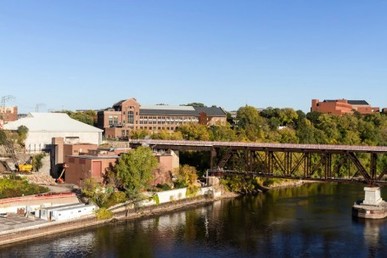
>” […] The project, in the 1912-vintage Old Main Utility Building, will produce enough steam to heat the entire campus and meet about half of its electricity demand.

CHP and carbon reductions

CHP will be a major tactic in the goal of reducing the University’s carbon emissions by 50 percent by 2020, said Shane Stennes, who serves as the University Services’ sustainability coordinator. The Southeast Steam Plant, itself a CHP facility, mainly used natural gas but still had a small measure of coal in its fuel mix, along with oat hulls.

“The carbon reduction is partly due to a change in fuel but mostly a result of increased efficiency,” Stennes said. The ability to use the waste heat from the electricity generation process is the real reason the University will see carbon emissions plummet, he added.

“From the sustainability point of view this plant is the right thing to do,” he said, noting that in 2008 the University’s campus system agreed to a net zero scenario in the American College and University Presidents’ Climate Commitment.

CHP is on a bit of a roll. President Barack Obama signed an executive order in 2012 promoting wider adoption of CHP and the state Department of Commerce recently held stakeholders’ meetings on the issue to determine how the state might help in moving forward projects.

The potential was described in a Commerce policy brief associated with the stakeholder meetings: “Power generation waste heat in Minnesota is nearly equal to the total requirement for heat energy in buildings and industry.” […]

Minnesota has at latest count 55 CHP systems in the state, according to the ICF International.

Reasons for CHP at the U

A campus CHP comes with another advantage by creating an “island” of energy independence should a regional blackout hit. Many major Midwest and coastal universities have CHP in part to rely less on power grids that are vulnerable to major storms or other weather maladies, he said.

“We see CHP as a way to be competitive with other schools and to protect research if we had a catastrophe,” he said.

The need for more boilers, said Malmquist, stems from growing demand for power. Although the nearly dozen new buildings constructed in the last few years meet rigorous energy efficiency standards they tend to demand more power due to their function as research centers.

The Biomedical Discovery District, a new physics laboratory, technology classroom and other science-related buildings, as well as a new residence hall, have added square footage for steam and electricity, he said.

“The buildings we’re putting up today are more energy intensive than the ones we’ve been taking down,” said Malmquist. […]”<

See on Scoop.itGreen Building Operations – Systems & Controls, Maintenance & Commissioning
Embodied Energy – A Measure of Sustainability in Buildings & Construction

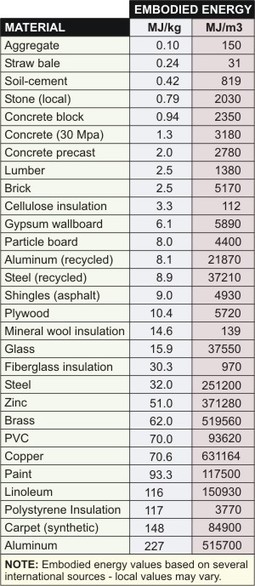
Embodied energy in building materials has been studied for the past several decades by researchers interested in the relationship between building materials, construction processes, and their environmental impacts.

Source: www.canadianarchitect.com

>” […]

What is embodied energy?
There are two forms of embodied energy in buildings:

· Initial embodied energy; and
· Recurring embodied energy

1.  The initial embodied energy in buildings represents the non-renewable energy consumed in the acquisition of raw materials, their processing, manufacturing, transportation to site, and construction. This initial embodied energy has two components:

  • Direct energy the energy used to transport building products to the site, and then to construct the building; and
  • Indirect energy the energy used to acquire, process, and manufacture the building materials, including any transportation related to these activities.

2.  The recurring embodied energy in buildings represents the non-renewable energy consumed to maintain, repair, restore, refurbish or replace materials, components or systems during the life of the building.

As buildings become more energy-efficient, the ratio of embodied energy to lifetime consumption increases. Clearly, for buildings claiming to be “zero-energy” or “autonomous”, the energy used in construction and final disposal takes on a new significance. […]”<

See on Scoop.itGreen & Sustainable News

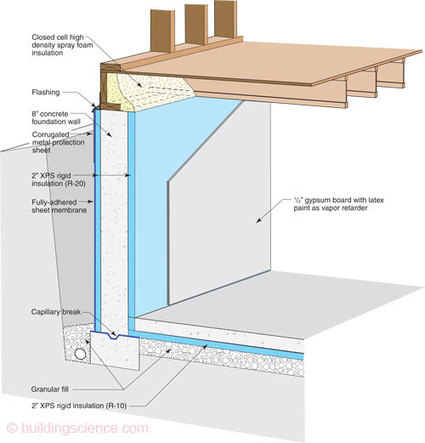
High-R20 Concrete Foundation Construction Diagram – Building Science

This construction strategy has an installed insulation R-value of R-20.

Source: www.buildingscience.com        >” […]


  • Dampproofing
  • 2″ XPS rigid insulation
  • Concrete foundation wall
  • 2″ XPS rigid insulation
  • 2″ XPS rigid sub-slab insulation
  • Gypsum board with vapor retarder paint
  • 2″ XPS rigid insulation under slab

Thermal Control:  This construction strategy has an installed insulation R-value of R-20 and has a predicted annual heating energy loss of 16.7 MBtus.

Moisture Control:  Two inches of XPS on the interior, connected to the thermal break at the slab edge, controls the interior vapor drive and capillary wicking to the interior so there are no moisture related issues from inward vapor diffusion or capillary wicking.

Constructability and Cost:  The interior of the insulated concrete form will require drywall or other thermal barrier to achieve the fire rating required by code. The gypsum board is very easy to attach to the plastic clips designed into the ICF. The drywall should not be painted, if it is not necessary, to allow maximum drying of the concrete. It may be easier and more practical to install a thin framed wall (e.g. 2×3 wood or steel framing) on the interior of the ICF to allow any necessary services to be run in the wall, and potentially more insulation.

Other Considerations:  Because the concrete is installed between two vapor retarding layers, it will take several years for the concrete to dry to equilibrium. Since additional interior vapor control should be avoided, no more than latex paint should be used on the interior surface of the drywall. […]”<


See on Scoop.itGreen Building Design – Architecture & Engineering

Retro-fit NYC Office Building Achieve’s LEED-EB Gold Rating

A $9 million retrofit that included $1.5 million in improvements that can be directly or indirectly linked to energy and water savings has elevated the building to a select group that includes 1440 Broadway, 498 Seventh Avenue and 345 Hudson Street.

Source: www.rew-online.com

>” […] Built in 1919, the 22-story tower with a block-through arcade of service shops for tenants, has undergone a plethora of changes to improve sustainability to achieve Gold Certification that include reducing water use by over 25 percent annually, saving over 536,800 gallons a year; recycling over 79 percent of ongoing consumable waste; recycling 100 percent of electronics waste; achieving Energy Star Label and Energy Star Scores of 86 and 83 in 2013 and 2014, respectively; and purchasing green power and carbon offsets from US-generated wind energy and landfill gas capture projects representing over 50% of the property’s two-year energy use

“The LEED-EB Gold Certification at 28 West 44th Street demonstrates APF Properties’ ongoing commitment to providing its tenants with a sustainable, modern and healthy environment in which to work,” said John Fitzsimmons, vice president/director of Real Estate Operations at APF Properties.

“Our overall goal is to achieve Energy Star and LEED Certification throughout our commercial office building portfolio in New York, Philadelphia and Houston.

[…]

LEED was developed to define and clarify the term “green building” by establishing a common standard of measurement — a benchmark for the design, construction, and operation of high-performance buildings.

To earn LEED certification, a building must meet certain prerequisites and performance criteria within five key areas of environmental health: 1) sustainable site development, 2) water savings, 3) energy efficiency, 4) materials selection, and 5) indoor environmental quality. Projects are awarded Certified, Silver, Gold, or Platinum certification, depending on the number of credits achieved.”<

See on Scoop.itGreen & Sustainable News

Energy Efficiency, Smart Buildings & Wireless Control Systems

Energy efficient technology and services for the building sector will double by 2022, according to a new report …

Source: www.climatecontrolnews.com.au

>”[…] Since buildings account for a large portion of national energy consumption, most of the governments in the Asia Pacific region have taken steps to promote energy management and energy efficiency in both new construction and existing buildings. […]

“With about 40 per cent of the world’s building stock, Asia Pacific represents a major portion of global real estate,” he said.

“Growing concerns about air pollution in Chinese cities, in particular, is expected to further drive investment in energy efficiency technologies to reduce China’s demand for coal-based electricity.

“The market for energy efficient buildings is expected to double in the next eight years, reaching nearly $92 billion in annual revenue by 2022.”

The largest segment of the energy efficient buildings market in Asia Pacific today is advanced lighting […]

“The commercial buildings sector in the region will experience a significant increase in the adoption of these products in the coming years,” Bloom said. Entitled“Energy Efficient Buildings: Asia Pacific”, the report examines the trends for energy efficient building technology and services in the Asia Pacific region.

It covers three main areas of technology – HVAC, energy efficient lighting, and commercial building automation – as well as the energy service company (ESCO) sector.

The convergence of building automation, information technology, and wireless communications is another area of growth identified by Navigant Research.

A separate report examines the state of the global wireless building controls industry, including global market forecasts for wireless node unit shipments and revenue through 2023.

Wireless controls can be used to link devices found in a variety of building systems, including heating, ventilating, and air conditioning (HVAC), lighting, fire and life safety, and security and access.

In addition, they often provide networked control in buildings or areas where wired controls are simply too challenging or expensive to install.

Worldwide revenue from wireless control systems for smart buildings is expected to grow from $97 million annually in 2014 to $434 million in 2023.  […]

While the adoption and deployment of wireless systems based on standard technologies and protocols, such as Wi-Fi, Zigbee, and EnOcean, are increasing, most wireless devices and control networks used today utilize proprietary, vendor-specific wireless communications technology.

That is likely to change as the demand for interoperability grows, according to the “Wireless Control Systems for Smart Buildings” report. “<

See on Scoop.itGreen Building Operations – Systems & Controls, Maintenance & Commissioning
Built in 1928 Chicago Apartment Building Energy Retrofit Achieves EPA Energy Star Certification

To say the 55-unit building in Chicago’s South Shore neighborhood was in disarray when it was changing hands in 2009 would be an understatement.

Source: www.chicagotribune.com

>” […] the building is among the first in the Midwest — and only three in Chicago — to achieve the Environmental Protection Agency’s new Energy Star certification for multifamily buildings. Also receiving the designation were two condominium buildings in Chicago, 680 N. Lake Shore Drive and River City, at 800 S. Wells.

[…] Jeffery Parkway also stands as an example of how an older, smaller, affordable apartment building can be made more comfortable for its tenants while saving its owner cash in the long run.

Seeking a neutral third party to help them figure out the entire scope of a rehab project, the Soods obtained a free energy audit of the building and its systems from Elevate Energy, a Chicago-based nonprofit that works with consumers and businesses to improve energy efficiency.

Elevate looks at historical analyses of a building’s energy use and compares it with similar buildings in terms of age and size. Then it performs an on-site performance assessment of the existing heating, cooling and lighting systems and makes recommendations for potential improvements. […]

“The average cost of a retrofit is about $2,500 to $3,000 a unit,” Ludwig said. “We’re not talking about huge-ticket items. A lot of times we are trying to identify the most cost-effective retrofit measures, how can we tighten the building envelope. It doesn’t have to mean a new boiler is going in the basement.”

However, in the case of Jeffery Parkway, it did mean a new steam boiler and new water heaters, among other upgrades.

The project was financially feasible because of a loan from nonprofit Community Investment Corp.’s Energy Savers loan program, which offers a seven-year loan with a 3 percent fixed interest rate for qualified upgrades made to buildings in the seven-county Chicago area and Rockford. […]

“We will cover any of the recommendations that show up in the energy assessment, and we’ll also do other energy-related improvements,” said Jim Wheaton, manager of the Energy Savers program. “This is not a program designed for the North Lake Shore Drive high-rise. It’s designed for buildings affordable for working folks.”

Multifamily buildings receive an Energy Star score of 1 to 100, and those that score above 75 can apply for the certification. Nautilus’ building received a score of 99.

“The savings are tremendous,” Sandeep Sood said. “We were facing, just on the gas bill, a $60,000 bill a year. As of last year, our bill was $18,000. It was an unbelievable savings.” […]”<

See on Scoop.itGreen Building Operations – Systems & Controls, Maintenance & Commissioning

Lightweight ‘solar cloth’ photovoltaics for Integration with Building Structures

A Cambridge start-up believes its flexible solar panelling solution could fundamentally change the landscape of solar installation in the commercial sector.

The Solar Cloth Company’s award winning flexible thin film photovoltaics (FTFP) are a few micrometres thick and can be integrated into flexible and lightweight tensile structures called building integrated photovoltaics (BIPV). In doing so, they provide an alternative to traditional photovoltaic panels that are heavy and cumbersome.

Source: www.theengineer.co.uk

See on Scoop.itGreen Building Design – Architecture & Engineering

Ice Energy Storage Solution Awarded 16 Contracts by SCE

Santa Barbara – Ice Energy today (Nov 5, 2014) announced it has been awarded sixteen contracts from Southern California Edison (SCE) to provide 25.6 megawatts of behind-the-meter thermal energy storage using Ice Energy’s proprietary Ice Bear system.

Source: www.ice-energy.com

>” […] Ice Energy was one of 3 providers selected in the behind-the-meter energy storage category, which was part of an energy storage procurement by SCE that was significantly larger than the minimum mandated by the California Public Utility Commission (CPUC). SCE is one of the nation’s leaders in renewable energy and the primary electricity supply company for much of Southern California.

The contract resulted from an open and competitive process under SCE’s Local Capacity Requirements (LCR) RFO. The goals of the LCR RFO and California’s Storage Act Mandates are to optimize grid reliability, support renewables integration to meet the 2020 portfolio standards, and support the goal of reducing greenhouse gas emissions to 20% of 1990 levels by 2050.

“SCE’s focus on renewable energy is critical to helping meet California’s long-term goals, and Ice Energy is proud to be part of the solution with these contracts,” said Mike Hopkins, CEO of Ice Energy, the leading provider of distributed thermal energy storage technology. “Using ice for energy storage is not new, we’ve just made it distributed, efficient, and cost-effective. The direct-expansion AC technology is robust and proven, which is important because SCE and other utilities require zero risk for their customers.”

In 2013, 22 percent of the power SCE delivered came from renewable sources, compared to 15 percent for other power companies in the state. The utility is on track to meet the state’s goal of 33 percent, and procuring energy storage helps them meet those targets while maintaining a robust and reliable grid.

Ice Energy’s product, the Ice Bear, attaches to one or more standard 5-20 ton commercial AC units. The Ice Bear freezes ice at night when demand for power is low, capacity is abundant and increasingly sourced from renewables such as wind power. Then during the day, stored ice is used to provide cooling, instead of the power-intensive AC compressor. Ice Bears are deployed in smart-grid enabled, megawatt-scale fleets, and each Ice Bear can reduce harmful CO2 emissions by up to 10 tons per year. Installation is as quick as deploying a standard AC system.

“Ice Bears add peak capacity to the grid, reduce and often eliminate the need for feeder and other distribution system upgrades, improve grid reliability and reduce electricity costs,” Hopkins said. “What’s special about our patented design and engineering is the efficiency and cost. It’s energy storage at the lowest cost possible with extraordinary reliability.”

See on Scoop.itGreen Energy Technologies & Development

Thermal Energy Storage uses Ice for Cooling of Buildings – Smart Grid Technologies

Ice Energy’s proven Ice Bear system is the most cost effective and reliable distributed energy storage solution for the grid. The Ice Bear delivers up to six hours of clean, firm, non-fatiguing stored energy daily and is fully dispatchable by the utility. Ice Bear projects are job engines, creating long-term green jobs in the hosting communities.

Source: www.ice-energy.com

>” […] The Ice Bear system is an intelligent distributed energy storage solution that works in conjunction with commercial direct-expansion (DX) air-conditioning systems, specifically the refrigerant-based, 4-20 ton package rooftop systems common to most small to mid-sized commercial buildings.

The system stores energy at night, when electricity generation is cleaner, more efficient and less expensive, and delivers that energy during the peak of the day to provide cooling to the building.

Daytime energy demand from air conditioning – typically 40-50% of a building’s electricity use during peak daytime hours – can be reduced significantly by the Ice Bear. Each Ice Bear delivers an average reduction of 12 kilowatts of source equivalent peak demand for a minimum of 6 hours daily, shifting 72 kilowatt-hours of on-peak energy to off-peak hours. In addition, the Ice Bear can be configured to provide utilities with demand response on other nearby electrical loads – effectively doubling or even tripling the peak-demand reduction capacity of the Ice Bear.

When aggregated and deployed at scale, a typical utility deployment will shift the operation of thousands of commercial AC condensing units from on-peak periods to off-peak periods, reducing electric system demand, improving electric system load factor, reducing electric system costs, and improving overall electric system efficiency and power quality.

The Ice Bear is installed behind the utility-customer meter, but the Ice Bear system was designed for the utility as a grid asset, with most of the benefits flowing to the utility and grid as a whole. Therefore Ice Bear projects are typically funded either directly or indirectly by the utility.[…]

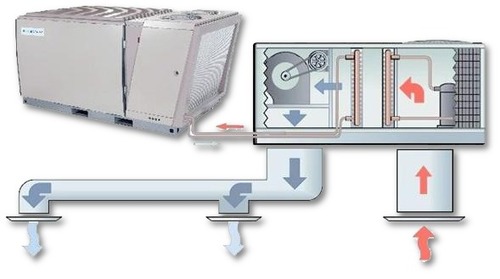
At its most basic, the Ice Bear consists of a large thermal storage tank that attaches directly to a building’s existing roof top air-conditioning system.

The unit makes ice at night, and uses that ice during the day to efficiently deliver cooling directly to the building’s existing air conditioning system.

The Ice Bear energy storage unit operates in two basic modes, Ice Cooling and Ice Charging, to store cooling energy at night, and to deliver that energy the following day.

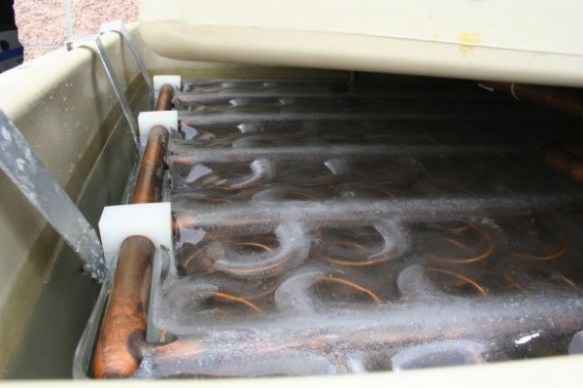
During Ice Charge mode, a self-contained charging system freezes 450 gallons of water in the Ice Bear’s insulated tank by pumping refrigerant through a configuration of copper coils within it. The water that surrounds these coils freezes and turns to ice. The condensing unit then turns off, and the ice is stored until its cooling energy is needed.

As daytime temperatures rise, the power consumption of air conditioning rises along with it, pushing the grid to peak demand levels. During this peak window, typically from noon to 6 pm, the Ice Bear unit replaces the energy intensive compressor of the building’s air conditioning unit.

[…]

The Ice Cooling cycle lasts for at least 6 hours.

Once the ice has fully melted, the Ice Bear transfers the job of cooling back to the building’s AC unit, to provide cooling, as needed, until the next day. During the cool of the night, the Ice Charge mode is activated and the entire cycle begins again. […]”<

See on Scoop.itGreen Energy Technologies & Development

CAN NYC REDUCE ITS CARBON FOOTPRINT 90% BY 2050?

“The building sector is the source of 75 percent of New York City’s greenhouse gas emissions. 90 by 50’s modeling of eight typical building types shows that heating and cooling loads can be reduced through retrofit measures to a point where all thermal loads can be met by heat pumps, eliminating building fuel use. The resulting electric energy used in 2050, supplied by carbon-free sources, will be slightly more than today’s, while peak demand will increase significantly. “

RO Engineers & Architects's avatarRO Engineers & Architects

In an article by urban green council,

“The building sector is the source of 75 percent of New York City’s greenhouse gas emissions. 90 by 50’s modeling of eight typical building types shows that heating and cooling loads can be reduced through retrofit measures to a point where all thermal loads can be met by heat pumps, eliminating building fuel use. The resulting electric energy used in 2050, supplied by carbon-free sources, will be slightly more than today’s, while peak demand will increase significantly. “

How will we meet this goal when there are a number of behavioral, institutional and infrustructural issues?

Let’s name a few…..

  1. The NYC subway still has outdated lighting with T12 with magnetic ballasts
  2. A large # of residential buildings the tenants leave their window a/c units installed year round which results in heat loss
  3. Alternate side parking- numerous places throughout the city people sit and idle their…

View original post 174 more words