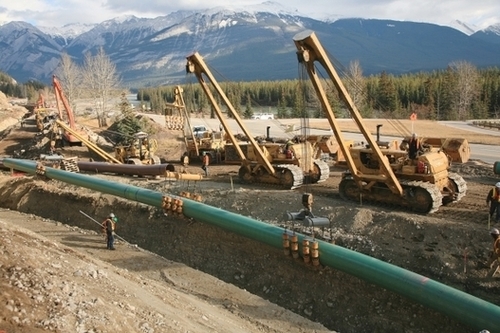
Proposed ‘Energy East’ Pipeline Benefits Overblown Argues Report

The proposed Energy East pipeline won’t be the boon to Eastern Canadian refineries that supporters claim because the vast majority of the oil in it would be bound for export markets, environmental groups argue in a report being released Tuesday.

Source: www.cbc.ca

>” […]

Refinery capacity already in use

The report Tuesday said the three refineries along the Energy East route — Suncor Energy’s in Montreal, Valero’s near Quebec City and Irving’s in Saint John, N.B. — have a combined capacity of 672,000 barrels per day.

Of that, the groups figure 550,000 barrels per day can come from elsewhere — offshore crude in Atlantic Canada, booming U.S. shale resources and, eventually, via Enbridge Inc.’s recently approved reversed Line 9 pipeline between southwestern Ontario and Montreal. That leaves just 122,000 barrels per day of refining capacity that can be served by Energy East, the report said.

“It’s very frustrating to watch a company trying to convince Canadians that they should accept these massive risks based on some perceived benefit that they may receive. When you dig into it, you find that it’s an empty promise,” said Adam Scott, with Environmental Defence.

“It’s just not true that Eastern Canada’s going to benefit in the way that TransCanada’s saying they are. And when you look and see that this is a project about putting vast quantities of oil onto tankers and shipping them out of the country, people who are convinced that ‘this is going to mean more local jobs for me’ are going to be very disappointed.” […]”<

See on Scoop.itGreen & Sustainable News

Why Electric Vehicles are not 100% Green

In 2013 Tesla’s [time-stock symbol=TSLA] Model S won the prestigious Motor Trend Car of the Year award. Motor Trend called it “one of the quickest American four-doors ever built.” It went on to say that the electric vehicle “drives like a sports car, eager and agile and instantly responsive.”

Source: time.com

>” […]

The secret behind Tesla’s success

While the power driving Tesla’s success might be its battery, that’s not the real secret to its success. Instead, Tesla has aluminum to thank for its superior outperformance, as the metal is up to 40% lighter than steel, according to a report from the University of Aachen, Germany. That lighter weight enables Tesla to fit enough battery power into the car to extend the range of the Model S without hurting its performance. Vehicles made with aluminum accelerate faster, brake in shorter distances, and simply handle better than cars loaded down with heavier steel.

Even better, pound-for-pound aluminum can absorb twice as much crash energy as steel. This strength is one of the reasons Tesla’s Model S also achieved the highest safety rating of any car ever tested by the National Highway Traffic Safety Administration.

But it’s not all good news when it comes to aluminum and cars.

Aluminum’s dirty side

[…]  Before alumina can be converted into aluminum its source needs to be mined. That source is an ore called bauxite, which is typically extracted in open-pit mines that aren’t exactly environmentally friendly. Bauxite is then processed into the fine white powder known as alumina, and from there alumina is exposed to intense heat and electricity through a process known as smelting, which transforms the material into aluminum.

Aluminum smelting is extremely energy-intense. It takes 211 gigajoules of energy to make one tonne of aluminum, while just 22.7 gigajoules of energy is required to produce one tonne of steel. In an oversimplification of the process, aluminum smelting requires temperatures above 1,000 degrees Celsius to melt alumina, while an electric current must also pass through the molten material so that electrolysis can reduce the aluminum ions to aluminum metals. This process requires so much energy that aluminum production is responsible for about 1% of global greenhouse gas emissions, according to the Carbon Trust.

There is, however, some good news: Aluminum is 100% recyclable. Moreover, recycled aluminum, or secondary production, requires far less energy to produce than primary production, as the […] chart shows. […]”<


See on Scoop.itGreen Energy Technologies & Development

Keystone XL Pipeline Climate Backgrounder

Pembina Institute Backgrounder, January 2013

Source: www.documentcloud.org

>”The climate implications of the proposed Keystone XL oilsands pipeline

by Nathan Lemphers

At a Glance Canada’s oilsands industry is growing quickly, with plans to nearly triple production from 1.8 to 5.2 million barrels a day by 2030.

To realize this substantial growth, pipelines to export markets are essential. TransCanada’s Keystone XL pipeline from the oilsands to a new market on the U.S. Gulf Coast is the most significant proposal awaiting approval. If built, Keystone XL will be a key driver for oilsands growth.

Other alternatives to ship oilsands to the west or east coast of Canada will, for the short to medium term, play a less dominant role in accelerating oilsands development.  These other proposals are smaller in pipeline capacity than Keystone XL, are in the very early stages of development, or face major public opposition. Regardless of whether other oilsands transport options move ahead, approval of Keystone XL will lead to substantial expansion of oilsands production and therefore an increase in global greenhouse gas emissions.

Filling Keystone XL with oilsands will cause a 36 per cent increase from current oilsands production, for which the higher upstream emissions alone will be equivalent to the annual emissions from 6.3 coal-fired power plants or over 4.6 million cars. This value will be higher when the additional emissions from upgrading and refining in the U.S. are considered.

In the absence of a credible plan for responsible development of the oilsands, including mitigating GHG emissions growth to a level that would allow Canada to meet its international climate commitments, the United States should not go ahead with the proposed Keystone XL pipeline.

[…]”<

See on Scoop.itGreen & Sustainable News

Will Falling oil prices cause oil sands shut-downs in Alberta?

Alberta Premier Jim Prentice says his province’s oil companies are not facing closures, even as prices approach $70 a barrel.

Source: www.ctvnews.ca

>””We don’t see oilsands operations shutting down,” Prentice told CTV’s Question Period in an interview that aired Sunday. “These are massive capital investments that have been built on a 50-year time horizon.”

Crude oil prices have dramatically fallen since June, when prices reached this year’s high of $107.54 USD per barrel of West Texas Intermediate crude oil. On Friday, WTI oil was about $75.70 per barrel.

[…]

The report said falling oil prices have been caused by large supply, low demand, and strong U.S. dollar. In order for the price to stabilize, “further oil price drops would likely be needed for supply to take a hit — or for demand growth to get a lift,” it said.

Analysts suggest that once prices fall below $72 a barrel, companies will begin to face serious financial consequences, and that some may be forced to close. But Prentice said Albertan oilsands companies are expected to survive the continuing drop in prices, even if they reach that $72 threshold.

Conservative Alberta MP Kevin Sorenson, the minister of state for finance, disagrees, saying falling oil prices could hurt employment numbers.

“We know that if oil prices continue to fall … in the long term that’s going to be very difficult,” Sorenson told Question Period. “It’s not so much that $70 is the plateau, but if it continued to fall, we could expect that there would be job losses.”

Though Prentice was more optimistic about the “resilience” of Albertan companies, he also said falling prices are cause for concern.

“I don’t want to underestimate the importance of this. The low-price environment has a significant implication for all of us,” Prentice said.

The premier said new projects may need to be postponed, and that the Albertan government must be prepared to control spending and budgeting.

According to the Alberta government’s budget website, if oil prices drop even $1 per barrel over 12 months, it can result in more than $200 million less in revenue for the province.

[…]

But Alberta’s provincial government factors all these variables into their economic forecasts.

“People need to be aware it’s a time for fiscal prudence. It’s a time for caution,” Prentice said Sunday. “And it’s a time to control what we can control, which is our public expenditures.” “<

Read more: http://www.ctvnews.ca/politics/falling-oil-prices-won-t-cause-shut-downs-in-alberta-prentice-1.2104374#ixzz3JXBPxTA3

See on Scoop.itGreen & Sustainable News

CAN NYC REDUCE ITS CARBON FOOTPRINT 90% BY 2050?

“The building sector is the source of 75 percent of New York City’s greenhouse gas emissions. 90 by 50’s modeling of eight typical building types shows that heating and cooling loads can be reduced through retrofit measures to a point where all thermal loads can be met by heat pumps, eliminating building fuel use. The resulting electric energy used in 2050, supplied by carbon-free sources, will be slightly more than today’s, while peak demand will increase significantly. “

RO Engineers & Architects's avatarRO Engineers & Architects

In an article by urban green council,

“The building sector is the source of 75 percent of New York City’s greenhouse gas emissions. 90 by 50’s modeling of eight typical building types shows that heating and cooling loads can be reduced through retrofit measures to a point where all thermal loads can be met by heat pumps, eliminating building fuel use. The resulting electric energy used in 2050, supplied by carbon-free sources, will be slightly more than today’s, while peak demand will increase significantly. “

How will we meet this goal when there are a number of behavioral, institutional and infrustructural issues?

Let’s name a few…..

  1. The NYC subway still has outdated lighting with T12 with magnetic ballasts
  2. A large # of residential buildings the tenants leave their window a/c units installed year round which results in heat loss
  3. Alternate side parking- numerous places throughout the city people sit and idle their…

View original post 174 more words

UK Renewable Energy Subsidy Underwrites Development

Energy secretary, Ed Davey, says new subsidy scheme will help underwrite green energy and reduce reliance on imported gas

Source: www.theguardian.com

>”[…] “Solar has been the rising star in the coalition’s renewable energy programme and has been championed recently by the Prime Minister at the UN and by Ministers at conference,” said Paul Barwell, chief executive of the STA.

“Why is the UK government putting this industry’s incredible achievements on solar power at risk? To curtail its growth now is just perverse and unjustified on budgetary grounds – solar has only consumed around 1% of the renewables obligation budget,” he added.

He was supported by Friends of the Earth, whose renewable energy campaigner, Alasdair Cameron, argued the government move would be bad news for jobs, the climate and people wanting to plug into clean power.

“Solar could be cheaper than fossil fuels in just a few years, but it needs a little more help from government to get it there. Failure to invest now will mean a huge missed opportunity for the UK economy,” he said.

The raised budget to £300m has been welcomed by the wider renewable power sector but industry officials said the complex structure and cost would unfairly benefit large utilities at the expense of smaller and medium-sized enterprises (SMEs). […]”<

See on Scoop.itGreen & Sustainable News

Fossil Fuel Development in the Arctic is a Bad Investment

Source: www.earth-policy.org

>”Currently, about 10 percent of the world’s oil and one-quarter of its natural gas production come from the Arctic region, which has warmed by more than 2 degrees Celsius since the mid-1960s. Countries that border the Arctic Ocean are staking claims to expand their rights beyond the traditional 200-mile exclusive economic zone in anticipation of future oil and gas prospects. According to current estimates, the United States has the largest Arctic oil resources, both on and offshore. Russia comes in second for oil, but it has the most natural gas. Norway and Greenland are virtually tied for third largest combined oil and gas resources. Canada comes in fifth, with almost equal parts oil and natural gas.

In developing these resources, Russia is leading the pack. Production has started at almost all of the 43 large oil and natural gas fields that have been discovered in the Russian Arctic, both on land and offshore. Russia drew its first oil from an offshore rig in Arctic waters in December 2013. […]

[…] operating in the Arctic brings great risks. The shrinking Arctic sea iceallows waves to become more powerful. The remaining ice can be more easily broken up into ice floes that can collide with vessels or drilling platforms. Large icebergs can scour the ocean floor, bursting pipes or other buried infrastructure. Much of the onshore infrastructure is built on permafrost—frozen ground—that can shift as the ground thaws from regional warming, threatening pipe ruptures. Already, official Russian sources estimate that there have been more than 20,000 oil spills annually from pipelines across Russia in recent years.  Arctic operations are far away from major emergency response support. The freezing conditions make it unsafe for crews to be outside for extended periods of time. Even communication systems are less reliable at the far end of the Earth. Why take such risks to pursue these dirty fuels when alternatives to oil and gas are there for the taking?

Rather than searching for new ways to get oil, we can look for better ways to move people and goods. Bus rapid transit, light rail and high-speed rail can move more people for less energy than a car can. And for the cars that remain on the road, electric and plug-in hybrid electric vehicles—powered by a clean energy grid—are much more efficient than those with a traditional internal combustion engine. Encouraging bicycle use through bike lanes andbike-sharing programs gets people active and out of cars.

Natural gas, which is mainly used to produce electricity, can be replaced with power generated by wind, solar, and geothermal projects. Many countries are demonstrating what is possible with renewables. Denmark already gets one-third of its electricity from wind. Australia is now dotted with 1 million rooftop solar systems. Iceland generates enough geothermal power to meet close to 30 percent of its electricity needs. These are just a few examples of looking past the old familiar solution to a better cleaner one. The risky search under every rock and iceberg for oil and gas deposits is a costly distraction from investing in a clean energy future.”<

See on Scoop.itGreen & Sustainable News

Sustainability and Development – Defining Relationships between Humanity, Energy and the Natural World

A new ‘Zeitgeist’ is increasingly taking hold in growing pockets of society, politics and the business world. All indications point to one direction – towards the concept of ‘sustainability’ dominating human behavior and thinking in the twenty-first century.

Source: breakingenergy.com

>”As the urbanization wave around the globe rolls on, megacities are increasingly becoming the epicenter of human life and economic activity for billions of people. Inevitably, this trend will bring about new challenges and exacerbate looming, well-known challenges such as climate change. As the World Economic Forum notes in a newly-released report on “The Competitiveness of Cities”: “Cities are especially intensive users of energy, food and water, given their concentrations of people and economic activity, and are responsible for over half of global greenhouse gas emissions. Their challenge, particularly in the developing world, is to fuse technology and markets to become much more efficient in using available resources.” Climate Actions and Economic Significance of Cities Source: Carbon Disclosure Project (CDP); data in overview from various sources Thus, global needs for clean water, sanitation and food as well as demand for energy, mobility (transportation) and for an improved standard of living will increase and put tremendous strain on existing natural resources.

The growing awareness of environmental problems – especially that without a timely, coordinated, and ‘corrective’ intervention by governments the problem of climate change will eventually become irreversible – in addition to the perception of natural resources’ finite supply brings any debate back to the fundamental question of how to sustain life on earth. What is Sustainable Development about?  The first association that comes to mind has to do with energy needs in general – and the finite fossil fuel supply amid projected future demand growth – and carbon-emissions-free energy in particular.

Renewable energy sources (solar, wind, hydro) have the potential to pick up the slack and supply a larger percentage of projected future energy demand globally. In this context, technological innovation represents one suitable solution to problems related to sustainability. However, a different angle to tackle these problems is a change in human behavior based on better information and awareness leading to energy savings by implementing simple energy efficiency measures. This point emphasizes the importance of public awareness and/or education, which can serve as a catalyst for action – i.e. a change of course. Apart from concerns about energy, the concept of sustainability includes all aspects of political, economic, and social life in so far as present actions may constrict future actions.

The so-called UN ‘Brundtland Report’ from 1987 is very instructive on this topic and defines sustainable development as follows: “Humanity has the ability to make development sustainable to ensure that it meets the needs of the present without compromising the ability of future generations to meet their own needs. The concept of sustainable development does imply limits – not absolute limits but limitations imposed by the present state of technology and social organization on environmental resources and by the ability of the biosphere to absorb the effects of human activities. But technology and social organization can be both managed and improved to make way for a new era of economic growth. […]

To date, many companies have realized the merits of modifying their products and processes to become more sustainable. (…) But, these [incremental] innovations will only get us so far. What we need are not just better products and processes, but fundamentally different business models. We need companies and industries whose underlying structures are, at worst, zero negative impact, and at best, contributing to the regeneration and restoration of natural, human and social capital.” The US utility industry will have no other choice than taking steps along the path towards more ‘value creation from sustainability’ in order to remain a viable business model for future generations.”<

See on Scoop.itGreen & Sustainable News

Evidence Suggests Nuclear Powered Core Provides 50% of Earth’s Heat Energy

See on Scoop.itGreen & Sustainable News

Geoneutrino detector probes deep into the Earth

Duane Tilden‘s insight:

“About 50% of the heat given off by the Earth is generated by the radioactive decay of elements such as uranium and thorium, and their decay products. That is the conclusion of an international team of physicists that has used the KamLAND detector in Japan to measure the flux of antineutrinos emanating from deep within the Earth. The result, which agrees with previous calculations of the radioactive heating, should help physicists to improve models of how heat is generated in the Earth.

Geophysicists believe that heat flows from Earth’s interior into space at a rate of about 44 × 1012 W (TW). What is not clear, however, is how much of this heat is primordial – left over from the formation of the Earth – and how much is generated by radioactive decay.  […]

One possibility that has been mooted in the past is that a natural nuclear reactor exists deep within the Earth and produces heat via a fission chain reaction. Data from KamLAND and Borexino do not rule out the possibility of such an underground reactor but place upper limits on how much heat could be produced by the reactor deep, if it exists. KamLAND sets this limit at about 5 TW, while Borexino puts it at about 3 TW.”

See on physicsworld.com

Kinder Morgan files for Trans Mountain pipeline expansion to triple capacity

See on Scoop.itGreen & Sustainable News

A second pipeline proposal to transport oil to Asia was officially launched on Monday when Kinder Morgan filed a project application for its $5.4-billion Trans Mountain expansion.

Duane Tilden‘s insight:

>The project would nearly triple oil capacity to 890,000 barrels annually and bring about 400 more tankers a year into Burrard Inlet (up from about 80) if it is approved by the National Energy Board and subsequently by the federal government.

The 1,150-kilometre pipeline will carry diluted bitumen from the Alberta oilsands, starting in Edmonton, through Jasper and across B.C. to the company’s Westbridge Terminal in Burnaby.

Kinder Morgan says nearly three-quarters of the proposed expanded pipeline’s length across most of the province will follow the existing right-of-way where the pipeline was first built in the 1950s. About 17 per cent of the route, and virtually all the way through the Lower Mainland west of Fort Langley, will deviate from the current line, but would follow other existing utility corridors or infrastructure.

Kinder Morgan is promising enhanced tanker safety in its more-than-15,000-page submission, and says it is continuing discussions with First Nations, whose support is critical to large infrastructure development projects in B.C.

The twinning of Kinder Morgan’s existing pipeline has already seen years of pushback from First Nations, environmentalists and community groups concerned about the potential for spills along the pipeline and from tankers. Both Vancouver and Burnaby’s city councils have voiced opposition to the project.

The project would create about 90 permanent jobs, and employ 4,500 people at the peak of construction.<

See on www.vancouversun.com