Dynamic Energy – A Leader in Energy Solutions | Combined Heat & Power

See on Scoop.itGreen Building Design – Architecture & Engineering
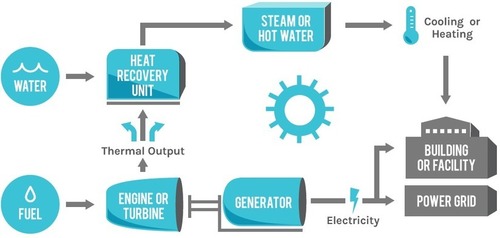
Dynamic Energy develops energy projects that reduce customers’ expenses, improve operating efficiency, provide an attractive return on investment, and help achieve sustainability goals.

Duane Tilden‘s insight:

CHP Financing – Direct Purchase

There are many reasons why now is a great time for CHP. Dynamic can provide multiple financing options including:

Purchasing a CHP system provides many benefits including:
• Traditional bank financing
• Federal 10% Investment Tax Credit
• Accelerated depreciation (MACRS)
• Aggressive state level incentives
• Locked forward natural gas contracts
• Significant thermal & electrical savings

Power Purchase Agreement
A Power Purchase Agreement (PPA) provides the host customer power and heat at a discounted rate, with no capital requirement. A third party investor owns the CHP system and eneters into a long term power contract with the host. PPAs provide the following benefits to host customers:

• No upfront cost or capital required
• Projects are cash flow positive from day one
• Predictable energy pricing & hedge against electricity prices
• No system performance or operating risk and no maintenance
• Align with organizational sustainability goals
• Press and media outreach

[For example of financing options, not intended as a corporate endorsement.]  DT

See on dynamicenergyusa.com

Guest Post: The Future of Energy Management in Commercial Buildings : Greentech Media

See on Scoop.itGreen Building Operations – Systems & Controls, Maintenance & Commissioning

Industry experts make predictions for 2013.

Duane Tilden‘s insight:

…the developments of 2012 are indicative of longer trends affecting how we will occupy and operate commercial buildings in 2013.

Policy and Disclosure

2012 saw a number of industry “firsts.” Perhaps none is more significant than the adoption of energy disclosure laws, which require residential and commercial buildings to reveal — sometimes publicly — the energy performance of the buildings. To date, six cities have passed such laws, which require the use of EPA’s Energy Star Portfolio Manager for buildings…

Utilities and the Green Button

Another major trend of 2012 has been the adoption by 35 electric and gas utilities of the “Green Button,” a voluntary, standardized data format for energy data. Green Button, a data standard developed by industry along with the National Institute of Standards and Technology (NIST), and ratified by the North American Energy Standards Board (NAESB), is meant to provide customer data in a computer-readable format so that software applications can uniformly tackle energy problems and identify opportunities for savings.

Civic Government

2012 was also a major year for civic and federal governments, as energy efficiency was a focus for large portfolios of public buildings. While some cities have already made strides in improving their own building performance, there has been a faster adoption of new technologies and operations strategies, and more vocal public acknowledgement of their goals to reduce energy and save taxpayer money.

See on www.greentechmedia.com

Smart Grid: Energy forecasting – a new approach to managing demand

See on Scoop.itGreen Building Operations – Systems & Controls, Maintenance & Commissioning

Smart Grid – A new service that could help the growing smart building management systems market forecasts energy demand day by day, a feature that allows users to increase energy efficiency and reduce…

Duane Tilden‘s insight:

Pete Segall, […] ATS Automation, … "Our customers look to us for ways to save money and reduce energy usage while minimizing capital expenses. GridNavigator’s energy forecasting service allows us to predict energy and demand spokes and launch automated reduction strategies before the demand event occurs."


Having that real-time information means operators can achieve smarter building management with remote adjustment of numerous devices and systems, like boilers and lighting. GridNavigator says engineers can now optimize BACnet (data communications protocol for building automation and control networks) building management systems based on day to day energy use patterns to avoid peaks and to respond to building occupant behavior to reduce demand.


"Energy forecasting allowed us to achieve an additional 3-5% energy savings and 7-10% demand reduction," said Kevin McKay, the community college’s VP for finance and operations. "This innovation in energy management helps manage our resources even more efficiently."


The service is being used throughout the 20-plus buildings on the 50-acre campus.

See on www.smartgridnews.com

EPB Deploys America’s Fastest Fiber-optic Smart Grid – Lee Baker, Smart Grid Consultant – Electric Energy Online

See on Scoop.itGreen Energy Technologies & Development

EPB Deploys America’s Fastest Fiber-optic Smart Grid – Lee Baker, Smart Grid Consultant – While many utilities struggle with the question of whether or not to build a Smart Grid, for the Electric Power Board (EPB) in …

Duane Tilden‘s insight:

Chattanooga: The Smarter City

EPB [Electric Power Board] is one of the first community-owned utilities to install a 100% fiber-optic network, which uses the fiber optic network for Smart Grid applications, in addition to the triple-play media services (i.e., high speed Internet, video and telephone) EPB already provides.

“Chattanooga is light years ahead when it comes to providing ultra fast broadband,” said Tom Edd Wilson, President and CEO of the Chattanooga Area Chamber of Commerce. “By offering the fastest available speeds to a whole community comprising a diverse population living in both urban and rural areas, Chattanooga has become the living laboratory for today’s innovations and tomorrow’s companies.”

EPB has built fiber optics throughout their entire customer service area and communications services are now available to all homes and businesses. By the end of 2012, all 170,000 homes and businesses will be equipped with a Tantalus smart meter.

[…] EPB already has 22 large industries signed up for a time-of-use (TOU) rate program, and its projected that together they will save $2.3 million a year. Those kinds of savings help businesses run more efficiently and bring jobs to the community.

“What makes Chattanooga stand out is that it is leveraging the network both for a full range of Smart Grid applications and communications connectivity,” Wade added.

“We looked at how the communication system and the electric system interact for many years and realized how closely tied together they are. As costs have stabilized and technology matured, we felt that the time was right to proceed with the project.”

“We’re building this network not just for today but for the future. The system we’re building will provide rapid, two-way communications with every meter, home and device, making it possible and practical for our customers to interact with their energy use as never before.”

See on www.electricenergyonline.com

EU faces fresh calls to strengthen biofuel rules

See on Scoop.itGreen Energy Technologies & Development

Greenpeace-backed report argues EU can meet green transport targets without relying on controversial land-based biofuels

Duane Tilden‘s insight:

NGOs are increasingly fearful that member states’ efforts to meet the targets through an increase in the use of biofuels will have a negligible impact on greenhouse gas emissions and in some cases could lead to increased emissions as companies source biofuels made from food and energy crops that are alleged to have contributed to deforestation and food price inflation.

The EU Commission has acknowledged the risk and last year proposed a new limit on the use of biofuels made from food crops that would ensure such fuels could only count towards half of the 10 per cent target for renewable fuel use.

The proposals have encountered lobbying from some member states who have argued the binding 10 per cent goal cannot be met if limits are placed on the use of biofuels made from food crops.

But the CE Delft report argues the targets can be met through greater investment in fuel efficiency measures, waste and residue-based biofuels, and electric vehicles, alongside tighter rules to phase out the use of biofuels made from land-based food or energy crops.

See on www.businessgreen.com

Could Some Midwest Land Support New Biofuel Refineries?

See on Scoop.itGreen Energy Technologies & Development

Millions of acres of marginal farmland in the Midwest — land that isn’t in good enough condition to grow crops — could be used to produce liquid fuels made from plant material, according to a study in Nature. And those biofuels could, in theory, provide about 25 percent of the advanced biofuels required by a 2007 federal law.

Duane Tilden‘s insight:

But some researchers in the field aren’t convinced the resource is nearly that big. Adam Liska at the University of Nebraska in Lincoln says a lot of this acreage is in the Great Plains, which wouldn’t produce a reliable crop year after year.

“One year you may have high rainfall and high crop yields and be able to sustain your facility, [but] the next year you may have a drought,” Liska says.

Indeed, Brent Erickson […] says nobody has plans just yet to use this kind of plant material to make biofuels. […]

“Every region of the country has some form of biomass — so the Northwest would have sawdust and wood waste; the California area might have rice straw or wheat straw, … Refiners in the Midwest are looking at corn cobs, and a plant that’s actually operating in Florida uses dead citrus trees.”

“As this technology progresses we’re going to see a great diversification of biomass supply,” Erickson predicts.

… Timothy Searchinger, an associate research scholar at Princeton University.

The 27 million acres identified in the latest study would provide less than 0.5 percent of our national energy demand, he says. And the more we try to expand biofuels, the more we risk displacing crops for food, or chopping down forests, which store a huge amount of carbon.

Searchinger says Europe has recently recognized those potential hazards and is scaling back its biofuels ambitions.

“They realize that it was a mistake, and their compromise for the moment is essentially to cap what they’re doing and then they promise by 2020 to phase out all government support for biofuels.”

See on www.opb.org

Day after patch, Java zero-day sold to highest bidders

See on Scoop.itGreen Energy Technologies & Development

With exploit sold for $5,000 via cybercrime forum, experts double down on calls for consumers to uninstall the software

Duane Tilden‘s insight:

“Java is fundamentally broken because it is built upon a broken promise: That it runs in a protected sandbox which somehow protects the user,” Krebs told CSO Online on Wednesday.

Sunday’s patch was an effort to quiet a firestorm of criticism and calls not only from a majority of security experts but even the Department of Homeland Security (DHS) for consumers to disable Java on their PCs.

This latest report intensified some of those calls, but also a bit of pushback, although not in the form of any major defense of Oracle. Simon Crosby, […] banning or disabling Java would not solve the problem. “Humans develop buggy code — […] they can all be subverted,” he wrote. “Moreover, many users (and businesses) depend on Java … banning it would severely impact my ability to work.”

Crosby wrote that “micro-virtualization” can solve the problem with Java and other insecure applications with “hardware isolation to enforce ‘need to know’ on a per-task basis on the endpoint.”

See on www.networkworld.com

Power Engineers, Smart Grid Techies: In Demand Now

See on Scoop.itGreen Energy Technologies & Development

At  several professional meetings over the past year a common theme emerges at some point. Electrical/power engineers are aging and the academic programs have been seeing a decline in enrollment.  …

Duane Tilden‘s insight:

For years this grid remained basically the same. The growth in power plants and transmission lines was steady and the educational system generating engineers maintained the same steady pace. But just as our electrical grid has aged so has the work force that runs and maintains it. And just as everything is aging new demands and new technologies are changing the face of power. The rate and type of growth – of new power sources, increased rate of transmission and now even types of transmission are out pacing the grid workforce.


So what does this mean? It means at just the time when new interest and new opportunities are arising, we are seeing a decline in the number of professors for power engineering (they do have to retire) and that maybe new professors prepared to instruct on the old and the new technologies have not been developed at the rates they should have.

See on blog.climateandenergy.org

Renewables Move up the Rankin’s

Renewables Move up the Rankin’s.

Energy Efficiency in Data Centres to Lower Costs and Benefit the Environment

See on Scoop.itGreen Energy Technologies & Development

LONDON, Jan. 16, 2013 /PRNewswire/ — The data centre market is growing at an extremely high rate and its boom…

Duane Tilden‘s insight:

“Data centre managers are under constant pressure to lower the TCO [Total Cost of Ownership] and energy is one of the main components of the overall data centre operation cost.  […]

Data centres are classified as mission critical facilities and any down time will result in a significant financial loss. In order to ensure highest availability, data centre managers employ high powered UPS systems. These UPS systems consume about 7% of the total energy.   […]

See on www.prnewswire.com