Grid Parity Is Accelerating the US Solar Revolution

“Solar PV installations in the U.S. increased an impressive 485% from 2010 to 2013, and by early 2014, there were more than 480,000 systems in the country. That’s 13,400 MW, enough to power about 2.4 million typical American homes.”


Source: www.pvsolarreport.com

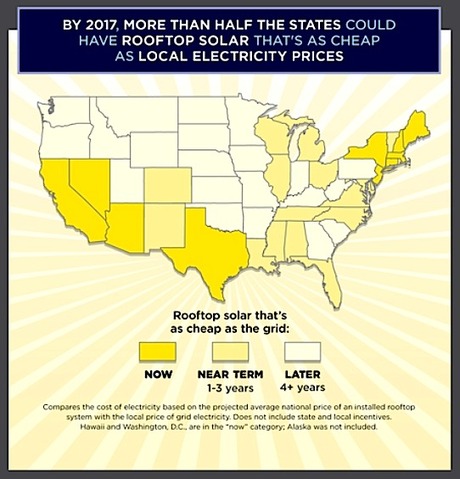
>” […] You can definitely see a correlation between electricity price and amount of solar installed, though there are exceptions. Kansas, for example, has fairly high grid prices but little solar — a testament to the fact that good policy is also a key ingredient in promoting solar. And Alaska is not exactly highly populated. For the most part, though, solar is flourishing in states with high electricity rates.

In some states like California, already one of the most expensive places for electricity in the country, residential rates will soon be going up further. Customers in the PG&E service area are looking at a 3.8% increase in electricity bills. Overall, electricity prices in the U.S. have been rising rapidly. According to the Energy Information Administration, in the first half of 2014, U.S. retail residential electricity prices went up 3.2% from the same period last year — the highest year-over-year growth since 2009. […]

The fact is, solar and other renewables just keep getting cheaper. We’ve noticed a number of stories debating this recently, many in reaction to an Economist article on how expensive wind and solar really are. But as Amory Lovins points out, the reality is that renewables are getting cheaper all the time, regardless of anyone’s arguments.

What does this mean? It means that grid parity is coming sooner than you might think […]”<

See on Scoop.itGreen Energy Technologies & Development

Energy Efficiency Gains, Backfire & The Rebound Effect – A Problem?

“Every few years, a new paper comes out about the rebound effect and the issue receives some short-term attention. (When a consumer or business buys an efficient car or air conditioner, they may use their energy-efficient equipment a little more often or may spend some of their energy bill savings on things that use energy—these are examples of rebound effects.)  […]”

Source: aceee.org

>” […] we found that rebound may average about 20%, meaning that 80% of the savings from energy efficiency programs and policies register in terms of reduced energy use, while the 20% rebound contributes to increased consumer amenities (for example, more comfortable homes) as well as to a larger economy.  […]

E2e, a joint initiative of three universities, released a working paper entitled “The Rebound Effect and Energy Efficiency Policy.” In it, they discuss various types of rebound and ways to analyze it. Much of their data relates to gasoline and oil prices and consumer and market responses to changes in those prices. They find that for developed countries, “most… studies fall […] in the range of 5 to 25 percent” direct rebound effect (where direct captures consumer response but not whole-economy effects). In developing countries, where incomes are lower and impose constraints on miles driven and other energy-consuming behavior, the E2e paper finds the “most common range” is 10-40% demand elasticity (related to but not exactly the same as direct rebound). They also discuss macroeconomic effects, emphasizing studies that show rebound of 11 percent and 21 percent due to economic growth. By way of comparison, the ACEEE paper estimates 10 percent direct rebound on average for the United States, noting the first of the two economic growth studies. In addition, in the case of oil prices, the E2e paper discusses how improvements in fuel economy soften oil prices, which can lead to a 20-30% increase in global oil use due to these price effects. Bottom line: The E2e paper sees modestly higher rebound effects than the earlier ACEEE paper.  […]

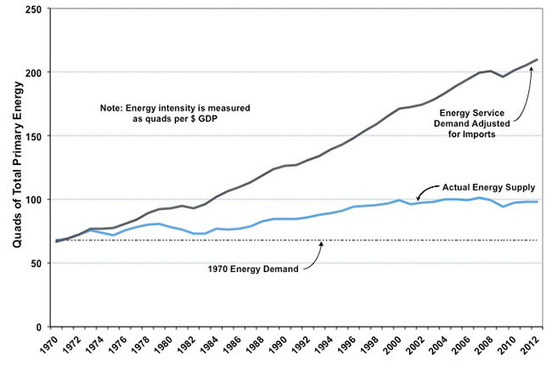
Regarding electricity use, Breakthrough discusses how electricity use has risen more quickly than generating plant efficiency has increased. The authors call this backfire, even as they acknowledge that these trends are also affected by rising incomes, urbanization, changes in consumer preferences, and other socioeconomic and demographic trends. They provide no evidence on the relative importance of energy efficiency relative to these other factors. Furthermore, they seem to mix up energy efficiency and economic efficiency.[…]

Breakthrough released their new report with an op-ed in the New York Times. The op-ed goes several steps further than the report. First, applying its claims of lighting backfire from the 1800s, it claims that LED lighting, for which the most recent Nobel Prize in physics was awarded, will increase lighting energy use, particularly in developing countries. As I wrote in a letter to the editor of the Times, LEDs are about six times more efficient than incandescent lamps, so in order to reach the backfire point, the average purchaser would need to increase the amount of lighting they use by a factor of six. While such an increase may well happen among the poorest households in developing countries, it is unlikely to be seen in developed countries, or even among the middle class in developing countries.

The Breakthrough op-ed also claims that the International Energy Agency and the Intergovernmental Panel on Climate Change find that “rebound could be over 50 percent globally.” While technically correct, their claim takes the upper end of the ranges found in recent IEA and IPCC studies. For example, IEA states, “Direct rebound can range from 0% to as much as 65%. However, estimates tend to converge between 10% and 30%.” It would be much more accurate if the institute would cite the full range, instead of looking only at the extreme. Applying that logic, I could argue that IEA supports ACEEE’s 10% direct rebound estimate–at least 10% is within IEA’s most likely range of 10-30%. IPCC estimates get similar treatment from Breakthrough.

Bottom line: The E2e analysis is very reasonable, but Breakthrough appears to be more interested in exaggerating to make its case, rather than sticking to the facts. The truth is that for 40 years energy efficiency has had a dramatic effect on worldwide energy consumption. In the United States, if we were to use energy today at the rate we were in 1974, we would be consuming more than twice the amount that we are actually using. […]”<


See on Scoop.itGreen & Sustainable News

US EPA Awards Energy Star to 3 CHP (Cogen) Projects

The US Environmental Protection Agency (EPA) has recognised three combined heat and power projects with ENERGY STAR CHP awards.

Source: www.cospp.com

>”[…] Eastman Chemical Company’s Kingsport, Tennessee, Campus plant (pictured) was recognised for its 200 MW CHP system, which includes 17 GE steam turbine generators. The Kingsport industrial campus, one of the largest chemical manufacturing sites in North America, employs nearly 7000 people […]

Seventeen boilers produce steam to support manufacturing processes, help meet the space heating/cooling needs of 550 buildings, and drive 17 GE and two ABB steam turbine generators with a combined design output of 200 MW. With an operating efficiency of more than 78%, the predominantly coal-fired system requires approximately 14% less fuel than grid-supplied electricity and conventional steam production, saving Eastman Chemical approximately US$45 million per year.

Janssen Research & Development, LLC, one of the Janssen Pharmaceutical Companies of Johnson & Johnson, was granted an award for its 3.8 MW CHP system, powered by a Caterpillar lean-burn low-emissions reciprocating natural gas generator set. The system supplies 60% of the annual power needs for the site and approximately 40% of the thermal energy used to support R&D operations and heat, cool, and dehumidify the facility’s buildings.

With an operating efficiency of more than 62%, the system requires approximately 29% less fuel than grid-supplied electricity and conventional steam production, saving approximately $1.1 million per year.

Merck’s CoGen3 CHP system at its West Point facility was also recognised by the EPA. A pharmaceutical and vaccine manufacturing, R&D and warehouse and distribution centre, the project is powered by a 38 MW GE 6B heavy-duty gas turbine and recovers heat to produce steam to heat, cool and dehumidify approximately 7 million square feet of manufacturing, laboratory and office space.

The system, designed by Burns & Roe, is the third CHP system that Merck has installed at the 400-acre West Point, Pennsylvania campus. With an operating efficiency of more than 75%, the natural gas-fired system requires approximately 30% less fuel than grid-supplied electricity and conventional steam production.”<


See on Scoop.itGreen Energy Technologies & Development

Intelligent Efficiency: Evolution of the Energy Efficiency Market

In the past, energy efficiency was seen as a discrete improvement in devices,” says Skip Laitner, an economist who specializes in energy efficiency. “But information technology is taking it to the next level, where we are thinking dynamically, holistically, and system-wide.

Source: www.greentechmedia.com

>” […] This emerging approach to energy efficiency is information-driven. It is granular. And it is empowering consumers and businesses to turn energy from a cost into an asset. We call this new paradigm “intelligent efficiency.”

That term, which was originally used by the American Council for an Energy-Efficient Economy in a 2012 report, accurately conveys the information technology shift underway in the efficiency sector.

The IT revolution has already dramatically improved the quality of information that is available about how products are delivered and consumed. Companies can granularly track their shipping fleets as they move across the country; runners can use sensors and web-based programs to monitor every step and heartbeat throughout their training; and online services allow travelers to track the price of airfare in real time.

Remarkably, these web-based information management tools are only now coming to the built environment in a big way. But with integration increasing and new tools evolving, they are starting to change the game for energy efficiency.

Although adoption has been slow compared to other sectors, many of these same technologies and applications are driving informational awareness about energy in the built environment. Cheaper sensors are enabling granular monitoring of every piece of equipment in a facility; web-based monitoring platforms are making energy consumption engaging and actionable; and analytic capabilities are allowing companies to find and predict hidden trends amidst the reams of data in their facilities and in the energy markets.

This intelligence is turning energy efficiency from a static, reactive process into a dynamic, proactive strategy.

We interviewed more than 30 analysts and companies in the building controls, equipment, energy management, software and utility sectors about the state of the efficiency market. Every person we spoke to pointed to this emerging intelligence as one of the most important drivers of energy efficiency.

“We are hitting an inflection point,” says Greg Turner, vice president of global offerings at Honeywell Building Solutions. “The interchange of information is creating a new paradigm for the energy efficiency market.”

Based on our conversations with a wide range of energy efficiency professionals, we have identified the five key ways intelligent efficiency is shaping the market in the commercial and industrial (C&I) sector:

The decreased cost of real-time monitoring and verification is improving project performance, helping build trust among customers and creating new opportunities for projects;Virtual energy assessments are bringing more building data to the market, leveraging new lead opportunities for energy service professionals;Web-based energy monitoring tools are linking the energy efficiency and energy management markets, making efficiency a far more dynamic offering;Big data analytics are creating new ways to find trends amidst the “noise” of information, allowing companies to be predictive and proactive in efficiency;Open access to information is strengthening the relationship between utilities and their customers, helping improve choices about efficiency and setting the foundation for the smart grid.


[…]”<

See on Scoop.itGreen Energy Technologies & Development

Combined Heat & Power Drives Biomass Demand

New analysis from the International Renewable Energy Agency (IRENA) forecasts CHP and industrial heat demand are set to drive global bioenergy consumption over the coming decade and more.

Source: www.cospp.com

>”The trend towards modern and industrial uses of biomass is growing rapidly, the report notes, adding that biomass-based steam generation is particularly interesting for the chemical and petrochemical sectors, food and textile sectors, where most production processes operate with steam. Low and medium temperature process steam used in the production processes of these sectors can be provided by boilers or CHP plants. Combusting biogas in CHP plants is another option already pursued in northern European countries, especially in the food sector, where food waste and process residues can be digested anaerobically to produce biogas, IRENA adds. A recent IRENA analysis (2014b) estimated that three quarters of the renewable energy potential in the industry sector is related to biomass-based process heat from CHP plants and boilers. Hence, biomass is the most important technology to increase industrial renewable energy use, they conclude.

In industry, demand is estimated to reach 21 EJ in the REmap 2030, up to three-quarters of which (15 EJ) will be in industrial CHP plants to generate low- and medium-temperature process heat (about two-thirds of the total CHP output). In addition to typical CHP users such as pulp and paper other sectors with potential include the palm-oil or natural rubber production sectors in rapidly developing countries like Malaysia or Indonesia where by-products are combusted in ratherinefficient boilers or only in power producing plants.

As a result, installed thermal CHP capacity would reach about 920 GWth with an additional 105 GWth of stand-alone biomass boilers and gasifiers for process heat generation could be installed worldwide by 2030. This is a growth of more than 70% in industrial biomass-based process heat generation capacity compared to the Reference Case.

Biomass demand for district heating will reach approximately 5 EJ by 2030 while the power sector, including fuel demand for on-site electricity generation in buildings and on-site CHP plants at industry sites, will require approximately another 31 EJ for power generation (resulting in the production of nearly 3,000 TWh per year in 2030, according to IRENA.

The total installed biomass power generation capacity in Remap 2030 reaches 390 GWe. Of this total, around 178 GWe is the power generation capacity component of CHPs installed in the industry and district heating sectors.”<


See on Scoop.itGreen Energy Technologies & Development

10 Most Efficient Renewable Energy Devices

Google invests $145 million in new 82MW Southern California solar power plant

Energy Storage Solutions for the Smart Grid

In order to ramp up clean energy production, we have to figure out how to store and transmit it effectively. Companies are experimenting with new tech to figure out the best way to progress.

Source: www.techrepublic.com

>”The smart grid energy storage sector is expected to grow to $50 billion by 2020, with an annual compound growth rate of 8%, according to a recent report from Lux Research. In 2013, renewable energy accounted for only 10% of total US energy usage and 13% of electricity generation, according to the US Energy and Information Administration.

But as renewable energy generation rises, transmission and storage advancements will be necessary. Curtailment, the act of spilling renewable energy because there’s more than enough, is one issue to tackle. By changing grid transmission lines in 2010, Texas saw the curtailment in their grid drop from 9% to 4% in 2012, according to a report by the National Renewable Energy Laboratory.

The tipping point with energy storage depends on the grid and the technology used, said Sam Jaffe, an analyst at Navigant Research. Some places in the world that have extremely high penetration rates of renewable energy don’t have major problems with wasted renewables. Denmark sends its extra wind power to Sweden and Norway, while importing hydro power from those two countries when the wind isn’t blowing. Denmark’s wind penetration is now at almost 40%.

“That’s because they are interconnected to other grids that have a lot of flexibility to offtake renewable energy,” he said.”<


See on Scoop.itGreen Energy Technologies & Development

Residential Battery Storage Nears Grid Parity in Germany

It’s very close, according to the German government and some industry observers.

Source: www.greentechmedia.com

>”It is now generally recognized that rooftop solar has reached “socket parity” — meaning that it is comparable to or cheaper than grid prices — in many countries over the last few years. The big question for consumers and utilities is when socket parity will arrive for solar and battery storage.

[…] Electricity prices are rising and solar PV prices are falling, which means that if battery storage falls to around €0.20 per kilowatt-hour (U.S. $0.27), parity will be achieved.

Australian investment firm Morgans, in an assessment of Brisbane-based battery storage developer Redflow, suggests that that company’s zinc-bromine flow battery may already be commercially economic in Germany, the country that leads the world in terms of household adoption and government support for renewables.

Morgans notes that in Germany, the cost of household grid power is around €0.30 per kilowatt-hour (U.S. $0.40) and that the government is now subsidizing residential energy storage systems that are connected to solar systems.

“Given Germany’s substantial adoption of solar PV…costs for solar power range from €0.10 to €0.15 per kilowatt-hour (half the grid price), so when energy storage costs reach €0.15 to €0.20, this will mean renewable energy costs will be at parity with grid prices,” Morgans concludes.  […]”<


See on Scoop.itGreen Energy Technologies & Development

Manufacturer Installs 10 ORC “Machines” to Municipal District Heating System in Europe

RENO, NV–(Marketwired – Aug 7, 2014) – ElectraTherm, a leader in distributed heat to power generation, commissioned 10 Green Machine 4400s in Levice, Slovakia in June 2014.

Source: www.cospp.com

>”[…]The 10-machine installation utilizes the waste heat from two Rolls Royce gas turbines through a combined cycle. Exhaust from the turbines goes through a heat recovery steam generator, and lower temperature exhaust gas that cannot be utilized produces hot water to meet demand for heating on the municipality’s district heating system. The remaining heat runs through ElectraTherm’s Green Machines to generate clean energy and attain attractive feed-in-tariff incentives.

Hot water enters the Green Machine at between 77-116°C (170-240°F), where it heats a working fluid into pressurized vapor, using Organic Rankine Cycle (ORC) and proprietary technologies. As the vapor expands, it drives ElectraTherm’s patented twin screw power block, which spins an electric generator and produces emission free power. Run in parallel, the Green Machines in Levice generate approximately 500 kWe. While combined cycle gas turbines are widely used throughout Europe for power generation and district heating, this is the first application of its kind to utilize ElectraTherm’s ORC technology for the lower temperature waste heat.

The Green Machines help the site reach maximum efficiency levels through heat that would otherwise go to waste. ElectraTherm’s Green Machine generates power from waste heat on applications such as internal combustion engines, biomass, geothermal/co-produced fluids and solar thermal. ElectraTherm’s product line includes units with 35, 65 and 110 kW outputs and offers stand alone or packaged solutions. Read more about Green Machine products at http://electratherm.com/products/.  […]”<

See on Scoop.itGreen Energy Technologies & Development