Net Zero Energy Buildings at Zero Cost

The Netherlands has found a way to refurbish existing buildings to net zero energy, within a week, with a 30-year builders’ guarantee and no subsidies.

Source: www.energypost.eu

>”Inside the house, the pounding rain stills to distant murmur. That’s thanks to the triple glazing, points out Ron van Erck, enthusiastic member of Platform31, an innovation programme funded by the Dutch government that brings together different actors for out-of-the-box thinking to crack intractable problems. One of its big successes to date is Energiesprong, an initiative that turns the building market on its head to deliver social housing with zero net energy consumption, i.e. no energy bill, at zero cost to the tenant and with no subsidies to the builder.

Starting off in 2010 with three staff, a €50 million budget and five years to come up with something to make buildings more sustainable, Energiesprong today boasts 45 staff and a deal with 27 housing associations and four big construction companies to refurbish 111,000 houses in the Netherlands. Total investment? €6 billion. The initial focus is social housing, but it’s already looking at the private market, care centres and commercial office buildings too.

How does the plan work? The basic trick is that tenants instead of paying their energy bills, pay a similar amount to the housing corporations that own the houses. With this money, the corporations pay building companies to retrofit the houses, which after renovation have net zero energy costs. The building companies have for this project developed ‘industrialised’ renovation procedures that are highly cost-effective. One important difference with existing renovation projects is that all elements that are needed for a successful move to zero-energy housing are brought together  in one plan.

Energy Post’s Sonja van Renssen met with manager Jasper van den Munckhof, to understand exactly what Energiesprong does, how it does it and why it will succeed – in the Netherlands and elsewhere.

Q: What was your starting point?

A: We started off with what we spend. The household energy bill in the Netherlands is about €13 billion. This money is available. If you spent it on a mortgage or payback on a loan of about 30 years [instead of energy], you have €225 billion to invest in the Dutch housing stock. This is substantial money: €30-40,000 per house to make it energy neutral.

“Retrofit wasn’t interesting – unless you were rich – but using the energy bill to fund it, no one had thought of that! A building and its energy system were developed as parallel, complementary but not integrated, entities.”

-Jan Kamphuis, BJW Wonen, a one-stop-shop for retrofits inspired by Energiesprong

The trick is, how to get this money flowing. We tried to imagine what owners would need to start investing. They buy kitchens and they don’t see this as an investment but good for their family. You need to get this focus on people and how they buy stuff, how they accept things. If you lose that focus and think it’s about financial arrangements, you won’t find a solution.

Q: So what will make people spend money on retrofits?

A: It needs to be very well done, like if they buy a car, they buy a decent one. It has to be fast – the problem with retrofitting (vs. buying new stuff) is that it’s usually a lot of trouble, dust and hassle. So we said one, the retrofits have to be done within a week. Two, it has to be affordable: ideally the cost to the tenant before and after should be equal. That means the energy bill converted to the mortgage or extra rent has to cover the full cost of the retrofit. Three, it has to be attractive. It needs to be something you see. […]”<

See on Scoop.itGreen & Sustainable News

Energy Efficiency Gains, Backfire & The Rebound Effect – A Problem?

“Every few years, a new paper comes out about the rebound effect and the issue receives some short-term attention. (When a consumer or business buys an efficient car or air conditioner, they may use their energy-efficient equipment a little more often or may spend some of their energy bill savings on things that use energy—these are examples of rebound effects.)  […]”

Source: aceee.org

>” […] we found that rebound may average about 20%, meaning that 80% of the savings from energy efficiency programs and policies register in terms of reduced energy use, while the 20% rebound contributes to increased consumer amenities (for example, more comfortable homes) as well as to a larger economy.  […]

E2e, a joint initiative of three universities, released a working paper entitled “The Rebound Effect and Energy Efficiency Policy.” In it, they discuss various types of rebound and ways to analyze it. Much of their data relates to gasoline and oil prices and consumer and market responses to changes in those prices. They find that for developed countries, “most… studies fall […] in the range of 5 to 25 percent” direct rebound effect (where direct captures consumer response but not whole-economy effects). In developing countries, where incomes are lower and impose constraints on miles driven and other energy-consuming behavior, the E2e paper finds the “most common range” is 10-40% demand elasticity (related to but not exactly the same as direct rebound). They also discuss macroeconomic effects, emphasizing studies that show rebound of 11 percent and 21 percent due to economic growth. By way of comparison, the ACEEE paper estimates 10 percent direct rebound on average for the United States, noting the first of the two economic growth studies. In addition, in the case of oil prices, the E2e paper discusses how improvements in fuel economy soften oil prices, which can lead to a 20-30% increase in global oil use due to these price effects. Bottom line: The E2e paper sees modestly higher rebound effects than the earlier ACEEE paper.  […]

Regarding electricity use, Breakthrough discusses how electricity use has risen more quickly than generating plant efficiency has increased. The authors call this backfire, even as they acknowledge that these trends are also affected by rising incomes, urbanization, changes in consumer preferences, and other socioeconomic and demographic trends. They provide no evidence on the relative importance of energy efficiency relative to these other factors. Furthermore, they seem to mix up energy efficiency and economic efficiency.[…]

Breakthrough released their new report with an op-ed in the New York Times. The op-ed goes several steps further than the report. First, applying its claims of lighting backfire from the 1800s, it claims that LED lighting, for which the most recent Nobel Prize in physics was awarded, will increase lighting energy use, particularly in developing countries. As I wrote in a letter to the editor of the Times, LEDs are about six times more efficient than incandescent lamps, so in order to reach the backfire point, the average purchaser would need to increase the amount of lighting they use by a factor of six. While such an increase may well happen among the poorest households in developing countries, it is unlikely to be seen in developed countries, or even among the middle class in developing countries.

The Breakthrough op-ed also claims that the International Energy Agency and the Intergovernmental Panel on Climate Change find that “rebound could be over 50 percent globally.” While technically correct, their claim takes the upper end of the ranges found in recent IEA and IPCC studies. For example, IEA states, “Direct rebound can range from 0% to as much as 65%. However, estimates tend to converge between 10% and 30%.” It would be much more accurate if the institute would cite the full range, instead of looking only at the extreme. Applying that logic, I could argue that IEA supports ACEEE’s 10% direct rebound estimate–at least 10% is within IEA’s most likely range of 10-30%. IPCC estimates get similar treatment from Breakthrough.

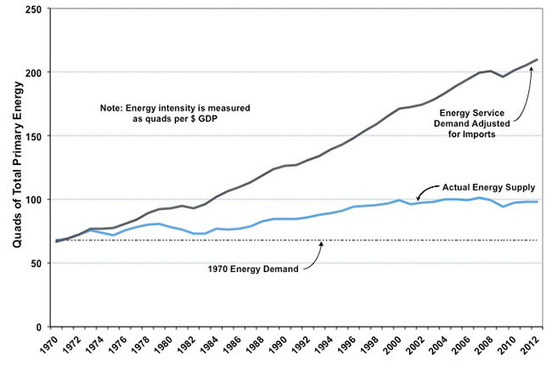
Bottom line: The E2e analysis is very reasonable, but Breakthrough appears to be more interested in exaggerating to make its case, rather than sticking to the facts. The truth is that for 40 years energy efficiency has had a dramatic effect on worldwide energy consumption. In the United States, if we were to use energy today at the rate we were in 1974, we would be consuming more than twice the amount that we are actually using. […]”<


See on Scoop.itGreen & Sustainable News

Multifamily Building Energy Efficiency: SLEEC Financing

This winter, ACEEE, in partnership with Energi Insurance Services, will host a second gathering of select members of the Small Lenders Energy Efficiency Community (SLEEC) in Washington, D.C. The initial SLEEC convening in October 2013 brought together small- to medium-size lenders to discuss strategies for expanding activity in the market for energy efficiency financing. Building off the success of that first meeting, the second SLEEC gathering will focus exclusively on financing in the multifamily sector […]

Source: aceee.org

>” […] The goal of the upcoming SLEEC meeting is to discuss how recent developments inform the lender perspective on the size, attractiveness, and viability of the finance market for multifamily efficiency. We chose to address multifamily this year because potential savings are phenomenal at an estimated $3.4 billion per annum, and multifamily has traditionally been characterized by the label “hard to reach” due to significant barriers to entry. Single-family residential, large commercial, and MUSH (municipal, universities, schools, and hospitals) markets pose fewer barriers and have therefore been easier to approach, while multifamily is a more complex market posing greater obstacles.

The first and most commonly cited obstacle is known as the split-incentive problem: Landlords and building owners don’t always have an incentive to pursue energy efficiency improvements since their tenants would be the ones benefitting from reductions in energy bills. The next most bemoaned roadblocks are a lack of information and lack of available capital. Landlords and owners are experts at running their buildings, but may be in the dark on energy efficiency. Utilities and many loan agencies, while knowledgeable about energy efficiency, lack experience interacting with tenants. The resulting information gap inhibits energy efficiency projects from getting off the ground. This problem is exacerbated by a lack of capital, especially in the affordable housing market, where many buildings owners hold 30-year mortgages on their property with only one refinancing opportunity after 15 years. Unless building owners and potential lenders can capitalize on this small window, many projects would not have another opportunity to finance efficiency improvements for another 15 years.

Despite these barriers, there are a number of successful initiatives that are poised for impact. Perhaps the most successful is Energy Savers, a Chicago-based partnership between Elevate Energy and the Community Investment Corporation (CIC) that has retrofitted 17,500 apartments since 2008.  […] Innovative programs such as these are paving the way for energy efficiency in the multifamily housing market.

A perceived lack of capital may be attributable to issues surrounding the valuation of energy efficiency from a building owner’s perspective that manifests as low demand. […] “<


See on Scoop.itGreen Building Design – Architecture & Engineering

Asia-Pacific Microgrid Market on ‘threshold of exponential growth’

According to the report, the market generated revenues of US$84.2 million in 2013 and Frost & Sullivan predicts that by 2020 this will rise almost tenfold to US$814.3 million, forecasting a compound annual growth rate of 38.3%.

Source: www.pv-tech.org

>” […] This growth is expected to come from activity in establishing microgrids for rural electrification in developing countries, and from commercial microgrids in the developed ones. The report cites the examples of Australia and Japan among the developed countries.

Mining operations in remote parts of Australia are one example of reliance on microgrids, powered by on-site generation. This has come traditionally from diesel generators, which are being combined with or replaced by solar-plus-storage. According to several sources the economics for this are already compelling.

Countries with a strong recent history in rural electrification referred to by Frost & Sullivan include Indonesia, the Philippines and Malaysia. In the example of Indonesia, the country’s utilities are aiming to bring electrification to 90% of the rural population by 2025. In total the report covered the countries of Japan, South Korea, Indonesia, Malaysia, the Philippines, and Australia.

However, despite this recent activity, the report highlights several barriers that are preventing the market reaching its potential. One such example is the high capital cost of installing microgrids in tandem with energy storage systems.  […]

[…] rising electricity prices in many regions would lead utility companies away from diesel and onto renewables to run their microgrids. It could also encourage “stronger governmental support through favorable regulations, funds and subsidies”, as the use of renewable energy for microgrids would require some forms of energy storage, which are still expensive to install […]

“The utilisation of renewable energy sources, either in standalone off-grid applications or in combination with local micro-grids, is therefore recognised as a potential route for rural farming communities to develop, as well as an opportunity to tackle the health issues associated with kerosene and biomass dependence. For example, the Indian Government aims to replace around 8 million existing diesel fuelled groundwater pumps, used by farmers for irrigation, with solar powered alternatives,” according to Fox. […]”<

See on Scoop.itGreen Energy Technologies & Development

UK Renewable Energy Subsidy Underwrites Development

Energy secretary, Ed Davey, says new subsidy scheme will help underwrite green energy and reduce reliance on imported gas

Source: www.theguardian.com

>”[…] “Solar has been the rising star in the coalition’s renewable energy programme and has been championed recently by the Prime Minister at the UN and by Ministers at conference,” said Paul Barwell, chief executive of the STA.

“Why is the UK government putting this industry’s incredible achievements on solar power at risk? To curtail its growth now is just perverse and unjustified on budgetary grounds – solar has only consumed around 1% of the renewables obligation budget,” he added.

He was supported by Friends of the Earth, whose renewable energy campaigner, Alasdair Cameron, argued the government move would be bad news for jobs, the climate and people wanting to plug into clean power.

“Solar could be cheaper than fossil fuels in just a few years, but it needs a little more help from government to get it there. Failure to invest now will mean a huge missed opportunity for the UK economy,” he said.

The raised budget to £300m has been welcomed by the wider renewable power sector but industry officials said the complex structure and cost would unfairly benefit large utilities at the expense of smaller and medium-sized enterprises (SMEs). […]”<

See on Scoop.itGreen & Sustainable News

6 Schemes to Implement for Plant ISO 50001 Certification

During a webcast  […] representatives from the US Department of Energy and Underwriters Laboratories walked through the details of the just-released energy management standard, and how companies can get on board, quickly.

Source: www.greenbiz.com

>”When the standard achieves widespread adoption, it’s estimated that ISO 50001 could influence up to 60 percent of the world’s energy use.  […]

ISO 50001 requires continuous improvement, but not specific requirements, which is where the ITP program comes in, to have specific requirements of improvement. The value of the certification, Scheihing said, is that for the first time it provides a framework for continual improvement for facilities on energy performance, and across the entire organization.

To be certified, you have to conform to the ISO 50001 management standard, and you have to improve your energy performance, and get both aspects certified under a third party. There are 24 companies working in the pilot mode of ISO 50001, across all types of manufacturing sectors and at all sizes.

Between 2008 and 2010, five initial facilities in Texas were piloted, and have been certified to date. Scheihing said the energy improvements achieved at the facilities ranged from 6.5 percent to 17.1 percent over a three-year period.

Among the initial feedback from the pilot project include the benefits of having a cross-functional plant energy management team that goes beyond just operations or engineering means that energy management becomes a shared responsibility, and that makes it much easier to incorporate significant changes in energy use.

One of the biggest shifts that the pilot projects found was that as a result of going through ISO 50001 certification, energy management became a way of doing business, instead of a project-by-project undertaking.  […]


Scheihing laid out six steps that any organization can take to get started on ISO 50001 today:

Secure support from top management;Collect, track, and analyze energy data;Identify key energy uses;Establish a baseline;Identify energy-saving opportunities;Prioritize opportunities

The Department of Energy has created a new website for energy management, which lays out an overview of ISO 50001 and offers case studies and tools to help companies undertake those first steps.

Jerry Skaggs from UL DQS followed on Scheihing’s presentation to walk through each of the six steps, as well as a checklist for organizations to follow once they’ve gone through the process to ensure proper implementation and follow-through.

In the end, there are a number of benefits to effectively implement an energy management system, including:

• Reduced operational and overhead costs lead to increased profitability
• Reduced air emissions, such as GHGs
• Increased efficiency of energy sources
• Increased assurance of legal, internal compliance
• Variables affecting energy use and consumption are identified
• Increased understanding of energy use and consumption via defined methods, processes of data collection

UL DQS, which brings the Management Systems Solutions division of Underwriters Laboratories together with DQS, a German management certification company, offers a number of specialized services for helping companies assess and implement opportunities for energy management, including ISO 50001 certification.  […] “<

See on Scoop.itGreen Building Operations – Systems & Controls, Maintenance & Commissioning

Energy Management Standard ISO 50001: Case Studies Document Energy And Cost Savings For N/A Industrial Plants

Three North American industrial plants that recently deployed energy management systems (EnMS) are highlighted in new case studies from the Global…

Source: www.plantautomation.com

>”Washington /PRNewswire / – Three North American industrial plants that recently deployed energy management systems (EnMS) are highlighted in new case studies from the Global Superior Energy Performance (GSEP) Energy Management Working Group (EMWG). These latest entries in the growing GSEP series explain how two Canadian plants, IBM and Lincoln Electric, and one U.S. plant, HARBEC, Inc., deployed ISO-compliant systems to manage their energy more efficiently while boosting competitiveness. GSEP, an initiative of the Clean Energy Ministerial, publishes the series in an effort to improve energy efficiency and mitigate carbon emissions around the globe.

U.S. Case Study HARBEC, Inc. improved the energy performance of its specialty plastics manufacturing plant in upstate New York by 16.5%, primarily by managing its combined heat and power unit more efficiently. The plant’s verified conformance with the international energy management standard ISO 50001 and its sustained improvements in energy performance earned HARBEC Platinum certification from the U.S. Superior Energy Performance (SEP) program, administered through the U.S. Department of Energy. […]

The USD$127,000 invested to implement SEP was paid back by the resulting operational energy cost savings within 2.4 years. The EnMS now saves the plant 6 billion Btu (6,300 gigajoules) annually and lowers energy costs by USD$52,000 each year at prevailing energy prices. HARBEC’s real-time automated system continuously monitors plant equipment to sustain and continuously improve energy performance. […]

Canadian Case Studies: (1)  IBM implemented an EnMS at its manufacturing facility in Bromont, Quebec, which helped it to reduce energy consumption by 9.2% and save CAD$550,000 in 2013. The savings came from 36 energy efficiency projects implemented as part of the EnMS. Tool modifications generated approximately 27% of the savings, while heating, ventilation, and air conditioning and exhaust reduction projects generated the other 73%. Equipment throughout the plant is now monitored using dashboards that show real-time energy use. View IBM case study.

With the support of Natural Resources Canada (NRCan), IBM Bromont was certified for conformance with CAN/CSA ISO 50001 in 2013. NRCan’s Canadian Industry Program for Energy Conservation provided plant staff with various energy conservation tools and services that assisted with EnMS development and certification.

(2)  Lincoln Electric became CAN/CSA ISO 50001 certified after implementing an EnMS at its facility in Toronto, Ontario, which manufactures steel welding wire and industrial diesel-driven DC generator welding machines. With the help of NRCan, Lincoln Electric developed an EnMS that reduced the facility’s energy consumption by 22% in 2013. […]

Plant management was initially interested in an EnMS as a means to maintain competitiveness and reduce risks associated with volatile energy prices. The company learned that its successful EnMS implementation owes much to its corporate culture that actively encourages the identification of energy improvements and conservation measures. The plant expects its EnMS to lead to continuous improvement in overall plant energy consumption. […]”<

See on Scoop.itGreen Building Operations – Systems & Controls, Maintenance & Commissioning

California Real Estate Assn’ Educates Members on Building Energy Performance & Benchmarking

In California, brokers are at the heart of every non-residential sale or lease. Can the AIR organization get them on board with benchmarking?

Source: www.greenbiz.com

>”Commercial buildings are some of California’s largest energy- and water-guzzlers. With 58 percent of the state locked in the highest category of drought, many commercial property owners are seeing increased utility bills, and with a new building energy benchmarking and disclosure law on the books, building owners seek energy efficiency solutions as a common-sense way to ease some of the pressure. One key trade association in California, the AIR Commercial Real Estate Association, is taking the lead by educating its members on the benefits of energy efficiency.

AIR, founded in 1960, is a regional commercial real estate brokers association with more than 1,700 members across southern California, and is one of the nation’s largest organizations of its kind. It’s recognized across the U.S. for its ever-expanding library of sample lease forms, which members use to stay updated on industry and lease language trends — several of which now include sustainability. When California’s energy benchmarking law, AB 1103, went into effect in January, AIR responded by creating sample energy disclosure lease and sale addenda (PDF) and began educating its members on these new tools.

Brokers are in the thick of it

The law states that any time a non-residential building owner finances, sells or leases a whole building, the property owner is required to use Energy Star portfolio manager to benchmark the building and provide the Energy Star rating and supporting consumption information to the lender, buyer or tenant in the transaction. As brokers are central to every aspect of a commercial transaction, their participation is essential for the law to have its intended effect. AIR’s lease and sale addenda effectively address these energy disclosure requirements in one document, providing real estate professionals, building owners, tenants and attorneys with a framework template for compliance with the regulation.

Brokers hold the key to increasing stakeholder awareness, potentially boosting compliance rates, benchmarking data quality and ultimately better building performance and energy management — and educating the community about new regulations and tools is essential to unlocking this potential.”<

See on Scoop.itGreen & Sustainable News

CEC Delays Energy Benchmarking and Disclosure Requirements 2 Years for Smaller Buildings


>”[…]Compliance with AB 1103 is not suspended, and will continue to be required, for the sale, lease, or financing of buildings over 10,000 square feet that are otherwise subject to the regulations based upon occupancy type.

Significant barriers to compliance with AB 1103

An Emergency Rulemaking Action requires a description of specific facts justifying the immediate action. In justifying the two-year delay, the CEC explained that several stakeholders had expressed concerns about significant barriers to compliance with AB 1103. The CEC noted the following factors in justifying the two-year delay:

  • Some utilities have required tenant consents before releasing utility usage data despite letters sent from the CEC to utilities in July 2013 prohibiting such requirement. This requirement to obtain tenant consents significantly increases compliance costs.
  • Smaller utilities have expressed concerns with their ability to comply given limited staff and resources.
  • The Portfolio Manager platform and software has experienced significant technical problems.
  • The expansion in scope to smaller buildings would increase the number of compliance requests received by utilities, impeding their ability to address barriers to compliance.
  • Smaller building owners may lack the expertise, resources, or capacity necessary to overcome current barriers to compliance without incurring undue expense.
  • Based on initial disclosure data following the January 1, 2014 implementation, it became apparent that “the required disclosures were not being made for the majority of transactions for which they were required.”
  • The development of best practices approaches is lowering compliance costs and paving the way to greater compliance. The additional two years will facilitate lower costs and higher compliance rates before further expanding the program to smaller buildings.”<

See on Scoop.itGreen Building Operations – Systems & Controls, Maintenance & Commissioning

Advanced Controls Devices for HVAC in Buildings shows growth

Worldwide revenue from advanced HVAC controls is expected to grow from $7 billion annually in 2014 to $11.7 billion in 2023, according to a new report

Source: www.businesswire.com

BOULDER, Colo.–(BUSINESS WIRE)–Heating, ventilation, and air conditioning (HVAC) in commercial buildings typically accounts for roughly 40% of total building energy consumption. While advancements have been made in the efficiency of HVAC equipment, the actual energy consumption of HVAC equipment depends largely on their operation – which can be made much more efficient and less energy-intensive through the application of advanced HVAC controls. […]

“The drive to reduce energy use in commercial buildings has put a spotlight on improving the efficiency of HVAC systems, and HVAC controls retrofits offer a compelling value proposition through reduced energy consumption in existing buildings.”

[…]

New building certification and benchmarking regulations are driving faster retrofits of controls in existing buildings, according to the report, and changing how automation is designed into new buildings. The wider adoption of open standards for controls functions (such as BACnet), and of communications based on the Internet Protocol (IP) suite and Ethernet connectivity, is expected to help bring advanced HVAC technology to a wider market.

[…]

See on Scoop.itGreen Building Operations – Systems & Controls, Maintenance & Commissioning