German village delivers great green energy blueprint

See on Scoop.itGreen Energy Technologies & Development

Nations as diverse as North Korea and the United States have sent personnel to a tiny village in the east of Germany in a bid to understand its successful energy transformation.

Duane Tilden‘s insight:

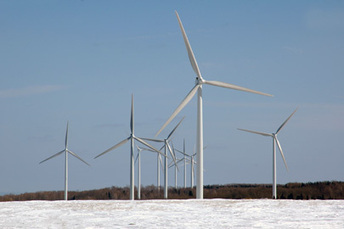
…Feldheim is powered by a mix of 43 wind turbines, a woodchip-fired heating plant and a biogas plant that uses cattle and pig slurry as well as maize silage.

Local energy costs of 16.6 euro cents per kilowatt hour (kWh) are just a little more than half of the 27-30 cents Germans pay on average …

Feldheim’s rates are not far off those in Poland, which generates nearly all its electricity from carbon-intensive coal-fired plants.  Households there paid on average 14 cents per kWh in 2012, while those in the Czech Republic, which relies on nuclear for about a third of its power generation, paid about 15 cents per kWh.

DT:  Current electricity pricing in Canada is 6.3 to 11.8 cents/kWh (US$) & United States is 8 to 17 cents/kWh (US$) ~ wiki

See on www.businessspectator.com.au

Is IT an Agent of Mass Extinction?

See on Scoop.itGreen Energy Technologies & Development

Enterprise architecture that automated decades ago must deal with new requirements and manage existing complexity, or face extinction

Duane Tilden‘s insight:

One of the first aspects of complexity in mature enterprises that comes to mind is what philosopher R. G. Collingwood called “the law of primitive survivals.” This states that earlier, more primitive forms of things coexist with later, more sophisticated forms of things. We see this in biology, where primitive forms, like sharks, exist with modern forms, like bony fishes, and algae coexist with flowering plants. The primitive coexists with the modern to a surprising extent. …

What is Complexity?

The complexity of information, technology and application architectures in mature enterprises seems to take the form of the survival of previous generations of environments integrated with overlays of more modern generations. …

Evolution and Extinction

Large, mature enterprises have seen mainframes, PCs, distributed processing, the Internet, the cloud and are now in the early stages of another revolution: big data. How much more complexity can be added to their environments? I have tried looking for answers in evolutionary science, which I studied at university; the field teaches that specialization typically leads to the inability to adapt to changing circumstances. …

See on www.information-management.com

Imagining the Supergrid: HVDC Loops for High Penetration of Renewable Energy | The Energy Collective

See on Scoop.itGreen Energy Technologies & Development

The piecemeal way that the grid is being reinforced today is not compatible with a future supergrid incorporating renewable energy sources. This post examines an alternative layout for new HVDC connections for a future supergrid.

Duane Tilden‘s insight:

The case for a supergrid is very sensibly made by several organizations, …

GW must be transmitted thousands of km) so that the aggregate reliability of wind and solar are greatly improved, because generators in different weather regions can share capacity.

Since weather systems are typically ~ 2500 km (~1500 miles) across, the supergrid does not begin to fulfill its potential until it is quite large, after many billions of dollars have been invested.

This factor is very much holding up practical movement towards a supergrid, and what we are currently getting instead is a patchwork of transmission upgrades that are economically inefficient point-to-point connections that will not later fit in as components of a future supergrid. …

See on theenergycollective.com

The Most Important Man in Energy Storage? Try Archimedes – Forbes

See on Scoop.itGreen Energy Technologies & Development

A growing number of energy storage start-ups are promoting the idea that the most economical, most expedient ways to store power revolves around harnessing the four elements of the ancient world: earth, air, water and fire.

Duane Tilden‘s insight:

Energy Cache, for instance, is developing a system that resembles a ski lift for gravel. Gravel is ferried uphill during the day by a series of buckets, and then dropped during peak power hours. The system essentially provides the drop in elevation nature left out.

An Energy Cache system could be erected at a large number of abandoned mining sites, where there is plenty of gravel and an existing grid connection,  […] Along with the physics, the company is analyzing algorithms to ensure smooth power deliver on demand for the power grid. …

See on www.forbes.com

GTM Research Names Top 150 Vendors in Smart Grid Across 12 Market Segments : Greentech Media

See on Scoop.itGreen Energy Technologies & Development

The Networked Grid 150 report is the strategic compendium on the vendor and technology landscape for today’s smart grid utility.

Duane Tilden‘s insight:

… the report ranks the top vendors within each of the following market segments: Advanced Metering Infrastructure, Building Area Networks, Consulting & Integration, Demand Response, Electric Vehicle Infrastructure, Energy Storage, Field Area Networks, Home Area Networks, Networking & Management, Soft Grid, Security, Transmission & Distribution, and Wide Area Network Communications.

See on www.greentechmedia.com

Stanford researchers map out an alternative energy future for New York

See on Scoop.itGreen & Sustainable News

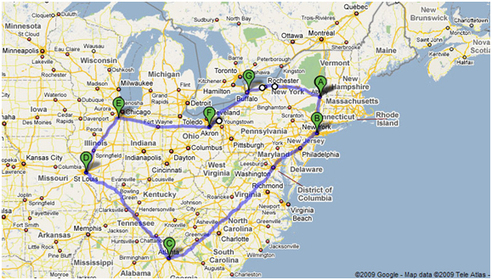
A study, co-authored by Stanford researcher Mark Z. Jacobson, outlines a path to statewide renewable energy conversion, and away from natural gas and imported fuel.

Duane Tilden‘s insight:

The study is the first to develop a plan to fulfill all of a state’s transportation, electric power, industry, and heating and cooling energy needs with renewable energy, and to calculate the number of new devices and jobs created, amount of land and ocean areas required, and policies needed for such an infrastructure change. It also provides new calculations of air pollution mortality and morbidity impacts and costs based on multiple years of air quality data.

To ensure grid reliability, the plan outlines several methods to match renewable energy supply with demand and to smooth out the variability of WWS resources. These include a grid management system to shift times of demand to better match with timing of power supply, and “over-sizing” peak generation capacity to minimize times when available power is less than demand.

The study’s authors are developing similar plans for other states, including California and Washington. They took no funding from any interest group, company or government agency for this study.

See on news.stanford.edu

WIND ENERGY TOP SOURCE FOR NEW GENERATION IN 2012; AMERICAN WIND POWER INSTALLED NEW RECORD OF 13,124 MW …

See on Scoop.itGreen Energy Technologies & Development

The U.S. wind energy industry had its strongest year ever in 2012 […] installing a record 13,124 megawatts (MW) of electric generating capacity, leveraging $25 billion in private investment,and achieving over 60,000 MW of cumulative wind capacity.

Duane Tilden‘s insight:

In this historic year of achievement, wind energy for the first time became the number one source of new U.S. electric generating capacity, providing some 42 percent of all new generating capacity; the final tally will be released in April in AWEA’s annual report. In fact, 2012 was a strong year for all renewables, as together they accounted for over 55 percent of all new U.S. generating capacity.

“The fact that wind power grew by another 28 percent in 2012 alone and poured $25 billion of private investment into the U.S. last year demonstrates wind’s ability to scale up, and continue to serve as a leading source of energy in America,” Gramlich said.

The global wind energy industry will gather in Chicago, Ill., this May 5-8, 2013, for the world’s largest annual wind power event, WINDPOWER 2013. Thousands of workers and leaders from all sectors will attend to show their wares, attend conference sessions, and seek further solutions for success.

See on www.power-eng.com

Renewables Move up the Rankin’s

Renewables Move up the Rankin’s.

Energy Managers Also Manage People

See on Scoop.itGreen Building Operations – Systems & Controls, Maintenance & Commissioning

It takes three specifically-trained professionals to run a successful energy-management program at a large facility, according to a column in Chemical Processing

Duane Tilden‘s insight:

While the energy manager assumes responsibility for the company’s energy program, he or she can can get help from energy consultants & energy auditors.

See on www.energymanagertoday.com