Energy scavenging by U.S. Army Research Laboratory using SmartBED – Energy Harvesting Journal

See on Scoop.itGreen Energy Technologies & Development

Energy Scavenging is just one way ARL experts are getting more from existing resources, said Dr. Edward Shaffer, who is the Energy and Power Division Chief at the lab. Energy harvesting is critical to realize “net zero” energy use, a key element of the…

Duane Tilden‘s insight:

Department of Defense operational energy is an emerging area being shaped. It is what is required to train, move, and sustain forces, weapons, and equipment for military operations. It accounted for 75 percent of all energy used by DOD in 2009, according to the Energy website for DOD. It was in May 2011, when the Assistant Secretary of Defense for Operational Energy, Plans and Programs defined an operational energy strategy, and then published Operational Energy for the warfighter, a guide that would transform the way the DOD consumes energy in military operations.

Shaffer has a wide view of the energy needs across Army, DOD and interagency forums that explore complimentary ways of addressing energy and power technology gaps and reduce duplicated efforts, including the DOD Energy and Power Community of Interest and the Interagency Advanced Power Group that includes agencies like the Department of Energy and NASA. These communities are comprised of scientists, engineers, subject matter experts, technologists and program managers with a common interest in promoting innovative energy and power solutions for the nation.

At ARL, the future is a seamless energy architecture that begins with concepts like SmartBED, Long-lived Power and Fuel-Reforming for better energy convergence.


See on www.energyharvestingjournal.com

Vestas Receives Its Largest Order Ever in Chile

See on Scoop.itGreen & Sustainable News

Project consists of 22 V100-1.8 MW and 35 V100-2.0 MW wind turbines, which will be installed in Coquimbo region.

Duane Tilden‘s insight:

The order has been placed by Empresas Públicas de Medellín (EPM), a Colombian multi-utility focusing on power generation, transmission and distribution, natural gas distribution, wastewater treatment and telecommunications. The company’s power segment has an installed base of 3,250MW, equal to 23.5% of the national installed capacity.

The Los Cururos wind power plant will have an estimated annual production of more than 290,000MWh, […] it will provide enough electricity to cover the residential electricity consumption of more than 550,500 people in Chile.

See on www.onlinetes.com

Wind energy is clearly B.C.’s clean choice

See on Scoop.itGreen & Sustainable News

British Columbians have consistently called for an energy system that is independent, low-impact and as affordable as possible.

Duane Tilden‘s insight:

For many decades, the province has benefited significantly from the abundant and affordable supply of hydroelectricity provided through dams built by BC Hydro between the 1920s and the 1980s. Demand now significantly exceeds these aging sources of supply. […]

Wind energy is the ideal complement to B.C.’s existing hydro-dependent electricity system. B.C.’s wind energy resources produce more electricity in winter, when demand for power is at its highest and there is less water available to generate hydroelectricity. Better yet, we have the potential to integrate 6,000 MW of wind-generated electricity at minimal cost within BC Hydro’s existing and planned hydroelectric facilities, so wind-generated power is available when it’s needed. In fact, combining new wind energy resources with B.C.’s heritage hydroelectric resources will create a stronger hybrid electricity system better suited to the needs of the province than the system in place today.

Read more: http://www.vancouversun.com/business/Wind+energy+clearly+clean+choice/8308417/story.html#ixzz2RsG9qP16

See on www.vancouversun.com

Solar Wind Energy Tower, Inc. Partners with Commonwealth Dynamics, Inc.

See on Scoop.itGreen Energy Technologies & Development

Solar Wind Energy Tower, Inc. Partners with Commonwealth Dynamics, Inc.

Duane Tilden‘s insight:

Over the last six months, Solar Wind Energy’s design and construction management  teaming partners have been diligently working on value engineering the core of our Tower structure in order to reduce cost, time of construction and utilize readily available construction materials, some of which that are indigenous to our region of construction.

Read more: http://www.digitaljournal.com/pr/1207274#ixzz2RVmrH89d

See on www.digitaljournal.com

NEMA Praises Introduction of Bill to Promote Energy Storage Technologies, National

See on Scoop.itGreen Energy Technologies & Development

April 25, 2013 – NEMA endorsed HR 1465, STORAGE 2013, which promotes adoption of state-of-the-art energy storage technologies, calling this legislation “carefully crafted” in its regard for entire range of energy storage technologies. …

Duane Tilden‘s insight:

“Energy storage is a key enabler of the Smart Grid and is transforming the way we think about electricity,” said NEMA President and CEO Evan R. Gaddis. “By getting us beyond the need to generate electricity at the same moment as it is used, energy storage delivers greater system efficiency, enhances reliability and resiliency, and fosters integration of renewable energy.”

STORAGE 2013 would offer a 30 percent investment tax credit for energy storage used in connection with the power grid, with no project eligible to receive more than $40 million, and the total program capped at $1.5 billion. For municipal utilities and electric cooperatives, the legislation would make energy storage eligible for new clean renewable energy bonds. To promote efficiency and distributed generation in the commercial and residential markets, the bill offers a 30 percent credit (up to $1 million) for onsite application of energy storage.

See on news.thomasnet.com

International Battery and Energy Storage Alliance Founded – Solar Novus Today

See on Scoop.itGreen Energy Technologies & Development

IPVEA and EuPD Research form International Battery and Energy Storage Alliance

Duane Tilden‘s insight:

The newly founded alliance plans to support and enable cooperation between companies from the fields of solar energy production, electrical energy storage and smart grid technologies. Together, the members of the International Battery and Energy Storage Alliance (IBESA) will create access to professional resources, market intelligence, new networks, and emerging markets. Over 70 members of the International PV Equipment Association (IPVEA) will immediately benefit from this strong partnership.

Alongside companies in the photovoltaic, battery and solar storage sectors, IBESA is also a valuable partner for energy providers, municipal utilities, installers, consulting firms and banks. …

Interested companies can contact the International Battery and Energy Storage Alliance directly in order to become members.

See on www.solarnovus.com

Biofuel Used to Make Stronger Building Materials

See on Scoop.itGreen Building Design – Architecture & Engineering

Biodiesel Fuel. Image Source: Tomorrow Is Greener Civil engineers have developed a tougher and more resilient form of concrete by using waste material created during the manufacture of biofuel as a proxy for cement.

Duane Tilden‘s insight:

Biofuel manufactured from cellulose materials such as wood and straw creates a residue called lignin, which is generally deemed a waste product and disposed of via burning or burial.

Engineers at the University of Kansas have found that the lignin has immense potential as a green building ingredient. When 20 per cent lignin waste was added to a concrete mix as a replacement for cement, the ensuing chemical reaction created a building material endowed with 30 per cent more strength.

The findings could have tremendous implications for both the biofuel and concrete industries, as well as the carbon footprint of the construction sector, which generates immense CO2 emissions due to cement production.

See on designbuildsource.com.au

Zero Carbon Building Wins Hong Kong’s Inaugural Engineering Innovation Award

See on Scoop.itGreen Building Design – Architecture & Engineering

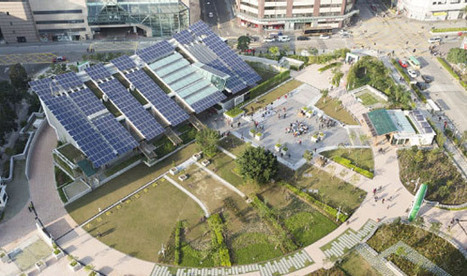
Image Source: Arup Hong Kong’s Zero Carbon Building (ZCB) has won the inaugural “Champion of the Innovation Award for the Engineering Industry” from the Hong Kong Institution of Engineers (HKIE). The ZCB employed a swath of integrated innovatio …

Duane Tilden‘s insight:

The ZCB employed a swath of integrated innovations to best meet the unique conditions of Hong Kong’ sub-tropical location and frenetic urban setting, incorporating a total of over 80 sustainability features to heighten its efficiency and diminish its environmental impact.

The roof of the three-storey building is almost completely covered in photovoltaic panels to take advantage of Hong Kong’s torrid climate for power generation purposes. In addition to solar power, the ZCB is also capable of producing energy using biodiesel derived from waste cooking oil, which is widely used in the city’s thriving culinary culture.

See on designbuildsource.com.au

Waste and Recycling Industry – Landfill Gas Collection Almost 50% of Renewable Energy Supply USA

See on Scoop.itGreen & Sustainable News

WASHINGTON, April 18, 2013 /PRNewswire-USNewswire/ — The waste and recycling industry is continuing to reduce its release of greenhouse gases — even as waste volumes increase, according to the latest greenhouse gas inventory released by U.S. Environmental Protection Agency (EPA).

Duane Tilden‘s insight:

Despite the fact that we are landfilling 6 percent less than 20 years ago, we have greatly improved our ability to reduce methane emissions. As a result, these emissions declined by 30 percent during the same period. This has happened as a result of converting methane to energy, flaring of methane emissions and oxidation techniques.

There are 594 landfill gas-to-energy sites in the United States that generated 1,813 megawatts (MW) of energy and 312 million standard cubic feet a day (mmscfd) of gas. This is enough energy to directly power 1 million homes and heat 729,000, respectively.

Methane gas collected at landfills is used to power home, businesses and government facilities across the nation. Some of it is even used to fuel garbage trucks. Landfill-gas-to-energy projects and other forms of biomass-derived energy make up the almost half of the nation’s renewable energy supply, almost the same amount as is derived from solar, wind, geothermal and hydropower combined.

See on online.wsj.com

Is Gasification Better Than Incineration? Read: Global Markets for Gasifiers – WSJ.com

See on Scoop.itGreen Energy Technologies & Development

NEW YORK, April 15, 2013 /PRNewswire/ — Reportlinker.com announces that a new market research report is available in its catalogue:

Global Markets for Gasifiers

Duane Tilden‘s insight:

INTRODUCTION

Gasification is a centuries–old thermochemical energy conversion technology that has slowly achieved modernity over the decades. The technology is undergoing its third evolutionary surge. Fuel shortages in WWII spurred widespread adoption for vehicle fuels. The oil crisis 1973 spurred a re–evaluation and renewed development. Rising oil prices, globally increasing fuel demand, and overwhelming scientific evidence of climate change have spurred this last leg to full industrialization.

The central concept of gasification is that by raising carbon–rich materials to high temperatures in an oxygen–deficient containment, the material will break down thermochemically instead of burning. If the same material is combusted (burned), it emits carbon monoxide and a host of pollutants, besides being incompletely consumed. If gasified, the products are hydrogen (H2), carbon monoxide (CO) and carbon dioxide (CO2). This is synthetic gas, simply called “syngas.” It can be burned, captured, stored, or its molecules rearranged to form fuels and chemical feedstocks.

The process is moderately more efficient than incineration, has significantly fewer emissions and waste, and the syngas can be shaped into a myriad of products for power production, chemical industries, liquid fuels, and heat.

Feedstock for gasification can be coal, the organic components of municipal waste, industrial waste streams, chemical feedstocks, forestry residues, forest products and crop residues, medical waste, unrecycled plastic or, in the case of plasma gasifiers, almost any nonradioactive material.

A gasifier is the central component of a gasification plant. Surrounding it are the feedstock conditioning and delivery systems, oxygen, steam and air input systems, waste removal components, syngas cooling and cleaning systems, power plants, heat recovery units, Fischer–Tropsch molecule rearrangers, and so on. This report focuses on the markets for gasifier units that are in place and will be installed by application segment and geographic location through the year 2017.

See on online.wsj.com