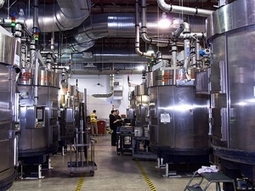
Energy Efficiency Key to Reducing Energy Waste and Consumption

Advocates say doing more with less power may be an even more critical weapon in the fight against climate change than renewable technologies.

Source: www.nytimes.com

>” […]

“Some people call energy efficiency low-hanging fruit. I would even say energy efficiency is fruit lying on the ground. We only need to bend over and pick it up.”

Realizing those energy savings would be a huge boon to the climate, ease illness-causing air pollution, reduce many nations’ reliance on fuel imports and increase competitiveness by lowering costs, the advocates say. It creates jobs in fields like upgrading buildings, and is generally cheaper than the alternative of constructing new power plants and buying more energy, they argue. […]”<

See on Scoop.itGreen & Sustainable News

CAN NYC REDUCE ITS CARBON FOOTPRINT 90% BY 2050?

“The building sector is the source of 75 percent of New York City’s greenhouse gas emissions. 90 by 50’s modeling of eight typical building types shows that heating and cooling loads can be reduced through retrofit measures to a point where all thermal loads can be met by heat pumps, eliminating building fuel use. The resulting electric energy used in 2050, supplied by carbon-free sources, will be slightly more than today’s, while peak demand will increase significantly. “

RO Engineers & Architects's avatarRO Engineers & Architects

In an article by urban green council,

“The building sector is the source of 75 percent of New York City’s greenhouse gas emissions. 90 by 50’s modeling of eight typical building types shows that heating and cooling loads can be reduced through retrofit measures to a point where all thermal loads can be met by heat pumps, eliminating building fuel use. The resulting electric energy used in 2050, supplied by carbon-free sources, will be slightly more than today’s, while peak demand will increase significantly. “

How will we meet this goal when there are a number of behavioral, institutional and infrustructural issues?

Let’s name a few…..

  1. The NYC subway still has outdated lighting with T12 with magnetic ballasts
  2. A large # of residential buildings the tenants leave their window a/c units installed year round which results in heat loss
  3. Alternate side parking- numerous places throughout the city people sit and idle their…

View original post 174 more words

The financial case for energy efficiency

“The report, Building the Future, has piled pressure on Ministers to act to fix Britain’s badly insulated homes. The report shows that a much more ambitious energy efficiency investment programme would pay for itself and significantly boost the UK economy.

The programme would add £13.9 billion annually to the UK economy by 2030, with GDP boosted by £3.20 for every £1 invested by the Government. A national scheme to make homes super-energy efficient would result in £8.6 billion in energy savings per year by 2030, an average energy saving of £372 per household. After taking into account loan repayments this would result in £4.95 billion in financial savings per year for Britain’s households.”

Multifamily Building Energy Efficiency: SLEEC Financing

This winter, ACEEE, in partnership with Energi Insurance Services, will host a second gathering of select members of the Small Lenders Energy Efficiency Community (SLEEC) in Washington, D.C. The initial SLEEC convening in October 2013 brought together small- to medium-size lenders to discuss strategies for expanding activity in the market for energy efficiency financing. Building off the success of that first meeting, the second SLEEC gathering will focus exclusively on financing in the multifamily sector […]

Source: aceee.org

>” […] The goal of the upcoming SLEEC meeting is to discuss how recent developments inform the lender perspective on the size, attractiveness, and viability of the finance market for multifamily efficiency. We chose to address multifamily this year because potential savings are phenomenal at an estimated $3.4 billion per annum, and multifamily has traditionally been characterized by the label “hard to reach” due to significant barriers to entry. Single-family residential, large commercial, and MUSH (municipal, universities, schools, and hospitals) markets pose fewer barriers and have therefore been easier to approach, while multifamily is a more complex market posing greater obstacles.

The first and most commonly cited obstacle is known as the split-incentive problem: Landlords and building owners don’t always have an incentive to pursue energy efficiency improvements since their tenants would be the ones benefitting from reductions in energy bills. The next most bemoaned roadblocks are a lack of information and lack of available capital. Landlords and owners are experts at running their buildings, but may be in the dark on energy efficiency. Utilities and many loan agencies, while knowledgeable about energy efficiency, lack experience interacting with tenants. The resulting information gap inhibits energy efficiency projects from getting off the ground. This problem is exacerbated by a lack of capital, especially in the affordable housing market, where many buildings owners hold 30-year mortgages on their property with only one refinancing opportunity after 15 years. Unless building owners and potential lenders can capitalize on this small window, many projects would not have another opportunity to finance efficiency improvements for another 15 years.

Despite these barriers, there are a number of successful initiatives that are poised for impact. Perhaps the most successful is Energy Savers, a Chicago-based partnership between Elevate Energy and the Community Investment Corporation (CIC) that has retrofitted 17,500 apartments since 2008.  […] Innovative programs such as these are paving the way for energy efficiency in the multifamily housing market.

A perceived lack of capital may be attributable to issues surrounding the valuation of energy efficiency from a building owner’s perspective that manifests as low demand. […] “<


See on Scoop.itGreen Building Design – Architecture & Engineering

6 Schemes to Implement for Plant ISO 50001 Certification

During a webcast  […] representatives from the US Department of Energy and Underwriters Laboratories walked through the details of the just-released energy management standard, and how companies can get on board, quickly.

Source: www.greenbiz.com

>”When the standard achieves widespread adoption, it’s estimated that ISO 50001 could influence up to 60 percent of the world’s energy use.  […]

ISO 50001 requires continuous improvement, but not specific requirements, which is where the ITP program comes in, to have specific requirements of improvement. The value of the certification, Scheihing said, is that for the first time it provides a framework for continual improvement for facilities on energy performance, and across the entire organization.

To be certified, you have to conform to the ISO 50001 management standard, and you have to improve your energy performance, and get both aspects certified under a third party. There are 24 companies working in the pilot mode of ISO 50001, across all types of manufacturing sectors and at all sizes.

Between 2008 and 2010, five initial facilities in Texas were piloted, and have been certified to date. Scheihing said the energy improvements achieved at the facilities ranged from 6.5 percent to 17.1 percent over a three-year period.

Among the initial feedback from the pilot project include the benefits of having a cross-functional plant energy management team that goes beyond just operations or engineering means that energy management becomes a shared responsibility, and that makes it much easier to incorporate significant changes in energy use.

One of the biggest shifts that the pilot projects found was that as a result of going through ISO 50001 certification, energy management became a way of doing business, instead of a project-by-project undertaking.  […]


Scheihing laid out six steps that any organization can take to get started on ISO 50001 today:

Secure support from top management;Collect, track, and analyze energy data;Identify key energy uses;Establish a baseline;Identify energy-saving opportunities;Prioritize opportunities

The Department of Energy has created a new website for energy management, which lays out an overview of ISO 50001 and offers case studies and tools to help companies undertake those first steps.

Jerry Skaggs from UL DQS followed on Scheihing’s presentation to walk through each of the six steps, as well as a checklist for organizations to follow once they’ve gone through the process to ensure proper implementation and follow-through.

In the end, there are a number of benefits to effectively implement an energy management system, including:

• Reduced operational and overhead costs lead to increased profitability
• Reduced air emissions, such as GHGs
• Increased efficiency of energy sources
• Increased assurance of legal, internal compliance
• Variables affecting energy use and consumption are identified
• Increased understanding of energy use and consumption via defined methods, processes of data collection

UL DQS, which brings the Management Systems Solutions division of Underwriters Laboratories together with DQS, a German management certification company, offers a number of specialized services for helping companies assess and implement opportunities for energy management, including ISO 50001 certification.  […] “<

See on Scoop.itGreen Building Operations – Systems & Controls, Maintenance & Commissioning

Energy Management Standard ISO 50001: Case Studies Document Energy And Cost Savings For N/A Industrial Plants

Three North American industrial plants that recently deployed energy management systems (EnMS) are highlighted in new case studies from the Global…

Source: www.plantautomation.com

>”Washington /PRNewswire / – Three North American industrial plants that recently deployed energy management systems (EnMS) are highlighted in new case studies from the Global Superior Energy Performance (GSEP) Energy Management Working Group (EMWG). These latest entries in the growing GSEP series explain how two Canadian plants, IBM and Lincoln Electric, and one U.S. plant, HARBEC, Inc., deployed ISO-compliant systems to manage their energy more efficiently while boosting competitiveness. GSEP, an initiative of the Clean Energy Ministerial, publishes the series in an effort to improve energy efficiency and mitigate carbon emissions around the globe.

U.S. Case Study HARBEC, Inc. improved the energy performance of its specialty plastics manufacturing plant in upstate New York by 16.5%, primarily by managing its combined heat and power unit more efficiently. The plant’s verified conformance with the international energy management standard ISO 50001 and its sustained improvements in energy performance earned HARBEC Platinum certification from the U.S. Superior Energy Performance (SEP) program, administered through the U.S. Department of Energy. […]

The USD$127,000 invested to implement SEP was paid back by the resulting operational energy cost savings within 2.4 years. The EnMS now saves the plant 6 billion Btu (6,300 gigajoules) annually and lowers energy costs by USD$52,000 each year at prevailing energy prices. HARBEC’s real-time automated system continuously monitors plant equipment to sustain and continuously improve energy performance. […]

Canadian Case Studies: (1)  IBM implemented an EnMS at its manufacturing facility in Bromont, Quebec, which helped it to reduce energy consumption by 9.2% and save CAD$550,000 in 2013. The savings came from 36 energy efficiency projects implemented as part of the EnMS. Tool modifications generated approximately 27% of the savings, while heating, ventilation, and air conditioning and exhaust reduction projects generated the other 73%. Equipment throughout the plant is now monitored using dashboards that show real-time energy use. View IBM case study.

With the support of Natural Resources Canada (NRCan), IBM Bromont was certified for conformance with CAN/CSA ISO 50001 in 2013. NRCan’s Canadian Industry Program for Energy Conservation provided plant staff with various energy conservation tools and services that assisted with EnMS development and certification.

(2)  Lincoln Electric became CAN/CSA ISO 50001 certified after implementing an EnMS at its facility in Toronto, Ontario, which manufactures steel welding wire and industrial diesel-driven DC generator welding machines. With the help of NRCan, Lincoln Electric developed an EnMS that reduced the facility’s energy consumption by 22% in 2013. […]

Plant management was initially interested in an EnMS as a means to maintain competitiveness and reduce risks associated with volatile energy prices. The company learned that its successful EnMS implementation owes much to its corporate culture that actively encourages the identification of energy improvements and conservation measures. The plant expects its EnMS to lead to continuous improvement in overall plant energy consumption. […]”<

See on Scoop.itGreen Building Operations – Systems & Controls, Maintenance & Commissioning

Methods of Improving Data Centers’ Energy Efficiency and Performance

America’s data centers are consuming — and wasting — a surprising amount of energy.

Source: www.livescience.com

>”Our study shows that many small, mid-size, corporate and multi-tenant data centers still waste much of the energy they use. Many of the roughly 12 million U.S. servers spend most of their time doing little or no work, but still drawing significant power — up to 30 percent of servers are “comatose” and no longer needed, while many others are grossly underutilized. However, opportunities abound to reduce energy waste in the data-center industry as a whole.  Technology that will improve efficiency exists, but systemic measures are needed to remove the barriers limiting its broad adoption across the industry.

How much energy do data centers use?

The rapid growth of digital content, big data, e-commerce and Internet traffic more than offset energy-efficiency progress, making data centers one of the fastest-growing consumers of electricity in the U.S. economy, and a key driver in the construction of new power plants. If such data centers were a country, they would be the globe’s 12th-largest consumer of electricity, ranking somewhere between Spain and Italy.

In 2013, U.S. data centers consumed an estimated 91 billion kilowatt-hours of electricity. That’s the equivalent annual output of 34 large (500-megawatt) coal-fired power plants — enough electricity to power all the households in New York City, twice over, for a year.  […]

Fixing the problem

While current technology can improve data center efficiency, we recommend systemic measures to create conditions for best-practices across the data center industry, including:

Adoption of a simple, server-utilization metric. One of the biggest efficiency issues in data centers is underutilization of servers. Adoption of a simple metric, such as the average utilization of the server central processing units (CPUs), is a key step in resolving the energy-consumption issue.  […]

Rewarding the right behaviors. Data center operators, service providers and multi-tenant customers should review their internal organizational structures and external contractual arrangements and ensure that incentives are aligned to provide financial rewards for efficiency best practices.  […]

Disclosure of data-center energy and carbon performance.Public disclosure is a powerful mechanism for demonstrating leadership and driving behavior change across an entire sector. […]

If just half of the technical savings potential for data-center efficiency that we identify in our report is realized (taking into account market barriers), electricity consumption in U.S. data centers could be cut by as much as 40 percent.  […]”<


See on Scoop.itGreen Energy Technologies & Development

California Real Estate Assn’ Educates Members on Building Energy Performance & Benchmarking

In California, brokers are at the heart of every non-residential sale or lease. Can the AIR organization get them on board with benchmarking?

Source: www.greenbiz.com

>”Commercial buildings are some of California’s largest energy- and water-guzzlers. With 58 percent of the state locked in the highest category of drought, many commercial property owners are seeing increased utility bills, and with a new building energy benchmarking and disclosure law on the books, building owners seek energy efficiency solutions as a common-sense way to ease some of the pressure. One key trade association in California, the AIR Commercial Real Estate Association, is taking the lead by educating its members on the benefits of energy efficiency.

AIR, founded in 1960, is a regional commercial real estate brokers association with more than 1,700 members across southern California, and is one of the nation’s largest organizations of its kind. It’s recognized across the U.S. for its ever-expanding library of sample lease forms, which members use to stay updated on industry and lease language trends — several of which now include sustainability. When California’s energy benchmarking law, AB 1103, went into effect in January, AIR responded by creating sample energy disclosure lease and sale addenda (PDF) and began educating its members on these new tools.

Brokers are in the thick of it

The law states that any time a non-residential building owner finances, sells or leases a whole building, the property owner is required to use Energy Star portfolio manager to benchmark the building and provide the Energy Star rating and supporting consumption information to the lender, buyer or tenant in the transaction. As brokers are central to every aspect of a commercial transaction, their participation is essential for the law to have its intended effect. AIR’s lease and sale addenda effectively address these energy disclosure requirements in one document, providing real estate professionals, building owners, tenants and attorneys with a framework template for compliance with the regulation.

Brokers hold the key to increasing stakeholder awareness, potentially boosting compliance rates, benchmarking data quality and ultimately better building performance and energy management — and educating the community about new regulations and tools is essential to unlocking this potential.”<

See on Scoop.itGreen & Sustainable News

CEC Delays Energy Benchmarking and Disclosure Requirements 2 Years for Smaller Buildings


>”[…]Compliance with AB 1103 is not suspended, and will continue to be required, for the sale, lease, or financing of buildings over 10,000 square feet that are otherwise subject to the regulations based upon occupancy type.

Significant barriers to compliance with AB 1103

An Emergency Rulemaking Action requires a description of specific facts justifying the immediate action. In justifying the two-year delay, the CEC explained that several stakeholders had expressed concerns about significant barriers to compliance with AB 1103. The CEC noted the following factors in justifying the two-year delay:

  • Some utilities have required tenant consents before releasing utility usage data despite letters sent from the CEC to utilities in July 2013 prohibiting such requirement. This requirement to obtain tenant consents significantly increases compliance costs.
  • Smaller utilities have expressed concerns with their ability to comply given limited staff and resources.
  • The Portfolio Manager platform and software has experienced significant technical problems.
  • The expansion in scope to smaller buildings would increase the number of compliance requests received by utilities, impeding their ability to address barriers to compliance.
  • Smaller building owners may lack the expertise, resources, or capacity necessary to overcome current barriers to compliance without incurring undue expense.
  • Based on initial disclosure data following the January 1, 2014 implementation, it became apparent that “the required disclosures were not being made for the majority of transactions for which they were required.”
  • The development of best practices approaches is lowering compliance costs and paving the way to greater compliance. The additional two years will facilitate lower costs and higher compliance rates before further expanding the program to smaller buildings.”<

See on Scoop.itGreen Building Operations – Systems & Controls, Maintenance & Commissioning

Advanced Controls Devices for HVAC in Buildings shows growth

Worldwide revenue from advanced HVAC controls is expected to grow from $7 billion annually in 2014 to $11.7 billion in 2023, according to a new report

Source: www.businesswire.com

BOULDER, Colo.–(BUSINESS WIRE)–Heating, ventilation, and air conditioning (HVAC) in commercial buildings typically accounts for roughly 40% of total building energy consumption. While advancements have been made in the efficiency of HVAC equipment, the actual energy consumption of HVAC equipment depends largely on their operation – which can be made much more efficient and less energy-intensive through the application of advanced HVAC controls. […]

“The drive to reduce energy use in commercial buildings has put a spotlight on improving the efficiency of HVAC systems, and HVAC controls retrofits offer a compelling value proposition through reduced energy consumption in existing buildings.”

[…]

New building certification and benchmarking regulations are driving faster retrofits of controls in existing buildings, according to the report, and changing how automation is designed into new buildings. The wider adoption of open standards for controls functions (such as BACnet), and of communications based on the Internet Protocol (IP) suite and Ethernet connectivity, is expected to help bring advanced HVAC technology to a wider market.

[…]

See on Scoop.itGreen Building Operations – Systems & Controls, Maintenance & Commissioning