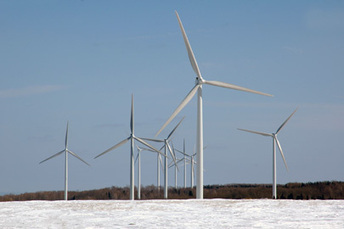
Stanford researchers map out an alternative energy future for New York

See on Scoop.itGreen & Sustainable News

A study, co-authored by Stanford researcher Mark Z. Jacobson, outlines a path to statewide renewable energy conversion, and away from natural gas and imported fuel.

Duane Tilden‘s insight:

The study is the first to develop a plan to fulfill all of a state’s transportation, electric power, industry, and heating and cooling energy needs with renewable energy, and to calculate the number of new devices and jobs created, amount of land and ocean areas required, and policies needed for such an infrastructure change. It also provides new calculations of air pollution mortality and morbidity impacts and costs based on multiple years of air quality data.

To ensure grid reliability, the plan outlines several methods to match renewable energy supply with demand and to smooth out the variability of WWS resources. These include a grid management system to shift times of demand to better match with timing of power supply, and “over-sizing” peak generation capacity to minimize times when available power is less than demand.

The study’s authors are developing similar plans for other states, including California and Washington. They took no funding from any interest group, company or government agency for this study.

See on news.stanford.edu

Historic Energy Decisions in U.S. and Canada | The Energy Collective

See on Scoop.itGreen & Sustainable News

Renewable energy in the U.S. and Canada will rise while the consumption of fossil fuels lessens.Wishful thinking by some people to the contrary, fossil fuels are here to stay for at least the next 30-40 years. In North America this timeframe will be an era of transition as the proportion of renewable energy in the U.S. and Canada will rise while the consumption of fossil fuels lessens.

Duane Tilden‘s insight:

The increase in U.S. oil production is the result of advances in non-traditional drilling technologies, including oil hydrofracking […].  For its natural gas production, the U.S. is in the throes of a hydrofracking frenzy, producing natural gas in unprecedented amounts. […]

The U.S. trend toward energy self sufficiency represents a precarious situation for Canada’s economic wellbeing since 95 percent of Canada’s energy exports (including hydroelectric power) today go to the U.S.  […]

See on theenergycollective.com

EPA proposes 2013 biofuels quota, RIN verification program – Oil & Gas Journal

See on Scoop.itGreen Energy Technologies & Development

The US Environmental Protection Agency proposed 2013 biofuels quotas representing a more than 1.35 billion gal increase from what it mandated for 2012. Officials from two leading petroleum trade associations immediately called the 16.55 billion gal total representing 9.63% of total projected US motor fuel production unrealistic and unreasonable.

Duane Tilden‘s insight:

“We are disturbed that EPA is mandating 14 million gallons of cellulosic ethanol when zero gallons are available for compliance as of today,” AFPM President Charles T. Drevna said on Jan. 31. […]

“[…] This stealth tax on gasoline might be the most egregious example of bad public policy, and consumers could be left to pay the price. EPA needs a serious reality check.”

“[…] it is shocking that the Agency would mandate such high biodiesel volumes this year since 140 million biodiesel credits turned out to be fraudulent,” […] it is unrealistic to assume the biodiesel industry will actually produce 1.28 billion gal of real biodiesel this year.”

See on www.ogj.com

Biofuels groups downplay ruling’s impact on investment – The Hill’s E2-Wire

See on Scoop.itGreen Energy Technologies & Development

Biofuels groups are downplaying a Friday federal court decision that some believe could cut off investments in advanced green fuels.

Duane Tilden‘s insight:

The rule requires refiners to blend 36 billion gallons of biofuel into traditional transportation fuel by 2022. Of that total, 21 billion gallons must come from cellulosic and “advanced” biofuels, which are made from non-edible feedstock.

But the court said EPA acted in “excess of the agency’s statutory authority” in projecting refiners could blend 10.45 million gallons of cellulosic biofuel in 2012, as only 22,000 gallons were produced.

[…]

In its lawsuit against the EPA, the American Petroleum Institute (API) argued refiners were forced to buy credits to fill the gap in the agency’s projections and actual production levels.

The court sided with API on that point, giving the oil-and-gas lobby its first victory in its full-court press to repeal the biofuel mandate.

API is pushing Congress to tear down the rule and is fighting the rule through the courts. It also has a lawsuit on file challenging EPA’s projections for 2011.

“We are glad the court has put a stop to EPA’s pattern of setting impossible mandates for a biofuel that does not even exist. This absurd mandate acts as a stealth tax on gasoline with no environmental benefit that could have ultimately burdened consumers,” API Group Downstream Director Bob Greco said in a Friday statement.

See on thehill.com

Photovoltaics vs. Biofuel

See on Scoop.itGreen Energy Technologies & Development

As facility managers and building owners prepare for another year of green pushes and renewable energy options, has research determined a winner in the photovoltaic vs. biofuel energy battle?

Duane Tilden‘s insight:

[…] in a paper titled “Spatially Explicit Life Cycle Assessment of Sun-to-Wheels Transportation Pathways in the U.S.” and published in the Dec. 26 issue of the journal Environmental Science & Technology, showed photovoltaics (PV) to be much more efficient than biomass at turning sunlight into energyto fuel a car.

“PV is orders of magnitude more efficient than biofuels pathways in terms of land use – 30, 50, even 200 times more efficient – depending on the specific crop and local conditions,” says Geyer. “You get the same amount of energy using much less land, and PV doesn’t require farm land.”

The researchers examined three ways of using sunlight to power cars: a) the traditional method of converting corn or other plants to ethanol; b) converting energy crops into electricity for BEVs rather than producing ethanol; and C) using PVs to convert sunlight directly into electricity for BEVs.

… “The cost of solar power is dropping, and our quick calculations suggests that with the federal tax credit, electric vehicles are already competitive.”

What does this mean for the future?

“What it says to me is that by continuing to throw money into biofuels, we’re barking up the wrong tree,” Geyer explains. …

See on www.buildings.com

EU faces fresh calls to strengthen biofuel rules

See on Scoop.itGreen Energy Technologies & Development

Greenpeace-backed report argues EU can meet green transport targets without relying on controversial land-based biofuels

Duane Tilden‘s insight:

NGOs are increasingly fearful that member states’ efforts to meet the targets through an increase in the use of biofuels will have a negligible impact on greenhouse gas emissions and in some cases could lead to increased emissions as companies source biofuels made from food and energy crops that are alleged to have contributed to deforestation and food price inflation.

The EU Commission has acknowledged the risk and last year proposed a new limit on the use of biofuels made from food crops that would ensure such fuels could only count towards half of the 10 per cent target for renewable fuel use.

The proposals have encountered lobbying from some member states who have argued the binding 10 per cent goal cannot be met if limits are placed on the use of biofuels made from food crops.

But the CE Delft report argues the targets can be met through greater investment in fuel efficiency measures, waste and residue-based biofuels, and electric vehicles, alongside tighter rules to phase out the use of biofuels made from land-based food or energy crops.

See on www.businessgreen.com

Could Some Midwest Land Support New Biofuel Refineries?

See on Scoop.itGreen Energy Technologies & Development

Millions of acres of marginal farmland in the Midwest — land that isn’t in good enough condition to grow crops — could be used to produce liquid fuels made from plant material, according to a study in Nature. And those biofuels could, in theory, provide about 25 percent of the advanced biofuels required by a 2007 federal law.

Duane Tilden‘s insight:

But some researchers in the field aren’t convinced the resource is nearly that big. Adam Liska at the University of Nebraska in Lincoln says a lot of this acreage is in the Great Plains, which wouldn’t produce a reliable crop year after year.

“One year you may have high rainfall and high crop yields and be able to sustain your facility, [but] the next year you may have a drought,” Liska says.

Indeed, Brent Erickson […] says nobody has plans just yet to use this kind of plant material to make biofuels. […]

“Every region of the country has some form of biomass — so the Northwest would have sawdust and wood waste; the California area might have rice straw or wheat straw, … Refiners in the Midwest are looking at corn cobs, and a plant that’s actually operating in Florida uses dead citrus trees.”

“As this technology progresses we’re going to see a great diversification of biomass supply,” Erickson predicts.

… Timothy Searchinger, an associate research scholar at Princeton University.

The 27 million acres identified in the latest study would provide less than 0.5 percent of our national energy demand, he says. And the more we try to expand biofuels, the more we risk displacing crops for food, or chopping down forests, which store a huge amount of carbon.

Searchinger says Europe has recently recognized those potential hazards and is scaling back its biofuels ambitions.

“They realize that it was a mistake, and their compromise for the moment is essentially to cap what they’re doing and then they promise by 2020 to phase out all government support for biofuels.”

See on www.opb.org

5 Biofuel Trends to Watch Out for in 2013

See on Scoop.itGreen & Sustainable News

2012 saw the introduction of next generation, advanced biorefineries. Here we look at the trends that will hit the biofuel market in 2013, including; Green Diesel, Decline of Oil,

Duane Tilden‘s insight:

The Retreat of Oil Majors

Trend: Oil Majors double down on “Golden Age of Gas” while narrowing investments across the advanced biofuel space.

An early strategic investor in the advanced biofuels industry, global oil majors have begun trimming excess fat from their biofuel investment portfolios over the past couple of years. BP, a leading investor in the biofuels industry, pulled out of its commercial Highlands Park project in Florida in October 2012 to refocus on R&D efforts. Shell, meanwhile, has dropped a number of investments across the advanced biofuels landscape, concentrating its commercialization efforts on its Raizen joint venture with Cosan in Brazil.

See on oilprice.com

Lower nitrogen losses with perennial biofuel crops

See on Scoop.itGreen & Sustainable News

Perennial biofuel crops such as miscanthus, whose high yields have led them to be considered an eventual alternative to corn in producing ethanol, are now shown to have another beneficial characteristic — the ability to reduce the escape of…

Duane Tilden‘s insight:

In the study, funded by the Energy Biosciences Institute, miscanthus, switchgrass, and mixed prairie species were compared against a typical corn-corn-soybean rotation. Harvested biomass and nitrogen, nitrous oxide emissions, and nitrate leaching in the mid-soil profile and through tile drainage lines were all measured.

The researchers found that the perennial crops quickly reduced nitrate leaching in the mid-soil profile as well as from tile lines. “By year four each of the perennial crops had small losses,” Smith said. “Nitrous oxide emissions also were much smaller in the perennial crops–including switchgrass, which was fertilized with nitrogen, while prairie and miscanthus were not. Overall, nitrogen levels were higher for the corn and soybean treatment as well as switchgrass, but were lower for prairie and miscanthus. Prairie and miscanthus levels were lower due to harvest of the plant biomass (and nitrogen) each winter, with no fertilizer nitrogen additions to replace it, as occurred in corn and switchgrass,” she said.

See on www.sciencedaily.com

Why Frack When You Can Grow Biofuel? USDA Has $25 Million In Answers

See on Scoop.itGreen & Sustainable News

The U.S. Department of Agriculture has just embarked on a new round of $25 million in funding for four new biofuel research and development projects, offering farmers and other rural property owners the potential for new alternatives to selling or…

Duane Tilden‘s insight:

One of USDA’s new projects addresses this approach through a new cropping system, in which the weedy biofuel plant camelina will be rotated with wheat-based plants. The $5 million project, through Kansas State University, will study the commercial feasibility of converting camelina to biobased adhesives and coatings as well as biofuel.

Another $6.5 million will go to Ohio State University to demonstrate an innovative anaerobic digestion system (anaerobic refers to bacteria that thrive without oxygen) that can handle multiple feedstocks. The new system will use natural decomposition to break down manure, agricultural waste, woody biomass and biofuel crops.

There is no such thing as impact-free energy production, but all of these biofuel projects are designed to fit sustainably into the core business of the farmer, which all boils down to long term land stewardship.

See on cleantechnica.com