NREL: News – NREL Teams Up on Three ARPA-E Projects to Optimize Electric Vehicle Battery Management and Controls

See on Scoop.itGreen Energy Technologies & Development

Over the next three years, NREL engineers will work with teams led by Utah State University, Washington University, and Eaton Corporation to optimize utilization, life, and cost of lithium-ion (Li-ion) batteries for electric-drive vehicles (EDVs) through improved battery management and controls. The three projects are funded under the AMPED program with more than $7.4 million from DOE’s Advanced Research Projects Agency-Energy (ARPA-E).

Duane Tilden‘s insight:

The ultimate goal of these projects is to make EDVs viable options for a larger and wider population of drivers. The projects for each team are:

Power Management of Large Battery Packs – Utah State University ($3 million)

Objectives:    Reduction in battery size, 20% longer battery pack lifetime or 20% reduction in battery pack energy content and 50% increase in cold temperature charge rate […]
Battery Management System Design – Washington University ($2 million)

Objective:     20% increase in utilization of untapped Li-ion battery capacity at the cell level […]
Predictive Battery Management for Hybrid Vehicles -Eaton Corporation ($2.4 million)

Objective:    50% improvement in fuel economy of heavy-duty HEVs without sacrificing battery life […]

See on www.nrel.gov
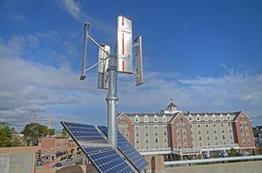
Wing Power Energy focuses on micro-wind systems for cell towers, buildings – Boston Business Journal

See on Scoop.itGreen Energy Technologies & Development

While large wind farms like the Cape Wind Project routinely take years to get approval and support, Wing Power Energy is focused on micro-wind systems – small generators that produce less than 10 kilowatts…

Duane Tilden‘s insight:

[…]Wing Power Energy’s technology is a vertical, four-blade wind propeller combined with a solar panel, which together can generate as much as 3.5 kilowatt hours of electricity.

Recently, the company put up a live demonstration in the City of Salem, consisting of three hybrid wind/solar turbines on the rooftop of a municipal parking garage powering 4G LTE enabled Verizon wireless equipment, including two video surveillance cameras, one digital signboard and a complete wireless network, completely off grid and running only on the power generated by the turbines. The company now has about 15 systems up and running or in the works around the country.

See on www.bizjournals.com

Commercial, institutional and federal buildings | Office of Energy Efficiency

See on Scoop.itGreen Building Operations – Systems & Controls, Maintenance & Commissioning

ENERGY STAR Portfolio Manager, developed by the U.S. Environmental Protection Agency, is being adapted for the Canadian buildings sector.

Duane Tilden‘s insight:

Portfolio Manager is a free, interactive energy management tool that allows you to track and assess energy and water consumption across your entire portfolio of buildings in a secure online environment.

See on oee.nrcan.gc.ca

Photovoltaics vs. Biofuel

See on Scoop.itGreen Energy Technologies & Development

As facility managers and building owners prepare for another year of green pushes and renewable energy options, has research determined a winner in the photovoltaic vs. biofuel energy battle?

Duane Tilden‘s insight:

[…] in a paper titled “Spatially Explicit Life Cycle Assessment of Sun-to-Wheels Transportation Pathways in the U.S.” and published in the Dec. 26 issue of the journal Environmental Science & Technology, showed photovoltaics (PV) to be much more efficient than biomass at turning sunlight into energyto fuel a car.

“PV is orders of magnitude more efficient than biofuels pathways in terms of land use – 30, 50, even 200 times more efficient – depending on the specific crop and local conditions,” says Geyer. “You get the same amount of energy using much less land, and PV doesn’t require farm land.”

The researchers examined three ways of using sunlight to power cars: a) the traditional method of converting corn or other plants to ethanol; b) converting energy crops into electricity for BEVs rather than producing ethanol; and C) using PVs to convert sunlight directly into electricity for BEVs.

… “The cost of solar power is dropping, and our quick calculations suggests that with the federal tax credit, electric vehicles are already competitive.”

What does this mean for the future?

“What it says to me is that by continuing to throw money into biofuels, we’re barking up the wrong tree,” Geyer explains. …

See on www.buildings.com

Dynamic Energy – A Leader in Energy Solutions | Combined Heat & Power

See on Scoop.itGreen Building Design – Architecture & Engineering

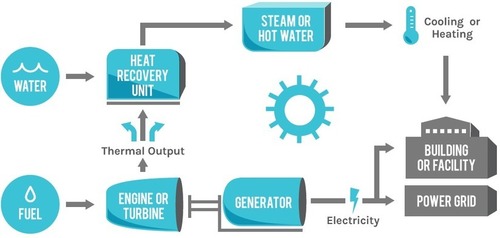
Dynamic Energy develops energy projects that reduce customers’ expenses, improve operating efficiency, provide an attractive return on investment, and help achieve sustainability goals.

Duane Tilden‘s insight:

CHP Financing – Direct Purchase

There are many reasons why now is a great time for CHP. Dynamic can provide multiple financing options including:

Purchasing a CHP system provides many benefits including:
• Traditional bank financing
• Federal 10% Investment Tax Credit
• Accelerated depreciation (MACRS)
• Aggressive state level incentives
• Locked forward natural gas contracts
• Significant thermal & electrical savings

Power Purchase Agreement
A Power Purchase Agreement (PPA) provides the host customer power and heat at a discounted rate, with no capital requirement. A third party investor owns the CHP system and eneters into a long term power contract with the host. PPAs provide the following benefits to host customers:

• No upfront cost or capital required
• Projects are cash flow positive from day one
• Predictable energy pricing & hedge against electricity prices
• No system performance or operating risk and no maintenance
• Align with organizational sustainability goals
• Press and media outreach

[For example of financing options, not intended as a corporate endorsement.]  DT

See on dynamicenergyusa.com

Guest Post: The Future of Energy Management in Commercial Buildings : Greentech Media

See on Scoop.itGreen Building Operations – Systems & Controls, Maintenance & Commissioning

Industry experts make predictions for 2013.

Duane Tilden‘s insight:

…the developments of 2012 are indicative of longer trends affecting how we will occupy and operate commercial buildings in 2013.

Policy and Disclosure

2012 saw a number of industry “firsts.” Perhaps none is more significant than the adoption of energy disclosure laws, which require residential and commercial buildings to reveal — sometimes publicly — the energy performance of the buildings. To date, six cities have passed such laws, which require the use of EPA’s Energy Star Portfolio Manager for buildings…

Utilities and the Green Button

Another major trend of 2012 has been the adoption by 35 electric and gas utilities of the “Green Button,” a voluntary, standardized data format for energy data. Green Button, a data standard developed by industry along with the National Institute of Standards and Technology (NIST), and ratified by the North American Energy Standards Board (NAESB), is meant to provide customer data in a computer-readable format so that software applications can uniformly tackle energy problems and identify opportunities for savings.

Civic Government

2012 was also a major year for civic and federal governments, as energy efficiency was a focus for large portfolios of public buildings. While some cities have already made strides in improving their own building performance, there has been a faster adoption of new technologies and operations strategies, and more vocal public acknowledgement of their goals to reduce energy and save taxpayer money.

See on www.greentechmedia.com

Smart Grid: Energy forecasting – a new approach to managing demand

See on Scoop.itGreen Building Operations – Systems & Controls, Maintenance & Commissioning

Smart Grid – A new service that could help the growing smart building management systems market forecasts energy demand day by day, a feature that allows users to increase energy efficiency and reduce…

Duane Tilden‘s insight:

Pete Segall, […] ATS Automation, … "Our customers look to us for ways to save money and reduce energy usage while minimizing capital expenses. GridNavigator’s energy forecasting service allows us to predict energy and demand spokes and launch automated reduction strategies before the demand event occurs."


Having that real-time information means operators can achieve smarter building management with remote adjustment of numerous devices and systems, like boilers and lighting. GridNavigator says engineers can now optimize BACnet (data communications protocol for building automation and control networks) building management systems based on day to day energy use patterns to avoid peaks and to respond to building occupant behavior to reduce demand.


"Energy forecasting allowed us to achieve an additional 3-5% energy savings and 7-10% demand reduction," said Kevin McKay, the community college’s VP for finance and operations. "This innovation in energy management helps manage our resources even more efficiently."


The service is being used throughout the 20-plus buildings on the 50-acre campus.

See on www.smartgridnews.com

EPB Deploys America’s Fastest Fiber-optic Smart Grid – Lee Baker, Smart Grid Consultant – Electric Energy Online

See on Scoop.itGreen Energy Technologies & Development

EPB Deploys America’s Fastest Fiber-optic Smart Grid – Lee Baker, Smart Grid Consultant – While many utilities struggle with the question of whether or not to build a Smart Grid, for the Electric Power Board (EPB) in …

Duane Tilden‘s insight:

Chattanooga: The Smarter City

EPB [Electric Power Board] is one of the first community-owned utilities to install a 100% fiber-optic network, which uses the fiber optic network for Smart Grid applications, in addition to the triple-play media services (i.e., high speed Internet, video and telephone) EPB already provides.

“Chattanooga is light years ahead when it comes to providing ultra fast broadband,” said Tom Edd Wilson, President and CEO of the Chattanooga Area Chamber of Commerce. “By offering the fastest available speeds to a whole community comprising a diverse population living in both urban and rural areas, Chattanooga has become the living laboratory for today’s innovations and tomorrow’s companies.”

EPB has built fiber optics throughout their entire customer service area and communications services are now available to all homes and businesses. By the end of 2012, all 170,000 homes and businesses will be equipped with a Tantalus smart meter.

[…] EPB already has 22 large industries signed up for a time-of-use (TOU) rate program, and its projected that together they will save $2.3 million a year. Those kinds of savings help businesses run more efficiently and bring jobs to the community.

“What makes Chattanooga stand out is that it is leveraging the network both for a full range of Smart Grid applications and communications connectivity,” Wade added.

“We looked at how the communication system and the electric system interact for many years and realized how closely tied together they are. As costs have stabilized and technology matured, we felt that the time was right to proceed with the project.”

“We’re building this network not just for today but for the future. The system we’re building will provide rapid, two-way communications with every meter, home and device, making it possible and practical for our customers to interact with their energy use as never before.”

See on www.electricenergyonline.com

EU faces fresh calls to strengthen biofuel rules

See on Scoop.itGreen Energy Technologies & Development

Greenpeace-backed report argues EU can meet green transport targets without relying on controversial land-based biofuels

Duane Tilden‘s insight:

NGOs are increasingly fearful that member states’ efforts to meet the targets through an increase in the use of biofuels will have a negligible impact on greenhouse gas emissions and in some cases could lead to increased emissions as companies source biofuels made from food and energy crops that are alleged to have contributed to deforestation and food price inflation.

The EU Commission has acknowledged the risk and last year proposed a new limit on the use of biofuels made from food crops that would ensure such fuels could only count towards half of the 10 per cent target for renewable fuel use.

The proposals have encountered lobbying from some member states who have argued the binding 10 per cent goal cannot be met if limits are placed on the use of biofuels made from food crops.

But the CE Delft report argues the targets can be met through greater investment in fuel efficiency measures, waste and residue-based biofuels, and electric vehicles, alongside tighter rules to phase out the use of biofuels made from land-based food or energy crops.

See on www.businessgreen.com

Could Some Midwest Land Support New Biofuel Refineries?

See on Scoop.itGreen Energy Technologies & Development

Millions of acres of marginal farmland in the Midwest — land that isn’t in good enough condition to grow crops — could be used to produce liquid fuels made from plant material, according to a study in Nature. And those biofuels could, in theory, provide about 25 percent of the advanced biofuels required by a 2007 federal law.

Duane Tilden‘s insight:

But some researchers in the field aren’t convinced the resource is nearly that big. Adam Liska at the University of Nebraska in Lincoln says a lot of this acreage is in the Great Plains, which wouldn’t produce a reliable crop year after year.

“One year you may have high rainfall and high crop yields and be able to sustain your facility, [but] the next year you may have a drought,” Liska says.

Indeed, Brent Erickson […] says nobody has plans just yet to use this kind of plant material to make biofuels. […]

“Every region of the country has some form of biomass — so the Northwest would have sawdust and wood waste; the California area might have rice straw or wheat straw, … Refiners in the Midwest are looking at corn cobs, and a plant that’s actually operating in Florida uses dead citrus trees.”

“As this technology progresses we’re going to see a great diversification of biomass supply,” Erickson predicts.

… Timothy Searchinger, an associate research scholar at Princeton University.

The 27 million acres identified in the latest study would provide less than 0.5 percent of our national energy demand, he says. And the more we try to expand biofuels, the more we risk displacing crops for food, or chopping down forests, which store a huge amount of carbon.

Searchinger says Europe has recently recognized those potential hazards and is scaling back its biofuels ambitions.

“They realize that it was a mistake, and their compromise for the moment is essentially to cap what they’re doing and then they promise by 2020 to phase out all government support for biofuels.”

See on www.opb.org