The Dark Side of Efficiency

zsturm's avatarInnovation in Business, Energy, and Environment

By Peter Brooks

In at least three of the cases we have studied so far (Maersk, Groom, Wal-Mart) efficiency was the one thing everyone seemed to agree on.  Investments in greater resource efficiency (energy, water, space) that cost less than future benefits are no-brainers; a company can save money while also preserving precious, finite resources (to say nothing of the safety, regulatory, aesthetic, and morale benefits of finding and fixing inefficiencies) and that is unequivocally a good thing.

Unfortunately there is a dark side to efficiency: it can be more destructive to the environment and speed the withdrawal and consumption of natural resources than if the investment were never made.  In the late 19th century, an English economist, William Jevons, made the startling discovery that technological improvements that increased the efficiency of coal-burning, led to an increased consumption of coal.  To put it another way, greater efficiency was used…

View original post 473 more words
Stanford Scientists Analyse Life Cycle Costs of Energy Storage vs Curtailment for Renewables

See on Scoop.itGreen Energy Technologies & Development

Stanford CA (SPX) Sep 17, 2013 –
Renewable energy holds the promise of reducing carbon dioxide emissions. But there are times when solar and wind farms generate more electricity than is needed by consumers.

Duane Tilden‘s insight:

>”We calculated how much energy is used over the full lifecycle of the battery – from the mining of raw materials to the installation of the finished device,” Barnhart said. “Batteries with high energetic cost consume more fossil fuels and therefore release more carbon dioxide over their lifetime. If a battery’s energetic cost is too high, its overall contribution to global warming could negate the environmental benefits of the wind or solar farm it was supposed to support.”

For this study, he and his colleagues calculated the energetic cost of grid-scale photovoltaic solar cells and wind turbines.

“Both wind turbines and photovoltaics deliver more energy than it takes to build and maintain them,” said GCEP postdoctoral scholar Michael Dale, a co-author of the study. “However, our calculations showed that the overall energetic cost of wind turbines is much lower than conventional solar panels, which require lots of energy, primarily from fossil fuels, for processing silicon and fabricating other components.” […]

To find out, the researchers compared the energetic cost of curtailing solar and wind power, versus the energetic cost of grid-scale storage. Their calculations were based on a formula known as “energy return on investment” – the amount of energy produced by a technology, divided by the amount of energy it takes to build and maintain it.

Using that formula, the researchers found that the amount of energy required to create a solar farm is comparable to the energy used to build each of the five battery technologies. “Using batteries to store solar power during periods of low demand would, therefore, be energetically favorable,” Dale said.

The results were quite different for wind farms. The scientists found that curtailing wind power reduces the energy return on investment by 10 percent. But storing surplus wind-generated electricity in batteries results in even greater reductions – from about 20 percent for lithium-ion batteries to ?more than 50 percent for lead-acid.<

See on www.solardaily.com

Revisiting The North American Hydropower Opportunity

See on Scoop.itGreen Energy Technologies & Development

It is no secret that many renewable energy advocates are not in favor of large hydropower.

Duane Tilden‘s insight:

>[…] there exists a threat that is even more worrisome to endangered species, a threat that has the potential to cause destructive flooding and destroy ecosystems: climate change.  […]

Perhaps that’s why in May of this year, the World Bank reversed its stance on large-scale hydropower. Whereas the major international development bank was once a staunch opponent of large-scale hydro, recognition that developing regions like Africa and Southeast Asia desperately need power have forced it to reconsider.  The world needs energy to lift people out of poverty and building more fossil fuel-fired electricity plants will only serve to exacerbate the problems already associated with climate change. Hydropower is an answer.

Maybe it is time for the renewable energy industry to take a second look at hydropower development. The clean energy it can provide is a vast improvement over the dirty energy we get from fossil fuels. Hydropower already meets about 8 percent of U.S. electricity demand and with improved technologies that already exist the National Hydropower Association (NHA) estimates that we can double the amount of energy we get from hydropower without building any more dams.<

See on www.renewableenergyworld.com

Google obtains a Renewable Energy Power Purchase Agreement in Texas

See on Scoop.itGreen Energy Technologies & Development

Duane Tilden‘s insight:

>The structure of this agreement is similar to our earlier commitments in Iowa and Oklahoma. Due to the current structure of the market, we can’t consume the renewable energy produced by the wind farm directly, but the impact on our overall carbon footprint and the amount of renewable energy on the grid is the same as if we could consume it. After purchasing the renewable energy, we’ll retire the renewable energy credits (RECs) and sell the energy itself to the wholesale market. We’ll apply any additional RECs produced under this agreement to reduce our carbon footprint elsewhere.<

See on googleblog.blogspot.ca

Boston Leads Ranking of Energy-Efficient U.S. Cities by ACEEE

See on Scoop.itGreen & Sustainable News

A new ranking highlights Boston’s achievements in conserving energy as the Senate debates a bipartisan energy efficiency bill.

Duane Tilden‘s insight:

>ACEEE graded 34 cities for their efforts in five areas: buildings, transportation, energy and water utility programs, local government operations, and community-wide initiatives.  […]

The cities’ leap forward in energy-efficiency efforts has been a stark contrast to the slow movement on Capitol Hill, where the Energy Savings and Industrial Competitiveness Act of 2013, authored by Sen. Jeanne Shaheen (D-New Hampshire) and Sen. Rob Portman (R-Ohio) has been struggling to move forward.

The bill, […] would require the federal government—the nation’s single largest energy consumer—to update government buildings to improve energy efficiency, institute electricity-saving measures for government computers, and make it easier for agencies to switch to electric and natural-gas-powered vehicles. It also would provide training for workers in how to build more energy-efficient buildings for the private sector, and help finance private-sector renovations for energy efficiency. […]<

See on news.nationalgeographic.com

Developing an Energy Management Program for Your Business

See on Scoop.itGreen Building Operations – Systems & Controls, Maintenance & Commissioning

Today more than ever, businesses are concerned with maximizing operational efficiency, minimizing costs, and seeking out untapped revenue streams. At the same

Duane Tilden‘s insight:

>Large energy users like many commercial, institutional, and industrial organizations have a unique opportunity to act as a “virtual power plant” while reducing their real-time demand for electricity—and opening up a new revenue stream. This strategy, known as demand response, is not only a cost-free way to reduce energy usage, but also it generates payments for participating businesses simply for being on call.

Demand response providers work with commercial, institutional, and industrial businesses to identify ways for facilities to reduce energy consumption without affecting business operations, comfort, or product quality. In turn, those facilities agree to reduce their demand during strategic times so that utilities and grid operators can improve reliability during times of peak demand. Demand response also helps increase economic efficiency in regional energy markets and integrate renewable generation capacity into generation systems.

Demand response can be considered a form of strategic energy efficiency, but what about long-term, persistent energy efficiency, a second key to a comprehensive energy management program? In even the most high-tech, LEED Platinum certified buildings, it can be very difficult to ensure efficient operation over time. […]<

See on www.dailyenergyreport.com

Japan to Switch Off Nuclear Power, With No Firm Date for Re-Start: Sci Am

See on Scoop.itGreen & Sustainable News

Japan is set to be nuclear power-free, for just the third time in more than four decades, and with no firm date for re-starting an energy source that has provided about 30 percent of electricity to the world’s third-largest economy.

Duane Tilden‘s insight:

>Kansai Electric Power Co’s 1,180 MW Ohi No.4 reactor is scheduled to be disconnected from the power grid late on Sunday and then shut for planned maintenance. It is the only one of Japan’s 50 reactors in operation after the nuclear industry came to a virtual halt following the March 2011 Fukushima disaster.

Japan last went without nuclear power in May-June 2012 – the first shutdown since 1970 – a year after a massive earthquake and tsunami triggered reactor meltdowns and radiation leaks at the Fukushima facility. The country’s nuclear reactors provided close to a third of the electricity to keep the $5 trillion economy going before the Fukushima disaster, and utilities have had to spend billions of dollars importing oil, gas and coal to make up for the shortfall. […]


IMPORT BILL

Japan consumes about a third of the world’s liquefied natural gas (LNG) production, and will likely boost LNG demand to record levels over the next couple of years. LNG imports rose 4.4 percent in volume to a record 86.87 million tonnes, and 14.9 percent in value to a record 6.21 trillion yen ($62.1 billion) in the year through March.

Imports are likely to rise to around 88 million tonnes this year and around 90 million tonnes in the year to March 2015, according to projections by the Institute of Energy Economics Japan based on a mid-scenario that 16 reactors will be back on-line by March 2015.<

See on www.scientificamerican.com

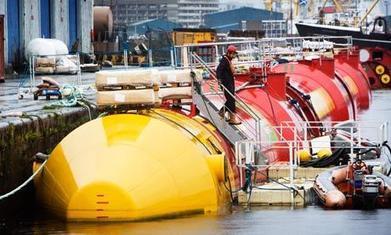
Scotland gives green light to Europe’s largest tidal energy project

See on Scoop.itGreen Energy Technologies & Development

Wave power to provide electricity to 40% homes in Highlands as work on building turbines in Pentland Firth gets approved

Duane Tilden‘s insight:

>”This is a major step forward for Scotland’s marine renewable energyindustry. When fully operational, the 86 megawatt array could generate enough electricity to power the equivalent of 42,000 homes – around 40% of homes in the Highlands. This … is just the first phase for a site that could eventually yield up to 398 megawatts.”<

See on www.theguardian.com

Coal Power: One Percent Of U.S. Power Plants Produce 12 % Of U.S. Carbon Emissions

See on Scoop.itGreen & Sustainable News

The disproportionate greenhouse impact of a small portion of U.S. power plants shows how damaging inefficiency and inertia can be.

Duane Tilden‘s insight:

>That one percent is actually 50 plants, all of them coal-fired. In fact, America’s single dirtiest power plant — Georgia Power’s Plant Scherer — dumped over 21 million metric tons (MMT) of carbon dioxide into the atmosphere in 2011. That’s more than all the energy-related emissions produced by the state of Maine that year.

And the disproportionate contribution of the dirtiest plants to greenhouse gas emissions continues on down the scale: in 2011, half of all the power sector’s carbon emissions came from the 100 dirtiest plants (98 of which are coal-fired). And 90 percent of all those emissions came from just the 500 dirtiest power plants. That’s out of almost 6,000 electricity generating facilities — renewable and fossil-fuel-powered alike — in the country.<

See on thinkprogress.org

Coal opposes Senate Energy Commission Nomination

See on Scoop.itGreen & Sustainable News

Ronald J. Binz, nominated to lead the Federal Energy Regulatory Commission, is opposed by the coal industry because of his efforts to promote renewable energy.

Duane Tilden‘s insight:

>At the Electricity Consumers Resource Council, which represents large industrial customers, Marc Yacker, a vice president, said that the coal industry had some reason to be worried. The industry believes, he said, that “the whole idea of socializing the cost of new transmission necessary to get wind to population centers is anti-coal.”<

See on www.nytimes.com