Energy Management Standard ISO 50001: Case Studies Document Energy And Cost Savings For N/A Industrial Plants

Three North American industrial plants that recently deployed energy management systems (EnMS) are highlighted in new case studies from the Global…

Source: www.plantautomation.com

>”Washington /PRNewswire / – Three North American industrial plants that recently deployed energy management systems (EnMS) are highlighted in new case studies from the Global Superior Energy Performance (GSEP) Energy Management Working Group (EMWG). These latest entries in the growing GSEP series explain how two Canadian plants, IBM and Lincoln Electric, and one U.S. plant, HARBEC, Inc., deployed ISO-compliant systems to manage their energy more efficiently while boosting competitiveness. GSEP, an initiative of the Clean Energy Ministerial, publishes the series in an effort to improve energy efficiency and mitigate carbon emissions around the globe.

U.S. Case Study HARBEC, Inc. improved the energy performance of its specialty plastics manufacturing plant in upstate New York by 16.5%, primarily by managing its combined heat and power unit more efficiently. The plant’s verified conformance with the international energy management standard ISO 50001 and its sustained improvements in energy performance earned HARBEC Platinum certification from the U.S. Superior Energy Performance (SEP) program, administered through the U.S. Department of Energy. […]

The USD$127,000 invested to implement SEP was paid back by the resulting operational energy cost savings within 2.4 years. The EnMS now saves the plant 6 billion Btu (6,300 gigajoules) annually and lowers energy costs by USD$52,000 each year at prevailing energy prices. HARBEC’s real-time automated system continuously monitors plant equipment to sustain and continuously improve energy performance. […]

Canadian Case Studies: (1)  IBM implemented an EnMS at its manufacturing facility in Bromont, Quebec, which helped it to reduce energy consumption by 9.2% and save CAD$550,000 in 2013. The savings came from 36 energy efficiency projects implemented as part of the EnMS. Tool modifications generated approximately 27% of the savings, while heating, ventilation, and air conditioning and exhaust reduction projects generated the other 73%. Equipment throughout the plant is now monitored using dashboards that show real-time energy use. View IBM case study.

With the support of Natural Resources Canada (NRCan), IBM Bromont was certified for conformance with CAN/CSA ISO 50001 in 2013. NRCan’s Canadian Industry Program for Energy Conservation provided plant staff with various energy conservation tools and services that assisted with EnMS development and certification.

(2)  Lincoln Electric became CAN/CSA ISO 50001 certified after implementing an EnMS at its facility in Toronto, Ontario, which manufactures steel welding wire and industrial diesel-driven DC generator welding machines. With the help of NRCan, Lincoln Electric developed an EnMS that reduced the facility’s energy consumption by 22% in 2013. […]

Plant management was initially interested in an EnMS as a means to maintain competitiveness and reduce risks associated with volatile energy prices. The company learned that its successful EnMS implementation owes much to its corporate culture that actively encourages the identification of energy improvements and conservation measures. The plant expects its EnMS to lead to continuous improvement in overall plant energy consumption. […]”<

See on Scoop.itGreen Building Operations – Systems & Controls, Maintenance & Commissioning

Methods of Improving Data Centers’ Energy Efficiency and Performance

America’s data centers are consuming — and wasting — a surprising amount of energy.

Source: www.livescience.com

>”Our study shows that many small, mid-size, corporate and multi-tenant data centers still waste much of the energy they use. Many of the roughly 12 million U.S. servers spend most of their time doing little or no work, but still drawing significant power — up to 30 percent of servers are “comatose” and no longer needed, while many others are grossly underutilized. However, opportunities abound to reduce energy waste in the data-center industry as a whole.  Technology that will improve efficiency exists, but systemic measures are needed to remove the barriers limiting its broad adoption across the industry.

How much energy do data centers use?

The rapid growth of digital content, big data, e-commerce and Internet traffic more than offset energy-efficiency progress, making data centers one of the fastest-growing consumers of electricity in the U.S. economy, and a key driver in the construction of new power plants. If such data centers were a country, they would be the globe’s 12th-largest consumer of electricity, ranking somewhere between Spain and Italy.

In 2013, U.S. data centers consumed an estimated 91 billion kilowatt-hours of electricity. That’s the equivalent annual output of 34 large (500-megawatt) coal-fired power plants — enough electricity to power all the households in New York City, twice over, for a year.  […]

Fixing the problem

While current technology can improve data center efficiency, we recommend systemic measures to create conditions for best-practices across the data center industry, including:

Adoption of a simple, server-utilization metric. One of the biggest efficiency issues in data centers is underutilization of servers. Adoption of a simple metric, such as the average utilization of the server central processing units (CPUs), is a key step in resolving the energy-consumption issue.  […]

Rewarding the right behaviors. Data center operators, service providers and multi-tenant customers should review their internal organizational structures and external contractual arrangements and ensure that incentives are aligned to provide financial rewards for efficiency best practices.  […]

Disclosure of data-center energy and carbon performance.Public disclosure is a powerful mechanism for demonstrating leadership and driving behavior change across an entire sector. […]

If just half of the technical savings potential for data-center efficiency that we identify in our report is realized (taking into account market barriers), electricity consumption in U.S. data centers could be cut by as much as 40 percent.  […]”<


See on Scoop.itGreen Energy Technologies & Development

California Real Estate Assn’ Educates Members on Building Energy Performance & Benchmarking

In California, brokers are at the heart of every non-residential sale or lease. Can the AIR organization get them on board with benchmarking?

Source: www.greenbiz.com

>”Commercial buildings are some of California’s largest energy- and water-guzzlers. With 58 percent of the state locked in the highest category of drought, many commercial property owners are seeing increased utility bills, and with a new building energy benchmarking and disclosure law on the books, building owners seek energy efficiency solutions as a common-sense way to ease some of the pressure. One key trade association in California, the AIR Commercial Real Estate Association, is taking the lead by educating its members on the benefits of energy efficiency.

AIR, founded in 1960, is a regional commercial real estate brokers association with more than 1,700 members across southern California, and is one of the nation’s largest organizations of its kind. It’s recognized across the U.S. for its ever-expanding library of sample lease forms, which members use to stay updated on industry and lease language trends — several of which now include sustainability. When California’s energy benchmarking law, AB 1103, went into effect in January, AIR responded by creating sample energy disclosure lease and sale addenda (PDF) and began educating its members on these new tools.

Brokers are in the thick of it

The law states that any time a non-residential building owner finances, sells or leases a whole building, the property owner is required to use Energy Star portfolio manager to benchmark the building and provide the Energy Star rating and supporting consumption information to the lender, buyer or tenant in the transaction. As brokers are central to every aspect of a commercial transaction, their participation is essential for the law to have its intended effect. AIR’s lease and sale addenda effectively address these energy disclosure requirements in one document, providing real estate professionals, building owners, tenants and attorneys with a framework template for compliance with the regulation.

Brokers hold the key to increasing stakeholder awareness, potentially boosting compliance rates, benchmarking data quality and ultimately better building performance and energy management — and educating the community about new regulations and tools is essential to unlocking this potential.”<

See on Scoop.itGreen & Sustainable News

CEC Delays Energy Benchmarking and Disclosure Requirements 2 Years for Smaller Buildings


>”[…]Compliance with AB 1103 is not suspended, and will continue to be required, for the sale, lease, or financing of buildings over 10,000 square feet that are otherwise subject to the regulations based upon occupancy type.

Significant barriers to compliance with AB 1103

An Emergency Rulemaking Action requires a description of specific facts justifying the immediate action. In justifying the two-year delay, the CEC explained that several stakeholders had expressed concerns about significant barriers to compliance with AB 1103. The CEC noted the following factors in justifying the two-year delay:

  • Some utilities have required tenant consents before releasing utility usage data despite letters sent from the CEC to utilities in July 2013 prohibiting such requirement. This requirement to obtain tenant consents significantly increases compliance costs.
  • Smaller utilities have expressed concerns with their ability to comply given limited staff and resources.
  • The Portfolio Manager platform and software has experienced significant technical problems.
  • The expansion in scope to smaller buildings would increase the number of compliance requests received by utilities, impeding their ability to address barriers to compliance.
  • Smaller building owners may lack the expertise, resources, or capacity necessary to overcome current barriers to compliance without incurring undue expense.
  • Based on initial disclosure data following the January 1, 2014 implementation, it became apparent that “the required disclosures were not being made for the majority of transactions for which they were required.”
  • The development of best practices approaches is lowering compliance costs and paving the way to greater compliance. The additional two years will facilitate lower costs and higher compliance rates before further expanding the program to smaller buildings.”<

See on Scoop.itGreen Building Operations – Systems & Controls, Maintenance & Commissioning

Google invests $145 million in new 82MW Southern California solar power plant

Energy Storage Solutions for the Smart Grid

In order to ramp up clean energy production, we have to figure out how to store and transmit it effectively. Companies are experimenting with new tech to figure out the best way to progress.

Source: www.techrepublic.com

>”The smart grid energy storage sector is expected to grow to $50 billion by 2020, with an annual compound growth rate of 8%, according to a recent report from Lux Research. In 2013, renewable energy accounted for only 10% of total US energy usage and 13% of electricity generation, according to the US Energy and Information Administration.

But as renewable energy generation rises, transmission and storage advancements will be necessary. Curtailment, the act of spilling renewable energy because there’s more than enough, is one issue to tackle. By changing grid transmission lines in 2010, Texas saw the curtailment in their grid drop from 9% to 4% in 2012, according to a report by the National Renewable Energy Laboratory.

The tipping point with energy storage depends on the grid and the technology used, said Sam Jaffe, an analyst at Navigant Research. Some places in the world that have extremely high penetration rates of renewable energy don’t have major problems with wasted renewables. Denmark sends its extra wind power to Sweden and Norway, while importing hydro power from those two countries when the wind isn’t blowing. Denmark’s wind penetration is now at almost 40%.

“That’s because they are interconnected to other grids that have a lot of flexibility to offtake renewable energy,” he said.”<


See on Scoop.itGreen Energy Technologies & Development

Advanced Controls Devices for HVAC in Buildings shows growth

Worldwide revenue from advanced HVAC controls is expected to grow from $7 billion annually in 2014 to $11.7 billion in 2023, according to a new report

Source: www.businesswire.com

BOULDER, Colo.–(BUSINESS WIRE)–Heating, ventilation, and air conditioning (HVAC) in commercial buildings typically accounts for roughly 40% of total building energy consumption. While advancements have been made in the efficiency of HVAC equipment, the actual energy consumption of HVAC equipment depends largely on their operation – which can be made much more efficient and less energy-intensive through the application of advanced HVAC controls. […]

“The drive to reduce energy use in commercial buildings has put a spotlight on improving the efficiency of HVAC systems, and HVAC controls retrofits offer a compelling value proposition through reduced energy consumption in existing buildings.”

[…]

New building certification and benchmarking regulations are driving faster retrofits of controls in existing buildings, according to the report, and changing how automation is designed into new buildings. The wider adoption of open standards for controls functions (such as BACnet), and of communications based on the Internet Protocol (IP) suite and Ethernet connectivity, is expected to help bring advanced HVAC technology to a wider market.

[…]

See on Scoop.itGreen Building Operations – Systems & Controls, Maintenance & Commissioning

Residential Battery Storage Nears Grid Parity in Germany

It’s very close, according to the German government and some industry observers.

Source: www.greentechmedia.com

>”It is now generally recognized that rooftop solar has reached “socket parity” — meaning that it is comparable to or cheaper than grid prices — in many countries over the last few years. The big question for consumers and utilities is when socket parity will arrive for solar and battery storage.

[…] Electricity prices are rising and solar PV prices are falling, which means that if battery storage falls to around €0.20 per kilowatt-hour (U.S. $0.27), parity will be achieved.

Australian investment firm Morgans, in an assessment of Brisbane-based battery storage developer Redflow, suggests that that company’s zinc-bromine flow battery may already be commercially economic in Germany, the country that leads the world in terms of household adoption and government support for renewables.

Morgans notes that in Germany, the cost of household grid power is around €0.30 per kilowatt-hour (U.S. $0.40) and that the government is now subsidizing residential energy storage systems that are connected to solar systems.

“Given Germany’s substantial adoption of solar PV…costs for solar power range from €0.10 to €0.15 per kilowatt-hour (half the grid price), so when energy storage costs reach €0.15 to €0.20, this will mean renewable energy costs will be at parity with grid prices,” Morgans concludes.  […]”<


See on Scoop.itGreen Energy Technologies & Development

US Company Deploys Aqueous, Lithium-Ion and Flow Batteries for Grid Storage

“Batteries must do more than just work—they have to scale.”

Source: www.greentechmedia.com

>”[…] The startup is a software developer and system integrator that has attracted investment, personnel and a growing roster of turnkey energy storage projects.

[…]

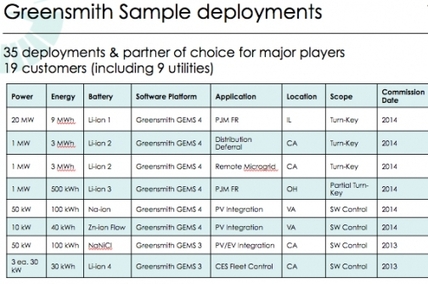
Companies like the 30-employee Greensmith are winning energy storage projects not because they are building better batteries but because they are writing software that integrates batteries with inverters and allows energy storage to work with the grid at scale. Greensmith works with a variety of battery chemistries from different vendors, as well as multiple inverters and power electronics partners.

New battery technologies and projects

Amongst other technologies, Greensmith is using Aquion Energy’s sodium-ion battery. The Pittsburgh, Penn.-based Aquion says its technology can deliver round-trip energy efficiency of 85 percent; a ten-year, 5,000-plus-cycle lifespan; energy storage capacity optimized to charge and discharge for multi-hour applications; and perhaps most notably, a price point of $250 per kilowatt-hour.

In April, Aquion closed a $55 million Series D venture capital investment, bringing total investments and grants to more than $100 million. New investors Bill Gates, Yung’s Enterprise, Nick and Joby Pritzker (through their family’s firm Tao Invest), Bright Capital, and Gentry Venture Partners joined previous investors Kleiner Perkins Caufield & Byers, Foundation Capital, and Advanced Technology Ventures in the round. Aquion is already producing its 1.5-kilowatt-hour S10 Battery Stack units, as well as an 18-kilowatt-hour system that combines twelve of its S10 units.

Greensmith is also using ViZn Energy Systems’ zinc redox flow battery energy storage technology. ViZn aims to produce a 80-kilowatt/160-kilowatt-hour system housed in a 20-foot shipping container, as well as larger systems. Other flow battery firms include American Vanadium, EnerVault, Primus Power, Imergy and ZBB Energy.

The CEO of the firm told GTM that Greensmith is developing a hybrid system using both the Aquion and ViZn storage chemistries.

Since its 2006 founding, Greensmith has deployed 30 battery energy systems for eighteen different customers, nine of them utilities, and is aiming to have 23 megawatts of systems under management by year’s end. […]”<

See on Scoop.itGreen Energy Technologies & Development

School to Combine Solar PV Modules with Battery Storage in Belgian Pilot Project

“Such an energy storage and distribution system can offer a great value, certainly for schools”, says Bert Dekeyzer of npo iD, the organization behind the ‘School of the Future’.

Source: www.solarserver.com

>'”During weekends a school consumes almost no electricity. The energy produced by the solar panels is stored in the batteries. On Monday morning there is a peak consumption: then all the computers and machines are turned on, which requires quite a lot of electricity. If the solar panels supply too little at that time, the batteries can provide the remaining energy. Moreover, a study showed that the energy consumption of a school does not stop after four o’clock in the afternoon. Schools are increasingly used in the evening for sports activities and evening classes. Also in this situation, the batteries can play their part.”

PV, storage combination offers a solution for a possible power shortage

In addition to an optimal and economic usage of solar power, the system can provide a solution for a possible power shortage in Belgium. Because of problems with the Belgian nuclear power plants, various municipalities could get disconnected from the electricity grid. In case of a power disruption, a traditional solar installation does not work anymore. The inverter of a traditional system switches off automatically because of a power failure. The owners of solar modules also have no electricity at that time, and in addition they suffer losses of the power output and any feed-in tariffs from their solar panels during the outage.

The storage system provides a solution. Such an installation combines solar modules with battery storage and intelligent software: if the grid fails, the system provides uninterrupted power for the user from the solar modules and/or batteries. […]”<


See on Scoop.itGreen Building Design – Architecture & Engineering