Supercritical CO2 turbine for Power Production & Waste Heat Energy Recovery

See on Scoop.itGreen Building Design – Architecture & Engineering
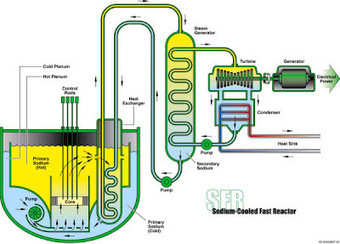
A former scientist at Sandia National Lab is bringing the technology to market

Duane Tilden‘s insight:

>Because of its physical properties as a liquid, it has become a target fluid of opportunity to run turbines and thus make electricity. Steven Wright, Ph.D., who recently retired from Sandia National Laboratory (SNL), has set up a consulting company called Critical Energy LLC to bring this technology to a commercial level.

The objective of using supercritical CO2 (S-CO2) in a Brayton-Cycle turbine is to make it much more efficient in the transfer of heat. Wright points out that a steam turbine is about 33% efficient, but that an S-CO2 turbine could be as high as 48% efficient, a significant increase.

A closed loop supercritical CO2 system has the density of a liquid, but many of the properties of a gas. A turbine running on it, “is basically a jet engine running on a hot liquid,” says Wright.

“There is a tremendous amount of scientific and industrial interest in S-CO2 for power generation. All heat sources are involved…<

See on theenergycollective.com
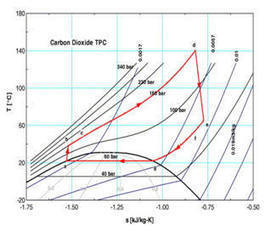
Waste Heat Recovery using Supercritical CO2 turbines to create Electrical Power

See on Scoop.itGreen Building Design – Architecture & Engineering

Working fluids with relatively low critical temperature and pressure can be compressed directly to their supercritical pressures and heated to their supercritical state before expansion so as to obtain a better thermal match with the heat source.

Duane Tilden‘s insight:

>Chen et al. [1-3] did a comparative study of the carbon dioxide supercritical power cycle and compared it with an organic Rankine cycle using R123 as the working fluid in a waste heat recovery application. It shows that a CO2 supercritical power cycle has higher system efficiency than an ORC when taking into account the behavior of the heat transfer between the heat source and the working fluid. The CO2 cycle shows no pinch limitation in the heat exchanger. Zhang et al.  [4-11] has also conducted research on the supercritical CO2 power cycle. Experiments revealed that the CO2 can be heated up to 187℃ and the power generation efficiency was 8.78% to 9.45% [7] and the COP for the overall outputs from the cycle was 0.548 and 0.406, respectively, on a typical summer and winter day in Japan [5].

Organic fluids like isobutene, propane, propylene, difluoromethane and R-245fa [12] have also been suggested for supercritical Rankine cycle. It was found that supercritical fluids can maximize the efficiency of the system. However, detailed studies on the use of organic working fluids in supercritical Rankine cycles have not been widely published.

There is no supercritical Rankine cycle in operation up to now. However, it is becoming a new direction due to its advantages in thermal efficiency and simplicity in configuration.<

See on www.eng.usf.edu

Basic optimising building orientation for performance

Good article on how building orientation and geometry in the planning stages of design affects the energy efficiency, consumption and equipment sizing for heating, ventilation and cooling.

firstgreenadmin's avatar

Building orientation plays a major role in the building envelop heat gain. A proper building orientation of the building will reduce the solar heat gain to your building and will make good use of day light as well. Hence it is important to consider the building orientation as well as material selection for the building envelop to optimise the building energy consumption. Maximum heat gain in the building is from the south façade/windows, hence the designers can also consider the extended shading devices in order to reduce the heat gain.

square shape

The plate size of the building also affects the building heat gain. If there is a building having the square plate size, the envelope surface area (peripheral area) will be minimum and if the building is having a long rectangular plate size, the envelop area will be larger. The larger surface area will lead to the larger heat gain in…

View original post 246 more words

Manufacturer’s Energy Efficient Heat Recovery Unit Runs High in Energy Awards

See on Scoop.itGreen Building Design – Architecture & Engineering

Vent-Axia has made the final shortlist in the prestigious Energy Awards 2013, which recognise and reward companies leading the way in reducing carbon emissions. Vent-Axia’s Lo-Carbon Kinetic Plus E…

Duane Tilden‘s insight:

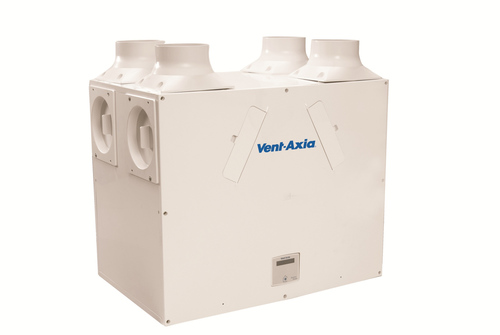
>Consuming as little as 20W, the Kinetic Plus E only costs around £20 a year to run, offering 94% thermal efficiency and potentially recovering 10 or 20 times more energy than it costs to operate. This offers homeowners an attractive cost saving as we enter the winter months and rising fuel costs.<

See on kirhammond.wordpress.com

Green financing for industry still a problem in the UK

Existing Building Energy Consumption: Current Situations, Trends, Legislature and Solutions …

mce68's avatarMichael C. English's Blog

After all this talk about how great energy audits and retro-commissioning is, let’s take a look at a case study which shows the power of these tools in action. We worked on a historic 555,000 sf museum, originally built in 1897. After an energy audit and retro-commissioning study, the facility will save approximately $520,000 in annual energy savings with a simple payback of a little over 2 years.

Major energy conservation measures (ECMs) that were found in the energy auditing process include: retrofitting gallery light fixtures from incandescent and halogen to CFL/LED lamps, upgrading the old pneumatic controls to direct digital controls (DDC) for AHUs and implementing several control strategy upgrades, such as gallery VFD speed optimization, economizer controls and demand control ventilation.

Through the retro-commissioning process, HEA determined several key retro-commissioning measures (RCMs). A selection of issues found include: non-functioning hand-off-auto switches, inactive BMS points, improperly wired supply and…

View original post 173 more words

What Actually Happens As We Move Away From Coal as an Energy Source?

Business Management: Habits Of Successful People – Infographic

See on Scoop.itTwitter & Social Media

  Many C-level executives have distinctive formulas to reach business success, and some of the techniques are surprisingly peculiar. Does your pursuit of corporate victory by way of traditional practices need adjusting?

See on themainstreetanalyst.com

Shaheen-Portman Energy Bill gaining Bi-Partisan Support in Senate

See on Scoop.itGreen & Sustainable News

Senate leaders and industry groups have a plan to revive the energy-efficiency bill that stalled in the upper chamber last month amid a flurry of unrelated amendments.

Duane Tilden‘s insight:

>"There’s been a ramped-up or increased pace of meetings this week in exploring a bunch of different ways to increase support for Shaheen-Portman, especially among Republicans," added a Democratic Senate aide. "There have been discussions about amendments being one way to do that." Still, the aide emphasized that no single strategy has been set in stone.

Another Republican aide echoed that behind-the-scenes work has been ongoing. "Portman is working to get bipartisan agreements to get to 60 votes," said the staffer, singling out Hoeven as a potential key vote. "Hoeven’s a guy that a lot of folks look to," agreed another Senate staffer, adding that there are already at least 59 potential yes votes for the bill.

All the aides agreed that hitting the 60-vote threshold would greatly increase the likelihood that Senate Majority Leader Harry Reid, D-Nev., would move the bill. "If folks can make a case that there’s a lot of support for this, then that makes it easier to bring it back to the floor," said the Democratic aide.<

See on www.nationaljournal.com

New York to Retrofit 250,000 Streetlights With Energy-Saving LED Bulbs

See on Scoop.itGreen Energy Technologies & Development

The phaseout is part of a long-term plan to reduce greenhouse gas emissions by 30 percent by 2017 and, Mayor Michael R. Bloomberg said, would save taxpayers money.

Duane Tilden‘s insight:

>The news conference was on Eastern Parkway in Brooklyn, where lights have already been replaced, expecting to save more than $70,000 and nearly 248,000 kilowatt-hours a year in energy. Unlike standard lights, which last six years, LED bulbs can burn for 20 years before they need to be replaced, the administration said, and the project is expected to save $14 million a year in energy and maintenance costs. […]

“People tend to like them,” she said. “It’s clear. It’s bright. It really does a good job in providing fresher light.” The project is estimated to cost $76.5 million.

The project is the first to receive financing through the Accelerated Conservation and Efficiency initiative or “ACE,” the administration said, a $100 million competitive program that the Department of Citywide Administrative Services created to expedite such sustainability projects.<

See on www.nytimes.com