Energy Storage Technologies Will Replace Utilities Gas Fired Turbine Peaker Plants

“Power grids need extra generating capacity to work properly. For example, about 20 percent of New York State’s generation fleet runs less than 250 hours a year. Because they don’t run much, “peaker plants” are by design the cheapest and least efficient fossil generators.”

Source: www.renewableenergyworld.com

>”[…] As has happened with solar PV, the costs for multi-hour energy storage are about to undergo a steep decline over the next 2 to 3 years. This cost trend will disrupt the economic rationale for gas-fired simple cycle combustion turbines (CTs) in favor of flexible zero emissions energy storage. This will be especially true for storage assets owned and operated by vertical utilities and distributed near utility substations.

Simple cycle gas-fired CTs have been a workhorse utility asset for adding new peaker capacity for decades. But times and technologies change, and the power grid’s long love affair with gas-fired CTs is about to be challenged by multi-hour energy storage. Flow batteries that utilize a liquid electrolyte are especially cost-effective because the energy they store can be easily and inexpensively increased just by adding more electrolyte.

CTs cost from $670 per installed kilowatt to more than twice that much for CT’s located in urban areas. But the economics of peaking capacity must also reflect the benefits side of the cost/benefit equation. Distributed storage assets can deliver both regional (transmission) and local (distribution) level energy balancing services using the same storage asset. This means the locational value and capacity use factor for distributed storage can be significantly higher compared to CTs operated on a central station basis.

[…]

The disruptive potential of energy storage as a substitute for simple cycle CTs has been recognized. For example, Arizona Public Service (APS) and the Residential Utility Consumer Office (RUCO) recently filed a proposed settlement which, if approved, would require that at least 10% of any new peaker capacity now being planned as simple cycle combustion turbines would instead need to be energy storage — as long as the storage meets the cost effectiveness and reliability criteria of any CTs being proposed.

[…]

Lower cost solar PV and its rising penetration in all market segments will have a profoundly disruptive effect on utility operations and the utility cost-of-service business model. This has already started to happen. Storage offers a way for utilities to replace lost revenues premised on margins from kilowatt-hour energy sales by placing energy storage into the rate based and earning low-risk regulated returns.”<

See on Scoop.itGreen Energy Technologies & Development

Cove Point LNG Project Obtains Federal Approval and Opposition

Initially, Cove Point helped the United States overcome what was then an energy shortage. Now that our nation is developing a burgeoning surplus of natural gas, Cove Point can help send a small portion of that surplus to allied nation’s looking for stable supplies of clean energy, supporting economic development and replacing coal as a fuel.

Source: www.fierceenergy.com

>” […] The project offers significant economic, environmental and geopolitical benefits. The construction of the approximately $3.8 billion export project will create thousands of skilled construction jobs, an additional $40 million in annual tax revenue to Calvert County, and millions of dollars in new revenues for Maryland and the federal government, as well as a reduction in the nation’s trade deficit by billions of dollars annually.

Dominion’s project has faced and will continue to face significant and widespread grassroots opposition. Despite these benefits, environmental and community groups are denouncing FERC’s approval of the controversial project, claiming that the facility will incentivize environmental damage from fracking across the mid-Atlantic region and, according to federal data, would likely contribute more to global warming over the next two decades than if Asian countries burned their own coal.

Environmental groups, including the Chesapeake Climate Action Network, Earthjustice, and the Sierra Club are poised to petition FERC and potentially to sue the agency to challenge on the basis of an inadequate environmental review. These groups are assessing the issue upon which to file a motion for a rehearing, which needs to occur before an appeal can happen.

The groups claim that in its Environmental Assessment, which was limited at best, FERC omitted credible analysis of the project’s lifecycle global warming pollution, including all the pollution associated with driving demand for upstream fracking and fracked gas infrastructure.

The Dominion Cove Point project would be the first LNG export facility to be sited so close to a residential area and in such close proximity to Marcellus Shale fracking operations, and could trigger more global warming pollution than all seven of Maryland’s existing coal-fired power plants combined, the groups contend.

“FERC’s decision to approve Cove Point is the result of a biased review process rigged in favor of approving gas industry projects no matter how great the environmental and safety concerns,” said Mike Tidwell, director of the Chesapeake Climate Action Network, in a statement. “FERC refused to even require an environmental impact statement for this $3.8 billion facility right on the Bay. We intend to challenge this ruling all the way to court if necessary…we will continue to fight this project until it is stopped.”

Dominion must now review and accept the order. Upon completion, Dominion will file an implementation plan describing how it plans to comply with the conditions set forth in the order. Dominion expects to ask the FERC for a “Notice to Proceed” at that time and plans to begin construction when the notice is received. This process – from Dominion review through FERC’s notice – is expected to take several weeks.

Cove Point is the fourth liquefied natural gas export project to receive approval to site, construct and operate and is the first LNG export project on the East Coast. “<

See on Scoop.itGreen & Sustainable News

Could desalination solve California’s water problem?

Desalination would seem to answer every prayer to fix California’s water shortages. But turning the sea into drinking water is not so easy. The state’s first major desalination plant, under construction in Carlsbad, is a major test for the industry and wary environmental groups.

Source: www.sacbee.com

See on Scoop.itsustainability and resilience

US EPA Awards Energy Star to 3 CHP (Cogen) Projects

The US Environmental Protection Agency (EPA) has recognised three combined heat and power projects with ENERGY STAR CHP awards.

Source: www.cospp.com

>”[…] Eastman Chemical Company’s Kingsport, Tennessee, Campus plant (pictured) was recognised for its 200 MW CHP system, which includes 17 GE steam turbine generators. The Kingsport industrial campus, one of the largest chemical manufacturing sites in North America, employs nearly 7000 people […]

Seventeen boilers produce steam to support manufacturing processes, help meet the space heating/cooling needs of 550 buildings, and drive 17 GE and two ABB steam turbine generators with a combined design output of 200 MW. With an operating efficiency of more than 78%, the predominantly coal-fired system requires approximately 14% less fuel than grid-supplied electricity and conventional steam production, saving Eastman Chemical approximately US$45 million per year.

Janssen Research & Development, LLC, one of the Janssen Pharmaceutical Companies of Johnson & Johnson, was granted an award for its 3.8 MW CHP system, powered by a Caterpillar lean-burn low-emissions reciprocating natural gas generator set. The system supplies 60% of the annual power needs for the site and approximately 40% of the thermal energy used to support R&D operations and heat, cool, and dehumidify the facility’s buildings.

With an operating efficiency of more than 62%, the system requires approximately 29% less fuel than grid-supplied electricity and conventional steam production, saving approximately $1.1 million per year.

Merck’s CoGen3 CHP system at its West Point facility was also recognised by the EPA. A pharmaceutical and vaccine manufacturing, R&D and warehouse and distribution centre, the project is powered by a 38 MW GE 6B heavy-duty gas turbine and recovers heat to produce steam to heat, cool and dehumidify approximately 7 million square feet of manufacturing, laboratory and office space.

The system, designed by Burns & Roe, is the third CHP system that Merck has installed at the 400-acre West Point, Pennsylvania campus. With an operating efficiency of more than 75%, the natural gas-fired system requires approximately 30% less fuel than grid-supplied electricity and conventional steam production.”<


See on Scoop.itGreen Energy Technologies & Development

Asia-Pacific Microgrid Market on ‘threshold of exponential growth’

According to the report, the market generated revenues of US$84.2 million in 2013 and Frost & Sullivan predicts that by 2020 this will rise almost tenfold to US$814.3 million, forecasting a compound annual growth rate of 38.3%.

Source: www.pv-tech.org

>” […] This growth is expected to come from activity in establishing microgrids for rural electrification in developing countries, and from commercial microgrids in the developed ones. The report cites the examples of Australia and Japan among the developed countries.

Mining operations in remote parts of Australia are one example of reliance on microgrids, powered by on-site generation. This has come traditionally from diesel generators, which are being combined with or replaced by solar-plus-storage. According to several sources the economics for this are already compelling.

Countries with a strong recent history in rural electrification referred to by Frost & Sullivan include Indonesia, the Philippines and Malaysia. In the example of Indonesia, the country’s utilities are aiming to bring electrification to 90% of the rural population by 2025. In total the report covered the countries of Japan, South Korea, Indonesia, Malaysia, the Philippines, and Australia.

However, despite this recent activity, the report highlights several barriers that are preventing the market reaching its potential. One such example is the high capital cost of installing microgrids in tandem with energy storage systems.  […]

[…] rising electricity prices in many regions would lead utility companies away from diesel and onto renewables to run their microgrids. It could also encourage “stronger governmental support through favorable regulations, funds and subsidies”, as the use of renewable energy for microgrids would require some forms of energy storage, which are still expensive to install […]

“The utilisation of renewable energy sources, either in standalone off-grid applications or in combination with local micro-grids, is therefore recognised as a potential route for rural farming communities to develop, as well as an opportunity to tackle the health issues associated with kerosene and biomass dependence. For example, the Indian Government aims to replace around 8 million existing diesel fuelled groundwater pumps, used by farmers for irrigation, with solar powered alternatives,” according to Fox. […]”<

See on Scoop.itGreen Energy Technologies & Development

Combined Heat & Power Drives Biomass Demand

New analysis from the International Renewable Energy Agency (IRENA) forecasts CHP and industrial heat demand are set to drive global bioenergy consumption over the coming decade and more.

Source: www.cospp.com

>”The trend towards modern and industrial uses of biomass is growing rapidly, the report notes, adding that biomass-based steam generation is particularly interesting for the chemical and petrochemical sectors, food and textile sectors, where most production processes operate with steam. Low and medium temperature process steam used in the production processes of these sectors can be provided by boilers or CHP plants. Combusting biogas in CHP plants is another option already pursued in northern European countries, especially in the food sector, where food waste and process residues can be digested anaerobically to produce biogas, IRENA adds. A recent IRENA analysis (2014b) estimated that three quarters of the renewable energy potential in the industry sector is related to biomass-based process heat from CHP plants and boilers. Hence, biomass is the most important technology to increase industrial renewable energy use, they conclude.

In industry, demand is estimated to reach 21 EJ in the REmap 2030, up to three-quarters of which (15 EJ) will be in industrial CHP plants to generate low- and medium-temperature process heat (about two-thirds of the total CHP output). In addition to typical CHP users such as pulp and paper other sectors with potential include the palm-oil or natural rubber production sectors in rapidly developing countries like Malaysia or Indonesia where by-products are combusted in ratherinefficient boilers or only in power producing plants.

As a result, installed thermal CHP capacity would reach about 920 GWth with an additional 105 GWth of stand-alone biomass boilers and gasifiers for process heat generation could be installed worldwide by 2030. This is a growth of more than 70% in industrial biomass-based process heat generation capacity compared to the Reference Case.

Biomass demand for district heating will reach approximately 5 EJ by 2030 while the power sector, including fuel demand for on-site electricity generation in buildings and on-site CHP plants at industry sites, will require approximately another 31 EJ for power generation (resulting in the production of nearly 3,000 TWh per year in 2030, according to IRENA.

The total installed biomass power generation capacity in Remap 2030 reaches 390 GWe. Of this total, around 178 GWe is the power generation capacity component of CHPs installed in the industry and district heating sectors.”<


See on Scoop.itGreen Energy Technologies & Development

10 Most Efficient Renewable Energy Devices

Google invests $145 million in new 82MW Southern California solar power plant

Energy Storage Solutions for the Smart Grid

In order to ramp up clean energy production, we have to figure out how to store and transmit it effectively. Companies are experimenting with new tech to figure out the best way to progress.

Source: www.techrepublic.com

>”The smart grid energy storage sector is expected to grow to $50 billion by 2020, with an annual compound growth rate of 8%, according to a recent report from Lux Research. In 2013, renewable energy accounted for only 10% of total US energy usage and 13% of electricity generation, according to the US Energy and Information Administration.

But as renewable energy generation rises, transmission and storage advancements will be necessary. Curtailment, the act of spilling renewable energy because there’s more than enough, is one issue to tackle. By changing grid transmission lines in 2010, Texas saw the curtailment in their grid drop from 9% to 4% in 2012, according to a report by the National Renewable Energy Laboratory.

The tipping point with energy storage depends on the grid and the technology used, said Sam Jaffe, an analyst at Navigant Research. Some places in the world that have extremely high penetration rates of renewable energy don’t have major problems with wasted renewables. Denmark sends its extra wind power to Sweden and Norway, while importing hydro power from those two countries when the wind isn’t blowing. Denmark’s wind penetration is now at almost 40%.

“That’s because they are interconnected to other grids that have a lot of flexibility to offtake renewable energy,” he said.”<


See on Scoop.itGreen Energy Technologies & Development

US Company Deploys Aqueous, Lithium-Ion and Flow Batteries for Grid Storage

“Batteries must do more than just work—they have to scale.”

Source: www.greentechmedia.com

>”[…] The startup is a software developer and system integrator that has attracted investment, personnel and a growing roster of turnkey energy storage projects.

[…]

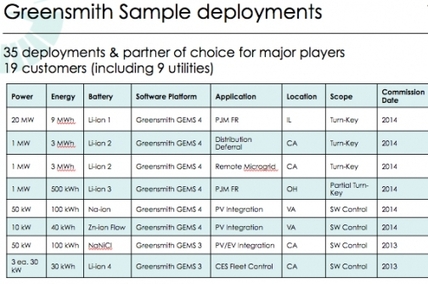
Companies like the 30-employee Greensmith are winning energy storage projects not because they are building better batteries but because they are writing software that integrates batteries with inverters and allows energy storage to work with the grid at scale. Greensmith works with a variety of battery chemistries from different vendors, as well as multiple inverters and power electronics partners.

New battery technologies and projects

Amongst other technologies, Greensmith is using Aquion Energy’s sodium-ion battery. The Pittsburgh, Penn.-based Aquion says its technology can deliver round-trip energy efficiency of 85 percent; a ten-year, 5,000-plus-cycle lifespan; energy storage capacity optimized to charge and discharge for multi-hour applications; and perhaps most notably, a price point of $250 per kilowatt-hour.

In April, Aquion closed a $55 million Series D venture capital investment, bringing total investments and grants to more than $100 million. New investors Bill Gates, Yung’s Enterprise, Nick and Joby Pritzker (through their family’s firm Tao Invest), Bright Capital, and Gentry Venture Partners joined previous investors Kleiner Perkins Caufield & Byers, Foundation Capital, and Advanced Technology Ventures in the round. Aquion is already producing its 1.5-kilowatt-hour S10 Battery Stack units, as well as an 18-kilowatt-hour system that combines twelve of its S10 units.

Greensmith is also using ViZn Energy Systems’ zinc redox flow battery energy storage technology. ViZn aims to produce a 80-kilowatt/160-kilowatt-hour system housed in a 20-foot shipping container, as well as larger systems. Other flow battery firms include American Vanadium, EnerVault, Primus Power, Imergy and ZBB Energy.

The CEO of the firm told GTM that Greensmith is developing a hybrid system using both the Aquion and ViZn storage chemistries.

Since its 2006 founding, Greensmith has deployed 30 battery energy systems for eighteen different customers, nine of them utilities, and is aiming to have 23 megawatts of systems under management by year’s end. […]”<

See on Scoop.itGreen Energy Technologies & Development