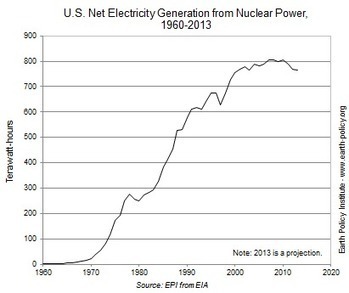
U.S. Nuclear Power waning: A history of Failures

See on Scoop.itGreen & Sustainable News

By J. Matthew RoneyNuclear power generation in the United States is falling. After increasing rapidly since the 1970s, electricity generation at U.S. nuclear plants began to grow more slowly in the…

Duane Tilden‘s insight:

>Of the 253 reactors that were ordered by 1978, 121 were canceled either before or during construction, according to the Union of Concerned Scientists’ David Lochbaum. Nearly half of these were dropped by 1978. The reactors that were completed—the last of which came online in 1996—were over budget three-fold on average.

By the late 1990s, 28 reactors had permanently closed before their 40-year operating licenses expired. […]

In 2012, the U.S. Nuclear Regulatory Commission (NRC) approved four new reactors for construction, two each at the Vogtle plant in Georgia and the Summer plant in South Carolina. These reactors are all of the same commercially untested design, purportedly quicker to build than previous plants. Both projects benefit from fairly new state laws that shift the economic risk to ratepayers. These “advanced cost recovery” laws, also passed in Florida and North Carolina, allow utilities to raise their customers’ rates to pay for new nuclear plants during and even before construction—regardless of whether the reactors are ever finished.

Construction at both sites began in March 2013. Even as the first concrete was poured at the $14-billion Vogtle project, it was reportedly 19 months behind schedule and more than $1 billion over budget. The Summer project, a $10 billion endeavor, also quickly ran into problems. […] With these delays, the earliest projected completion date for any of these reactors is some time in late 2017. […]

This year has also already witnessed the permanent shutdown of four reactors totaling 3.6 gigawatts of capacity. The first to fall was Duke’s Crystal River reactor in Florida. Although the plant was licensed to run until 2016, Duke decided to close it rather than pay for needed repairs. Then Dominion Energy’s 39-year-old Kewaunee reactor in Wisconsin closed, citing competition from low gas prices. It had recently been approved to operate through 2033. And in June, Southern California Edison shuttered its two San Onofre reactors after 18 months of being offline due to a leak in a brand new steam generator. These retirements leave the United States with 100 reactors, averaging 32 years in operation. (France is second, with 58 reactors.)

More closures will soon follow, particularly among the roughly half of U.S. reactors in so-called merchant areas […]

Dealing with nuclear waste is another expensive proposition. Over the past 30 years, the U.S. government has spent some $15 billion trying to approve a central repository for nuclear waste, and for most of that time the only site under consideration has been Nevada’s Yucca Mountain. Amid concerns about the site’s safety and its extreme unpopularity in Nevada, the Obama administration has moved to abandon the project entirely and explore other options.

A federal appeals court ruled in August 2013 that the NRC must resume reviewing the site’s suitability. In the meantime, the waste keeps accumulating. The 75,000 tons of waste now stored at 80 temporary sites in 35 states is projected to double by 2055. […]

See on grist.org

Clay key to high-temperature supercapacitors

See on Scoop.itGreen Energy Technologies & Development

Clay, an abundant and cheap natural material, is a key ingredient in a supercapacitor that can operate at very high temperatures, according to researchers who have developed such a device.

Duane Tilden‘s insight:

>”Our intention is to completely move away from conventional liquid or gel-type electrolytes, which have been limited to low-temperature operation of electrochemical devices,” said Arava Leela Mohana Reddy, lead author and a former research scientist at Rice.

“We found that a clay-based membrane electrolyte is a game-changing breakthrough that overcomes one of the key limitations of high-temperature operation of electrochemical energy devices,” Reddy said. “By allowing safe operation over a wide range of temperatures without compromising on high energy, power and cycle life, we believe we can dramatically enhance or even eliminate the need for expensive thermal management systems.”

A supercapacitor combines the best qualities of capacitors that charge in seconds and discharge energy in a burst and rechargeable batteries that charge slowly but release energy on demand over time. The ideal supercapacitor would charge quickly, store energy and release it as needed.<

See on www.sciencedaily.com

Geothermal Energy: Iceland could provide renewable energy to the UK

See on Scoop.itGreen & Sustainable News

Under plans currently being discussed by both the UK and Icelandic governments, renewable electricity could be provided by Iceland to the UK at a cheaper cost than offshore wind.

Duane Tilden‘s insight:

>The plans being discussed by the two governments concern a 1,000km undersea cable with a capacity of 1GW. The package is worth an estimated £4 billion with the inclusion of related generation and onshore transmission investments and could be operational by 2022.  […]


At present, Iceland benefits from some of the lowest electricity prices in Europe given that much of their renewable energy comes from hydroelectricity and geothermal. […] the interconnector could provide power to the UK at around 60 to 70 percent of the price of offshore wind and that whichever way you look at it there are big potential benefits. However, in order to be successful, the Icelandic government must also convince their own citizens that there are also benefits for Iceland and there are concerns that exposure to a larger market could increase domestic energy prices.<

See on www.renewableenergymagazine.com

Call for Energy Efficient Air-Conditioning with Technological Development

See on Scoop.itGreen Building Design – Architecture & Engineering

Innovations could cut the growing amount of energy used for air-conditioning and refrigeration

Duane Tilden‘s insight:

>Conventional air conditioners employ refrigerants such as chlorofluorocarbons to absorb heat from the room to be cooled. That heat is then expelled outside, requiring electrically powered pumps and compressors.

One idea to conserve energy is to replace coolant fluids and gases—which are often super-powered greenhouse gases capable of trapping more than 1,000 times more heat than CO2—with solid materials, such as bismuth telluride.

A new device from Sheetak, developed in part with ARPA-E funding, uses electricity to change a thermoelectric solid to absorb heat, and could lead to cheaper air conditioners or refrigerators.

Such refrigerators, which lack moving parts and are therefore less likely to break down, can be lifesavers in remote, rural areas for keeping medicines cool or food fresh.<

See on www.scientificamerican.com

Supply of Renewable Wind Power Surges in Texas with some Plant Closures

See on Scoop.itGreen & Sustainable News

Market Upheaval In the U.S., hydraulic fracturing techniques used to drill shale have produced a flood of cheap natural gas. That, combined with the growth in wind and tepid customer demand, is upending power markets, leading to plant closures and bankruptcy for some generator owners.

Duane Tilden‘s insight:

>Traditional power companies across the U.S. and Europe are struggling to compete in wholesale markets with newer generators supplying subsidized wind and solar energy. In Texas, wind has more than doubled in the past six years and now makes up 13 percent of the state’s generation capacity.[…]

Falling Prices – Electricity prices for 2014 also have fallen. The on-peak North Texas power price for next year has dropped 19 percent since reaching a peak on May 23, according to data compiled by Bloomberg.

During a heat wave in the first week of August, ample wind supplies served to keep a lid on prices that would’ve normally spiked from the higher demand, NRG Chief Executive Officer David Crane said during a call with investors on Aug. 9. “Wind energy reduces electricity prices and that is good for consumers,” said Michael Goggin, an analyst for the American Wind Energy Association, an industry trade group. “Wind energy has no fuel costs, allowing it to replace more expensive and polluting sources of energy.”

Once complete, Oncor’s power lines will be part of a system that can eventually deliver about 18,500 megawatts of wind power, nearly double the amount now available in Texas and 25 percent of the state’s current generation capacity.<

See on www.renewableenergyworld.com

Coal Power Plants to be retired – Duke Energy Settles Edwardsport air permit Dispute

See on Scoop.itGreen & Sustainable News

Duke Energy Corp. said it reached a settlement with the a handful of environmental and activist organizations over outstanding issues with the.

Duane Tilden‘s insight:

>The Indiana Department of Environmental Management issued the new Knox County, Ind., plant’s air permits in 2008, and- -under the settlement with the Sierra Club, Citizens Action Coalition, Save the Valley and Valley Watch–they remain approved with no changes. The dispute centered on technical issues surrounding the permits that enabled the company to build and operate the plant, the company said.

The settlement also addresses deadlines for retiring units at Duke’s Wabash River Station in Vigo County, Ind. Prior to the settlement, the company had said it planned to retire four, 1950s-vintage units totaling 350 megawatts at the station by the 2015 federal mercury rule deadline. In the agreement, the company agreed to finish the retirements by the compliance deadline or, if the mercury rule is vacated or delayed, by June 1, 2018, whichever comes first.

Duke also had been exploring converting another unit at the Wabash station to natural gas, and, under the settlement, the company agreed to cease burning coal at that 318-megawatt unit by June 1, 2018. The deadline won’t prevent Duke Energy from converting the unit to natural gas earlier.

The settlement also includes a commitment to pursue additional green energy sources.<

See on www.nasdaq.com

Waste Heat Energy Recovery – ThermoAcoustic Refrigeration for Transportation Industry

Revisiting the Automotive ThermoAcoustic Refrigerator – ATAR

Diagram of Simplified ThermoAcoustic Engine

I wish to further investigate the idea of thermoacoustics for waste heat recovery processes.  Also, will in future look into latest developments in thermoacoustics, including any applications, studies, reviews or products and manufacturers.

In today’s new economy of energy efficiency, there are technologies available that are worth further investigation that can be utilized for improved performance.  Automotive air conditioning is one industry which could bear further scrutiny, where running compressors consume valuable fuel, decreasing the energy efficiency and increasing operating cost of a vehicle.

For professional drivers where fuel consumption increases will come out of pocket, the utilization of air conditioning is an important consideration.  The idea of using the waste heat in the exhaust system to provide the cooling energy necessary to provide air conditioning is a novel approach to improving vehicle efficiency and comfort.  The concept of thermoacoustic refrigeration is not new, and was previously reviewed by concerns of the ozone layer depletion and refrigerants, which ultimately lead to changes in the refrigeration and HVAC industries.

See original reference paper presented at 2005 Proceedings of Acoustics:  http://bit.ly/17qwTYK

Reshaping Corporations: Can Divestment Work?

See on Scoop.itGreen & Sustainable News

With enough collective action, mass divestment campaigns can be effective in creating social change. 

Duane Tilden‘s insight:

>To be effective, a huge amount of money must be withdrawn from a company. Where boycotting unites individual buyers to have impact, individual stockowners aren’t likely to make a huge enough hit with divestment or negative investing for a corporation to take notice. Institutional owners, though, could impact a company or industry because collectively they control vast amounts. 

The Fossil Fuel Divestment Campaign

The current student campaign to divest from fossil fuels is interesting. For example, Harvard has $30 billion in endowment while Yale has $16.7 billion.

While it’s clearly not all in one company or industry, what kind of impact could university endowments have if they withdrew from fossil fuel companies and allied industries? By my count, there are well over a hundred campaigns at universities around the nation, and there are additional groups working to get towns and communities to join the fight. As a collective action, the potential for these divestment campaigns is fascinating to ponder.

Mass Divestment Creates Cultural Change

Perhaps the most important thing divestment shares with boycotting is publicity.  The attention that a mass divestment can bring to an issue could be profound. The student fossil fuels divestment effort is garnering national media attention, and rather than fizzling out seems to be gaining momentum. This attention could be as effective as actual divestment for dealing with climate change and fossil fuel issues. 

As Cecelie Counts wrote in January, divestment was just one tool used to combat apartheid and bring change in South Africa. I don’t know if there will be mass divestment among universities, but I suspect that this campaign will be successful in the long run because it’s educating a generation and could create the cultural change necessary to pursue long-term alternatives, change policy and pressure energy companies to adapt.<

See on csrwire.sharedby.co

Biofuel Production from Palm oil plantation waste

See on Scoop.itGreen Building Design – Architecture & Engineering

NextFuels to produce biofuels from palm plantation residue – Renewable Energy Magazine, at the heart of clean energy journalism

Duane Tilden‘s insight:

>Edible palm oil has surpassed soybean to become the largest source of cooking oil in the world, accounting for over 50 million tons of oil annually.

While plantation owners have managed to increase the productivity of their land by 15X since the late 80s, the growth of the industry has created a corresponding residue problem. Approximately 4.4 to 6 metric tons of agricultural waste is generated for each metric ton of oil. There are over 1,000 crude palm oil (CPO) mills in Southeast Asia and a single (60 tons per hour) mill can generate 135,000 tons of agricultural residue a year.

NextFuels uses a system called bio-liquefaction that efficiently transforms agricultural biomass to green energy. Biomass is placed into the plant mixed with water. The mixture is then heated to 330-degree Celsius while pressure is increased to 220 bar. Increasing the pressure keeps the water from coming to a boil, which conserves energy.

When cooled, the hydrocarbons form a putty-like substance called GreenCrude. Roughly 25 percent of the GreenCrude can be burned as a solid fuel in industrial boilers. The remaining 75 percent can be converted into a liquid-fuel equivalent to petroleum that is compatible with existing pipelines and vehicles.

The equipment required to convert GreenCrude into liquid fuels, in a process called hydrodeoxygenation, is already installed at most refineries and can… <

See on www.renewableenergymagazine.com

U.S. Geothermal Inc. Announced Final Completion of Neal Hot Springs Power Plant

See on Scoop.itGreen Energy Technologies & Development

BOISE, IDAHO, Aug 01, 2013 (Marketwired via COMTEX) — U.S. Geothermal Inc., (nyse mkt:HTM) CA:GTH -1.96% a leading renewable energy company focused on the development, production, and sale of electricity from geothermal energy, announced () that Final Completion of the 22 megawatt (net) Neal Hot Springs Project has been achieved.

Duane Tilden‘s insight:

>The Neal Hot Springs Project was the first geothermal project to obtain a loan guarantee under the DOE’s Title XVII loan guarantee program, which was created by the Energy Policy Act of 2005 to support the deployment of innovative clean energy technologies. The DOE loan guarantee, guarantees a loan from the U.S. Treasury’s Federal Financing Bank. The project was authorized for a loan guarantee of up to $96.8 million.

The Neal Hot Springs project deployed a first of its kind binary cycle process, utilizing a supercritical cycle that uses R134a refrigerant as the working fluid, as well as pre-fabricated modular construction of major plant components. […]

The project is selling electricity to Idaho’s largest utility, Idaho Power Company, under a previously signed 25-year power purchase agreement for up to 25 megawatts of power per year. Beginning in 2012, the base energy price is $96 per MW Hour and escalates annually. The calculated 25-year levelized price is $117.65 per MW hour.<

See on www.marketwatch.com