Supercritical CO2 turbine for Power Production & Waste Heat Energy Recovery

See on Scoop.itGreen Building Design – Architecture & Engineering
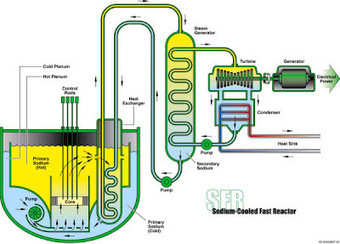
A former scientist at Sandia National Lab is bringing the technology to market

Duane Tilden‘s insight:

>Because of its physical properties as a liquid, it has become a target fluid of opportunity to run turbines and thus make electricity. Steven Wright, Ph.D., who recently retired from Sandia National Laboratory (SNL), has set up a consulting company called Critical Energy LLC to bring this technology to a commercial level.

The objective of using supercritical CO2 (S-CO2) in a Brayton-Cycle turbine is to make it much more efficient in the transfer of heat. Wright points out that a steam turbine is about 33% efficient, but that an S-CO2 turbine could be as high as 48% efficient, a significant increase.

A closed loop supercritical CO2 system has the density of a liquid, but many of the properties of a gas. A turbine running on it, “is basically a jet engine running on a hot liquid,” says Wright.

“There is a tremendous amount of scientific and industrial interest in S-CO2 for power generation. All heat sources are involved…<

See on theenergycollective.com
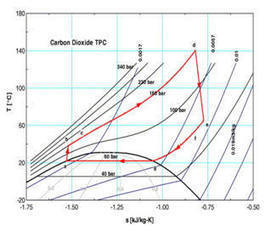
Waste Heat Recovery using Supercritical CO2 turbines to create Electrical Power

See on Scoop.itGreen Building Design – Architecture & Engineering

Working fluids with relatively low critical temperature and pressure can be compressed directly to their supercritical pressures and heated to their supercritical state before expansion so as to obtain a better thermal match with the heat source.

Duane Tilden‘s insight:

>Chen et al. [1-3] did a comparative study of the carbon dioxide supercritical power cycle and compared it with an organic Rankine cycle using R123 as the working fluid in a waste heat recovery application. It shows that a CO2 supercritical power cycle has higher system efficiency than an ORC when taking into account the behavior of the heat transfer between the heat source and the working fluid. The CO2 cycle shows no pinch limitation in the heat exchanger. Zhang et al.  [4-11] has also conducted research on the supercritical CO2 power cycle. Experiments revealed that the CO2 can be heated up to 187℃ and the power generation efficiency was 8.78% to 9.45% [7] and the COP for the overall outputs from the cycle was 0.548 and 0.406, respectively, on a typical summer and winter day in Japan [5].

Organic fluids like isobutene, propane, propylene, difluoromethane and R-245fa [12] have also been suggested for supercritical Rankine cycle. It was found that supercritical fluids can maximize the efficiency of the system. However, detailed studies on the use of organic working fluids in supercritical Rankine cycles have not been widely published.

There is no supercritical Rankine cycle in operation up to now. However, it is becoming a new direction due to its advantages in thermal efficiency and simplicity in configuration.<

See on www.eng.usf.edu

What Actually Happens As We Move Away From Coal as an Energy Source?

Greening Coal Power with CO2-eating Microalgae as a Biofuel Feedstock

See on Scoop.itGreen Energy Technologies & Development

Successful microalgae-to-biodiesel conversion has been the goal of some renewable energy researchers for more than two decades.

Duane Tilden‘s insight:

>To that end, Algae.Tec has signed a deal with Macquarie Generation, Australia’s largest electricity generator, to put an “algae carbon capture and biofuels” production facility next to a coal-fired power station in Australia’s Hunter Valley. Macquarie Generation, which operates the Sydney-area 2640 MW Bayswater Power Station, will feed waste CO2 into an enclosed algae growth system. […]

Projections are for the first year of production to hit 100,000 tons of algae biomass; half of which would be converted to an estimated 60 million liters of biodiesel. One sea-land container would generate 250 tons of biomass per annum, said the company, which would be harvested on a continuous basis. […]

Stroud projects that some 75 percent of his company’s income will come from biodiesel. The remaining 25 percent of Algae.Tec’s income will hinge on the sale of the microalgae’s leftover biomass for animal feed.<

See on www.renewableenergyworld.com

U.S. Nuclear Power Closures Signal Wider Problems for Industry

See on Scoop.itGreen & Sustainable News

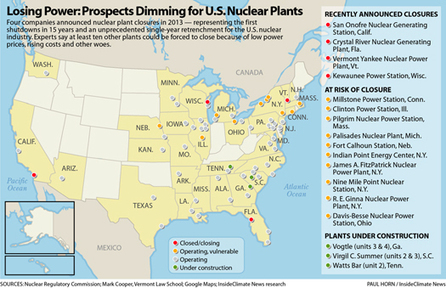
A string of plant closures, project cancellations and other setbacks has raised new doubts about the future of nuclear power in the United States, but there’s disagreement about whether the retrenchment will be limited and temporary or the…

Duane Tilden‘s insight:

>The blows to nuclear power’s prospects have come on many fronts, but it was the surprising spurt of plant closures that laid bare the industry’s worsening plight. The plant shutdowns are the first to hit the U.S. nuclear power market in 15 years, and the retirements don’t bode well for many of the nation’s 99 remaining power reactors.

Analysts say economic woes make at least 10 other plants vulnerable enough to follow suit. Almost all of those are among the nation’s 47 “merchant” nuclear plants, which, unlike regulated plants, operate in open markets and have to beat out other power suppliers to win customers and long-term supply contracts. The especially vulnerable facilities cited by analysts are at greater risk for closure because their power is too expensive to sell profitably in wholesale markets or because their output is too small or too unreliable to support rising operating and retrofit costs.<

See on insideclimatenews.org

EPA sets terms for New Power Plant carbon emissions

See on Scoop.itGreen & Sustainable News

Frances Beinecke: We’re already paying the costs of climate change. The new power plant emissions standards could not be more timely

Duane Tilden‘s insight:

>The carbon standards announced Friday by Gina McCarthy, administrator of the US Environmental Protection Agency, will set reasonable limits on carbon pollution from the power plants of tomorrow, those that are yet to be built.<

See on www.theguardian.com

Water Energy Nexus: A Literature Review

See on Scoop.itGreen Energy Technologies & Development

Water-Energy Nexus: A Literature Review provides readers with an overview and analysis of the policy, scientific and technical research on the connections between water and energy. This review is a comprehensive survey of the literature from the academic, government and nonprofit sectors, organized around the water and energy life cycles.  It examines research and policy from energy use across the water and wastewater sectors, as well as water across the various components of the energy sector.
See on waterinthewest.stanford.edu

Japan to Switch Off Nuclear Power, With No Firm Date for Re-Start: Sci Am

See on Scoop.itGreen & Sustainable News

Japan is set to be nuclear power-free, for just the third time in more than four decades, and with no firm date for re-starting an energy source that has provided about 30 percent of electricity to the world’s third-largest economy.

Duane Tilden‘s insight:

>Kansai Electric Power Co’s 1,180 MW Ohi No.4 reactor is scheduled to be disconnected from the power grid late on Sunday and then shut for planned maintenance. It is the only one of Japan’s 50 reactors in operation after the nuclear industry came to a virtual halt following the March 2011 Fukushima disaster.

Japan last went without nuclear power in May-June 2012 – the first shutdown since 1970 – a year after a massive earthquake and tsunami triggered reactor meltdowns and radiation leaks at the Fukushima facility. The country’s nuclear reactors provided close to a third of the electricity to keep the $5 trillion economy going before the Fukushima disaster, and utilities have had to spend billions of dollars importing oil, gas and coal to make up for the shortfall. […]


IMPORT BILL

Japan consumes about a third of the world’s liquefied natural gas (LNG) production, and will likely boost LNG demand to record levels over the next couple of years. LNG imports rose 4.4 percent in volume to a record 86.87 million tonnes, and 14.9 percent in value to a record 6.21 trillion yen ($62.1 billion) in the year through March.

Imports are likely to rise to around 88 million tonnes this year and around 90 million tonnes in the year to March 2015, according to projections by the Institute of Energy Economics Japan based on a mid-scenario that 16 reactors will be back on-line by March 2015.<

See on www.scientificamerican.com

Coal Power: One Percent Of U.S. Power Plants Produce 12 % Of U.S. Carbon Emissions

See on Scoop.itGreen & Sustainable News

The disproportionate greenhouse impact of a small portion of U.S. power plants shows how damaging inefficiency and inertia can be.

Duane Tilden‘s insight:

>That one percent is actually 50 plants, all of them coal-fired. In fact, America’s single dirtiest power plant — Georgia Power’s Plant Scherer — dumped over 21 million metric tons (MMT) of carbon dioxide into the atmosphere in 2011. That’s more than all the energy-related emissions produced by the state of Maine that year.

And the disproportionate contribution of the dirtiest plants to greenhouse gas emissions continues on down the scale: in 2011, half of all the power sector’s carbon emissions came from the 100 dirtiest plants (98 of which are coal-fired). And 90 percent of all those emissions came from just the 500 dirtiest power plants. That’s out of almost 6,000 electricity generating facilities — renewable and fossil-fuel-powered alike — in the country.<

See on thinkprogress.org

Coal opposes Senate Energy Commission Nomination

See on Scoop.itGreen & Sustainable News

Ronald J. Binz, nominated to lead the Federal Energy Regulatory Commission, is opposed by the coal industry because of his efforts to promote renewable energy.

Duane Tilden‘s insight:

>At the Electricity Consumers Resource Council, which represents large industrial customers, Marc Yacker, a vice president, said that the coal industry had some reason to be worried. The industry believes, he said, that “the whole idea of socializing the cost of new transmission necessary to get wind to population centers is anti-coal.”<

See on www.nytimes.com