World Record Solar Cell with 44.7 Percent Efficiency (news)

See on Scoop.itGreen Energy Technologies & Development

Freiburg, Germany – The Fraunhofer Institute for Solar Energy Systems ISE, Soitec, CEA-Leti and the Helmholtz Center Berlin jointly announced on late Monday having achieved a new world record for the conversion of sunlight into electricity using a new solar cell structure with four solar subcells. …

Duane Tilden‘s insight:

>These solar cells are used in concentrator photovoltaics (CPV), a technology which achieves more than twice the efficiency of conventional PV power plants in sun-rich locations. The terrestrial use of so-called III-V multi-junction solar cells, which originally came from space technology, has prevailed to realize highest efficiencies for the conversion of sunlight to electricity. In this multi-junction solar cell, several cells made out of different III-V semiconductor materials are stacked on top of each other. The single subcells absorb different wavelength ranges of the solar spectrum.<

See on renewable-energy-industry.com

Energy from tides and currents: Arranging underwater Tidal Sails

See on Scoop.itGreen & Sustainable News

In the long sprint to find new sources of clean, low-cost power, slow and steady might win the race — the slow-moving water of currents and tides, that is.

Duane Tilden‘s insight:

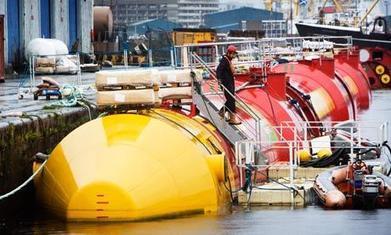
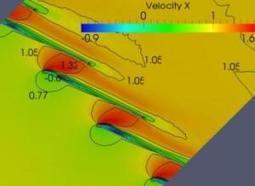
>The system, developed by a Norwegian company called Tidal Sails AS, consists of a string of submerged blades or sails, connected via wire ropes, angled into the oncoming current. The rushing current generates large lift forces in the sails, and as they are pushed along through a continuous loop, they drive a generator to produce electricity. […]

In their analysis, the researchers found that the maximum amount of power could be generated using blades with a chord length (the width of the blade at a given distance along its length) equal to the separation between each individual blade, that are positioned at about a 79 degree angle relative to the oncoming current, and that move at a speed about one and half times faster than the current.<

See on www.sciencedaily.com

UK government rejects current Severn tidal barrage plans

See on Scoop.itGreen & Sustainable News

Ministers say major changes must be made to the scheme if it is to be revived and given serious consideration

Duane Tilden‘s insight:

>Concerns over the impact of such a barrage on marine life played a major part in the rejection, with the government agreeing with MPs that better studies were needed to establish the effects on fish.

The response was: “It is for the developers to do the necessary work to prove that their design is ‘fish-friendly’ and will not jeopardise the UK’s obligations under the water framework directive and habitats directive. Such studies will need to take account of the wide variation in vulnerability of different fish species arising from to their different morphology, physiology and behaviour.”

The government said Hafren would need to provide much more detailed, credible evidence of the proposal, including a study of the environmental impacts and information on turbines, as well as information on allaying fears of flooding that could be worsened by any barrage. The coalition said it would consider the proposal further if this information was provided, but added that legal hurdles would mean the consortium’s current proposals were likely to be subject to delay.

Ministers reiterated their view that there should be no firm commitments of public financial support – in the form of the “strike price” of a premium for low-carbon power that has been confirmed for wind power and is expected soon for nuclear energy – for tidal barrage schemes until 2019 at the earliest.<

See on www.theguardian.com

Stanford Scientists Analyse Life Cycle Costs of Energy Storage vs Curtailment for Renewables

See on Scoop.itGreen Energy Technologies & Development

Stanford CA (SPX) Sep 17, 2013 –
Renewable energy holds the promise of reducing carbon dioxide emissions. But there are times when solar and wind farms generate more electricity than is needed by consumers.

Duane Tilden‘s insight:

>”We calculated how much energy is used over the full lifecycle of the battery – from the mining of raw materials to the installation of the finished device,” Barnhart said. “Batteries with high energetic cost consume more fossil fuels and therefore release more carbon dioxide over their lifetime. If a battery’s energetic cost is too high, its overall contribution to global warming could negate the environmental benefits of the wind or solar farm it was supposed to support.”

For this study, he and his colleagues calculated the energetic cost of grid-scale photovoltaic solar cells and wind turbines.

“Both wind turbines and photovoltaics deliver more energy than it takes to build and maintain them,” said GCEP postdoctoral scholar Michael Dale, a co-author of the study. “However, our calculations showed that the overall energetic cost of wind turbines is much lower than conventional solar panels, which require lots of energy, primarily from fossil fuels, for processing silicon and fabricating other components.” […]

To find out, the researchers compared the energetic cost of curtailing solar and wind power, versus the energetic cost of grid-scale storage. Their calculations were based on a formula known as “energy return on investment” – the amount of energy produced by a technology, divided by the amount of energy it takes to build and maintain it.

Using that formula, the researchers found that the amount of energy required to create a solar farm is comparable to the energy used to build each of the five battery technologies. “Using batteries to store solar power during periods of low demand would, therefore, be energetically favorable,” Dale said.

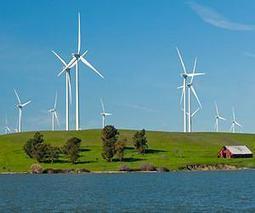
The results were quite different for wind farms. The scientists found that curtailing wind power reduces the energy return on investment by 10 percent. But storing surplus wind-generated electricity in batteries results in even greater reductions – from about 20 percent for lithium-ion batteries to ?more than 50 percent for lead-acid.<
See on www.solardaily.com

Revisiting The North American Hydropower Opportunity

See on Scoop.itGreen Energy Technologies & Development

It is no secret that many renewable energy advocates are not in favor of large hydropower.

Duane Tilden‘s insight:

>[…] there exists a threat that is even more worrisome to endangered species, a threat that has the potential to cause destructive flooding and destroy ecosystems: climate change.  […]

Perhaps that’s why in May of this year, the World Bank reversed its stance on large-scale hydropower. Whereas the major international development bank was once a staunch opponent of large-scale hydro, recognition that developing regions like Africa and Southeast Asia desperately need power have forced it to reconsider.  The world needs energy to lift people out of poverty and building more fossil fuel-fired electricity plants will only serve to exacerbate the problems already associated with climate change. Hydropower is an answer.

Maybe it is time for the renewable energy industry to take a second look at hydropower development. The clean energy it can provide is a vast improvement over the dirty energy we get from fossil fuels. Hydropower already meets about 8 percent of U.S. electricity demand and with improved technologies that already exist the National Hydropower Association (NHA) estimates that we can double the amount of energy we get from hydropower without building any more dams.<

See on www.renewableenergyworld.com

Google obtains a Renewable Energy Power Purchase Agreement in Texas

See on Scoop.itGreen Energy Technologies & Development

Duane Tilden‘s insight:

>The structure of this agreement is similar to our earlier commitments in Iowa and Oklahoma. Due to the current structure of the market, we can’t consume the renewable energy produced by the wind farm directly, but the impact on our overall carbon footprint and the amount of renewable energy on the grid is the same as if we could consume it. After purchasing the renewable energy, we’ll retire the renewable energy credits (RECs) and sell the energy itself to the wholesale market. We’ll apply any additional RECs produced under this agreement to reduce our carbon footprint elsewhere.<

See on googleblog.blogspot.ca

Scotland gives green light to Europe’s largest tidal energy project

See on Scoop.itGreen Energy Technologies & Development

Wave power to provide electricity to 40% homes in Highlands as work on building turbines in Pentland Firth gets approved

Duane Tilden‘s insight:

>”This is a major step forward for Scotland’s marine renewable energyindustry. When fully operational, the 86 megawatt array could generate enough electricity to power the equivalent of 42,000 homes – around 40% of homes in the Highlands. This … is just the first phase for a site that could eventually yield up to 398 megawatts.”<

See on www.theguardian.com

Canadian renewable energy output continues to fall

See on Scoop.itGreen & Sustainable News

The contribution from renewable energy sources continues to decline in Canada in comparison to conventional carbon-based fuel according to Federal statistics

Duane Tilden‘s insight:

>“While wind output dropped 14.4% and solar slipped 3.6%, Canada’s total generation of electricity declined 0.8%, which means that renewables continue to lose share” said Bill Eggertson, the Executive Director of the Canadian Association for Renewable Energies. “We’ve been warning for some time that the good news on the growth in renewables, is overshadowed by the even-greater growth in conventional energy output. The recent meeting of energy ministers in Yellowknife noted that green power capacity has grown at a rapid pace over the last decade and the trend is expected to continue, but that is not due to sources which many Canadians regard as truly renewable. Feed-in tariffs and legislated renewable portfolio standards are key, but there must be stronger efforts to curtail the growth of conventional energy sources, or the share from renewables will continue to drop.”<

See on www.renewableenergymagazine.com

Are current batteries cost effective for wind and solar power storage on the grid?

See on Scoop.itGreen Energy Technologies & Development

Renewable energy holds the promise of reducing carbon dioxide emissions. But there are times when solar and wind farms generate more electricity than is needed by consumers.

Duane Tilden‘s insight:

>”We calculated how much energy is used over the full lifecycle of the battery – from the mining of raw materials to the installation of the finished device,” Barnhart said. “Batteries with high energetic cost consume more fossil fuels and therefore release more carbon dioxide over their lifetime. If a battery’s energetic cost is too high, its overall contribution to global warming could negate the environmental benefits of the wind or solar farm it was supposed to support.” […]

In addition to batteries, the researchers considered other technologies for storing renewable energy, such as pumped hydroelectric storage, which uses surplus electricity to pump water to a reservoir behind a dam. Later, when demand for energy is high, the stored water is released through turbines in the dam to generate electricity. […]

Storage is not the only way to improve grid reliability. “Energy that would otherwise be lost during times of excess could be used to pump water for irrigation or to charge a fleet of electric vehicles, for example,” Dale said.

See on phys.org