North Dakota Bill Introduced to Minimize Natural Gas Waste from Oil Wells

North Dakota’s Senate is considering legislation that would drastically cut the time oil companies can burn off and waste natural gas from an oil well.

Source: www.pennenergy.com

>”[…] Democratic Sen. Connie Triplett is sponsoring the bill that would require companies to begin paying royalties and taxes on natural gas within 14 days after an oil well begins production. Companies are given a year at present.

Triplett and others told the Senate Energy and Natural Resources Committee on Friday that mineral owners and the state are being shortchanged because revenue on the wasted gas is not immediately being collected.

North Dakota Petroleum Council President Ron Ness says the industry has invested $13 billion to capture the gas. But he says there is still a challenge obtaining permission to place gas pipelines in some areas.”<


See on Scoop.itGreen & Sustainable News

Crude Oil Spills From Pipeline Into Yellowstone River, Montana

Residents have reportedly smelled and tasted oil in their drinking water downstream from the spill, and the city’s water plant has stopped drawing from the river.

Source: thinkprogress.org

>” […] On Saturday morning, a pipeline in Montana spilled up to 50,000 gallons of crude oil into the Yellowstone River, the pipeline’s operator confirmed Sunday night. […]

The 12-inch diameter steel pipe breached and spilled anywhere from 12,600 to 50,000 gallons of oil nine miles upriver from the town of Glendive, with an unknown amount of it spilling into the partially frozen river, according to a statement from Bridger Pipeline LLC. The company said the spill occurred at 10 a.m. and they “shut in” the flow of oil just before 11 a.m. — meaning that though the pipeline section could still empty itself of its contents, no new addition oil would flow into the spilled area.

“Oil has made it into the river,” Bridger spokesperson Bill Salvin confirmed to the AP on Monday. “We do not know how much at this point.” Observers spotted oil, some of which was trapped under the ice, up to 60 miles downstream from Glendive. Paul Peronard, the EPA’s on-scene coordinator, said crews were attempting to use booms to prevent the spill from spreading further but the ice on top of the river was forcing them to “hunt and peck” through it.  […]

“We think it was caught pretty quick, and it was shut down,” said Montana Governor Steve Bullock spokesperson Dave Parker, noting that the river was frozen over near the spill, which could help isolate the spill.

Parker told MTN News that “the Governor is committed to ensuring that the river is completely cleaned up and the folks responsible are held accountable.”

In 2011, an Exxon Mobil pipeline spilled 63,000 gallons of crude oil into the Yellowstone near Laurel, Montana. Days after the spill, goat rancher Alexis Bonogofsky was hospitalized for acute hydrocarbon exposure after noticing oil slicks along the riverbank abutting her ranch. She lived far enough downstream that any evacuation order missed her, she said. There was concern then that the cause of the spill was related to climate-change-influenced raging floodwaters that exposed the normally deeply-buried pipe to damaging debris.

Even two years later, the state was still fighting with Exxon over damages to the area from the spill and the clean-up process, leaving fish, birds, and wildlife dead or injured and interrupting environmental studies, recreation, and fishing.

Bridger’s pipeline runs from the Canadian border down through Montana across the Missouri and Yellowstone rivers and east into North Dakota, dubbed the Poplar System. It is on the opposite side of Wyoming from, and downstream of, Yellowstone National Park, but the river empties into the Missouri River.

The proposed — and controversial — northern leg of the Keystone XL pipeline would bethree times the diameter of the breached Bridger pipeline, and pump more than 34 million gallons of oil per day through the Dakotas down into Nebraska and into the southern leg in Oklahoma and Texas. Many landowners and local residents are concerned about what a potential spill would mean for critical watersheds and aquifers — not to mention what subsequent increased tar sands oil production means for Canadian watersheds.”<


See on Scoop.itGreen & Sustainable News

The Oil Crash Sours LNG Future, Project Put on Hold

The floating 8 million tonne per annum (mtpa) export plant moored at Lavaca Bay, Texas advanced by Houston-based Excelerate has been put on hold, according to regulatory filings obtained by Reuters.

Source: www.businessinsider.com

>” […] The project was initially due to begin exports in 2018.

Excelerate’s move bodes ill for thirteen other U.S. LNG projects, which have also not signed up enough international buyers, to reach a final investment decision (FID). Only Cheniere’s Sabine Pass and Sempra’s Cameron LNG projects have hit that milestone.

Back when LNG and crude oil prices were riding high in February, Excelerate, founded by Oklahoma billionaire George Kaiser, applied for permits to build the facility.

Eleven months on, its submission to the U.S. Federal Energy Regulatory Commission on Dec. 23 said that uncertainty generated by a steep decrease in oil prices has forced it to conduct a “strategic reconsideration of the economic value of the project” and to suspend all activities until April 1, 2015.

“Due to the recent global market conditions, the company has determined that, at this time, this project no longer meets the financial criteria necessary in order for us to move forward with the capital investment,” a company spokesman told Reuters.

Stiff economic headwinds are making new developments tough going.

Prices that LNG projects can charge for long-term supply are falling from historic highs as new producers crowd the market, which is already oversupplied due to slowing demand and rising output that has seen spot Asian LNG prices halve this year.

At the same time, major consumers from Japan to South Korea and China are seeking to offload some of their long-term LNG supply commitments, contributing to the glut. […]”<

Read more: http://www.businessinsider.com/r-exclusive-oil-price-crash-claims-first-us-lng-project-casualty-2014-12#ixzz3NVGgV68I

See on Scoop.itGreen & Sustainable News

Renewable Geothermal Power with Oil and Gas Coproduction Technology may be Feasible

The U.S. has been harnessing geothermal energy since 1960 and if recently announced research projects and startups are successful, even more geothermal power might soon be available.

Source: www.renewableenergyworld.com

>” […]  in the past, wastewater from oilfield production processes was viewed as a nuisance byproduct that needed to be disposed of. But new research has shown that much of the 25 billion barrels of this geothermally heated “wastewater” produced at oil wells each year in the U.S. is hot enough to produce electricity. It is estimated that many of the wells might have clean energy capacities of up to 1 MW.

Oil and Gas Coproduction in the US

In 2008, the DOE developed the first low-temperature geothermal unit in an oil field at the Rocky Mountain Oilfield Testing Center (RMOTC) in Wyoming. The well is producing energy and has a capacity of approximately 217 kW. RMOTC continues to test power units produced by Ormat Technologies and UTC/Pratt and Whitney Power Systems at the center and more than 30 oil firms have visited the center to learn about coproduction technology. The technology is also being implemented in Nevada, Mississippi, Louisiana, North Dakota and Texas.

In Nevada, Florida Canyon Mining Inc. is using the 220°F groundwater in a coproduction project that uses ElectraTherm’s 50-kW waste heat generators, aka “Green Machines” to generate electricity.

Energy can be harnessed at working oilfields and used to power them without interrupting their operation. A Gulf Coast Green Energy (GCGE) coproduction project at the Denbury oilfields in Laurel, Mississippi, is using this technique again with ElectraTherm Green Machines.  It replaced Denbury’s electric submersible pump and cut electricity costs by a third. GCGE has a second 50-kW geothermal natural gas coproduction project in Louisiana.

University of North Dakota was awarded $1.7 million through the DOE’s Geothermal Technologies Program to install a geothermal Organic Rankine Cycle (ORC) system at another oilfield operated byDenbury. For two years the plant will be used to develop engineering and economic models for geothermal ORC energy production. The technology could be used throughout the Williston Basin.

Liberty County Pilot Project

Texas is oil country, and the 4000+ dormant oil and gas wells speckled across the landscape provide a new, or perhaps recycled, frontier in geothermal energy production.  To tap some of that energy,Universal GeoPower CEO and petroleum geologist George Alcorn Jr. and his partner, Chris Luchini, a PhD physicist will use the $1.5 million in federal stimulus funds that they were awarded to bring geothermal energy to Liberty County, Texas. The company said that to prepare its DOE application, it worked with Southern Methodist University. The university has performed extensive research on coproduction and has found that it is applicable to an estimated 37,500 oil and gas wells in the Gulf Coast region.

Universal GeoPower’s pilot project is expected to be one of many that will recomplete the wells to produce low temperature, geopressured brine water. The brine will run through a commercial off-the-shelf turbo expander and an ORC binary generator.

Alcorn spoke recently at GEA’s global geothermal meeting in Washington, DC, offering a snapshot of the economic benefits of the process. “The lead-time to revenue generation is about 6 months, whereas traditional geothermal can take up to five years,” he said. “The wells already have known geothermal potential, and capital costs are dramatically reduced.”

Additionally, Alcorn noted, units are installed at existing oil wells, eliminating the need for investment in drilling, new roads or transmission lines. […]”<

See on Scoop.itGreen Energy Technologies & Development

University Researchers Find Abandoned Wells Leak Substantial Quantities of GHG’s (Methane)

After testing a sample of abandoned oil and natural gas wells in northwestern Pennsylvania, the researchers found that many of the old wells leaked substantial quantities of methane.

Source: www.princeton.edu

>” […] To conduct the research, the team placed enclosures called flux chambers over the tops of the wells. They also placed flux chambers nearby to measure the background emissions from the terrain and make sure the methane was emitted from the wells and not the surrounding area.

Although all the wells registered some level of methane, about 15 percent emitted the gas at a markedly higher level — thousands of times greater than the lower-level wells. Denise Mauzerall, a Princeton professor and a member of the research team, said a critical task is to discover the characteristics of these super-emitting wells.

Mauzerall said the relatively low number of high-emitting wells could offer a workable solution: while trying to plug every abandoned well in the country might be too costly to be realistic, dealing with the smaller number of high emitters could be possible.

“The fact that most of the methane is coming out of a small number of wells should make it easier to address if we can identify the high-emitting wells,” said Mauzerall, who has a joint appointment as a professor of civil and environmental engineering and as a professor of public and international affairs at the Woodrow Wilson School.

The researchers have used their results to extrapolate total methane emissions from abandoned wells in Pennsylvania, although they stress that the results are preliminary because of the relatively small sample. But based on that data, they estimate that emissions from abandoned wells represents as much as 10 percent of methane from human activities in Pennsylvania — about the same amount as caused by current oil and gas production. Also, unlike working wells, which have productive lifetimes of 10 to 15 years, abandoned wells can continue to leak methane for decades.

“This may be a significant source,” Mauzerall said. “There is no single silver bullet but if it turns out that we can cap or capture the methane coming off these really big emitters, that would make a substantial difference.” […]”<

See on Scoop.itGreen & Sustainable News

New Alberta Oilsands Projects to Start Up Despite Falling Oil Prices

Oil producers are set to be squeezed as a total of 14 new oilsands projects are scheduled to start next year while crude prices continue to fall

Source: business.financialpost.com

” […] “There is a lot of crude coming on next year,” Juan Osuna, IHS Energy Inc.’s senior director for North American oil said in a phone interview Dec. 12. Producers “aren’t going to be happy, they will make a greater effort to cut costs, but they have been prepared for this.”

Western Canadian Select fell to US$39.38 a barrel Monday, the lowest since April 2009, according to data compiled by Bloomberg. The grade, which has higher sulfur content than U.S. benchmark West Texas Intermediate, sold at an average US$18.78 a- barrel discount in the past year, according to data compiled by Bloomberg.

Oilsands projects slated to start next year include ConocoPhillips and Total SA’s joint 118,000 barrel a day Surmont project and the 40,000-barrel-a-day expansion of Cenovus Energy Inc.’s Foster Creek project […]

Sunrise Project

Husky Energy Inc. said last week it began steam operations on its Sunrise crude project with the first phase set to begin pumping oil by early next year.

While oilsands producers may curtail future development, most existing operations won’t be shut and ones under construction will go ahead because of the investments involved and potential harm to future output, Osuna said.

Cenovus said Dec. 11 production would rise 9 per cent to 129,000 barrels a day from its Foster Creek and Christina Lake projects next year even as it lowered its spending plan by about 15 per cent.

Canada’s oilsands output is projected to rise to 3.7 million barrels a day by 2020 from 1.98 million last year, according to a report last month by the Canadian Energy Research Institute.

Brent oil traded near US$61 a barrel Monday as the United Arab Emirates said the Organization of Petroleum Exporting Countries will resist output cuts even if prices slump as low as US$40. […]”<

See on Scoop.itGreen & Sustainable News

Oil Price Slump Good News for Solar Power?

As global oil prices hit a five-year low, the fossil fuel industry is facing a gathering storm that could spell great news for the solar power industry.

Source: www.pv-magazine.com

” […]

Some analysts had suggested that cheaper oil could initially cause problems for the solar industry. With utilities able – but not guaranteed – to pass on gains to the consumer, the thirst for renewable energy could wane, analysts warned. “Such a scenario could destroy value on existing renewable energy projects and make it difficult to raise financing for future projects,” Peter Atherton, utility analyst at Liberum Capital, told the Guardian.

However, Deutsche Bank energy analyst Vishal Shah yesterday released a report that suggested there would be “limited/no impact from recent oil price weakness” on the solar industry, with PPA prices in the U.S. immune from oil fluctuations. In China, Shah added, government appetite to tackle air pollution also protects the solar industry from external volatility, while the U.S. residential solar market is even more insulated from external forces, which spells good news for companies like Solar City.

In Japan, energy advisor to the government and senior fellow at Mitsui Global Strategic Studies Institute Takashi Hongo told Bloomberg that “renewables are supported by policies, and that is not something that will be amended quickly just because oil prices fall,” suggesting there will be hardly any negative impact to the solar industry.

A warning shot was fired from Lin Boqiang, director of the Energy Economics Research Center at China’s Xiamen University, however. “If oil stays at current prices or weakens through the first half of next year, the impact on new energy would be massive,” Boqiang told Bloomberg. “Weakening oil prices would hamper the competitiveness of new energy.”

[…]

“The fact that oil is so unpredictable is one of the reasons why we must move to renewable energy, which has a completely predictable cost of zero for fuel,” urged Christiana Figueres, executive secretary of the UN Framework Convention on Climate Change at the opening of the COP20 climate conference in Peru.

A changing tide
Following oil’s dramatic price fall last week, this week began with two seismic announcements that could hammer a further nail into the fossil fuel coffin. First, German utility E.ON announced that it is to pivot away from fossil fuels by 2016, pouring the majority of its resources into the development of renewable energy sources.

Then, a day later, the Bank of England (BOE) wrote a letter to the U.K. government’s Environment Audit Committee announcing that it is to formally begin examining the risks fossil fuel companies pose to financial stability.

BOE governor Mark Carney expressed his concern that much of the world’s proven coal, oil and gas reserves may be “unburnable” if the world is to keep global warming within safe limits.

“In light of discussions with officials, we will be deepening and widening our inquiry into the topic,” wrote Carney. “I expect the Financial Policy Committee to also consider this issue as part of its regular horizon-scanning work on financial stability risks.” […]”

Read more: http://www.pv-magazine.com/news/details/beitrag/is-the-oil-price-slump-a-boon-for-solar_100017395/#ixzz3LrUAGr88


See on Scoop.itGreen & Sustainable News

5 Reasons Oil Prices Are Dropping

Key contributing factors in the fall in oil prices range from surprise production levels in Libya to, in-fighting between OPEC members and EU economic outlook…

Source: oilprice.com

“> […]

1. The U.S. Oil Boom
America’s oil boom is well documented. Shale oil production has grown by roughly 4 million barrels per day (mbpd) since 2008. Imports from OPEC have been cut in half and for the first time in 30 years, the U.S. has stopped importing crude from Nigeria.

2. Libya is Back
Because of internal strife, analysts have until recently assumed that Libya’s output would hover around 150,000-250,000 thousand barrels per day. It turns out that Libya has sorted out their disruptions much quicker than anticipated, producing 810,000 barrels per day in September. […]

3. OPEC Infighting 
There have been numerous reports about the discord between OPEC members, leading many to believe that OPEC will not be able to reign in production like it has done so in the past. The Saudis and Kuwaitis have reportedly been in an oil price war, repeatedly lowering their prices in order to maintain their market share in Asia. […]

4. Negative European Economic Outlook
European Central Bank president Mario Draghi has left investors concerned about the continent’s slow growth. Germany’s exports were down 5.8 percent in August, stoking the fears of anxious investors that the EU’s largest economy had double dipped into recession last quarter. Across the Eurozone, the IMF again lowered its growth forecast to 0.8 percent in 2014 and 1.3 percent in 2015.

5. Tepid Asian Demand 
Beyond slow economic growth and currency depreciation, a number of Asian countries have begun cutting energy subsidies, resulting in higher fuel costs despite a drop in global oil prices. […]”<


See on Scoop.itGreen & Sustainable News

Price of Oil Continues to Drop Due to Oversupply

The price of oil has hit another five-year low as fears of oversupply continue to mount.  Brent crude was down $1.77 at $67.30 a barrel in Monday afternoon trading, having earlier hit $66.77 – its lowest since October 2009.

Source: www.bbc.com

>” […]US crude was down $1.44 at $64.40, after falling as low as $64.14.

Morgan Stanley predicted that Brent would average $70 a barrel in 2015, down $28 from a previous forecast, and be $88 a barrel in 2016.

The investment bank also said that oil prices could fall as low as $43 a barrel next year. Analyst Adam Longson said that markets risked becoming “unbalanced” unless the Opec producers’ cartel decided to intervene.

Saudi Arabia, the cartel’s biggest member, resisted calls at last month’s meeting to cut production despite the slide in prices, which have fallen more than 40% since June.

Kuwait, another Opec member, said that oil prices were likely to remain about $65 a barrel until the middle of next year unless Opec cut output. […]”<

See on Scoop.itGreen & Sustainable News

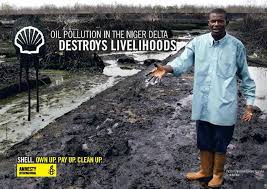
Corroded Pipeline with History of Leaks – Major Shell Oil Spill into Niger Delta

“We saw dead fish, dead crabs. … This spill occurred seven, eight nautical miles from the shore … [so] the volume runs into thousands of barrels,” said Alagoa Morris, head of the Niger Delta Resource Center for Environmental Rights Action.

Source: royaldutchshellplc.com

>” […] Some 3,800 barrels spilled recently, according to an investigation by Shell and government officials. It ranks as one of the worst in Nigeria for years, local environmental activists said.

A Shell spokesman said that some 1,200 barrels had been recovered as of Tuesday, and “recovery efforts are continuing” at the site on the Okolo Launch on Bonny Island.

Shell said the spill was caused by a failed crude theft. Nigeria, Africa’s top oil producer, loses tens of thousands of barrels per day to oil theft that often causes spills, although many are also caused by corroded pipelines.

Shell shut down its 28-inch pipeline carrying Bonny Light crude Nov. 22, but the origin of the spill was from the smaller 24-inch pipe, which was shut last year.

Crude washed up in pools in front of beach shacks in the affected site, coating the roots of palm trees and leaving a trail of dead sea life. In some areas, people scooped up the crude to fill drums and jerry cans.

“We saw dead fish, dead crabs. … This spill occurred seven, eight nautical miles from the shore … [so] the volume runs into thousands of barrels,” said Alagoa Morris, head of the Niger Delta Resource Center for Environmental Rights Action.

“We can’t go fishing anymore. It has destroyed our fishing equipment,” Bonny fisherman Boma Macaulay said, adding that it was the worst spill he had seen for at least five years.

Shell is under pressure to pay damages on other spills. Parliament said last month that it should pay nearly $4 billion for a spill at the offshore Bonga oilfield.

The Bodo community in Ogoniland is also suing for two massive spills in 2008 that devastated the area. […]”<

See on Scoop.itGreen & Sustainable News