Shaw partners with City of Calgary to offer free public WiFi

See on Scoop.itTwitter & Social Media

The City of Calgary has reached an agreement with Shaw Communications to provide free Wi-Fi at city-owned locations.

Duane Tilden‘s insight:

>After reviewing applications, the city decided Shaw had the best proposal and technical expertise, and awarded Shaw the contract.

Shaw will partner with the city to install free WiFi zones in a variety of public locations including recreation facilties, parks and LRT stations.

“The City manages a variety of public spaces and we were looking to partner with an organization that would be able to provide reliable WiFi services, at no cost to citizens, as well as meet industry regulations and provide technical support,” says Heather Reed-Fenske, the city’s manager of  Information Technology.

During the initial launch of the program, public WiFi will be available in a select number of public spaces. […]

Mayor Naheed Nenshi says free public WiFi will give Calgarians better access to city services.

Once the initial zones are up and running, the city will collect feedback from Calgarians to evaluate the success of the program.

An announcement is expected soon on when the service will be available.<

See on globalnews.ca

Asbestos – Best Practice Approach To Roof Refurbishment

Excellent article on legacy asbestos insulated roofing systems and remediation methods.

Specifier Review's avatarArchitecture, Design & Innovation

For any demolition, refurbishment or repair project, the presence of asbestos in the building can have far reaching cost and health & safety implications. And it’s not an uncommon problem. Asbestos was widely used as a roofing material right the way through to the 1970s thanks to its durability and fire resistance benefits at low cost.

The use of asbestos as a building material is a legacy of the built environment that today’s roofing contractors are often tasked with tackling, as those roofs originally specified in the 1950s, 60s and 70s fail and need to be replaced.  Sometimes, there may be no other option than to remove the asbestos roof and incur the project delays and added costs that specialist remediation involves. However, while the Control of Asbestos regulations 2012 ensures that building owners are accountable for preventing any risk of exposure to asbestos fibres from their building, contractors do…

View original post 747 more words

California Building Code Title 24 Will Revolutionize Efficiency Financing for Buildings

See on Scoop.itGreen Building Design – Architecture & Engineering

If successful, Title 24 will open the door to increased amounts of energy efficiency financing, expanded sources of capital and lower financing costs.

Duane Tilden‘s insight:

>California’s Title 24

Title 24 is California’s body of state building codes. These codes have been revised to move the building industry toward comprehensive building solutions with a goal of achieving Zero Net Energy (ZNE) residential and commercial buildings. In a ZNE building, the annual building’s energy consumption is equal to the building’s onsite renewable energy generation. California has set a goal for all new residential construction to be ZNE by 2020 and for all new commercial construction to be ZNE by 2030. Additionally, the repurposing and remodeling of existing buildings that are of a size-threshold defined by Title 24 will also have to comply with Title 24 revised codes.

Financing a “smart” Zero Net Energy building

The challenge of financing any energy efficiency or renewable energy project is in providing assurances to the source of capital that the project will actually generate sufficient cost savings to cover financing costs plus repayment of invested capital. The number one challenge for winning energy efficiency investments is the uncertainty in documenting bill savings results. Too often, the cost savings generated by an investment in energy efficiency is lost in higher electric bills as new loads are added and utilities raise rates.

Information technologies that monitor, control and financially operate a building through links to real time prices of grid-supplied electricity are the foundation for enabling Title 24 project financing. Smart ZNE buildings will operate to optimize the economics between reducing building demand, reducing energy consumption, on-site generation, use of on-site energy storage and purchases of grid electricity.

What will further enable the financing of ZNE buildings is the ability of enabling information technologies to “look forward” in time to proactively shape a building’s operation and grid purchases to financially support the building’s project financing. The technologies that can achieve these results have already been invented. What California is pursuing through its Title 24 code revisions is a massive economies of scale push for these technologies to drive their costs down and increase their ability to be financed.

The sales pie just got bigger…a lot bigger

Beginning in 2014, Title 24 will blow the sales doors open for smart building technologies, energy efficiency technologies, onsite energy storage and renewable energy technologies. Title 24 will create a new competitive landscape for architects, general contractors, sub-contractors and vendors based upon their ability to offer price competitive services and products that comply with Title 24 codes. The construction industry’s sales path for energy efficiency projects will no longer be anchored by utility incentives that support targeted energy efficiency upgrades like re-lamping a building with more efficient lights. The new sales path will be based upon cost-effectively delivering code compliance to achieve financeable building performance. New competitive advantages will be won by contractors and architects that offer building performance assurances to building owners and financing sources.<

See on www.triplepundit.com

The 10 Most Energy-Efficient U.S. States: The Forgotten ‘Fifth Fuel’

See on Scoop.itGreen & Sustainable News

Access to energy in the U.S. — and the effects of generating it — are a national concern.

Duane Tilden‘s insight:

>The Forgotten ‘Fifth Fuel’

Access to energy in the U.S. — and the effects of generating it — are a national concern. Debates persist over the most cost-effective and environmentally friendly mix of nuclear energy, coal, gas and liquid hydrocarbons and renewable sources.

Too often left out of these discussions is the so-called fifth fuel: energy efficiency. States have driven benefits for consumers and the environment with policies that both reduce energy use and encourage economic growth.

The American Council for an Energy-Efficient Economy (ACEEE) yesterday issued its annual scorecard for each state based on multiple factors, including reductions in greenhouse gas, energy codes for buildings and switching to cleaner fuels.<

See on www.bloomberg.com

How Real Estate Energy Managers Can Use Big Data to Schedule Building Energy Retrofits

See on Scoop.itGreen Building Operations – Systems & Controls, Maintenance & Commissioning

Big Data remains a fairly nebulous concept for many real estate professionals, including those who stand to gain tremendously from it right now: real estate energy managers.

Duane Tilden‘s insight:

>To effectively time energy retrofit measures, energy managers can first develop those measures. New energy analytical tools such as FirstFuel identify and develop measures, and even estimate a range for capital cost. It does this analysis remotely over the course of a day just by analyzing hourly electricity data (which is sometimes also stored by the utility); no time-intensive on-site energy audit is required. Another new tool is Retroficiency, which provides a high-level look at energy performance improvement potential using the same interval data and, with minimal additional data from the IWMS, can further develop retrofit measures to investment-grade level.

After identifying energy-retrofit measures for the portfolio using remote energy analysis tools or more standard on-site energy analysis, energy managers can create a new retrofit measures database in the IWMS. Having this new database on hand enables managers to integrate energy retrofit opportunities with space management, maintenance and capital upgrade needs, and potentially other real estate issues. Such integration drives down the incremental cost of an energy retrofit, which is the gross cost minus the avoided cost of otherwise required capital or space upgrades.<

See on blog.rmi.org

Federal Energy Management Program: Online Training – Live & On-Demand – CEU’s

See on Scoop.itGreen & Sustainable News

FEMP trains Federal agency managers about the latest energy requirements, best practices, and technologies through eTraining Courses, First Thursday Seminars, and webinars.

See on apps1.eere.energy.gov

Lessons in Energy Saving, a guest blog by Roger Hunt

>The energy saving measures are being retrofitted during a wider refurbishment project. They range from secondary glazing, draught-proofing and new energy efficient boilers to roof insulation, LED lighting and the installation of wood burning stoves. There are also low volume baths, dual flush cisterns and heat recovery systems in the bathrooms. Full details of the Buscot and Coleshill refurbishments and a short video can be found at the SuperHomes website.<

US GSA Recognizes two 3rd-party Green Building Certification Systems

See on Scoop.itGreen Building Design – Architecture & Engineering
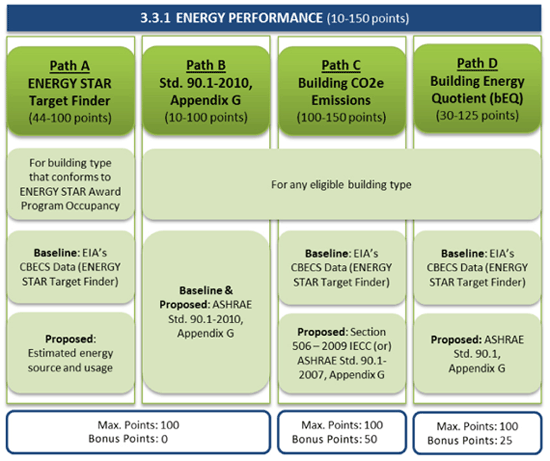
Green-Globes-NC-Building-Energy-Performance-Paths-chart

LEED and Green Globes approved as third party certification programs for federal facilities.

Duane Tilden‘s insight:

>In its recommendation to DOE, GSA recommended the Green Building Initiative’s Green Globes 2010 and the U.S. Green Building Council’s Leadership in Energy and Environmental Design (LEED) 2009 as the third party certification systems that the federal government can use to gauge performance in its construction and renovation projects. Other certification systems were not selected because they did not align with the government’s requirements. Additionally, under this recommendation, GSA will conduct more regular reviews in order to keep up with the latest green building tools that the market has to offer.

Third party certification systems like LEED and Green Globes help in measuring reduction targets for water, energy, and greenhouse gas emissions against industry standards. Agencies can use one of the two certification systems that best meet their building portfolios, which range from office buildings, to laboratories, to hospitals, to airplane hangars.

Federal construction and modernization projects must adhere to the government’s own green building requirements by law and executive orders. No one certification system meets all of the federal government’s green building requirements. Green building certification systems are just one tool that GSA uses to cut costs and meet sustainability and economic performance goals.<

See on www.todaysfacilitymanager.com

GBI’s Green Globes Recognized by Portland’s GSA as Equivalent to LEED for Green Building

See on Scoop.itGreen Building Design – Architecture & Engineering

PORTLAND, OR–(Marketwired – Oct 29, 2013) – The Green Building Initiative (GBI) applauds the General Services Administration on its recognition of Green Globes® alongside the U.S.

Duane Tilden‘s insight:

>GBI’s growth in the market is due to its commitment to the practicality of its tools for use by building owners, designers, and facility managers as well as its commitment to open, consensus-based review of its technical criteria. In 2010, GBI was recognized for developing Green Globes for New Construction as the first ever American National Standard for a commercial building rating system. As it continues to improve its rating systems based on changes in the market, GBI remains committed to using the American National Standards Institute (ANSI) approved consensus procedures.

“GBI is the only commercial building rating system developer to vet its technical criteria through the ANSI process,” stated GBI Chairman Tonjes. “This helps to ensure that GBI’s rating systems provide the opportunity to evaluate the widest range of buildings using an open, science-based approach to building performance.”

ANSI/GBI 01-2010, also known as Green Globes for New Construction, is due for revision before the end of 2015 based on ANSI periodic maintenance requirements. According to Tonjes, GBI’s ANSI-based rating system review process will begin before the end of this year with the filing of required documents followed by reformation of the technical review committee.

GBI’s tools have a significant focus on both the reduction and efficient use of energy and water in buildings. These, along with other criteria, help reduce building operating costs and their overall impact on the environment.

“Since 2005, the Green Globes product line has evolved to include several updated and expanded tools,” stated Erin Shaffer, vice president of federal outreach at GBI.<

See on www.marketwired.com

Qualifications and Documents for Comprehensive Reserve Fund Studies

See on Scoop.itGreen Building Operations – Systems & Controls, Maintenance & Commissioning

As of May 5, 2001, the Condominium Act 1998 requires all existing and new condominium corporations to have a “Reserve Fund Study” undertaken. This article outlines some of the key aspects of Reserve Funds and the Studies.

Duane Tilden‘s insight:

>[…]The regulations to the Condominium Act stipulate the minimum liability insurance requirements; $1,000,000.

6. What Information Does The Corporation Need To Provide?

Once you have hired a consultant, he/she will require information about the condominium corporation. This will include the following:

  • As-built drawings and specifications.
  • The Declaration and Description.
  • Reciprocal cost sharing agreements.
  • Previous reserve fund studies.
  • The most recent audited financial statements.
  • What the current annual contribution to the Reserve Fund is.
  • Repairs or replacements to the common elements that have already been completed and when.
  • Similarly, scheduled future work needs to be accounted for.
  • A summary of problems being encountered by the Corporation that should be reviewed.
  • As an example, water penetration concerns.

7. What Is The Process?

The process is as follows:

  • The consultant is provided the above information. One of the most important are the drawings. They will be reviewed prior to visiting the site in order for the consultant to become familiar with the overall design and construction schemes.
  • Site inspection. In order to have an understanding on the current condition of the common elements, visual inspections are undertaken. Problem areas noted above can be reviewed. After the first study, the next study update can be completed without a site inspection. The next update must include a site inspection.
  • The report is then prepared (see next question). The drawings are used to “take-off” quantities such as roofing, exterior wall cladding, asphalt, hallway finishes etc that will assist in preparing the replacement/repair cost budgets. It is recommended that a draft report should be submitted in order for the Board and Property Manager to review it prior to it being finalized. The consultant should be available to attend a meeting to review the report.
  • Upon receiving direction from the Board of Directors, the Reserve Fund Study is finalized and submitted. […] 

See on www.maytower.ca