Shipping’s Growing Carbon Gap

davecolemanblog's avatarTransport's Carbon & Energy Future

sinking_container_ship

On the face of it, Shipping is the most efficient of freight transport modes. Intermodal shipping containers kick-started rapid growth in trade globalisation 60 years ago, and container ships, tankers and bulk carriers have been getting bigger ever since. Carrying more freight with less fuel on a tonne-mile basis, shipping has the highest energy productivity of all transport modes.

Yet looks can be deceiving. While international shipping contributes 2.4% of global greenhouse gas emissions, business-as-usual could see this explode to a whopping 18% by 2050. As trade growth increases demand, today’s fleet burns the dirtiest transport fuels, and a new report shows the market doesn’t reward ship owners who invest in the latest fuel- and carbon-efficient technologies.

When you consider the scale of the sector’s emission reductions that need to start now to contribute to the COP 21 Paris Agreement target of 1.5°C to 2°C global warming, there’s clearly an…

View original post 604 more words

The “fuel” that’s helping America fight climate change isn’t natural gas

Ivy Main's avatarPower for the People VA

You’ve heard the good news on climate: after a century or more of continuous rise, U.S. CO2 emissions have finally begun to decline, due largely to changes in the energy sector. According to the Energy Information Agency (EIA), energy-related CO2 emissions in 2015 were 12% below their 2005 levels. The EIA says this is “because of the decreased use of coal and the increased use of natural gas for electricity generation.”

Is the EIA right in making natural gas the hero of the CO2 story? Hardly. Sure, coal-to-gas switching is real. But take a look at this graph showing the contributors to declining carbon emissions. Natural gas displacement of coal accounts for only about a third of the decrease in CO2 emissions.

Courtesy of the Sierra Club Beyond Coal Campaign, using data from the Energy Information Agency. Courtesy of the Sierra Club Beyond Coal Campaign, using data from the Energy Information Agency.

By far the biggest driver of the declining emissions is energy efficiency. Americans…

View original post 746 more words

Urbane Legends

Is Climate Change an Urban Legend?

usissuescom's avatarUS Issues

By Willis Eschenbach – Re-Blogged From http://www.WattsUpWithThat.com

So we were sitting around the fire at the fish camp on the Colombia a few days ago, and a man said “Did you hear about the scientific study into meat preservatives?” We admitted our ignorance, and he started in. The story was like this:

“A few years ago there was a study done by some University, I can’t remember which one, but it was a major one. What they did was to examine the corpses of people who had died in Siberia, and those that had died in Washington State. Now of course the people in Siberia weren’t eating meat preservatives during their lives, and the Washington people were eating them. And when they dug up the graves and looked at the bodies, guess what they found?” 

the killer in the back seatUrban Legend: The Killer In The Back Seat SOURCE 

View original post 1,264 more words

Low Coal Prices Fuel Demand as Trading Volumes Soar 46%

coal-trains

Image Source:  Power Plant Men

Coal leads surge in European energy exchange trading in first half 2016 -study

Wholesale trading of coal on the exchanges soared 46 percent from a year earlier to 3.5 billion tonnes

FRANKFURT: Coal lead a surge in trading volumes on west European energy exchanges in the first half of this year as traders took advantage of low commodity prices, research company Prospex said on Monday.

Wholesale trading of coal on the exchanges soared 46 percent from a year earlier to 3.5 billion tonnes, according to Prospex.

“Low coal prices mean a fixed amount of trading capital will buy higher volumes than it did in the past,” said Prospex Research director Ben Tait.

“In fact, many traders seeking to hit absolute profit targets have indeed ramped up volumes,” he said.

Prospex’s data covers volumes on what traders call the paper market, where two parties agree deals in the over-the-counter (OTC) market and have them cleared by an exchange.

In coal, this type of business accounts for 98 percent of volumes changing hands in Europe.

Prospex said commodity trading houses remain keen on coal, with some holding extensive physical coal interests that play out on the dominant Amsterdam-Rotterdam-Antwerp (ARA) region of ports that serve Europe’s power stations and steelmakers with raw material.  Read more:  Full Article


Defining energy and exergy

Before discussing any aspect of energy technology one should give a definition of energy. Most textbooks on energy technology do not go down to this fundamental level. The authors may have worked o…

Source: Defining energy and exergy

Thermoelectric Materials: Converting Heat to Electricity

When we think of using electricity one of the prevalent uses is to provide a heat source.  We see this in our everyday lives as ranges and ovens, microwaves, kettles, hot water tanks, baseboard heaters, as well as other applications.  So how about reversing the process and capturing heat and directly converting to electricity, is this possible?  As it happens there is a classification of materials which have a property called a thermoelectric effect.

Boosting energy efficiency is an important element of the transition to a sustainable energy system. There are big savings to be made. For example, less than half the energy content of diesel is actually used to power a diesel truck. The rest is lost, mostly in the form of heat. Many industrial processes also deal with the problem of excessive .

That’s why many research teams are working to develop that can convert waste heat into energy. But it’s no easy task. To efficiently convert heat to electricity, the materials need to be good at conducting electricity, but at the same time poor at conducting heat. For many materials, that’s a contradiction in terms.

“One particular challenge is creating thermoelectric materials that are so stable that they work well at high temperatures,” says Anders Palmqvist, professor of materials chemistry, who is conducting research on thermoelectric materials. (1)

2dthermoelec.jpg

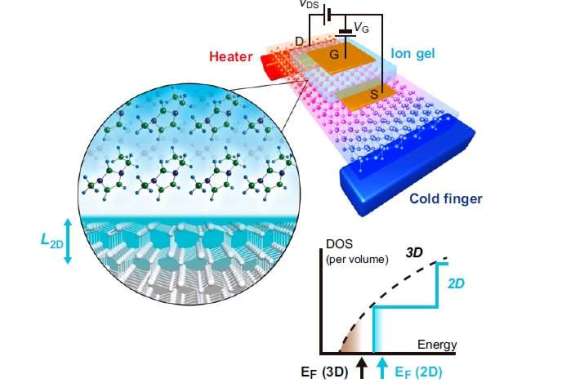
Image 1:  The enlarged illustration (in the circle) shows a 2D electron gas on the surface of a zinc oxide semiconductor. When exposed to a temperature difference, the 2D region exhibits a significantly higher thermoelectric performance compared to that of bulk zinc oxide. The bottom figure shows that the electronic density of states distribution is quantized for 2D and continuous for 3D materials. Credit: Shimizu et al. ©2016 PNAS

The thermoelectric effect is not as efficient as converting electricity to heat, which is generally 100% efficient.  However, with waste energy streams even a small conversion rate may return a significant flow of usable electricity which would normally go up a stack or out a tailpipe.

The large amount of waste heat produced by power plants and automobile engines can be converted into electricity due to the thermoelectric effect, a physics effect that converts temperature differences into electrical energy. Now in a new study, researchers have confirmed theoretical predictions that two-dimensional (2D) materials—those that are as thin as a single nanometer—exhibit a significantly higher thermoelectric effect than three-dimensional (3D) materials, which are typically used for these applications.

The study, which is published in a recent issue of the Proceedings of the National Academy of Sciences by Sunao Shimizu et al., could provide a way to improve the recycling of into useful energy.

Previous research has predicted that 2D materials should have better thermoelectric properties than 3D materials because the electrons in 2D materials are more tightly confined in a much smaller space. This confinement effect changes the way that the electrons can arrange themselves. In 3D materials, this arrangement (called the density of states distribution) is continuous, but in 2D materials, this distribution becomes quantized—only certain values are allowed. At certain densities, the quantization means that less energy is required to move electrons around, which in turn increases the efficiency with which the material can convert heat into . (2)


Related Articles:

References:

  1. http://phys.org/news/2016-06-track-electricity.html#jCp
  2. http://phys.org/news/2016-06-electricity-dimensions.html#jCp

Entrepreneurial Value and Energy Conservation

014.JPG

Photo of Arbutus Mall, Vancouver

As an engineer and self-proclaimed entrepreneur I find myself value driven when seeking opportunities.  Usually value is something which can measured, whether it be in profit, market share, response rate, efficiency in operations and resource management, or other metric.  It may be to date unrecognized or otherwise under-utilized or untapped resource which can be subject to improvements or other opportunities.

Education of the market can be a daunting task, and getting recognition may be challenging.  However, perseverance and targeted marketing can eventually lead to opportunities where value can be recognized in a structured manner where a service contract may be offered to complete the scope of the determined project.  Here are some personal thoughts that I am putting down in a Q/A format:

Q.  Why do I write a blog?

A.  Writing a blog on energy in our built and constructed world has multiple benefits.  I get to practice my writing and research skills, learn new and emerging technology, meet new people, continue my growth as an individual and professional, and publish my research.

Q.  Why do I write about energy?

A.  One of the reasons I choose energy conservation and efficiency is my own understanding of how we can rationalize construction projects and work by building operations savings.  In the past with failing mechanical systems in buildings I have specified upgrades to the building plant to improve operations and partially pay for the repairs and upgrades by operational savings.

Q.  What kind of professional services are needed in buildings?

A.  To start we must to perform baseline measurements of the building.  Before changes are made so as to establish existing consumption rates of energy and water, as well as waste streams.  By doing this we can examine methods of reducing consumption rates and establish priorities for improvements and budget proposals for improvements in building equipment, the building envelope, electrical and lighting, as well as fixing ongoing problems or other deficiencies.  Generally speaking, a building energy audit and report is proposed start to this process, where an informal meeting with building staff, obtaining existing plans and doing an initial onsite inspection of operations and systems.

Q.  How can we achieve energy savings and be more green?

A.  Small and local things can add up, this is a fundamental tenet of conservation.  Every act gets examined, where is the waste, what can be reduced, is it needed, how can we do this differently.  All questions need to be asked and answered where an environment is occupied, and can be quite intensive where industry or other energy intensive commercial enterprise may be involved.

Q.  Why do I need an outside consultant or professional to perform this work?

A.  There are many tools a consultant can use and bring to the table with a client.   Knowledge and understanding of systems are important and how they fit together, someone who has experience in systems design, has worked in the field and can provide a service to either establish an initial plan to overseeing the entire project, including design, execution and final occupancy.

Q.  What else is important besides an energy audit?

A.  After an energy audit, building condition review and report may follow a request for proposal if it is determined by the client that repairs are required and a budget for these may be established prior to commencing work.  Within the proposal will be a preliminary scope or statement of work.


It takes money to make money: getting money to flow into energy efficiency projects

Overly Simple Energy-Economy Models Give Misleading Answers

Does it make a difference if our models of energy and the economy are overly simple? I would argue that it depends on what we plan to use the models for. If all we want to do is determine approximately how many years in the future energy supplies will turn down, then a simple model is perfectly sufficient. But if we want to determine how we might change the current economy to make it hold up better against the forces it is facing, we need a more complex model that explains the economy’s real problems as we reach limits.We need a model that tells the correct shape of the curve, as well as the approximate timing. I suggest reading my recent post regarding complexity and its effects as background for this post.

The common lay interpretation of simple models is that running out of energy supplies can be expected to be our overwhelming problem in the future. A more complete model suggests that our problems as we approach limits are likely to be quite different: growing wealth disparity, inability to maintain complex infrastructure, and growing debt problems.Energy supplies that look easy to extract will not, in fact, be available because prices will not rise high enough. These problems can be expected to change the shape of the curve of future energy consumption to one with a fairly fast decline, such as the Seneca Cliff.

Source: Overly Simple Energy-Economy Models Give Misleading Answers

World Energy Intensity

…while the energy consumption of Earth is still increasing, there is another trend where the energy intensity (the amount of energy needed to produce one unit of GDP) is decreasing.

via Human race 2015 Kardashev score — Scrub Physics