Fracking chairman: shale gas not going to cut prices

Rennie Campbell's avatarenergy & water insights

Lord Browne, former head of BP and current chairman of the UK’s largest shale gas company Cuadrilla, said this week that fracking is unlikely to reduce gas prices. In a speech at the London School of Economics he also said that…

  • the recent strike price agreed between the government and EDF for nuclear power was “very, very expensive”
  • oil and gas currently receive more subsidies than renewable energy, which he described as “like running the heating and air conditioning at the same time”

The economic, geological, regulatory and social differences between the UK and US mean it is highly unlikely that the shale gas revolution being experienced in North America can be translated across the Atlantic, with even modest production unlikely before the mid-2020s according to most in the industry.

Despite repeated assurances from David Cameron and George Osborne that shale gas will reduce prices, Browne has recognised…

View original post 210 more words
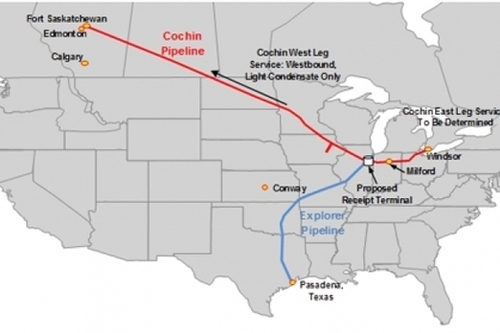
Obama approves border-crossing pipeline carrying corrosive fracked gas diluent to Alberta Tar-Sands

See on Scoop.itGreen Energy Technologies & Development

But the pipeline has problems with stress corrosion cracking. Is it safe to expand?

Duane Tilden‘s insight:

>Kinder Morgan Cochin LLC is now allowed to reverse and expand to build a 1,900-mile proposed pipeline to transport gas produced by hydraulic fracturing of the Eagle Ford Shale basin in Texas north into Alberta. It would carry gas condensate that is used to dilute the bitumen in the tar sands. The extra-thick oil produced in the tar sands needs to be cut with 30 per cent condensate so it can be carried, according to the Financial Post.

The Cochin pipeline has had some safety issues in the past, however. Last year, the National Energy Board sent Kinder Morgan a letter regarding Stress Corrosion Cracking (SCC) failure in the U.S. back in 2003. At the time, the U.S. Pipeline and Hazardous Materials Safety Administration (PHMSA) issued an order imposing a 20 per cent pressure restriction on the pipeline. Kinder Morgan later voluntarily imposed a further restriction on the operating pressure and received approval to increase  the operating pressure of the pipeline in US to 6895 kPa (1000 psi) in March 2012.<

See on www.vancouverobserver.com

UN and World Bank promote sustainable energy financing

See on Scoop.itGreen & Sustainable News

The United Nations and the World Bank announced what they call “a concerted effort” by governments, international agencies, civil society and the private sector to scale up financing for sustainable energy.


Duane Tilden‘s insight:

>Kim stressed that financing is key, with $600 billion to $800 billion a year needed from now until 2030 to reach the goals for access to energy, energy efficiency, and renewable energy.

“We are now starting in countries in which demand for action is most urgent,” he said. “In some of these countries, only one in 10 people has access to electricity. It is time for that to change.”

Ban praised achievements already attained such as Brazil’s ‘Light for All’ programme that has reached 15 million people, Norway’s commitment of 2 billion kroner ($330 million) in 2014 for global renewable energy and efficiency, and Bank of America’s Green Bond that has raised $500 million for three years as part of its 10-year $50 billion environmental business commitment.<

See on www.renewableenergymagazine.com

Renewable Geothermal Power – a Vast & Untapped Energy Resource

See on Scoop.itGreen Energy Technologies & Development

There are no plans for new coal plants to be built in the United States. This opens doors for the geothermal industry possibly more than ever before in U.S. history.

Duane Tilden‘s insight:

> Geothermal energy is a renewable source of electricity that has the same important baseload qualities […]  (of coal for) electric power generation in the U.S. at a fraction of the cost.

“Baseload is always better,” […] “[I]t assures a steady revenue stream which is much better for financing.”For a nation that’s thinking to the long term, geo plants are:

Firm. They can run 24 hours a day regardless of extraneous conditions.Flexible. Geothermal’s flow can be load following or allow for imbalance, can provide a spinning reserve or a non-spinning reserve, and works well as replacement or supplemental reserve.

Falcone says of geothermal’s flow options: “By being able to load follow, geothermal can be reduced during low need time and increased without much effort. There is no need to store power that cannot be used. The price of power can be kept lower than other renewables since more of it is sold than the intermittent power sources like wind and solar.”

Falcone adds, “There are now efforts to marry solar with geothermal so that extra power can be produced during sunny peak hours.

“There is no need to invest in fossil fuel to create heat in order to generate power, so the environment is better off.”But today’s solicitations for renewable energy in Western states tend to ignore these unique benefits of geothermal power. Additional long-term analysis shows geothermal plants are:

Small. Geothermal-impacted land in 2030 is expected to be around 7.5 km2/TW-hr/yr, as opposed to 9.7 .5 km2/TW-hr/yr for a coal plant.Hardy. Long-lasting geothermal plants include those at The Geysers in California (since the 1960s) and at the Lardarello field in Italy (since 1904).<

See on www.renewableenergyworld.com

NSF awards grant to Mechanical Engineer prof for underwater kite marine power research

A three-year, US$300,000 grant from the National Science Foundation will allow Worcester Polytechnic Institute associate professor of mechanical engineering David Olinger to conduct research on developing a new form of ocean energy.

Duane Tilden‘s insight:

“The research builds on Olinger’s prior research, funded by the NSF and U.S. Environmental Protection Agency, in which he developed a low-cost kite system that used wind to generate power. Olinger and a team of graduate students developed computational models that predict trajectories and power output for kites of different sizes and tethers of different lengths, which can be used to design kites capable of flying in stable, high-speed figure-eight patterns under changing weather conditions.

The same algorithms can be applied to the design of underwater kites, Olinger said, but “instead of moving air, you have moving water and the kites have rigid wings.”

Olinger will now evaluate possible designs for undersea kites and explore methods for tethering them to floating platforms similar to those used for oil and gas rigs.

WPI said the team will also examine the advantages and disadvantages of mounting turbine generators directly to the kites or placing the generators on the platforms. […]

Olinger’s kite system is similar to one already being developed by Swedish company Minesto, though a WPI representative said the two projects are not related.”<

See on www.hydroworld.com

Sweden’s Minesto Ocean Energy Kite System Proven Operational

2013-11-12

Minesto’s step-change marine power plant now producing electricity in Northern Ireland proving viability for huge ocean current power market

The Deep Green ‘underwater kite’ marine power plant is now producing electricity in the waters off Northern Ireland. This is the first time ever a marine power plant designed for low velocity currents produces electricity at sea, anywhere in the world, and the ocean trials verify the ability to unlock ocean currents as a renewable energy source. “This is a break-through for the entire renewable energy industry,” said Minesto’s CEO Anders Jansson.

deep-green-underwater-kite

Image source: minesto.com

Company Press Release:  http://bit.ly/18mXIfT

UK Proposed ban on Food Waste Landfill Disposal & Re-Purpose to Green Energy Feedstock

See on Scoop.itGreen & Sustainable News

Government, council and retailer-backed report says ban on landfill could save UK £17bn and heat 600,000 homes

Duane Tilden‘s insight:

>The ambition is to save the UK economy over £17bn a year through the reduction of food wasted by households, businesses and the public sector, preventing 27m tonnes of greenhouse gases a year from entering into the atmosphere.

The new study, Vision 2020: UK Roadmap to Zero Food Waste to Landfill is the culmination of more than two years’ work and has the backing and input of local authority and industry experts. It sets the framework for a food waste-free UK by 2020.

Last week official figures revealed the average UK family was wasting nearly £60 a month by throwing away almost an entire meal a day. A report from the government’s waste advisory group Wrap showed Britons were chucking out the equivalent of 24 meals a month, adding up to 4.2m tonnes of food and drink every year that could have been consumed. Almost half of this is going straight from fridges or cupboards into the bin, Wrap found. One-fifth of what households buy ends up as waste, and around 60% of that could have been eaten.

At the same time the UK’s largest retailer, Tesco, recently agreed to reduce its multi-buy items and other promotions after revealing that 35% of its bagged salad was being thrown out. It also found that 40% of apples were wasted, and just under half of bakery items.<

See on www.theguardian.com

Kyocera Opens Japan’s Largest Offshore Solar Power Plant

See on Scoop.itGreen & Sustainable News

The Kyocera Corporation just opened a 70 megawatt solar power plants off the southern coast of Japan.

Duane Tilden‘s insight:

>Kyocera partnered with six other companies to develop the solar plant, which is located in the Kagoshima Prefecture. The company hopes that this latest offshore venture will set a precedent for a cleaner Japan, especially in light of the 2011 Fukushima disaster. The solar plant is designed to inspire and encourage Japan to make the switch to more renewable energy sources.

The Kagoshima Nanatsujima Solar Power Plant was made possible in part because of Japan’s revised feed-in-tariff (FIT) program, which was restructured in July, 2012 to better accommodate solar energy. The adjusted FIT plan requires local utilities to purchase 100 percent of the power generated by solar plants that produce more than 10 kW.<

Read more: Kyocera Opens Japan’s Largest Offshore Solar Power Plant | Inhabitat – Sustainable Design Innovation, Eco Architecture, Green Building

See on inhabitat.com

84% Efficient Combined Heat & Power (CHP) Plant to be built by Siemens in Poland

See on Scoop.itGreen & Sustainable News

Through immediate publication of press releases, we keep the business, financial and public press informed on all important Siemens topics.

Duane Tilden‘s insight:

>The plant will be built in western Poland in the city of Gorzów Wielkopolski. Within the scope of turnkey construction, Siemens will deliver two SGT-800 gas turbines, one SST-400 steam turbine, three 11 kilovolt (kV) generators and two heat recovery steam generators. In addition, Siemens was awarded a long-term 12 years maintenance agreement for the gas turbines. The Gorzów plant will be fired with nitrogen-rich natural gas from gas reserves located in western Poland. This type of gas has a lower calorific value than conventional natural gas. […]

The Gorzów power plant will replace a currently used coal-fired block at the same location. The combined cycle power plant with district heat extraction will be able to generate electricity in a much more efficient and environmentally friendly manner. Compared to the old coal-fired power plant, the new plant will produce 95 percent less sulfur dioxide emissions, more than 30 percent less nitrogen dioxide emissions and more than 95 percent less particulate emissions.<

See on www.siemens.com

Clean Energy rebranded by DOE to Combined Heat and Power (CHP)

See on Scoop.itGreen Energy Technologies & Development

In a move that had been in the works for a while, the U.S. Department of Energy recently announced that its Clean Energy Application Centers have been rebranded as CHP Technical Assistance Partnerships, or CHP TAPs.

Duane Tilden‘s insight:

>The CHP TAPs maintain the same regional offices that existed under the former Clean Energy Application Centers:

  1. Pacific (California, Nevada);
  2. Southwest (Arizona, Colorado, New Mexico, Oklahoma, Texas, Utah, Wyoming);
  3. Northwest (Idaho, Montana, Oregon, Washington);
  4. Midwest (Illinois, Indiana, Iowa, Kansas, Michigan, Minnesota, Missouri, Nebraska, North Dakota, Ohio, South Dakota);
  5. Southeast (Alabama, Arkansas, Florida, Georgia, Kentucky, Louisiana, Mississippi, North Carolina, South Carolina, Tennessee);
  6. Mid-Atlantic (Delaware, Maryland, New Jersey, Pennsylvania, Virginia, West Virginia); and
  7. Northeast (Connecticut, Maine, Massachusetts, New Hampshire, New York, Rhode Island, Vermont).

With the new energy in these programs, now is the time to take advantage of the expertise offered by the Department of Energy and its CHP TAPs. Industrial users, municipalities, hospitals, college campuses and other large users of energy need to review and understand the significant benefits of CHP, district energy and waste heat capture technologies.<

See on www.natlawreview.com