Energy executive quits NEB, blasts Kinder Morgan review as ‘fraudulent,’

Marc Eliesen has withdrawn as an intervenor in the federal government’s review of Kinder Morgan’s Trans Mountain pipeline and oil tanker expansion project, detailing his reasons for quitting in a scathing 1,500 word letter to the National Energy Board.

Source: thetyee.ca

>” […] Given the Board’s lack of objectivity it is not surprising that out of the approximately 2000 questions not answered by Trans Mountain that Intervenors called on the Board to compel answers, only 5 per cent were allowed by the Board and 95 per cent were rejected.

The Board had stated that the elimination of cross-examination of the Proponent’s evidence can be evaluated through the two scheduled Information Requests. But we have a Kafkaesque outcome. Trans Mountain refuses to answer questions and the Board does not compel them to do so.

6. The Province of British Columbia stated that “Trans Mountain’s failure to file the evidence requested by the Province in Information Request No. 1 denies the Board, the Province and other Intervenors access to the information required to fully understand the risk posed by the Project, how Trans Mountain proposes to mitigate such risk and Trans Mountain’s ability to effectively respond to a spill related to the Project.”

The Province of British Columbia has the responsibility for undertaking due diligence on behalf of the public trust of British Columbians. The 80 questions Trans Mountain refused to answer — which the Province believed important enough to ask the Board for assistance and compel Trans Mountain to answer — were denied by the Board.

The Board has sided with Trans Mountain dismissing the Province of BC’s need for answers in pursuit of its duty to British Columbians. The NEB’s bias in support of the Proponent is reflecting poorly on the Province of BC in that it is unable to obtain necessary answers to conduct its due diligence. Accordingly, it raises the question as how it is possible for the Province of BC to continue to participate in this hearing process. The Province should cancel the Equivalency Agreement with the NEB on this project and undertake its own environmental assessment as the only meaningful way in which it will be able to effectively obtain the answers it seeks.

The National Energy Board is not fulfilling its obligation to review the Trans Mountain Expansion Project objectively. Accordingly it is not only British Columbians, but all Canadians that cannot look to the Board’s conclusions as relevant as to whether or not this project deserves a social license. Continued involvement in the process endorses this sham and is not in the public interest.

Yours truly,

Marc Eliesen “<

– See more at: http://thetyee.ca/Blogs/TheHook/2014/11/03/VIEW-energy-exec-blasts-Kinder-Morgan-quits/#sthash.lOr1uyt5.dpuf

See on Scoop.itGreen & Sustainable News

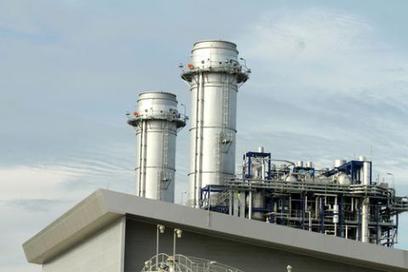
Energy Storage Technologies Will Replace Utilities Gas Fired Turbine Peaker Plants

“Power grids need extra generating capacity to work properly. For example, about 20 percent of New York State’s generation fleet runs less than 250 hours a year. Because they don’t run much, “peaker plants” are by design the cheapest and least efficient fossil generators.”

Source: www.renewableenergyworld.com

>”[…] As has happened with solar PV, the costs for multi-hour energy storage are about to undergo a steep decline over the next 2 to 3 years. This cost trend will disrupt the economic rationale for gas-fired simple cycle combustion turbines (CTs) in favor of flexible zero emissions energy storage. This will be especially true for storage assets owned and operated by vertical utilities and distributed near utility substations.

Simple cycle gas-fired CTs have been a workhorse utility asset for adding new peaker capacity for decades. But times and technologies change, and the power grid’s long love affair with gas-fired CTs is about to be challenged by multi-hour energy storage. Flow batteries that utilize a liquid electrolyte are especially cost-effective because the energy they store can be easily and inexpensively increased just by adding more electrolyte.

CTs cost from $670 per installed kilowatt to more than twice that much for CT’s located in urban areas. But the economics of peaking capacity must also reflect the benefits side of the cost/benefit equation. Distributed storage assets can deliver both regional (transmission) and local (distribution) level energy balancing services using the same storage asset. This means the locational value and capacity use factor for distributed storage can be significantly higher compared to CTs operated on a central station basis.

[…]

The disruptive potential of energy storage as a substitute for simple cycle CTs has been recognized. For example, Arizona Public Service (APS) and the Residential Utility Consumer Office (RUCO) recently filed a proposed settlement which, if approved, would require that at least 10% of any new peaker capacity now being planned as simple cycle combustion turbines would instead need to be energy storage — as long as the storage meets the cost effectiveness and reliability criteria of any CTs being proposed.

[…]

Lower cost solar PV and its rising penetration in all market segments will have a profoundly disruptive effect on utility operations and the utility cost-of-service business model. This has already started to happen. Storage offers a way for utilities to replace lost revenues premised on margins from kilowatt-hour energy sales by placing energy storage into the rate based and earning low-risk regulated returns.”<

See on Scoop.itGreen Energy Technologies & Development

Solar Energy Storage Added to Eight California Schools

Burton School District, in the heart of California’s sun-drenched San Joaquin Valley, will also house combined solar and energy storage systems[…]

Source: www.pvsolarreport.com

>”In the commercial sector, the cost of energy storage is now low enough that businesses are finding it a useful addition to solar. Generally, businesses’ peak energy consumption is when electricity is most expensive, which makes energy storage especially useful.

As the cost of energy storage continues to decline, large solar companies have been integrating it into their product offerings to complement a solar system. […]

The district will install solar and DemandLogic to generate and store its own clean, renewable electricity at eight schools. This will be the largest combined solar and energy storage installation SolarCity has undertaken to date. It will allow the district schools to reduce energy costs by using stored electricity to lower peak demand.

SolarCity will install the district’s solar systems and battery storage at eight elementary and middle schools, as well as additional solar generation at a district office. The solar installations will total more than 1.4 MW of capacity, with storage providing an additional 360 kW (720 kWh) of power to reduce peak demand. The new solar systems are expected to save the district more than $1 million over the life of the contracts, and the DemandLogic battery storage systems could save thousands more on demand charges each year.

[…]

The new SolarCity systems are expected to generate 2,300 MWh of solar energy annually, and enough over the life of the contract to power more than 4,000 homes for a year. The solar systems will also offset over 43 million pounds of carbon dioxide and save more than 203 million gallons of water, an especially important environmental benefit in the drought-stricken valley. The entire storage project is expected to be completed by May 2015.”<

See on Scoop.itGreen Energy Technologies & Development

Cove Point LNG Project Obtains Federal Approval and Opposition

Initially, Cove Point helped the United States overcome what was then an energy shortage. Now that our nation is developing a burgeoning surplus of natural gas, Cove Point can help send a small portion of that surplus to allied nation’s looking for stable supplies of clean energy, supporting economic development and replacing coal as a fuel.

Source: www.fierceenergy.com

>” […] The project offers significant economic, environmental and geopolitical benefits. The construction of the approximately $3.8 billion export project will create thousands of skilled construction jobs, an additional $40 million in annual tax revenue to Calvert County, and millions of dollars in new revenues for Maryland and the federal government, as well as a reduction in the nation’s trade deficit by billions of dollars annually.

Dominion’s project has faced and will continue to face significant and widespread grassroots opposition. Despite these benefits, environmental and community groups are denouncing FERC’s approval of the controversial project, claiming that the facility will incentivize environmental damage from fracking across the mid-Atlantic region and, according to federal data, would likely contribute more to global warming over the next two decades than if Asian countries burned their own coal.

Environmental groups, including the Chesapeake Climate Action Network, Earthjustice, and the Sierra Club are poised to petition FERC and potentially to sue the agency to challenge on the basis of an inadequate environmental review. These groups are assessing the issue upon which to file a motion for a rehearing, which needs to occur before an appeal can happen.

The groups claim that in its Environmental Assessment, which was limited at best, FERC omitted credible analysis of the project’s lifecycle global warming pollution, including all the pollution associated with driving demand for upstream fracking and fracked gas infrastructure.

The Dominion Cove Point project would be the first LNG export facility to be sited so close to a residential area and in such close proximity to Marcellus Shale fracking operations, and could trigger more global warming pollution than all seven of Maryland’s existing coal-fired power plants combined, the groups contend.

“FERC’s decision to approve Cove Point is the result of a biased review process rigged in favor of approving gas industry projects no matter how great the environmental and safety concerns,” said Mike Tidwell, director of the Chesapeake Climate Action Network, in a statement. “FERC refused to even require an environmental impact statement for this $3.8 billion facility right on the Bay. We intend to challenge this ruling all the way to court if necessary…we will continue to fight this project until it is stopped.”

Dominion must now review and accept the order. Upon completion, Dominion will file an implementation plan describing how it plans to comply with the conditions set forth in the order. Dominion expects to ask the FERC for a “Notice to Proceed” at that time and plans to begin construction when the notice is received. This process – from Dominion review through FERC’s notice – is expected to take several weeks.

Cove Point is the fourth liquefied natural gas export project to receive approval to site, construct and operate and is the first LNG export project on the East Coast. “<

See on Scoop.itGreen & Sustainable News

Could desalination solve California’s water problem?

Desalination would seem to answer every prayer to fix California’s water shortages. But turning the sea into drinking water is not so easy. The state’s first major desalination plant, under construction in Carlsbad, is a major test for the industry and wary environmental groups.

Source: www.sacbee.com

See on Scoop.itsustainability and resilience

UK Renewable Energy Subsidy Underwrites Development

Energy secretary, Ed Davey, says new subsidy scheme will help underwrite green energy and reduce reliance on imported gas

Source: www.theguardian.com

>”[…] “Solar has been the rising star in the coalition’s renewable energy programme and has been championed recently by the Prime Minister at the UN and by Ministers at conference,” said Paul Barwell, chief executive of the STA.

“Why is the UK government putting this industry’s incredible achievements on solar power at risk? To curtail its growth now is just perverse and unjustified on budgetary grounds – solar has only consumed around 1% of the renewables obligation budget,” he added.

He was supported by Friends of the Earth, whose renewable energy campaigner, Alasdair Cameron, argued the government move would be bad news for jobs, the climate and people wanting to plug into clean power.

“Solar could be cheaper than fossil fuels in just a few years, but it needs a little more help from government to get it there. Failure to invest now will mean a huge missed opportunity for the UK economy,” he said.

The raised budget to £300m has been welcomed by the wider renewable power sector but industry officials said the complex structure and cost would unfairly benefit large utilities at the expense of smaller and medium-sized enterprises (SMEs). […]”<

See on Scoop.itGreen & Sustainable News

Energy Storage Solutions for the Smart Grid

In order to ramp up clean energy production, we have to figure out how to store and transmit it effectively. Companies are experimenting with new tech to figure out the best way to progress.

Source: www.techrepublic.com

>”The smart grid energy storage sector is expected to grow to $50 billion by 2020, with an annual compound growth rate of 8%, according to a recent report from Lux Research. In 2013, renewable energy accounted for only 10% of total US energy usage and 13% of electricity generation, according to the US Energy and Information Administration.

But as renewable energy generation rises, transmission and storage advancements will be necessary. Curtailment, the act of spilling renewable energy because there’s more than enough, is one issue to tackle. By changing grid transmission lines in 2010, Texas saw the curtailment in their grid drop from 9% to 4% in 2012, according to a report by the National Renewable Energy Laboratory.

The tipping point with energy storage depends on the grid and the technology used, said Sam Jaffe, an analyst at Navigant Research. Some places in the world that have extremely high penetration rates of renewable energy don’t have major problems with wasted renewables. Denmark sends its extra wind power to Sweden and Norway, while importing hydro power from those two countries when the wind isn’t blowing. Denmark’s wind penetration is now at almost 40%.

“That’s because they are interconnected to other grids that have a lot of flexibility to offtake renewable energy,” he said.”<


See on Scoop.itGreen Energy Technologies & Development

US Company Deploys Aqueous, Lithium-Ion and Flow Batteries for Grid Storage

“Batteries must do more than just work—they have to scale.”

Source: www.greentechmedia.com

>”[…] The startup is a software developer and system integrator that has attracted investment, personnel and a growing roster of turnkey energy storage projects.

[…]

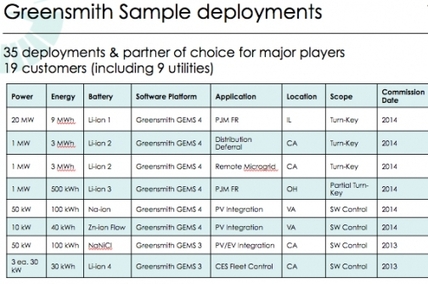
Companies like the 30-employee Greensmith are winning energy storage projects not because they are building better batteries but because they are writing software that integrates batteries with inverters and allows energy storage to work with the grid at scale. Greensmith works with a variety of battery chemistries from different vendors, as well as multiple inverters and power electronics partners.

New battery technologies and projects

Amongst other technologies, Greensmith is using Aquion Energy’s sodium-ion battery. The Pittsburgh, Penn.-based Aquion says its technology can deliver round-trip energy efficiency of 85 percent; a ten-year, 5,000-plus-cycle lifespan; energy storage capacity optimized to charge and discharge for multi-hour applications; and perhaps most notably, a price point of $250 per kilowatt-hour.

In April, Aquion closed a $55 million Series D venture capital investment, bringing total investments and grants to more than $100 million. New investors Bill Gates, Yung’s Enterprise, Nick and Joby Pritzker (through their family’s firm Tao Invest), Bright Capital, and Gentry Venture Partners joined previous investors Kleiner Perkins Caufield & Byers, Foundation Capital, and Advanced Technology Ventures in the round. Aquion is already producing its 1.5-kilowatt-hour S10 Battery Stack units, as well as an 18-kilowatt-hour system that combines twelve of its S10 units.

Greensmith is also using ViZn Energy Systems’ zinc redox flow battery energy storage technology. ViZn aims to produce a 80-kilowatt/160-kilowatt-hour system housed in a 20-foot shipping container, as well as larger systems. Other flow battery firms include American Vanadium, EnerVault, Primus Power, Imergy and ZBB Energy.

The CEO of the firm told GTM that Greensmith is developing a hybrid system using both the Aquion and ViZn storage chemistries.

Since its 2006 founding, Greensmith has deployed 30 battery energy systems for eighteen different customers, nine of them utilities, and is aiming to have 23 megawatts of systems under management by year’s end. […]”<

See on Scoop.itGreen Energy Technologies & Development

Province Calls for Renewable Energy Storage Systems Demonstration Projects

Most of the new systems will be able to turn on a dime, storing and releasing energy almost instantaneously to help balance out the supply and demand over the course of a day

Source: www.theglobeandmail.com

>”Ontario has embarked on a quest to find the holy grail of renewable energy – an effective means to store the power generated by intermittent wind and solar installations.

The province’s Independent Electricity System Operator (IESO) recently chose five companies who will build a dozen demonstration projects designed to capture and release energy. That would allow the electricity grid to react to fluctuations in power production, which are becoming more significant with the addition of renewables whose output varies depending on how the wind blows and sun shines.

[…]

The technologies that will be tested include advanced batteries, systems that store power in the form of hydrogen, and even flywheels that hold energy as kinetic energy in a spinning rotor.

Bruce Campbell, president of the IESO, called storage facilities a “game changer” for a grid that was designed to produce electricity at exactly the same time it is consumed. “Energy storage projects will provide more flexibility and offer more options to manage the system efficiently,” he said.

The test projects will be distributed at various locations around the province, and will be connected to different parts of the grid to see how effectively they can help balance supply, demand and other transmission issues.

Among the suppliers are Hydrogenics Corp., which will test a hydrogen storage system, and Hecate Energy and Canadian Solar Solutions Inc., which will use various battery technologies. Convergent Energy and Power LLC will test a flywheel that converts electricity to kinetic energy stored in a rotor. Dimplex North America Ltd. will install thermal systems in apartments in Hamilton, Ont., that store electricity as heat in special bricks, releasing it later when the building needs to be warmed.

Rob Harvey, director of energy storage at Hydrogenics, said his company’s test system will incorporate an advanced electrolysis system that uses electricity to split water into hydrogen and oxygen. That hydrogen can then be used in a fuel cell to generate electricity when needed. Coupling the fuel cell and the electrolyser means power can be effectively stored for any length of time and dispatched as needed.

If the tests are successful, Mr. Harvey said, this could be a significant new line of business for Hydrogenics, which now makes hydrogen-producing systems for industrial customers, as well as fuel cells, which are essentially engines that use hydrogen as fuel.”<


See on Scoop.itGreen Energy Technologies & Development

Grid Scale Energy Storage Solutions For Future Virtualization

Examines grid scale energy storage solutions ranging from pumped hydro, compressed air, thermal storage, advanced batteries, fuel cells and purely electric storage systems.

Source: greeneconomypost.com

Renewable energy sources often have a common problem of matching supply with demand, hence the need for energy storage to bridge the gap.  One major component of future VPP (Virtual Power Plants) is energy storage, in the form of battery storage, fuel cells, pumped hydro, flywheels, compressed air or other forms of existing and new technologies.

One promising form of energy storage combines gravity with water where energy is stored in raising heavy weights.  Electrical energy is converted to potential energy during periods of over-supply and then converted back to electricity when demand is greater than supply.

>”A Cutting Edge Variation of Pumped Hydro

Gravity Power, LLC, a privately-held company, based in Southern California (in Goleta, CA just north of Santa Barbara) is developing a novel grid-scale energy storage system for global commercialization called the Gravity Power Module (GPM). Like pumped hydro the working energy carrier is water that is pumped between a high pressure and a low pressure reservoir running a reversible generator/pump assembly to either produce power by drawing down the high pressure reservoir or store it up by pumping water from the low pressure store back into the high pressure store. In this sense it operates on the very same principles – and thus can also benefit from existing capital equipment, such as the reversible hydro generator/pump assemblies for example – as traditional pumped hydro.

Gravity Powers technology circumvents traditional pumped hydro difficulties related to siting, negative environmental impact, huge land demands, permitting, long-lead times and the very large investment required, by burying it all underground…. literally.

The GPM system uses a very large and very dense high mass piston that is suspended in a deep, water-filled shaft. The piston is equipped with sliding seals to prevent leakage around the piston/shaft interface and its immense mass pressurizes the supporting water column beneath it. A high pressure pipe from the bottom of this shaft enables water to be run or pumped through a generator/pump assembly of the same types now used in pumped hydro systems. The low pressure low energy potential water is returned above the piston adding somewhat to its weight and further pressuring the remaining high energy potential water column.

The massive piston moves up and down the shaft, storing and releasing power in a closed sealed cycle. It is compact with a small land footprint and the units can be clustered together into larger groups. It also is environmentally benign, no toxic chemicals or explosive dangers.

I like the scalable nature of this store that makes it suited to incremental growth of capacity. I also like how this energy storage system could be placed very near the big urban areas of greatest need for this kind of electric capacity. The fact that this energy storage system can take advantage of a lot of already existing infrastructure and technical knowhow from the existing pumped hydro sector is a definite advantage.

I would like to see more details on the costs of the boring of the immense vertical shafts; the long term performance metrics of the shaft seals (that would be an expensive repair job I would think. All in all I think this or something like it is a strong contender in the energy storage sector.”<

Read more: http://greeneconomypost.com/fifteen-grid-scale-energy-storage-solutions-watch-15924.htm#ixzz35bedEesM