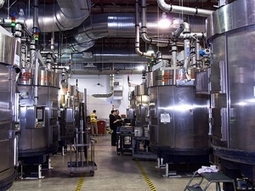
Could desalination solve California’s water problem?

Desalination would seem to answer every prayer to fix California’s water shortages. But turning the sea into drinking water is not so easy. The state’s first major desalination plant, under construction in Carlsbad, is a major test for the industry and wary environmental groups.

Source: www.sacbee.com

See on Scoop.itsustainability and resilience

10 Most Efficient Renewable Energy Devices

6 Schemes to Implement for Plant ISO 50001 Certification

During a webcast  […] representatives from the US Department of Energy and Underwriters Laboratories walked through the details of the just-released energy management standard, and how companies can get on board, quickly.

Source: www.greenbiz.com

>”When the standard achieves widespread adoption, it’s estimated that ISO 50001 could influence up to 60 percent of the world’s energy use.  […]

ISO 50001 requires continuous improvement, but not specific requirements, which is where the ITP program comes in, to have specific requirements of improvement. The value of the certification, Scheihing said, is that for the first time it provides a framework for continual improvement for facilities on energy performance, and across the entire organization.

To be certified, you have to conform to the ISO 50001 management standard, and you have to improve your energy performance, and get both aspects certified under a third party. There are 24 companies working in the pilot mode of ISO 50001, across all types of manufacturing sectors and at all sizes.

Between 2008 and 2010, five initial facilities in Texas were piloted, and have been certified to date. Scheihing said the energy improvements achieved at the facilities ranged from 6.5 percent to 17.1 percent over a three-year period.

Among the initial feedback from the pilot project include the benefits of having a cross-functional plant energy management team that goes beyond just operations or engineering means that energy management becomes a shared responsibility, and that makes it much easier to incorporate significant changes in energy use.

One of the biggest shifts that the pilot projects found was that as a result of going through ISO 50001 certification, energy management became a way of doing business, instead of a project-by-project undertaking.  […]


Scheihing laid out six steps that any organization can take to get started on ISO 50001 today:

Secure support from top management;Collect, track, and analyze energy data;Identify key energy uses;Establish a baseline;Identify energy-saving opportunities;Prioritize opportunities

The Department of Energy has created a new website for energy management, which lays out an overview of ISO 50001 and offers case studies and tools to help companies undertake those first steps.

Jerry Skaggs from UL DQS followed on Scheihing’s presentation to walk through each of the six steps, as well as a checklist for organizations to follow once they’ve gone through the process to ensure proper implementation and follow-through.

In the end, there are a number of benefits to effectively implement an energy management system, including:

• Reduced operational and overhead costs lead to increased profitability
• Reduced air emissions, such as GHGs
• Increased efficiency of energy sources
• Increased assurance of legal, internal compliance
• Variables affecting energy use and consumption are identified
• Increased understanding of energy use and consumption via defined methods, processes of data collection

UL DQS, which brings the Management Systems Solutions division of Underwriters Laboratories together with DQS, a German management certification company, offers a number of specialized services for helping companies assess and implement opportunities for energy management, including ISO 50001 certification.  […] “<

See on Scoop.itGreen Building Operations – Systems & Controls, Maintenance & Commissioning

Methods of Improving Data Centers’ Energy Efficiency and Performance

America’s data centers are consuming — and wasting — a surprising amount of energy.

Source: www.livescience.com

>”Our study shows that many small, mid-size, corporate and multi-tenant data centers still waste much of the energy they use. Many of the roughly 12 million U.S. servers spend most of their time doing little or no work, but still drawing significant power — up to 30 percent of servers are “comatose” and no longer needed, while many others are grossly underutilized. However, opportunities abound to reduce energy waste in the data-center industry as a whole.  Technology that will improve efficiency exists, but systemic measures are needed to remove the barriers limiting its broad adoption across the industry.

How much energy do data centers use?

The rapid growth of digital content, big data, e-commerce and Internet traffic more than offset energy-efficiency progress, making data centers one of the fastest-growing consumers of electricity in the U.S. economy, and a key driver in the construction of new power plants. If such data centers were a country, they would be the globe’s 12th-largest consumer of electricity, ranking somewhere between Spain and Italy.

In 2013, U.S. data centers consumed an estimated 91 billion kilowatt-hours of electricity. That’s the equivalent annual output of 34 large (500-megawatt) coal-fired power plants — enough electricity to power all the households in New York City, twice over, for a year.  […]

Fixing the problem

While current technology can improve data center efficiency, we recommend systemic measures to create conditions for best-practices across the data center industry, including:

Adoption of a simple, server-utilization metric. One of the biggest efficiency issues in data centers is underutilization of servers. Adoption of a simple metric, such as the average utilization of the server central processing units (CPUs), is a key step in resolving the energy-consumption issue.  […]

Rewarding the right behaviors. Data center operators, service providers and multi-tenant customers should review their internal organizational structures and external contractual arrangements and ensure that incentives are aligned to provide financial rewards for efficiency best practices.  […]

Disclosure of data-center energy and carbon performance.Public disclosure is a powerful mechanism for demonstrating leadership and driving behavior change across an entire sector. […]

If just half of the technical savings potential for data-center efficiency that we identify in our report is realized (taking into account market barriers), electricity consumption in U.S. data centers could be cut by as much as 40 percent.  […]”<


See on Scoop.itGreen Energy Technologies & Development

Data Centers and Energy Efficiency

New analysis suggests there’s still an opportunity to cut power consumption and save billions in 2014.

Source: www.greenbiz.com

>”A new tally by the Natural Resources Defense Council (NRDC) suggests there’s still a big opportunity to cut energy usage by 40 percent, saving more than $3.8 billion in 2014 alone.  Put another way, that’s like switching off 39 billion kilowatt-hours of electricity, the equivalent of 14 large, coal-fired power plants.

“Most of the attention is focused on the highly visible hyperscale ‘cloud’ data centers like Google’s and Facebook’s, but they are already very efficient and represent less than 5 percent of U.S. data center electricity consumption,” said Pierre Delforge, NRDC’s director of high-tech energy efficiency. “Our small, medium, corporate and multi-tenant data centers are still squandering huge amounts of energy.”

Here’s the likely outcome: By 2020, U.S. data centers will probably require about 140 kilowatt-hours of electricity to keep online.

The biggest culprits in wasteful IT power consumption are underutilized servers using significant amounts of electricity without performing any useful purpose, according to NRDC.  […]

Figures suggest the average server operates at just 12 percent to 18 percent of its capacity, which means businesses could stand to be far more aggressive about consolidating or virtualizing them. That’s particularly true of the smallest server rooms, ones that crop up with little advance planning.

“The more work a server performs, the more energy-efficient it is—just as a bus uses much less gasoline per passenger when ferrying 50 people than when carrying just a handful,” the analysis notes.

Among the recommended fixes for this persistent problem are the adoption of metrics that provide deeper insight into average server utilization, more public disclosure of data center energy performance information, and “green” data center leases that provide incentives for energy savings.

The reason why these green data center service contracts work, according to the report, is because they create financial incentives for companies to consider their energy use. […]”<

See on Scoop.itGreen Energy Technologies & Development