Study Finds Global Opportunities for Improvements in Elevator Efficiency

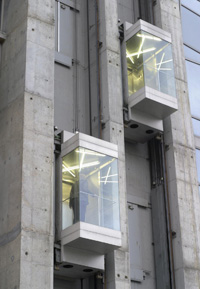
1259707a-d405-4e90-9e4b-4b7660c1a1d0.jpgElevators and escalators make up 2 to 5 percent of the energy used in most buildings, but can reach as high as 50 percent during peak operational times. At 5 percent, that means the yearly energy consumption of U.S. elevators is approximately five times of that used in all of Washington D.C.


image source: http://www.thyssenkrupp.com/en/produkte/energieeffiziente-aufzugssysteme.html

Source: aceee.org

>”Chicago—More energy-efficient elevators can significantly reduce the costs of operating a building, but the information needed to help building owners identify the appropriate elevator system—and the savings associated with it—aren’t readily available, according to a new study published by a leading policy group. The study, by the American Council for an Energy-Efficient Economy, was published with the support of UTC Building & Industrial Systems, the parent organization of Otis, the world’s largest manufacturer and maintainer of people-moving products.

[…] The technology exists today to reduce that consumption by 40 percent or more, especially by cutting energy use between trips, when an elevator is idle, according to the study. Some technologies have been found to reduce consumption by as much as 75 percent, but without a standard way to measure energy savings and a rating system to distinguish more efficient elevators, building owners may be unaware of the benefits of upgrading to a more efficient system or choosing a more efficient system for new construction.

“Enhanced visibility when it comes to elevator efficiency can help customers grasp the full value package of better controls, improved performance, reduced sound, and increased comfort,” said Harvey Sachs, ACEEE senior fellow, and the study’s lead author. Sameer Kwatra of ACEEE presented the study on Tuesday, January 27 at the 2015 American Society of Heating, Refrigerating and Air-Conditioning Engineers (ASHRAE) Winter Conference in Chicago.

The study lays out a framework for industry leaders to set common standards for measuring elevator efficiency. Those standards could lead to a rating system, such as the U.S. Environmental Protection Agency’s ENERGY STAR® ratings already in place for heating, ventilating and air-conditioning systems, and many home appliances. Clear standards also could lead energy utilities and government agencies to offer incentives, such as rebates, for very efficient models. And building label programs, such as the U.S. Green Building Council’s LEED® program, could include elevator efficiency as a factor in certifying buildings. Right now, the LEED program considers elevators a part of unregulated “process loads,” and there are no direct credits for installing more efficient systems.

“Owners see elevators as an extension of the building lobby — a way to include their personality and values in the building,” said John Mandyck, chief sustainability officer, UTC Building & Industrial Systems. “As consumers and tenants better understand and value the effects green buildings have on the health and productivity of inhabitants, clear standards for measuring elevator efficiency can provide a great opportunity to reduce operating costs and showcase the environmental attributes of a building.”

The report identified energy-efficient elevator technologies that can be included in building codes and factored in elevator rating and labeling systems. […]”<

See on Scoop.itGreen Building Design – Architecture & Engineering

Determining the True Cost (LCOE) of Battery Energy Storage

The true cost of energy storage depends on the so-called LCOE = Round-trip efficiency + maintenance costs + useful life of the energy system

Source: www.triplepundit.com

By Anna W. Aamone

“With regard to [battery] energy storage systems, many people erroneously think that the only cost they should consider is the initial – that is, the cost of generating electricity per kilowatt-hour. However, they are not aware of another very important factor.

This is the so-called LCOE, levelized cost of energy(also known as cost of electricity by source), which helps calculate the price of the electricity generated by a specific source. The LCOE also includes other costs associated with producing or storing that energy, such as maintenance and operating costs, residual value, the useful life of the system and the round-trip efficiency. […]

Batteries and round-trip efficiency

[…] due to poor maintenance, inefficiencies or heat, part of the energy captured in the battery is released … or rather, lost. The idea of round-trip efficiency is to determine the overall efficiency of a system (in that case, batteries) from the moment it is charged to the moment the energy is discharged. In other words, it helps to calculate the amount of energy that gets lost between charging and discharging (a “round trip”).

[…] So, as it turns out, using batteries is not free either. And it has to be added to the final cost of the energy storage system.

Maintenance costs

[…] An energy storage system requires regular check-ups so that it operates properly in the years to come. Note that keeping such a system running smoothly can be quite pricey. Some batteries need to be maintained more often than others. Therefore when considering buying an energy storage system, you need to take into account this factor. […]

Useful life of the energy system

Another important factor in determining the true cost of energy storage is a system’s useful life. Most of the time, this is characterized by the number of years a system is likely to be running. However, when it comes to batteries, there is another factor to take into account: use. […]

More often than not, the life of a battery depends on the number of charge and discharge cycles it goes through. Imagine a battery has about 10,000 charge-discharge cycles. When they are complete, the battery will wear out, no matter if it has been used for two or for five years.

[…] [However] flow batteries can be charged and discharged a million times without wearing out. Hence, cycling is not an issue with this type of battery, and you should keep this in mind before selecting an energy storage system. Think twice about whether you want to use batteries that wear out too quickly because their useful life depends on the number of times they are charged and discharged. Or would you rather use flow batteries, the LCOE of which is much lower than that of standard batteries?

So, what do we have so far?

LCOE = Round-trip efficiency + maintenance costs + useful life of the energy system.

These are three of the most important factors that determine the LCOE. Make sure you consider all the factors that determine the true cost of energy storage systems before you buy one.

Image credit: Flickr/INL”

See on Scoop.itGreen Energy Technologies & Development

Energy Efficiency, the Invisible fuel

THE CHEAPEST AND cleanest energy choice of all is not to waste it. Progress on this has been striking yet the potential is still vast. Improvements in energy…

Source: www.economist.com

>”[…] The “fifth fuel”, as energy efficiency is sometimes called, is the cheapest of all. A report by ACEEE, an American energy-efficiency group, reckons that the average cost of saving a kilowatt hour is 2.8 cents; the typical retail cost of one in America is 10 cents. In the electricity-using sector, saving a kilowatt hour can cost as little as one-sixth of a cent, says Mr Lovins of Rocky Mountain Institute, so payback can be measured in months, not years.

The largest single chunk of final energy consumption, 31%, is in buildings, chiefly heating and cooling. Much of that is wasted, not least because in the past architects have paid little attention to details such as the design of pipework (long, narrow pipes with lots of right angles are far more wasteful than short, fat and straight ones). Energy efficiency has been nobody’s priority: it takes time and money that architects, builders, landlords and tenants would rather spend on other things.

In countries with no tradition of thrifty energy use, the skills needed are in short supply, too. Even the wealthy, knowledgeable and determined Mr Liebreich had trouble getting the builders who worked on his energy-saving house to take his instructions seriously. Painstakingly taping the joins in insulating boards, and the gaps around them, seems unnecessary unless you understand the physics behind it: it is plugging the last few leaks that brings the biggest benefits. Builders are trained to worry about adequate ventilation, but not many know about the marvels of heat exchangers set in chimney stacks. […]

One answer to this market failure is to bring in mandatory standards for landlords and those selling properties. Another involves energy-service companies, known as ESCOs, which guarantee lower bills in exchange for modernisation. The company can develop economies of scale and tap financial markets for the upfront costs. The savings are shared with owners and occupiers. ESCOs are already a $6.5 billion-a-year industry in America and a $12 billion one in China. Both are dwarfed by Europe, with €41 billion ($56 billion) last year. Navigant Research, the consultancy, expects this to double by 2023.

That highlights one of the biggest reasons for optimism about the future of energy. Capital markets, frozen into caution after the financial crash of 2008, are now doing again what they are supposed to do: financing investments on the basis of future revenues. The growth of a bond market to pay for energy-efficiency projects was an encouraging sign in 2014, when $30 billion-40 billion were issued; this year’s total is likely to be $100 billion.

“The price of fossil fuels will always fluctuate. Solar is bound to get cheaper”

Solar energy is now a predictable income stream drawing in serious money. A rooftop lease can finance an investment of $15,000-20,000 with monthly payments that are lower than the customer’s current utility bill. SolarCity, an American company, has financed $5 billion in new solar capacity, raising money initially from institutional investors, including Goldman Sachs and Google, but now from individual private investors—who also become what the company calls “brand ambassadors”, encouraging friends and colleagues to install solar panels too.

The model is simple: SolarCity pays for the installation, then bundles the revenues and sells a bond based on the expected future income stream. Maturities range from one to seven years. The upshot is that the cost of capital for the solar industry is 200-300 basis points lower than that for utilities. […]”<

See on Scoop.itGreen & Sustainable News

Continuous Monitoring Solution Designed for Facility and Energy Management

Verisae and Ecova partner to combine technology and service across nearly 3,000 facilities for an innovative and smart operational approach …


image source: http://energymanagementsystems.org/faqs-on-developing-energy-management-systems/

Source: www.virtual-strategy.com

>” Verisae, a leading global provider of SaaS solutions that drive cost reductions in maintenance, energy, mobile workforces, and environmental management, and Ecova, a total energy and sustainability management company, are pleased to announce the success of their growing partnership to help multisite companies solve their toughest energy, operations, and maintenance challenges.

The continuous monitoring solution combines Verisae’s Software-as-a-Service (SaaS) technology platform with Ecova’s Operations Control Center (OCC) to empower data-driven decision making. The solution analyses operational data in real-time, and has the capability to look for issues and anomalies to predict equipment failure and automatically identify inefficiencies causing higher energy consumption.

Ecova’s fully-staffed 24/7/365 OCC investigates inbound service calls, alarms, telemetry data, and work orders to determine the source of energy, equipment, and system faults and, where possible, corrects issues remotely before they escalate into financial, operational, or comfort problems. Trouble tickets and inbound calls are captured and tracked in the Verisae platform to provide companies with visibility into any operational issues. Combining data analytics that flag potentially troubling conditions with a service that investigates and resolves issues increases operational efficiencies and improves energy savings.

“Companies are constantly challenged to cut costs while maintaining quality, performance, and comfort,” says Jerry Dolinsky, CEO of Verisae. “Our combined solution helps clients address these challenges so they can reduce costs and improve operational efficiencies without impacting value.”

[…] “<

See on Scoop.itGreen Energy Technologies & Development

Madrid upgrades with World’s largest street lighting project

To support its ambition of becoming a Smart City, the Spanish capital, Madrid, is embarking on the world’s largest street lighting upgrade project. Philips is providing the city’s government with 225,000 new energy-efficient lights for the renewal of the entire street lighting system.

Source: traffictechnologytoday.com

>”The products, which deliver 44% in energy savings, will finance the cost of the technology upgrade, providing Madrid with the best quality of street lighting for a brighter, safer and ‘smarter’ city at no additional cost to its citizens. The project has been conducted in collaboration with ESCO energy service companies hired by the Madrid city council through a public bidding process. […]”<

See on Scoop.itGreen & Sustainable News

Energy Efficiency Development and Adoption in the United States for 2015

The US wastes about 61% of the energy we produce — much of it due to how we generate, transmit, and distribute it.

Source: theenergycollective.com
I
mage Source:  http://www.seas.columbia.edu/earth/RRC/waste_material_utilization.html

>” […] Energy efficiency, simply put, is using less energy to get the same output or value. Ways of being more energy efficient include using appliances that use less energy or reducing air leakage from our homes and buildings. Programs to increase energy efficiency date back to the energy crises of the 1970s, and continue to be hugely successful today.

Take Michigan for example, where recent data from the Public Service Commission show that the $253 million Michigan utilities spent on energy efficiency programs in 2013 will yield a $948 million return in savings in the coming years. That’s an excellent investment, no matter who you talk to. And Michigan is by no means an anomaly.

We’ve seen states throughout the country see the same kinds of positive returns for their investments in energy efficiency, which continues to prove itself the cheapest “fuel” — investments in energy efficiency per unit of energy output are less costly than both traditional fossil fuels and clean renewable fuels.

Energy efficiency programs are administered by utilities, state agencies, or other third parties, and typically funded by modest charges on ratepayers’ energy bills. While some worry that this causes energy bills to go up, they also cause energy costs to go down, as widespread efficiency upgrades decrease the demand for energy across the state or the utility’s service area, reducing consumer costs. And the customers who participate directly in the programs reap the biggest savings.

It’s a wonder not all states are investing in these kinds of innovative, proven programs. But much of the resistance can be attributed to low energy prices and a lack of political will to charge customers a bit more, even if it does mean big returns. With energy prices steadily rising, such programs will become increasingly attractive to utility regulators and customers. Even historically lagging states like Arkansas and Kentucky are starting to jump on the energy efficiency bandwagon.

No matter where we live or what our personal circumstances are, there’s always room to make changes to improve our energy consumption, whether we make a big investment like installing better insulation, or small simple changes like turning down the thermostat a few degrees in the winter.

As we think about what changes we’re planning to make in 2015, we can look internally at how to reduce energy waste in our own homes and workplaces, as well as help our neighborhoods, communities, and local and state governments make informed decisions to invest in energy efficiency. Even as our energy starts coming from cleaner sources across the country, we can do our part to reduce waste in the energy we already generate — and efficiency is the quickest and cheapest place to look.”<

See on Scoop.itGreen Energy Technologies & Development

The Ripple Effect of Energy Efficiency Investment

“The term “multiple benefits” has emerged to describe the additional value that emerges with any energy performance improvement. The benefits that occur onsite can be especially meaningful to manufacturing, commercial, and institutional facilities. Energy efficiency’s positive ripple effects include increased productivity and product quality, system reliability, and more. ”


Source: aceee.org

>” […]  Over the past few decades, researchers have documented numerous cases of energy efficiency improvements—almost always focusing exclusively on energy savings. Non-energy benefits are often recognized, but only in concept. ACEEE’s new report, Multiple Benefits of Business-Sector Energy Efficiency, summarizes what we know about the multiple benefits for the business sector. True quantification of these benefits remains elusive due to a lack of standard definitions, measurements, and documentation, but also in part because variations in business facility design and function ensures that a comprehensive list of potential energy efficiency measures is long, varied, and often unique to the facility.

To give some concrete examples of non-energy benefits at work: Optimizing the use of steam in a plywood manufacturing plant not only reduces the boiler’s natural gas consumption, it also improves the rate of throughput, thus increasing the plant’s daily product yield. A lighting retrofit reduces electricity consumption while also introducing lamps with a longer operating life, thus reducing the labor costs associated with replacing lighting. In many instances, monitoring energy use also provides insights into water or raw material usage, thereby revealing opportunities to optimize manufacturing inputs and eliminate production waste. By implementing energy efficiency, businesses can also boost their productivity. This additional value may make the difference in a business leader’s decision to pursue certain capital investment for their facility.

Meanwhile, energy resource planners at utilities and public utility commissions recognize the impact of large-facility energy demands on the cost and reliability of generation and transmission assets. By maximizing consumer efficiency, costs are reduced or offset throughout a utility system. So the ability to quantify the multiple benefits of investing in energy efficiency, if only in general terms, is an appealing prospect for resource planners eager to encourage greater participation in efficiency programs.

Unfortunately, our research shows that this quantification rarely happens, even though the multiple benefits are frequently evident. A number of studies offer measurement methodologies, anticipating the availability of proper data. When these methodologies are employed with limited samples, we see how proper accounting of non-energy benefits dramatically improves the investment performance of energy efficiency improvements—for example, improving payback times by 50% or better. Samples may provide impressive results, but the data remains too shallow to confidently infer the value to come for any single project type implemented in a specific industrial configuration. Developing such metrics will require more data.  […]”<


See on Scoop.itGreen & Sustainable News

Building Recommissioning: Recertifying To LEED Platinum EB+OM

The facilities management director for Armstrong World Industries shares insights into the company’s LEED Platinum recertification pursuit.

Source: facilityexecutive.com

>” […] Q: When the LEED recertification process began for the Armstrong Headquarters facility (Building 701), how did you and the rest of the team begin evaluating the status of the building, in terms of its readiness to be re-certified?

A: Since our initial certification in 2007, we had established specific policies/procedures to follow for the building.  We had these in place so it was more a matter of reviewing what information was needed and fine tuning some of our data processes.  We continue to utilize our building automation system (Johnson Controls Metasys) for controlling all of our building systems and collect much of our operational data through that system. During our performance period, we read our data points on a more frequent basis to understand if systems were operating as designed. If readings were off, metrics signaled a physical change to be made to improve operations and data.

One surprise to our team was our Energy Star score.  We realized we had some searching to do when we saw that our building score had dropped below the 90’s where it had been in 2012. However, to recertify and meet the prerequisite for the E&A category, our Energy Score needed to be 70, and we met that.

In short, our recommissioning process helped us pinpoint many opportunities for improving building operations.

Q: For the recertification, which systems or strategies were newly introduced to the facility?

A: As a building owner, you are always thinking about improving building operations along with budgeting dollars to make the changes. Items that were budgeted for 2014 that were included in our building recertification included: a new roof with an SRI (Solar Reflectance Index) of 78; LED lamp replacements in the lobby; and electrical sub-meters for building lighting.

One other item that was completed in 2010 after electrical deregulation was daylight housekeeping. We traditionally did our housekeeping from 5 pm to midnight. However, as we reviewed our electrical costs and determined a savings opportunity, we moved to daytime hours for cleaning. This saved Building 701 approximately $750 weekly in energy costs. We implemented daylight housekeeping across the entire corporate campus, saving the company $150,000 annually in energy costs.

Q: What is the most challenging aspect of running a LEED Platinum facility? And what is most rewarding?

A: The most challenging aspect of operating and maintaining a LEED- EBOM facility is making sure you have qualified and trained technicians to understand and manage the building operations.

The most rewarding aspect is meeting with customers and guests to discuss the sustainable characteristics of the building and thinking about what to budget for in the upcoming year to improve overall building operations and maintenance to reduce costs. […] “<

See on Scoop.itGreen Building Operations – Systems & Controls, Maintenance & Commissioning

New Boston Start-up Tracks Multifamily Residential Energy Efficiency “Score”

wego_screen_shotWegoWise Inc., which provides energy analytics to private property owners and public housing entities, last week launched WegoScore, a rating system that assesses buildings in three areas, energy, water and carbon and then spits out a score between one and 100.

Source: www.bizjournals.com

>” […] “We are focusing on a universal approach with meaningful reductions,” WegoWise founder and CTO Barun Singh said of the platform.

With the water crisis in California and with 39 percent of carbon dioxide coming from buildings, property owners and public housing agencies are making energy-saving retrofits and want to market what they’ve done.

Those buildings that reach a high rating are issued certificates and decals to let the world know they are more efficient. Maloney Properties Inc., a Wellesley-based real estate management, sales and construction firm with 350 buildings, is featuring its decal proudly. Other area companies include Peabody Properties in Braintree and Homeowners Rehab, based in Cambridge.

The score not only brings awareness to a building’s efficiency, it also provides a way for property owners to market the value of the work completed in their buildings to perspective tenants who are concerned about the environment, Singh said. And the stickers are a fun way to market their accomplishments.

After using WegoWise, Maloney Properties was able to find $2.5 million in 2014 retrofits and expects to save 10 to 20 percent on utility costs related to the retrofits annually. John Magee, an assistant facilities director at Maloney, said the real estate company has been looking for a way to market the value of its properties. And now, the WegoScore will enable it to do that.

With the $4.9 million in funding it has raised from Boston Community Capital, WegoWise was able to build a portfolio of 23,000 multifamily buildings covering more than 600 million square feet. With all of the data that WegoWise has collected since its launch in 2010, coming up with a rating system would be a simple solution, right? Not exactly, according Singh.

Launching WegoScore was an expensive and lengthy process for the 25-person company, he said. Before launching the rating system, Singh said he wanted to be sure that had enough data to come up with a score that was meaningful.

“The end result is a straight-forward algorithm,” he said.

The WegoScore is currently only available for multifamily buildings, according to the company. Scores will be refreshed on a weekly basis and stickers are awarded twice a year.

In addition to gaining interest from its existing customers, venture-backed WegoWise is also garnering the attention of other potential partners including banks, who could use the score as a way to get a sense of the building and decide whether or not to lend to them, and insurance providers that would make decisions based on the building’s efficiency score and other factors. […]”<

See on Scoop.itGreen Building Operations – Systems & Controls, Maintenance & Commissioning

University to Install Combined Heat and Power Plant for Energy Savings and Climate Goals

“Construction is will soon begin on a $96 million combined heat and power (CHP) plant in another aging facility near the river’s edge that will dramatically cut the campus’ carbon footprint while driving down the cost of energy”

Source: www.midwestenergynews.com

>” […] The project, in the 1912-vintage Old Main Utility Building, will produce enough steam to heat the entire campus and meet about half of its electricity demand.

CHP and carbon reductions

CHP will be a major tactic in the goal of reducing the University’s carbon emissions by 50 percent by 2020, said Shane Stennes, who serves as the University Services’ sustainability coordinator. The Southeast Steam Plant, itself a CHP facility, mainly used natural gas but still had a small measure of coal in its fuel mix, along with oat hulls.

“The carbon reduction is partly due to a change in fuel but mostly a result of increased efficiency,” Stennes said. The ability to use the waste heat from the electricity generation process is the real reason the University will see carbon emissions plummet, he added.

“From the sustainability point of view this plant is the right thing to do,” he said, noting that in 2008 the University’s campus system agreed to a net zero scenario in the American College and University Presidents’ Climate Commitment.

CHP is on a bit of a roll. President Barack Obama signed an executive order in 2012 promoting wider adoption of CHP and the state Department of Commerce recently held stakeholders’ meetings on the issue to determine how the state might help in moving forward projects.

The potential was described in a Commerce policy brief associated with the stakeholder meetings: “Power generation waste heat in Minnesota is nearly equal to the total requirement for heat energy in buildings and industry.” […]

Minnesota has at latest count 55 CHP systems in the state, according to the ICF International.

Reasons for CHP at the U

A campus CHP comes with another advantage by creating an “island” of energy independence should a regional blackout hit. Many major Midwest and coastal universities have CHP in part to rely less on power grids that are vulnerable to major storms or other weather maladies, he said.

“We see CHP as a way to be competitive with other schools and to protect research if we had a catastrophe,” he said.

The need for more boilers, said Malmquist, stems from growing demand for power. Although the nearly dozen new buildings constructed in the last few years meet rigorous energy efficiency standards they tend to demand more power due to their function as research centers.

The Biomedical Discovery District, a new physics laboratory, technology classroom and other science-related buildings, as well as a new residence hall, have added square footage for steam and electricity, he said.

“The buildings we’re putting up today are more energy intensive than the ones we’ve been taking down,” said Malmquist. […]”<

See on Scoop.itGreen Building Operations – Systems & Controls, Maintenance & Commissioning