Alberta Energy Production And A Renewable Future

Author:  Duane M. Tilden, P.Eng  (January 14th, 2016)

Abstract:  Energy sources and pricing are hot topics world-wide with the Climate Change agenda leading the way.  Last year at the 2015 Paris Climate Conference long-term goal of emissions neutrality was established to be by as soon as 2050.  Alberta currently produces more atmospheric carbon emissions and other pollutants than any other Province in Canada, and in order to meet clean air objectives the energy sectors which consume & mine the natural resources of the Province will have to shift to non-polluting & renewable energy sources and be more efficient in energy utilization.  To achieve these goals new infrastructure will have to be built which will have the likely consequences of raising energy pricing as well as alter consumption rates and patterns.

Transportation

Transportation is a vital link in modern society, and often a personal vehicle is chosen as the main mode of mobility to work, leisure, & social purposes.  Cars and trucks also provide means of work and commerce & are essential to our way of life.  Most of these vehicles are fueled by gasoline, some by diesel, propane, and more recently the electric vehicle (EV) and hybrids.


GraphData Gas Price Comparison Canada

Graph #1:  Average Cost Comparison of Gasoline in Major Canadian Cities

In Alberta, using Calgary as a basis for comparison, it is apparent that pricing to consumers for gasoline is below nation-wide market averages when measured Province by Province, as demonstrated in Graph #1 (1). While if you live in Vancouver the cost is considerably higher, due to included carbon taxes and a transit levy among additional charges.  Additional means of moving growing populations efficiently have been seen by the development of LRT mass transit for the rapid movement of citizens to work, school, or social events.

Rapidly moving the large segments of the population in a cost effective manner is important to growth.  Buses are an important link in this mix as are cycling routes, green-ways and parks.  Changes in fuels for trucks, buses and trains by converting from diesel fuel to LNG will also provide for reductions in emissions while providing economic opportunity for utilization of the existing plentiful resource.  While EV’s show promise, the battery technologies for energy storage need further development.

Alberta Electricity Production

Alberta still relies on out-dated coal plants to generate electricity.  According to a CBC article coal provides power to 55% of homes in Alberta, and is the second largest contributor to emissions (2) and GHG’s to the Oil Sands projects.  However, it has been noted that the utility is reluctant to decommission recently constructed coal plants, until they have earned back (or are compensated for) their investment in capital costs.

local-input-wabamun-alberta-march-21-2014-a-giant-drag1

Photo #1:  Highvale coal mine to feed the nearby Sundance power plant (3)  

Photo credit:  John Lucas / Edmonton Journal

There are power purchase agreements in place, which may extend 50 to 60 years from the construction date of the plant (2).  It may be possible that the coal fired power plants could be converted to burn natural gas, which Alberta has in abundance, rather than be decommissioned.  However, this would still require the closure of the coal mines and mining operations currently supplying the existing power plants.  Also, combustion of natural gas will still release GHG’s into the atmosphere, while less than coal, they are not a total elimination of emissions.

Residential Energy Consumption

When comparing monthly residential electrical energy costs across Canada, using data obtained from a survey performed by Manitoba Hydro, we see that Edmonton and Calgary are in the lower middle range of pricing (4).  Variances in all regions will occur based on average home size, building codes and insulation requirements, heating system types and other factors.  Some homes may be heated with electric baseboard which will result in a higher electric bill while other homes may be heated using natural gas as a fuel.  Also household hot water generation can be by electric or gas-fired heater, so consumption of natural gas must be considered with electrical power usage to get a complete picture of energy consumption.

residential_1000kWhresidential_2000kWh

Charts #1 & 2:  Average Monthly Cost For Residential Electricity in Major Canadian Cities For Equivalent Usage in kWh (4)

Inspecting these charts it is proposed that a price increase of 10 to 20% to Alberta electrical energy consumers by a separate tax or fee to pay for a shift in technology would be reasonable when compared to other Canadian Cities.   Additional tariffs on natural gas consumption would also be recommended.  Such an increase would likely have a secondary benefit of creating an incentive for energy efficiency upgrades by home owners such as increased insulation, better windows and heating system upgrades. Such improvements would in turn lead to reduced demand at the source and thus to lower GHG & particulate emissions to the atmosphere.

Climate and the Proposed Energy Code

Energy consumption in populations is normalized in a number of ways, generally defined by habits and patterns.  We observe that in traffic as volumes increase early in the morning as commuters travel to work, and in the opposite direction as they head home in the evening.  Often people will attempt to “beat the traffic”.  This is an admirable goal in energy usage as well, for consumption of electricity will follow other such predictable patterns as people eat meals, shower, and perform other rituals that interface with electrical,  heating,  ventilating, elevators, water supply and disposal systems that form infrastructure and services provided by municipalities and utilities.

As these systems need to be energized and maintained, it is desirable to be able to predict and control the consumption and distribution of resources.  The greater of these is the electrical generation and distribution system.   Also, emerging technological advancements in energy efficiency such as CFL, LCD displays, computers, refrigeration, energy storage and more.  Advancements in co-generation, district energy systems, and other end use distribution of energy which provide economies of scale are also possible as strategies to obtain goals.Heating Degree Days - Lower Western Canada

Map #1:  Partial Map of Heating Degree Days for South-Western Canada (5)

Opportunities will exist for building mechanical system enhancements and upgrades as they may provide energy savings and cost reductions to users often calculated with a minimum nominal payback period of 5 to 7 years (and should be determined in every case).   The HDD map can provide a source of information which is used in energy models to determine predicted building energy costs when calculating payback periods to justify system upgrades or design decisions.  Obtaining and monitoring building energy consumption rates and year over year changes are important resources in determining where systems are running at below optimal rates and require replacement.

In new building construction the National Energy Code for Buildings 2011 (NECB) (6) has been adopted by Alberta (7) for all municipalities.  As there are higher HDD values attributed to Calgary and Edmonton as seen in the HDD Map of Western Canada, a requirement for stringent construction methods and materials to higher standards ensure new buildings meet carbon emissions reduction goals.

026

Photo #2:  Construction of Towers in Calgary with High Window to Wall Ratios 

Photo Credit: Duane Tilden P.Eng

Increased requirements in glass U-values and shading coefficients, maximum window to wall ratios (WWR) to reduce undesirable solar heat gain and heat losses, energy consumption and improve occupant comfort.  Buildings with excessive glazing are difficult to heat and cool, requiring sophisticated mechanical systems to offset poor performance by the building envelope.

Code mandated higher insulation values & better materials; moisture and heat control of the envelope through better design.  Higher efficiency requirements for mechanical systems; (fans & ducts, pumps & pipes, and wires & motors), lighting, controls, and other components of the building and it’s envelope.  Energy modeling should be performed of larger significant buildings to optimize operations in the design phase.  Commissioning of the building is integral to ensuring compliance throughout the project to it’s final phases at substantial completion and occupancy.

Renewable Energy

Renewable energy technologies including solar power and wind generation  have been gaining rapid adoption elsewhere in the world, while in Alberta (8) carbon based fuels currently provide over 80% of electrical power generation.   This has not been for a lack of wind and solar resources in Alberta but to be attributed to the large capital investments in fossil fuel resource extraction.  Other renewable technologies such as bio-mass, hydro, and geothermal may also be employed and should be investigated as alternatives to existing thermo-electric power plants.
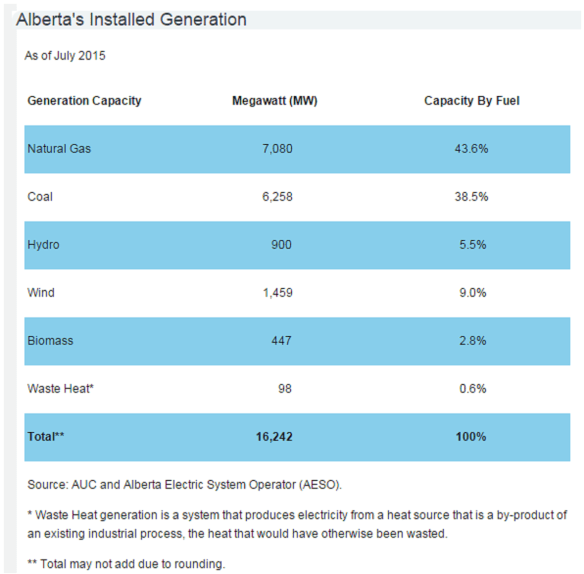
Alberta Energy Sources - 2015

Table #1:  Installed Electrical Generating Capacity by Fuel Source in Alberta (8)

Currently, Alberta has the third highest installed wind power capacity in Canada behind Ontario and Quebec.  Wind energy not only represents a means to green the power production, it also will contribute jobs and income to the economy.  As one source of electricity and revenues is removed another source will fill the void.
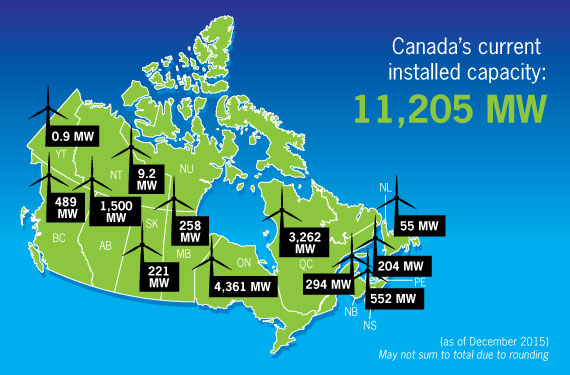
installed_capacity_e-4

Map #2:  Installed Wind Power Capacity by Province in Canada (9)

While significant inroads have been made in Alberta for wind power which is already established as a major power source for the future, there is unrealized potential for the installation of solar power production.  It has been noted that a photo-voltaic installation in Calgary is 52% more efficient than one installed in Berlin, Germany.  Meanwhile, Germany has 18,000 times more solar power generation capacity than installed in Alberta (10).

alberta-germanytiltweb

Map #4:  Solar Resource Comparison for Alberta & Germany (10)

Alberta has significant solar resources, even during the winter when daylight hours are shorter. Lower temperatures improve PV efficiency, and properly tilted south facing panels optimize light capture, while the flat terrain of the prairies provide unobstructed maximum daylight.  Light reflection by snow on the ground would further enhance light intensity during the colder months.  Thus solar represents a relatively untapped potential source of significant electrical power for Alberta and an unrealized economic opportunity for consumers and industry.
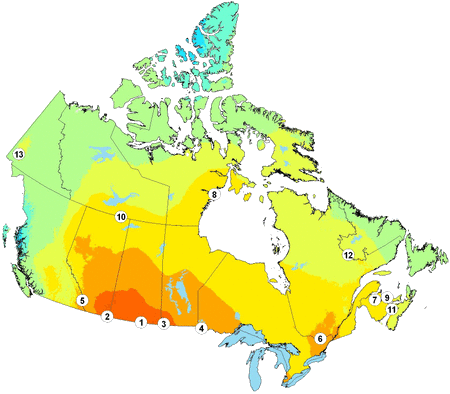
hotspots_13

hotspots_leg

Map #5:  Solar Resource Map for Canada With Hotspots (11)

Energy Efficiency, Smart Grid & Technological Advancements

Renewable energy produces electricity from natural resources without generating carbon and particulate emissions.  Another method of controlling emissions is to reduce the amount of energy consumed by being more efficient with the energy we already produce.   We can achieve this by using higher efficiency equipment, changing consumer patterns of use to non-peak periods, use of Smart Meter’s to monitor consumer usage and to alert homeowners when there is a problem with high consumption which could result in higher bills than normal if the problem remained unreported.

There are other advancements in the electrical grid system which are on the horizon which will enable a utility maximize resources by such means as energy storage, micro-grids, demand response to name a few.  Also, property owners and businesses could be able to grid-tie private solar panel (PV) and storage systems to supplement the utilities electrical system with additional power during the day.

Summary

In order to meet the goal of atmospheric emissions neutrality as agreed to at the 2015 Paris Climate Conference Alberta is posed with making decisions on how electricity is to be produced in the future.  Eliminating coal power plants and replacing them with Renewable Energy power sources such as solar and wind power are proven methods to reducing GHG and particulate emissions as these power sources do not involve combustion and discharge of waste gases formed during the combustion process.  Coal combustion is well documented as a major contributor of GHG’s to the atmosphere.

To make the transition will require capital for financing to build new infrastructure.  Funding of these projects should be raised proportionally charged to users with increased rates.  These rate increases will provide further incentives to reducing energy consumption and thus air emissions.  Jobs will shift and employment will be created in new forms as the old is phased out and replaced with new technology.  These new systems will have to be designed, built and maintained while the workforce will require training in new methods.  There will be many new opportunities for growth and advancement resulting from the implementation of these changes to meet Canada’s International commitments.

References:

  1. http://www.nrcan.gc.ca/energy/fuel-prices/4593
  2. http://www.cbc.ca/news/business/coal-compensation-power-alberta-1.3321467
  3. http://edmontonjournal.com/business/local-business/albertas-commitment-to-phase-out-coal-fired-power-sparks-fears-of-job-losses
  4. https://www.hydro.mb.ca/regulatory_affairs/energy_rates/electricity/utility_rate_comp.shtml
  5. http://ftp2.cits.rncan.gc.ca/pub/geott/atlas/archives/english/5thedition/environment/climate/mcr4033.jpg
  6. http://www.nrc-cnrc.gc.ca/eng/publications/codes_centre/necb_2011_adaptation_guidelines.html
  7. http://www.municipalaffairs.alberta.ca/CP_Energy_Codes_Information
  8. http://www.energy.alberta.ca/electricity/682.asp
  9. http://canwea.ca/wind-energy/installed-capacity/
  10. http://www.greenenergyfutures.ca/blog/sunny-days-ahead-solar-alberta
  11. http://pv.nrcan.gc.ca/index.php?lang=e&m=r


Massive Methane Gas Leak at California Storage Facility

The natural gas leak from a storage facility in the hills above Los Angeles is shaping up as a major ecological disaster as it vents large amounts of methane, a potent greenhouse gas.

Sourced through Scoop.it from: www.washingtonpost.com

” […]  A runaway natural gas leak from a storage facility in the hills above Los Angeles is shaping up as a significant ecological disaster, state officials and experts say, with more than 150 million pounds of methane pouring into the atmosphere so far and no immediate end in sight.

The rupture within a massive underground containment system — first detected more than two months ago — is venting gas at a rate of up to 110,000 pounds per hour, California officials confirm. The leak already has forced evacuations of nearby neighborhoods, and officials say pollutants released in the accident could have long-term consequences far beyond the region.

Newly obtained infrared video captures a plume of gas — invisible to the naked eye — spouting from a hilltop in the Aliso Canyon area above Burbank, like smoke billowing from a volcano. Besides being an explosive hazard, the methane being released is a powerful greenhouse gas, more potent than carbon dioxide in trapping heat in the lower atmosphere.

Scientists and environmental experts say the Aliso Canyon leak instantly became the biggest single source of methane emissions in all of California when it began two months ago. The impact of greenhouse gases released since then, measured over a 20-year time frame, is the equivalent of emissions from six coal-fired power plants or 7 million automobiles, environmentalists say. […]

See on Scoop.itGreen & Sustainable News

EPA Proposes to Cut Methane Emissions from New and Existing Landfills

Methane is a potent greenhouse gas with a global warming potential more than 25 times that of carbon dioxide. Climate change threatens the health and welfare of current and future generations. Children, older adults, people with heart or lung disease and people living in poverty may be most at risk from the health impacts of climate change. In addition to methane, landfills also emit other pollutants, including the air toxics benzene, toluene, ethylbenzene and vinyl chloride.

Image Source:  http://www.environmentalleader.com/

Sourced through Scoop.it from: yosemite.epa.gov

>”Release Date: 08/14/2015
Contact Information: Enesta Jones jones.enesta@epa.gov 202-564-7873 202-564-4355

WASHINGTON – As part of the President’s Climate Action Plan – Strategy to Reduce Methane Emissions, the U.S. Environmental Protection Agency (EPA) issued two proposals to further reduce emissions of methane-rich gas from municipal solid waste (MSW) landfills. Under today’s proposals, new, modified and existing landfills would begin collecting and controlling landfill gas at emission levels nearly a third lower than current requirements.  […]

Municipal solid waste landfills receive non-hazardous wastes from homes, businesses and institutions. As landfill waste decomposes, it produces a number of air toxics, carbon dioxide, and methane. MSW landfills are the third-largest source of human-related methane emissions in the U.S., accounting for 18 percent of methane emissions in 2013 – the equivalent of approximately 100 million metric tons of carbon dioxide pollution.

Combined, the proposed rules are expected to reduce methane emissions by an estimated 487,000 tons a year beginning in 2025 – equivalent to reducing 12.2 million metric tons of carbon dioxide, or the carbon pollution emissions from more than 1.1 million homes. EPA estimates the climate benefits of the combined proposals at nearly $750 million in 2025 or nearly $14 for every dollar spent to comply. Combined costs of the proposed rules are estimated at $55 million in 2025.

Today’s proposals would strengthen a previously proposed rule for new landfills that was issued in 2014, and would update the agency’s 1996 emission guidelines for existing landfills. The proposals are based on additional data and analysis, and public comments received on a proposal and Advance Notice of Proposed Rulemaking EPA issued in 2014.

EPA will take comment on the proposed rules for 60 days after they are published in the Federal Register. The agency will hold a public hearing if one is requested within five days of publication.  “<

See on Scoop.itGreen & Sustainable News

New EPA Emissions Rules To Cut GHG Methane Emissions By 40 Percent in Oil and Gas Sector

WASHINGTON (Reuters) – The U.S. Environmental Protection Agency will propose regulations on Tuesday aimed at cutting methane emissions from the oil and gas sector by 40 to 45 percent over the next decade

Sourced through Scoop.it from: www.huffingtonpost.com

>”WASHINGTON (Reuters) – The U.S. Environmental Protection Agency will propose regulations on Tuesday aimed at cutting methane emissions from the oil and gas sector by 40 to 45 percent over the next decade from 2012 levels, a source familiar with the issue said on Monday.

The regulations on methane are one part of the Obama administration’s strategy to curb greenhouse gases and combat climate change.

The targets in Tuesday’s proposal are in line with a January announcement by the Obama administration that it wanted to reduce oil and gas industry methane emissions by up to 45 percent from 2012 levels by 2025, the source said.

Earlier this month, President Barack Obama unveiled the final version of his plan to tackle greenhouse gases from coal-fired power plants, requiring carbon emissions from the sector be cut 32 percent from 2005 levels by 2030.

(Reporting By Valerie Volcovici; Writing by Mohammad Zargham; Editing by Peter Cooney)”<

See on Scoop.itGreen & Sustainable News

Increasing Heat Island Effect’s Influence on Urban Temperature Records Introduces Bias in Climate Studies

When it comes to human-caused climate change, urban warming is a big player.

Sourced through Scoop.it from: www.cato.org

>”Perhaps no other climatic variable receives more attention in the debate over CO2-induced global warming than temperature. Its forecast change over time in response to rising atmospheric CO2 concentrations is the typical measure by which climate models are compared. It is also the standard by which the climate model projections tend to be judged; right or wrong, the correctness of global warming theory is most often adjudicated by comparing model projections of temperature against real-world measurements. And in such comparisons, it is critical to have a proper baseline of good data; but that is easier acknowledged than accomplished, as multiple problems and potential inaccuracies have been identified in even the best of temperature data sets.

One particular issue in this regard is the urban heat island effect, a phenomenon by which urban structures artificially warm background air temperatures above what they normally would be in a non-urbanized environment. The urban influence on a given station’s temperature record can be quite profound. In large cities, for example, urban-induced heating can be as great as Tokyo’s 10°C, making it all the more difficult to detect and discern a CO2-induced global warming signal in the temperature record, especially since the putative warming of non-urbanized areas of the planet over the past century is believed to be less than 1°C.  Yet, because nearly all long-term temperature records have been obtained from sensors initially located in towns and cities that have experienced significant growth over the past century, it is extremely important that urbanization-induced warming – which can be a full order of magnitude greater than the background trend being sought – be removed from the original temperature records when attempting to accurately assess the true warming (or cooling!) of the natural non-urban environment. A new study by Founda et al. (2015) suggests this may not be so simple or straightforward a task.

Working with temperature records in and around the metropolitan area of Athens, Greece, Founda et al. set out to examine the interdecadal variability of the urban heat island (UHI) effect, since “few studies focus on the temporal variability of UHI intensity over long periods.” Yet, as they note, “knowledge of the temporal variability and trends of UHI intensity is very important in climate change studies, since [the] urban effect has an additive effect on long term air temperature trends.”

[…]

Such findings as these are of significant relevance in climate change studies, for they clearly indicate the UHI influence on a temperature record is not static. It changes over time and is likely inducing an ever-increasing warming bias on the temperature record, a bias that will only increase as the world’s population continues to urbanize in the years and decades ahead. Consequently, unless researchers routinely identify and remove this growing UHI influence from the various temperature data bases used in global change studies, there will likely be a progressive overestimation of the influence of the radiative effects of rising CO2 on the temperature record. “<

See on Scoop.itGreen & Sustainable News

Airplane Contrails Boost Global Warming by Trapping Earth’s Heat Energy

The warming effects of aircraft vapor trails could be eased with fewer night flights, especially during winter, the report says.

Sourced through Scoop.it from: news.nationalgeographic.com

>” […]

Nicola Stuber, first author of the study, to be published in tomorrow’s edition of the journal Nature, suggests that contrails’ overall impact on climate change is similar in scope to that of aircrafts’ carbon dioxide (CO2) emissions over a hundred-year period.

Aircraft are believed to be responsible for 2 to 3 percent of human CO2 emissions. Like other high, thin clouds, contrails reflect sunlight back into space and cool the planet.

However, they also trap energy in Earth’s atmosphere and boost the warming effect, the study says. […]

Contrails are artificial clouds that form around the tiny aerosol particles in airplane exhaust.

They appear only in moist, very cold (less than 40ºF/4ºC) air—usually at altitudes of 5 miles (8 kilometers) or higher.

Some contrails can last for a day or longer, though they gradually disperse and begin to resemble natural clouds.

Contrails Mystery Scientists disagree about the extent of contrails’ climate impact.

“The jury is out on the impact of contrails,” said Patrick Minnis, an atmospheric scientist at NASA’s Langley Research Center in Langley, Virginia.

David Travis, a climatologist at the University of Wisconsin-Whitewater, notes that some recent studies suggest that contrails have little impact on global climate change but have a greater regional warming impact.

“I prefer to think of contrails as a regional-scale climate problem, as they are most common in certain regions of the world, such as western Europe, eastern and central U.S., and parts of eastern Asia,” he said.

“This is due to a combination of dense air traffic in these areas and favorable atmospheric conditions to support contrail persistence once they form.”

Because of their locations and short life spans, contrails are a difficult study subject.

“The greatest impediment to understanding the contrail impacts on weather and climate is the poor state of knowledge of humidity in the upper troposphere [3.8 to 9.3 miles/6 to 15 kilometers in altitude],” NASA’s Minnis said.

“Until we can measure it properly and extensively, and model it and its interaction with cirrus clouds and contrails, we will continue to have large uncertainties about the effect of contrails.”

Winter is Contrail Season

At the high altitudes favored by commercial airlines, the air is much more humid in winter, so contrails are twice as likely in that season, study co-author Stuber said.

“We also found that flights between December and February contribute half of the annual mean climate warming, even though they account for less than a quarter of annual air traffic,” she said of her U.K.-based research.

Study leader Piers Forster, of England’s University of Leeds, suggests that contrails’ current impact on the atmosphere is likely to increase as air traffic grows. […]”<

See on Scoop.itGreen & Sustainable News

Jet Contrails Worse for Climate Change Than Aircraft Carbon Emissions

By John Timmer, Ars Technica

Air travel has come under fire for its potential contributions to climate change. Most people probably assume that its impact comes through carbon emissions, given that aircraft burn significant amounts of fossil fuel to stay aloft. But the carbon released by air travel remains a relatively minor part of the…

Sourced through Scoop.it from: www.wired.com

>” […]Others include the emissions of particulates high in the atmosphere, the production of nitrogen oxides and the direct production of clouds through contrail water vapor.

Over time, these thin lines of water evolve into “contrail cirrus” clouds that lose their linear features and become indistinguishable from the real thing.

Although low-altitude clouds tend to cool the planet by reflecting sunlight, high-altitude clouds like cirrus have an insulating effect and actually enhance warming.

To figure out the impact of these cirrus clouds, the authors created a module for an existing climate model (theECHAM4) that simulated the evolution of aircraft-induced cirrus clouds (they could validate some of the model’s output against satellite images of contrails).

They found hot spots of these clouds over the United States and Europe, as well as the North Atlantic travel corridor.

Smaller affects were seen in East Asia and over the northern Pacific. Over central Europe, values peaked at about 10 percent, in part because the output of the North Atlantic corridor drifted in that direction.

On their own, aircraft-generated cirrus produces a global climate forcing of about 40 milliwatts per square meter. (In contrast, the solar cycle results in changes of about a full watt/M2.)

But these clouds suppressed the formation of natural cirrus clouds, which partially offset the impact of the aircraft-generated ones, reducing the figure to about 30 mW/M2. That still leaves it among the most significant contribution to the climate produced by aircraft.

Some reports have suggested we might focus on makingengines that emit less water vapor, but the water is a necessary byproduct of burning hydrocarbon.

We’ll almost certainly be accomplishing that as a result of rising fuel prices, and will limit carbon emissions at the same time.

The nice thing is that, in contrast to the long atmospheric lifespan of CO2, if we can cause any changes in cloud formation, they’ll have an impact within a matter of days. […]”<

See on Scoop.itGreen & Sustainable News

China’s Switch to LNG From Coal Will Cut Global Pollution

To many people, natural gas seems to be more of the same, a continuation of the old fossil fuel path that has driven industrialization, air pollution and global warming.

Source: www.vancouversun.com

“> […]  China is currently producing twice the greenhouse gases of the United States. And its emissions are growing rapidly. Its emissions surpassed those of the U.S. in 2006, reached double the U.S. in 2014, and are expected to rise by seven per cent per year for the foreseeable future. China obtains 70 per cent of its electricity from burning coal, by far the worst polluter. China has plans for doubling its use of coal in the next 10 to 15 years. Meanwhile, the emissions from the U.S. have stabilized, partly from a slowing economy, but the biggest effect came from a switch from coal to natural gas. If you replace an old coal power plant with a modern natural gas one, you can cut carbon dioxide emissions by a factor of three.

Natural gas doesn’t cut emissions to zero; it is still a fossil fuel. But it obtains much of its energy from hydrogen, an atom that out numbers the carbon atoms in methane (the key component of natural gas) by 4:1. Natural gas can be burned with much higher efficiency than coal, by use of a combined cycle turbine that harnesses both gas and steam power generation.

China wants to move away from coal, to natural gas, nuclear, and solar. Their chief concern is not global warming, but the horrific air pollution that is killing an estimated 4,000 people per day in China, 1.6 million per year. […]”<

See on Scoop.itGreen & Sustainable News

LA’s Urban Heat Island Effect Alters Weather

Over the last 60 years urban areas of Southern California have lost significant amounts of fog due to the heat created by paved roads and buildings.

Source: www.scpr.org

>” A new study reports that coastal fog in Southern California is on the decline, especially in heavily urbanized areas.

In particular, Los Angeles saw a 63 percent decrease over the last 60 years.

You can blame the heat island effect created by city streets and buildings, said the study’s author Park Williams of Columbia University’s Lamont-Doherty Earth Observatory in New York.

Fog may be a nuisance for drivers, but according to Williams, it also plays a crucial role in hydrating many costal ecosystems.

These include mountains with coastal forests and hillsides covered in chaparral, which easily burns when conditions are too dry.

“They all receive water directly from fog and benefit from the shading of these clouds,” Williams said.

In fact, he noted that in some parts of Southern California, fog may provide plants with almost as much water as rain does. Williams says this loss of coastal fog could impact the regional environment.

Fog typically forms when the air is cool enough for clouds to condense close to ground level. This often happens at night and in the early morning.

However, Williams said this process is being upset by all the concrete in urban areas, which absorbs heat in the day and slowly releases it over night, raising temperatures.

“When you increase the temperature of the surface of the Earth, then you essentially need to go higher up into the atmosphere before [it] is cool enough to promote condensation,” Williams explained.

The end result is that as cities heat up, clouds rise and fog disappears.

Data for the study came from the detailed logs of the 24 coastal airports between Santa Barbara and San Diego.

“Of course airports have been collecting really good data on clouds because the presence of clouds and their hight in the atmosphere really affects air travel,” he said.

Many of these logs had hourly updates on cloud height, some dating back to the 1940s.

Using this information, Williams and his colleagues determined that the greatest loss of fog occurred in Ontario where there was a nearly 90% decrease over the last 60 years.

Other airports such as LAX, Burbank’s Bob Hope, Long Beach Airport and John Wayne Airport in Orange County also saw a considerable decrease in the average amount of fog.

However, less urban areas like Santa Barbara and the undeveloped the Channel Islands remained quite misty.

Williams says this trend is concerning because man-made climate change is expected to heat things up even more in the future.

Coastal fog can help cool an area down but as cities continue to bake, they will gather and emit even more heat, driving away even more fog.

“That can then feedback until the cloud layer is eaten away entirely in the daytime,” he said.

Soon, Williams hopes to explore how much water fog provides Southern California in general to see whether the continued loss of these low clouds could dry out the region even more.

His current paper appears in the journal Geophysical Research Letters.”<


See on Scoop.itGreen & Sustainable News

Climate Change, Pole Shift & Solar Weather

Scientists tell us that our magnetic poles have reversed in the past, and that they will again. The last one occurred 780,000 years ago. The average time period between reversals is 450,000 years, but there isn’t really any pattern, it is random. We are overdue by average only.

Source: poleshift.com

>” […] Accelerating

This is indisputable – the speed at which the magnetic north pole is moving (not necessarily in the same direction) has recently become much faster. Because this is the entirety of our studies, we don’t know what was normal prior to the 1500s… […]

Not only are the poles moving rapidly – the strength of our magnetic field is diminishing as well:

Rapid changes in the churning movement of Earth’s liquid outer core are weakening the magnetic field in some regions of the planet’s surface, a new study says.

“What is so surprising is that rapid, almost sudden, changes take place in the Earth’s magnetic field,” said study co-author Nils Olsen, a geophysicist at the Danish National Space Center in Copenhagen.

…The changes “may suggest the possibility of an upcoming reversal of the geomagnetic field,” said study co-author Mioara Mandea, a scientist at the German Research Centre for Geosciences in Potsdam. [National Geographic]

[…] Possible Triggers

Scientists have not yet worked out what causes a magnetic reversal, but recent studies of Mercury suggest that the solar wind and particles from the Sun have an effect on planetary cores. My interpretation is that a massive solar storm could be thestraw that breaks the camel’s back and trigger a reversal if the Earth is ready for one. The Electric Universe folk have also suggested that a highly-charged comet passing by could also do the trick. Or perhaps ocean currents, after being affected by climate change, are the trigger? And if climate change is caused by the Sun, then that ties in nicely with the first theory.

Another theory comes from  Rich Muller:

where “lighter components, like oxygen, sulfur, and silicon . . . rise toward the core-mantle boundary (CMB).” Accumulating like sediment on the floor of the ocean, these “fall” upward from the core onto the surface of the mantle, which is uneven like the topography of the Earth’s surface. When enough sediment collects, it tumbles like an avalanche, into the outer core, thereby cooling it.

Rare events could trigger really big avalanches at the CMB, however. When a massive asteroid or comet slammed into Earth’s surface at an oblique angle, the lower mantle would jerk sideways, shearing off whole mountains of sediment. As the sediments slide up, a downward-sinking mass of cool iron could completely disrupt large convection cells. Although variously oriented local fields within the core would remain strong, at the surface Earth’s dipole magnetic field would collapse.

And according to Gary Glatzmaier reversals are rooted in chaos theory:

The resulting three-dimensional numerical simulation of the geodynamo, run on parallel supercomputers at the Pittsburgh Supercomputing Center and the Los Alamos National Laboratory, now spans more than 300,000 years.

Our solution shows how convection in the fluid outer core is continually trying to reverse the field but that the solid inner core inhibits magnetic reversals because the field in the inner core can only change on the much longer time scale of diffusion. Only once in many attempts is a reversal successful, which is probably the reason why the times between reversals of the Earth’s field are long and randomly distributed.

[…]”<

See on Scoop.itGreen Energy Technologies & Development