1973-74 Oil Crisis – Timeline – Slaying the Dragon of Debt – UC Berkeley

See on Scoop.itGreen & Sustainable News

Between October 1973 and January 1974 world oil prices quadrupled. By putting an end to decades of cheap energy, the 1973-74 oil crisis, which was led by Arab members of the Organization of Petroleum Exporting Countries (OPEC), exacerbated the economic difficulties facing many industrialized nations, forced developing countries to finance their energy imports through foreign borrowing, and generated large surpluses for oil-exporters.

Duane Tilden‘s insight:

>The 1973-74 oil crisis followed years of often acrimonious negotiations between members of the Organization of Petroleum Exporting Countries (OPEC) and Western oil companies over petroleum production and pricing levels. Richard Nixon’s decision to take the U.S. off the gold standard in 1971 was of particular importance in contributing to the oil crisis.

Because oil prices were denominated in dollars, the devaluation that accompanied the end of the Bretton Woods monetary regime negatively impacted oil exporting countries and led OPEC officials to consider remedial steps, such as pricing oil in gold instead of dollars. Little came of these efforts until October 1973, when Arab members of OPEC, in response to the outbreak of the Yom Kippur War, raised the posted price of crude by 70% and placed an embargo on exports to the U.S. and other nations allied with Israel.

Although the fighting ended in late October, OPEC continued to use the “oil weapon” over the coming months. In November oil exporters cut production 25% below September levels, and the following month they doubled the price of crude. By January 1974 world oil prices were four times higher than they had been at the start of the crisis.<

See on bancroft.berkeley.edu
Fukushima leaks will keep fisheries closed indefinately

See on Scoop.itGreen & Sustainable News

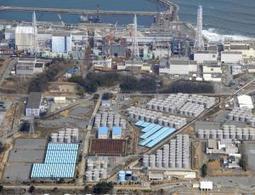
Some Japanese fisheries face a long-term threat from the steady trickle of radioactive water from the stricken Fukushima Daiichi nuclear plant

Duane Tilden‘s insight:

>Last month the plant’s owner, Tepco, finally admitted what many had suspected – that the plant was leaking. Now Japan’s Nuclear Regulatory Authority is calling the situation an emergency, and says Tepco’s plans to stop the leak are unlikely to work.

The problem is that groundwater is entering the damaged reactor buildings, picking up radioactive elements like caesium and seeping out to sea. Tepco has spent months pumping the water to the surface and storing it in tanks, and sinking wells to lower the water table.

[…] Given that Tepco is unlikely to stem the leaks from Fukushima any time soon, the fishing ban could continue for a long time. “People ask when will it be safe, and we can’t answer that,” says Buesseler. “The only thing you can do is stop the source, and that’s a huge engineering challenge.”<

See on www.newscientist.com

UK offers Big Tax Breaks for Shale Gas Fracking

See on Scoop.itGreen & Sustainable News

Chancellor George Osborne has said that the Treasury will go ahead with the most generous tax regime for shale gas in the world.

Duane Tilden‘s insight:

>In the North Sea oil and gas exploration has received tax breaks along the same lines. This has brought about a renewed interest in this field, which is both technically very difficult and rather expensive. The tax allowance will see a huge relief for fracking, with a portion of each production sites income taxation going to a level of 30% in place of the 62% currently levied.

The British Geological Society has said that shale gas in northern England alone could be as high as 1,300 trillion cubic feet and just 10% of that would meet Britain’s needs for more than 40 years.

Water UK, a representative of Britain’s biggest water suppliers has voiced fears that large quantities of water needed for fracking would stretch water supplies very thinly in the areas earmarked for fracking sites, and there is a concern of contamination of water supplies with chemical waste and methane gas. Water UK said that damage could be done to the existing water pipe infrastructure with resultant shortages for home and business use.

Fracking companies say that lengthy waiting periods for environmental permission to begin fracking are a major concern, and Ministers have said they will endeavour to minimise the waiting period from over three months to under two weeks. Public support for shale gas exploration is low.<

See on www.pcmswitch.co.uk

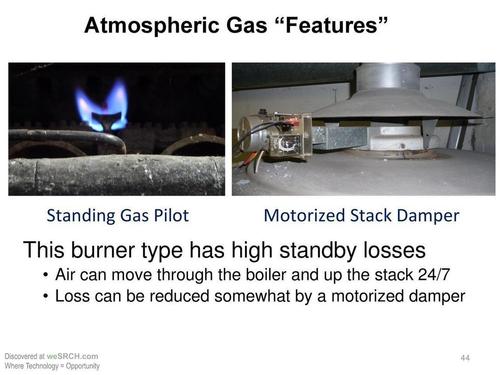
Atmospheric Gas Features – free slide submission, upload slide – weSRCH

See on Scoop.itGreen Building Design – Architecture & Engineering

The features are satnding gas pilot and motorized stack damper. This burner type has high standby losses. Air can move through the boiler and up the stack 24/7…. , Atmospheric Gas Features – free slide submission, upload slide – weSRCH.

Duane Tilden‘s insight:

Educational slideshow.

See on www.wesrch.com

Portfolio-wide Energy Management for Affordable Housing, Energy

See on Scoop.itGreen Energy Technologies & Development

Portfolio-wide Energy Management for Affordable Housing – \94NESEA” is a Registered Provider with The American Institute of Architects Continuing Education Syst…, Portfolio-wide Energy Management for Affordable Housing, Energy.

Duane Tilden‘s insight:

A slide show on Energy Management.

See on energy.wesrch.com

UK Energy Minister defends fracking comments

See on Scoop.itGreen & Sustainable News

Energy minister Michael Fallon defends comments about fracking, in which he appeared to suggest the process would affect those living near drilling sites.

Duane Tilden‘s insight:

>Mr Fallon said fracking would only be allowed if “absolutely safe”.

In an exchange with the BBC Mr Fallon confirmed he had made the remarks but said the newspaper report had “completely misconstrued a light hearted remark”.

He said “no fracking will be allowed in the Weald unless it is absolutely safe and the environment is fully protected”.

[…]

But demonstrators from across the UK have gathered in the area saying they fear test drilling could lead to the search for shale gas and fracking at the site.

In a separate development, Cuadrilla chief executive Francis Egan revealed he had received an anonymous email saying the company would receive “pipe bombs delivered by express mail to its premises” unless the company ceased its activities in the UK.

“Fracking kills and so do we,” the message said.<

See on www.bbc.co.uk

A Republican Case for Climate Action

See on Scoop.itGreen & Sustainable News

By WILLIAM D. RUCKELSHAUS, LEE M. THOMAS, WILLIAM K. REILLY and CHRISTINE TODD WHITMAN Published: August 1, 2013The United States must move now on substantive steps to curb climate change, at home and internationally.

Duane Tilden‘s insight:

>Mr. Obama’s plan is just a start. More will be required. But we must continue efforts to reduce the climate-altering pollutants that threaten our planet. The only uncertainty about our warming world is how bad the changes will get, and how soon. What is most clear is that there is no time to waste.<

See on www.nytimes.com

Smart Grid: Utility sued due to Smart Meter opt-out program

See on Scoop.itGreen Energy Technologies & Development

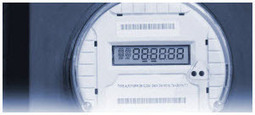
Smart Grid – BC Hydro offered customers who didn’t want to participate in its smart meter program the choice of opting out in mid-July. But that didn’t protect the utility from a lawsuit

Duane Tilden‘s insight:

>Just days after BC Hydro finally agreed to an opt-out program for smart meters, a customer is suing the utility for installing a smart meter last year even though she didn’t want one on her property. […]

The suit claims the installations caused the plaintiff “emotional distress,” because it “interfered with the quiet enjoyment of her property,” which she used to host yoga and meditation retreats. Opponents of smart meters believe the devices’ radio waves have health risks. The lawsuit further alleges that BC Hydro unlawfully leveraged its monopoly powers by imposing a smart meter on the plaintiff.

[…] The utility says that smart meters only broadcast several times a day, and that living next to a smart meter for 20 years would expose a resident to the same level of radiation as a 30-minute cell phone call.<

See on www.smartgridnews.com

Bakken Oil: North Dakota flaring burns 4 times Total National Consumption (2011 figure)

See on Scoop.itGreen & Sustainable News

NEW YORK (Reuters) – Oil drillers in North Dakota’s Bakken shale fields are allowing nearly a third of the natural gas they drill to burn off into the air, with a value of more than $100 million per month,…

Duane Tilden‘s insight:

An alarming state of affairs.  As per the article the flared Natural gas in North Dakota is reported to be 266,000,000,000 cfd (cubic feet per day) flared methane or 2750 x 10(9) cu m/year.

According to Wiki the 2011 US annual consumption for natural gas was 689.9 x 10(9) cu m, so apparently Bakken is actually burning 4 times the total 2011 national requirements.

>Roughly 29 percent of natural gas extracted in North Dakota was flared in May, down from an all-time high of 36 percent in September 2011. But the volume of natural gas produced has nearly tripled in that timeframe to about 900,000 million cubic feet per day, boosting flaring in the state to roughly 266,000 million cubic feet per day, according to North Dakota state and Ceres data.<

See on www.reuters.com