New Zero-Down, No-Risk Energy Efficiency Investment Fund Aims To Unlock $150 Billion In Savings

See on Scoop.itGreen Energy Technologies & Development

Double your money, create more than 1 million jobs and make a big dent in US carbon and greenhouse gas emissions – that’s what could be realized if the US were to double energy productivity by 2030, according to the Alliance Commission on National…

Duane Tilden‘s insight:

Looking to spur energy-efficiency gains across the US, CalCEF and Metrus Energy on March 13 launched a new financial intermediary service that could unlock the doors to a projected $150 billion in energy-efficiency savings by providing “otherwise hard-to-get financing for small and medium-sized businesses (SMBs).”

Added CalCEF managing director Paul Frankel:  “The Efficiency Resource Fund is a trail-blazing investment vehicle that taps a massive, underserved market opportunity.  We’re enabling a whole class of projects that would otherwise not be completed, while at the same time delivering not just savings for customers but also attractive returns for impact investors and generating capacity for utilities.”

See on cleantechnica.com
Stanford researchers map out an alternative energy future for New York

See on Scoop.itGreen & Sustainable News

A study, co-authored by Stanford researcher Mark Z. Jacobson, outlines a path to statewide renewable energy conversion, and away from natural gas and imported fuel.

Duane Tilden‘s insight:

The study is the first to develop a plan to fulfill all of a state’s transportation, electric power, industry, and heating and cooling energy needs with renewable energy, and to calculate the number of new devices and jobs created, amount of land and ocean areas required, and policies needed for such an infrastructure change. It also provides new calculations of air pollution mortality and morbidity impacts and costs based on multiple years of air quality data.

To ensure grid reliability, the plan outlines several methods to match renewable energy supply with demand and to smooth out the variability of WWS resources. These include a grid management system to shift times of demand to better match with timing of power supply, and “over-sizing” peak generation capacity to minimize times when available power is less than demand.

The study’s authors are developing similar plans for other states, including California and Washington. They took no funding from any interest group, company or government agency for this study.

See on news.stanford.edu

Wind power capacity grew 20% globally in 2012, figures show

See on Scoop.itGreen Energy Technologies & Development

A relative slowdown in new wind turbine construction in China was offset by increases in the US, Germany, India and the UK

Duane Tilden‘s insight:

“While China paused for breath, both the US and European markets had exceptionally strong years,” said Steve Sawyer, secretary general of the Global Wind Energy Council (GWEC), which produced the statistics. “Asia still led global markets, but with North America a close second, and Europe not far behind.”

The UK now ranks sixth in the world for installed wind power, with 8.5GW. In Europe, only Germany (31GW) and Spain (23GW) have more. China leads the world with 77GW installed and the US is second with 60GW. […]

The record year for installation in the US was driven by a rush to beat an anticipated end to tax credits: 8GW of the total 13GW were installed in the last quarter of 2012. However, the tax credit has since been extended, meaning a dramatic slowdown in the US in 2013 is less likely. […]

See on www.guardian.co.uk

Renewable energy debt issuers abound | FP Street | News | Financial Post

See on Scoop.itGreen Energy Technologies & Development

If the fixed income analysts at BMO Capital Markets have got it right, investors can expect another crop of issues by companies whose business is renewable energy, a move, they suggest will generate ‘a gust of income for your portfolio’…

Duane Tilden‘s insight:

In his view, the level of issuance in 2012 “will easily be surpassed this year,” he wrote in a 24-page report.

Laing makes that argument on the basis that across the land, there are more than 8,500 megawatts in projects at various stages of development “stemming from previous calls for green power.”

Most of those projects are based in B.C., Ontario and Quebec. According to his report, Canada’s wind energy capacity stood at 6,000MW at the end of 2012, up from 140MW in 2000.

See on business.financialpost.com

Renewable energy now cheaper than new fossil fuels in Australia | Bloomberg New Energy Finance

See on Scoop.itGreen & Sustainable News

Sydney, 7 February 2013 – Unsubsidised renewable energy is now cheaper than electricity from new-build coal- and gas-fired power stations in Australia, according to new analysis from research firm Bloomberg New Energy Finance.

Duane Tilden‘s insight:

[…] research on Australia shows that since 2011, the cost of wind generation has fallen by 10% and the cost of solar photovoltaics by 29%. In contrast, the cost of energy from new fossil-fuelled plants is high and rising. New coal is made expensive by high financing costs. […] New gas-fired generation is expensive as the massive expansion of Australia’s liquefied natural gas (LNG) export market forces local prices upwards. […]

[…] Australia’s fleet of coal-fired power stations built by state governments in the 1970s and 1980s can still produce power at lower cost than renewables, because their original construction cost has now been depreciated.

“New wind is cheaper than building new coal and gas, but cannot compete with old assets that have already been paid off,” Bhavnagri said. “For that reason policy support is still needed to put megawatts in the ground today and build up the skills and experience to de-carbonise the energy system in the long-term.”

See on about.bnef.com

North American Windpower: The Biggest Wind Energy Deals Of 2012

See on Scoop.itGreen Energy Technologies & Development

Bringing wind power news and analysis to industry professionals, North American Windpower covers utility-scale projects, renewable energy policy, turbine technology, and the market for new products and services.

Duane Tilden‘s insight:

In addition, there were 16 debt deals amounting to nearly $12.5 billion in 2012, compared to $11 billion in 15 deals in 2011, Mercom notes, adding that most of the larger debt deals were in China. The top debt deal was the $5.5 billion in credit received by Chinese turbine maker Xinjiang Goldwind Science Technology.

Mercom also tracked approximately $14 billion in 71 announced large-scale project funding deals in 2012. Of that amount, $4.2 billion in 22 deals came in the fourth quarter. In comparison, large-scale project funding announcements in 2011 came to approximately $11 billion in 52 deals.

Top project funding investors in 2012 included Union Bank, with seven deals; EBRD and KfW IPEX-Bank, with six deals; and JP Morgan and Rabobank, with five deals apiece.

See on www.nawindpower.com

Wind energy topped 30% of Danish power consumption at end 2012

See on Scoop.itGreen Energy Technologies & Development

Wind power provided enough electricity for over 30% of Denmark’s electricity consumption by the end of 2012. And it has 50% in its sights.

Duane Tilden‘s insight:

..Wind still accounts for just 3-4% of electricity production in the US, and the target is to hit 20% by 2030. So, with that context, I think you can see that Denmark’s figure is very impressive.

The Danish Wind Industry Association’s article on the news adds: “Anholt Offshore Wind Farm will be completed at the end of 2013 and by the time the park’s 400 MW will provide 4% of the Danish electricity consumption. In addition, the planning process has started for Horns Rev III of 400 MW, Krieger’s Flak of 600 MW and the near-shore turbines which will have a combined capacity of 500 MW, of which 50 MW will be test turbines.” [sic]

See on reneweconomy.com.au

Wind energy in Spain sets record – Business – CBC News

See on Scoop.itGreen Energy Technologies & Development

Wind farms in Spain have broken an energy record in January, generating more electricity than any other source.

Duane Tilden‘s insight:

The Spanish Wind Energy Association said wind energy accounted for 25 per cent of all electrical production in January, more than both coal and nuclear power.

See on www.cbc.ca

WIND ENERGY TOP SOURCE FOR NEW GENERATION IN 2012; AMERICAN WIND POWER INSTALLED NEW RECORD OF 13,124 MW …

See on Scoop.itGreen Energy Technologies & Development

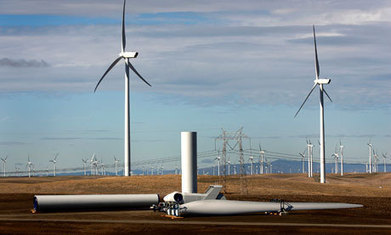
The U.S. wind energy industry had its strongest year ever in 2012 […] installing a record 13,124 megawatts (MW) of electric generating capacity, leveraging $25 billion in private investment,and achieving over 60,000 MW of cumulative wind capacity.

Duane Tilden‘s insight:

In this historic year of achievement, wind energy for the first time became the number one source of new U.S. electric generating capacity, providing some 42 percent of all new generating capacity; the final tally will be released in April in AWEA’s annual report. In fact, 2012 was a strong year for all renewables, as together they accounted for over 55 percent of all new U.S. generating capacity.

“The fact that wind power grew by another 28 percent in 2012 alone and poured $25 billion of private investment into the U.S. last year demonstrates wind’s ability to scale up, and continue to serve as a leading source of energy in America,” Gramlich said.

The global wind energy industry will gather in Chicago, Ill., this May 5-8, 2013, for the world’s largest annual wind power event, WINDPOWER 2013. Thousands of workers and leaders from all sectors will attend to show their wares, attend conference sessions, and seek further solutions for success.

See on www.power-eng.com

[…] Advanced Energy Management Patent Portfolio Developed by Pacific Northwest National Laboratory

See on Scoop.itGreen Energy Technologies & Development

SEATTLE, WA–(Marketwire – Jan 29, 2013) – Calico Energy Services (www.calicoenergy.com) and the Department of Energy’s Pacific Northwest National Laboratory (PNNL, www.pnnl.gov) today announced that Calico has licensed a portfolio of advanced energy management Intellectual Property (IP) developed by PNNL.

Duane Tilden‘s insight:

PNNL’s development of the technology was funded by DOE’s Office of Electricity Delivery and Energy Reliability and the American Recovery and Reinvestment Act. The innovative Patent Portfolio is based on a single, integrated smart grid model that utilizes an economic signal to automatically balance supply and demand at the lowest possible cost.

“PNNL’s Patent Portfolio is a breakthrough that allows an electric power system to virtually balance itself,” said Jesse Berst […]

See on www.marketwire.com