California Real Estate Assn’ Educates Members on Building Energy Performance & Benchmarking

In California, brokers are at the heart of every non-residential sale or lease. Can the AIR organization get them on board with benchmarking?

Source: www.greenbiz.com

>”Commercial buildings are some of California’s largest energy- and water-guzzlers. With 58 percent of the state locked in the highest category of drought, many commercial property owners are seeing increased utility bills, and with a new building energy benchmarking and disclosure law on the books, building owners seek energy efficiency solutions as a common-sense way to ease some of the pressure. One key trade association in California, the AIR Commercial Real Estate Association, is taking the lead by educating its members on the benefits of energy efficiency.

AIR, founded in 1960, is a regional commercial real estate brokers association with more than 1,700 members across southern California, and is one of the nation’s largest organizations of its kind. It’s recognized across the U.S. for its ever-expanding library of sample lease forms, which members use to stay updated on industry and lease language trends — several of which now include sustainability. When California’s energy benchmarking law, AB 1103, went into effect in January, AIR responded by creating sample energy disclosure lease and sale addenda (PDF) and began educating its members on these new tools.

Brokers are in the thick of it

The law states that any time a non-residential building owner finances, sells or leases a whole building, the property owner is required to use Energy Star portfolio manager to benchmark the building and provide the Energy Star rating and supporting consumption information to the lender, buyer or tenant in the transaction. As brokers are central to every aspect of a commercial transaction, their participation is essential for the law to have its intended effect. AIR’s lease and sale addenda effectively address these energy disclosure requirements in one document, providing real estate professionals, building owners, tenants and attorneys with a framework template for compliance with the regulation.

Brokers hold the key to increasing stakeholder awareness, potentially boosting compliance rates, benchmarking data quality and ultimately better building performance and energy management — and educating the community about new regulations and tools is essential to unlocking this potential.”<

See on Scoop.itGreen & Sustainable News

CEC Delays Energy Benchmarking and Disclosure Requirements 2 Years for Smaller Buildings


>”[…]Compliance with AB 1103 is not suspended, and will continue to be required, for the sale, lease, or financing of buildings over 10,000 square feet that are otherwise subject to the regulations based upon occupancy type.

Significant barriers to compliance with AB 1103

An Emergency Rulemaking Action requires a description of specific facts justifying the immediate action. In justifying the two-year delay, the CEC explained that several stakeholders had expressed concerns about significant barriers to compliance with AB 1103. The CEC noted the following factors in justifying the two-year delay:

  • Some utilities have required tenant consents before releasing utility usage data despite letters sent from the CEC to utilities in July 2013 prohibiting such requirement. This requirement to obtain tenant consents significantly increases compliance costs.
  • Smaller utilities have expressed concerns with their ability to comply given limited staff and resources.
  • The Portfolio Manager platform and software has experienced significant technical problems.
  • The expansion in scope to smaller buildings would increase the number of compliance requests received by utilities, impeding their ability to address barriers to compliance.
  • Smaller building owners may lack the expertise, resources, or capacity necessary to overcome current barriers to compliance without incurring undue expense.
  • Based on initial disclosure data following the January 1, 2014 implementation, it became apparent that “the required disclosures were not being made for the majority of transactions for which they were required.”
  • The development of best practices approaches is lowering compliance costs and paving the way to greater compliance. The additional two years will facilitate lower costs and higher compliance rates before further expanding the program to smaller buildings.”<

See on Scoop.itGreen Building Operations – Systems & Controls, Maintenance & Commissioning

Google invests $145 million in new 82MW Southern California solar power plant

US Company Deploys Aqueous, Lithium-Ion and Flow Batteries for Grid Storage

“Batteries must do more than just work—they have to scale.”

Source: www.greentechmedia.com

>”[…] The startup is a software developer and system integrator that has attracted investment, personnel and a growing roster of turnkey energy storage projects.

[…]

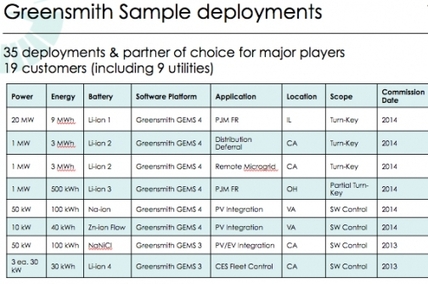
Companies like the 30-employee Greensmith are winning energy storage projects not because they are building better batteries but because they are writing software that integrates batteries with inverters and allows energy storage to work with the grid at scale. Greensmith works with a variety of battery chemistries from different vendors, as well as multiple inverters and power electronics partners.

New battery technologies and projects

Amongst other technologies, Greensmith is using Aquion Energy’s sodium-ion battery. The Pittsburgh, Penn.-based Aquion says its technology can deliver round-trip energy efficiency of 85 percent; a ten-year, 5,000-plus-cycle lifespan; energy storage capacity optimized to charge and discharge for multi-hour applications; and perhaps most notably, a price point of $250 per kilowatt-hour.

In April, Aquion closed a $55 million Series D venture capital investment, bringing total investments and grants to more than $100 million. New investors Bill Gates, Yung’s Enterprise, Nick and Joby Pritzker (through their family’s firm Tao Invest), Bright Capital, and Gentry Venture Partners joined previous investors Kleiner Perkins Caufield & Byers, Foundation Capital, and Advanced Technology Ventures in the round. Aquion is already producing its 1.5-kilowatt-hour S10 Battery Stack units, as well as an 18-kilowatt-hour system that combines twelve of its S10 units.

Greensmith is also using ViZn Energy Systems’ zinc redox flow battery energy storage technology. ViZn aims to produce a 80-kilowatt/160-kilowatt-hour system housed in a 20-foot shipping container, as well as larger systems. Other flow battery firms include American Vanadium, EnerVault, Primus Power, Imergy and ZBB Energy.

The CEO of the firm told GTM that Greensmith is developing a hybrid system using both the Aquion and ViZn storage chemistries.

Since its 2006 founding, Greensmith has deployed 30 battery energy systems for eighteen different customers, nine of them utilities, and is aiming to have 23 megawatts of systems under management by year’s end. […]”<

See on Scoop.itGreen Energy Technologies & Development

School to Combine Solar PV Modules with Battery Storage in Belgian Pilot Project

“Such an energy storage and distribution system can offer a great value, certainly for schools”, says Bert Dekeyzer of npo iD, the organization behind the ‘School of the Future’.

Source: www.solarserver.com

>'”During weekends a school consumes almost no electricity. The energy produced by the solar panels is stored in the batteries. On Monday morning there is a peak consumption: then all the computers and machines are turned on, which requires quite a lot of electricity. If the solar panels supply too little at that time, the batteries can provide the remaining energy. Moreover, a study showed that the energy consumption of a school does not stop after four o’clock in the afternoon. Schools are increasingly used in the evening for sports activities and evening classes. Also in this situation, the batteries can play their part.”

PV, storage combination offers a solution for a possible power shortage

In addition to an optimal and economic usage of solar power, the system can provide a solution for a possible power shortage in Belgium. Because of problems with the Belgian nuclear power plants, various municipalities could get disconnected from the electricity grid. In case of a power disruption, a traditional solar installation does not work anymore. The inverter of a traditional system switches off automatically because of a power failure. The owners of solar modules also have no electricity at that time, and in addition they suffer losses of the power output and any feed-in tariffs from their solar panels during the outage.

The storage system provides a solution. Such an installation combines solar modules with battery storage and intelligent software: if the grid fails, the system provides uninterrupted power for the user from the solar modules and/or batteries. […]”<


See on Scoop.itGreen Building Design – Architecture & Engineering

Energy Efficiency and Renewables Drives Smart Grid Technologies Market – Research & Developments

The market for smart grid technologies is evolving rapidly as the need for a more responsive, automated power grid rises worldwide.  …

Source: www.navigantresearch.com

>”The fundamental technology for injecting intelligence into the grid has been in existence for years – more than a decade in some cases. However, the past 18 to 24 months have seen accelerating technological advancements and shifting priorities among utility industry stakeholders.

Transmission system upgrades are driven by the need to interconnect offshore or remote wind and solar farms, as well as ongoing electrification across Asia Pacific and developing regions. Falling costs for devices and communications networking, combined with the increasing emphasis on reliability and energy efficiency, will lead to robust growth in the substation and distribution automation (SA and DA) markets. Meanwhile, government mandates, especially in Europe, will drive strong smart meter penetration gains over the next decade. At the same time, utilities are facing more competition than ever and squeezed margins. These issues, along with the proliferation of smart devices in the grid, will drive impressive growth in demand for more powerful utility IT solutions and analytics. Navigant Research forecasts that global smart grid technology revenue will grow from $44.1 billion in 2014 to $70.2 billion in 2023.

This Navigant Research report analyzes the global market for smart grid technologies, with a focus on transmission upgrades, SA, DA, information and operations technology (IT/OT) software and services, and advanced metering infrastructure (AMI). The study provides a detailed analysis of the market drivers, challenges, and trends, as well as regional and country factors, for each smart grid technology segment. Global market forecasts for revenue, broken out by technology, application, component, and region, extend through 2023. The report also provides profiles of key grid infrastructure vendors and includes information on 150-plus other types of companies, major global utilities, and smart grid-related industry associations.

Key Questions Addressed:

Which smart grid technology segments are the largest and how quickly are they expected to grow?

What are the key market drivers and challenges for each smart grid technology segment?

What are the most important new trends affecting the pace of investment in smart grid technologies?

What regional factors are affecting the pace of investment in smart grid technology?

Who are the key vendors in each category of smart grid technology?   […] “<

See on Scoop.itGreen Energy Technologies & Development

Development of small scale renewable landfill bio-gas electric generator in UK

ACP funds for development of small scale landfill gas engine in UK Energy Business Review ACP’s biogas partner AlphaGen Renewables, which oversee the installation and operation of a 50kW microgeneration landfill gas engine, will develop the project.

Source: biofuelsandbiomass.energy-business-review.com

>”The project is expected to generate power from the landfill gas resource at the site under a 20 year agreement with Norfolk County Council.

AlphaGen Renewables chairman Richard Tipping said: “We are delighted to be partnering with ACP on this project, which is set to deliver strong returns. Renewables such as biogas are playing a growing role in the UK’s energy production.”

Albion Ventures Renewables head David Gudgin said: “Biogas is an increasingly popular area of renewable energy and we are looking forward to working with AlphaGen both on this project and others in the future.”<

See on Scoop.itGreen Energy Technologies & Development

Cost Effective ‘net zero’ energy in Jerseyville, Illinois subdivision

Lexington Farms, an affordable housing project of rental homes [built in Illinois].

Source: www.stltoday.com

>”Rooftop solar panels and wind turbines mounted over garages power all 32 homes at Lexington Farms, a new Jerseyville subdivision designed to provide residents no-cost electricity. […]

“Over the course of a year the solar array and wind turbines provide all the energy needed to power heating and air-conditioning systems, along with other household electricity needs,” said Jeff Lewis, president of MidAmerica Solar. “While similar technology has been used in homes, it hasn’t been done on this scale in an entire subdivision.” […]

Each home can produce up to 7.2 kilowatts of energy from roof-mounted solar panels.

Wind turbines mounted on masts over garages provide up to 1 kilowatt of additional energy. Lewis said tests were conducted to make sure the turbines’ vibrations were so slight as to be unnoticed by the homes’ occupants.

Ground-mounted solar panels at the subdivision’s entrance generate power for the community center.

Lexington Farms’ three-bedroom homes rent for $590 per month to families with incomes of $41,000 or less. The houses have central air conditioning, heat, hot water and other appliances that are powered by electricity generated by the solar panels and wind turbines.

The Illinois Housing Development Authority provided more than $2.5 million in assistance for the project, including federal low-income housing tax credits and federal stimulus money. Funding also came from a $260,000 grant from the Illinois Department of Economic Opportunity and financing from Sterling Bank.

Included in the project are 16 streetlights that operate entirely off the electrical grid.

The streetlights, made by MidAmerica Solar, have their own wind turbines and solar panels that provide electricity to energy-efficient LED lights and a backup battery. The lights used to come from China. Now they come from a small factory in Affton.”<

Grid Scale Energy Storage Solutions For Future Virtualization

Examines grid scale energy storage solutions ranging from pumped hydro, compressed air, thermal storage, advanced batteries, fuel cells and purely electric storage systems.

Source: greeneconomypost.com

Renewable energy sources often have a common problem of matching supply with demand, hence the need for energy storage to bridge the gap.  One major component of future VPP (Virtual Power Plants) is energy storage, in the form of battery storage, fuel cells, pumped hydro, flywheels, compressed air or other forms of existing and new technologies.

One promising form of energy storage combines gravity with water where energy is stored in raising heavy weights.  Electrical energy is converted to potential energy during periods of over-supply and then converted back to electricity when demand is greater than supply.

>”A Cutting Edge Variation of Pumped Hydro

Gravity Power, LLC, a privately-held company, based in Southern California (in Goleta, CA just north of Santa Barbara) is developing a novel grid-scale energy storage system for global commercialization called the Gravity Power Module (GPM). Like pumped hydro the working energy carrier is water that is pumped between a high pressure and a low pressure reservoir running a reversible generator/pump assembly to either produce power by drawing down the high pressure reservoir or store it up by pumping water from the low pressure store back into the high pressure store. In this sense it operates on the very same principles – and thus can also benefit from existing capital equipment, such as the reversible hydro generator/pump assemblies for example – as traditional pumped hydro.

Gravity Powers technology circumvents traditional pumped hydro difficulties related to siting, negative environmental impact, huge land demands, permitting, long-lead times and the very large investment required, by burying it all underground…. literally.

The GPM system uses a very large and very dense high mass piston that is suspended in a deep, water-filled shaft. The piston is equipped with sliding seals to prevent leakage around the piston/shaft interface and its immense mass pressurizes the supporting water column beneath it. A high pressure pipe from the bottom of this shaft enables water to be run or pumped through a generator/pump assembly of the same types now used in pumped hydro systems. The low pressure low energy potential water is returned above the piston adding somewhat to its weight and further pressuring the remaining high energy potential water column.

The massive piston moves up and down the shaft, storing and releasing power in a closed sealed cycle. It is compact with a small land footprint and the units can be clustered together into larger groups. It also is environmentally benign, no toxic chemicals or explosive dangers.

I like the scalable nature of this store that makes it suited to incremental growth of capacity. I also like how this energy storage system could be placed very near the big urban areas of greatest need for this kind of electric capacity. The fact that this energy storage system can take advantage of a lot of already existing infrastructure and technical knowhow from the existing pumped hydro sector is a definite advantage.

I would like to see more details on the costs of the boring of the immense vertical shafts; the long term performance metrics of the shaft seals (that would be an expensive repair job I would think. All in all I think this or something like it is a strong contender in the energy storage sector.”<

Read more: http://greeneconomypost.com/fifteen-grid-scale-energy-storage-solutions-watch-15924.htm#ixzz35bedEesM

VPP – New Models for the Distributed Grid Network

National Instruments, LocalGrid, and Toronto Hydro pilot the software-defined, peer-to-peer distributed grid architecture.

Source: www.greentechmedia.com

>” […] Because each CompactRIO endpoint is inherently flexible, LocalGrid can provide “protocol conversion which we can update dynamically over the air, analytics that we can update to the system, and run multiple applications on the same device,” he said. This is similar in intent to the kind of field-distributed computing capability that Silver Spring Network’s new SilverLink Sensor Network platform and Cisco’s new IOx platform are opening up to partners, but it’s pretty far ahead of the capabilities of the vast majority of today’s grid edge devices.

In fact, in terms of technology that allows interoperability without a lot of expensive and complex pre-integration work, “The existing players do not have solutions that will do this job,” Leigh said. “They’re not fast enough, they’re not open enough, or they don’t have solutions that are cost-effective enough in the distribution space.”

So far, LocalGrid has connected four sites with a combination of solar PV and wind turbine inverters and metering hardware, and is now in the midst of its second phase of developing custom algorithms for tasks such as detecting faults and forecasting solar and wind generation and loads on distribution circuits, Leigh said. These aren’t necessarily huge challenges for Toronto Hydro’s existing IT infrastructure at pilot scale, “But if we were to multiply that across the network, it’s just not feasible to get all that data to be analyzed into a back-end system,” he said.

As for how to expand LocalGrid’s software capabilities to a broader set of grid endpoints, Leigh cited Cisco’s IOx-enabled grid routers as potential future partners. Other big grid vendors like General Electric, ABB and Siemens “are at different stages starting to open up their systems,” he said. “The question that still has to be worked out is how much third-party development can take place on their new systems.”

That’s the same question that Duke has been asking the grid vendor community, via its plans to open its source code and hardware adapter reference designs to the public. The past half-decade has seen open-source grid systems emerge from simulation software and data management tools to a few real-world grid applications, albeit still in the experimental stage. Perhaps the next half-decade will see the open grid edge platform attain real-world status.”<