Geothermal Energy: Iceland could provide renewable energy to the UK

See on Scoop.itGreen & Sustainable News

Under plans currently being discussed by both the UK and Icelandic governments, renewable electricity could be provided by Iceland to the UK at a cheaper cost than offshore wind.

Duane Tilden‘s insight:

>The plans being discussed by the two governments concern a 1,000km undersea cable with a capacity of 1GW. The package is worth an estimated £4 billion with the inclusion of related generation and onshore transmission investments and could be operational by 2022.  […]


At present, Iceland benefits from some of the lowest electricity prices in Europe given that much of their renewable energy comes from hydroelectricity and geothermal. […] the interconnector could provide power to the UK at around 60 to 70 percent of the price of offshore wind and that whichever way you look at it there are big potential benefits. However, in order to be successful, the Icelandic government must also convince their own citizens that there are also benefits for Iceland and there are concerns that exposure to a larger market could increase domestic energy prices.<


See on www.renewableenergymagazine.com

Monitoring Motivates Less Electricity Use

See on Scoop.itGreen & Sustainable News

Researchers found that families that were simply told they were in a study to track electricity use reduced electricity use more than 2.5 percent.

Duane Tilden‘s insight:

>The general phenomenon is called the Hawthorne effect: study subjects change their behavior because they’re being observed. So researchers collaborated with a utility to test for the Hawthorne effect in electricity use.

They monitored almost 5,600 randomly selected households. Half received a postcard saying that their energy use would be monitored for a month for research purposes. They also got four follow-up reminder postcards over the month. They received no other information, instructions or incentives.

The control group monitored for the study got no notifications. That group continued using the same amount of electricity. But the families being tracked reduced energy use 2.7 percent. And when the study period ended, their energy use shot back up. The report is in the Proceedings of the National Academy of Sciences. [Daniel Schwartz et al., The Hawthorne effect and energy awareness]<

See on www.scientificamerican.com

Supply of Renewable Wind Power Surges in Texas with some Plant Closures

See on Scoop.itGreen & Sustainable News

Market Upheaval In the U.S., hydraulic fracturing techniques used to drill shale have produced a flood of cheap natural gas. That, combined with the growth in wind and tepid customer demand, is upending power markets, leading to plant closures and bankruptcy for some generator owners.

Duane Tilden‘s insight:

>Traditional power companies across the U.S. and Europe are struggling to compete in wholesale markets with newer generators supplying subsidized wind and solar energy. In Texas, wind has more than doubled in the past six years and now makes up 13 percent of the state’s generation capacity.[…]

Falling Prices – Electricity prices for 2014 also have fallen. The on-peak North Texas power price for next year has dropped 19 percent since reaching a peak on May 23, according to data compiled by Bloomberg.

During a heat wave in the first week of August, ample wind supplies served to keep a lid on prices that would’ve normally spiked from the higher demand, NRG Chief Executive Officer David Crane said during a call with investors on Aug. 9. “Wind energy reduces electricity prices and that is good for consumers,” said Michael Goggin, an analyst for the American Wind Energy Association, an industry trade group. “Wind energy has no fuel costs, allowing it to replace more expensive and polluting sources of energy.”

Once complete, Oncor’s power lines will be part of a system that can eventually deliver about 18,500 megawatts of wind power, nearly double the amount now available in Texas and 25 percent of the state’s current generation capacity.<

See on www.renewableenergyworld.com

Coal Power Plants to be retired – Duke Energy Settles Edwardsport air permit Dispute

See on Scoop.itGreen & Sustainable News

Duke Energy Corp. said it reached a settlement with the a handful of environmental and activist organizations over outstanding issues with the.

Duane Tilden‘s insight:

>The Indiana Department of Environmental Management issued the new Knox County, Ind., plant’s air permits in 2008, and- -under the settlement with the Sierra Club, Citizens Action Coalition, Save the Valley and Valley Watch–they remain approved with no changes. The dispute centered on technical issues surrounding the permits that enabled the company to build and operate the plant, the company said.

The settlement also addresses deadlines for retiring units at Duke’s Wabash River Station in Vigo County, Ind. Prior to the settlement, the company had said it planned to retire four, 1950s-vintage units totaling 350 megawatts at the station by the 2015 federal mercury rule deadline. In the agreement, the company agreed to finish the retirements by the compliance deadline or, if the mercury rule is vacated or delayed, by June 1, 2018, whichever comes first.

Duke also had been exploring converting another unit at the Wabash station to natural gas, and, under the settlement, the company agreed to cease burning coal at that 318-megawatt unit by June 1, 2018. The deadline won’t prevent Duke Energy from converting the unit to natural gas earlier.

The settlement also includes a commitment to pursue additional green energy sources.<

See on www.nasdaq.com

Are developing Microgrids the Answer to supply next generation Electricity Markets?

See on Scoop.itGreen & Sustainable News

Managing the effect of intermittent renewables on the grid is one of the critical challenges we address in making the transition to renewables. One of the primary goals of grid modernization (aka “Smart Grid”) is to adapt grid management to account for the effects of intermittency in real time.

Duane Tilden‘s insight:

>Microgrids are one possible solution to these challenges. Microgrids, part of the Smart Grid toolbox, are autonomously managed and powered sections of the distribution grid that can be as small as a single building, or as large as a downtown area or neighborhood. Automation and digital communications are used to manage rooftop solar, small scale combined heat and power systems and storage systems, along with matching supply to demand.  Heating or cooling may also be a part of a microgrid. Microgrids can efficiently manage smaller sections of the grid, according to the local demand patterns and availability of renewable resources. They can also disconnect, or “island” from the larger grid to provide higher reliability.

Can microgrids reduce complexity and increase options for electricity market participants? What are the major barriers to microgrid implementation, and how might they be overcome? Are there other approaches, besides the microgrid, that might be employed as well?<

See on www.ourenergypolicy.org

Waste Heat Energy Recovery – ThermoAcoustic Refrigeration for Transportation Industry

Revisiting the Automotive ThermoAcoustic Refrigerator – ATAR

Diagram of Simplified ThermoAcoustic Engine

I wish to further investigate the idea of thermoacoustics for waste heat recovery processes.  Also, will in future look into latest developments in thermoacoustics, including any applications, studies, reviews or products and manufacturers.

In today’s new economy of energy efficiency, there are technologies available that are worth further investigation that can be utilized for improved performance.  Automotive air conditioning is one industry which could bear further scrutiny, where running compressors consume valuable fuel, decreasing the energy efficiency and increasing operating cost of a vehicle.

For professional drivers where fuel consumption increases will come out of pocket, the utilization of air conditioning is an important consideration.  The idea of using the waste heat in the exhaust system to provide the cooling energy necessary to provide air conditioning is a novel approach to improving vehicle efficiency and comfort.  The concept of thermoacoustic refrigeration is not new, and was previously reviewed by concerns of the ozone layer depletion and refrigerants, which ultimately lead to changes in the refrigeration and HVAC industries.

See original reference paper presented at 2005 Proceedings of Acoustics:  http://bit.ly/17qwTYK

Reshaping Corporations: Can Divestment Work?

See on Scoop.itGreen & Sustainable News

With enough collective action, mass divestment campaigns can be effective in creating social change. 

Duane Tilden‘s insight:

>To be effective, a huge amount of money must be withdrawn from a company. Where boycotting unites individual buyers to have impact, individual stockowners aren’t likely to make a huge enough hit with divestment or negative investing for a corporation to take notice. Institutional owners, though, could impact a company or industry because collectively they control vast amounts. 

The Fossil Fuel Divestment Campaign

The current student campaign to divest from fossil fuels is interesting. For example, Harvard has $30 billion in endowment while Yale has $16.7 billion.

While it’s clearly not all in one company or industry, what kind of impact could university endowments have if they withdrew from fossil fuel companies and allied industries? By my count, there are well over a hundred campaigns at universities around the nation, and there are additional groups working to get towns and communities to join the fight. As a collective action, the potential for these divestment campaigns is fascinating to ponder.

Mass Divestment Creates Cultural Change

Perhaps the most important thing divestment shares with boycotting is publicity.  The attention that a mass divestment can bring to an issue could be profound. The student fossil fuels divestment effort is garnering national media attention, and rather than fizzling out seems to be gaining momentum. This attention could be as effective as actual divestment for dealing with climate change and fossil fuel issues. 

As Cecelie Counts wrote in January, divestment was just one tool used to combat apartheid and bring change in South Africa. I don’t know if there will be mass divestment among universities, but I suspect that this campaign will be successful in the long run because it’s educating a generation and could create the cultural change necessary to pursue long-term alternatives, change policy and pressure energy companies to adapt.<

See on csrwire.sharedby.co

Energy Management – Determining Load Factor to Maximize Control

See on Scoop.itGreen Building Operations – Systems & Controls, Maintenance & Commissioning

Understanding load factor is an important component to energy management and learning how to take control of your electricity use.

Duane Tilden‘s insight:

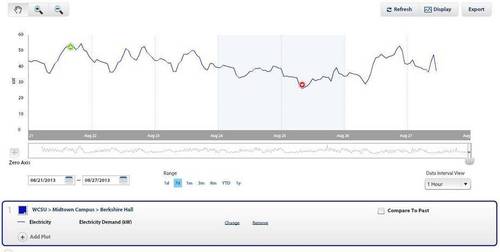
>Load factor is a ratio or percentage of the consistency of your electricity consumption – in other words, load factor is a way to answer the “how ‘spikey’ is your load?” question. The easiest way to understand your own load factor is by looking at your real-time energy data. Not only will your energy data indicate your load factor, but it will also highlight other important aspects of your electricity use over time that will enable you to make smarter energy management decisions.

While looking at your real-time energy data is the best way to accurately get your load factor, you can approximate it from your utility bill information. To manually find out your load factor, divide your total consumption (in kWh) by the number of hours in your billing period. Then, divide the result by your peak demand during the billing period, and the number you compute is your load factor. A load factor closer to 1, or 100%, indicates that you are using energy more evenly or consistently over time. It might also mean you are reducing your peak demand or otherwise avoiding spikes.<

See on energysmart.enernoc.com

U.S. Geothermal Inc. Announced Final Completion of Neal Hot Springs Power Plant

See on Scoop.itGreen Energy Technologies & Development

BOISE, IDAHO, Aug 01, 2013 (Marketwired via COMTEX) — U.S. Geothermal Inc., (nyse mkt:HTM) CA:GTH -1.96% a leading renewable energy company focused on the development, production, and sale of electricity from geothermal energy, announced () that Final Completion of the 22 megawatt (net) Neal Hot Springs Project has been achieved.

Duane Tilden‘s insight:

>The Neal Hot Springs Project was the first geothermal project to obtain a loan guarantee under the DOE’s Title XVII loan guarantee program, which was created by the Energy Policy Act of 2005 to support the deployment of innovative clean energy technologies. The DOE loan guarantee, guarantees a loan from the U.S. Treasury’s Federal Financing Bank. The project was authorized for a loan guarantee of up to $96.8 million.

The Neal Hot Springs project deployed a first of its kind binary cycle process, utilizing a supercritical cycle that uses R134a refrigerant as the working fluid, as well as pre-fabricated modular construction of major plant components. […]

The project is selling electricity to Idaho’s largest utility, Idaho Power Company, under a previously signed 25-year power purchase agreement for up to 25 megawatts of power per year. Beginning in 2012, the base energy price is $96 per MW Hour and escalates annually. The calculated 25-year levelized price is $117.65 per MW hour.<

See on www.marketwatch.com

MHI Completes Acquisition of Pratt & Whitney Power Systems

See on Scoop.itGreen Energy Technologies & Development

Tokyo, May 20, 2013 – Mitsubishi Heavy Industries, Ltd. (MHI) has completed its acquisition of Pratt & Whitney Power Systems, the small and medium-size gas turbine business unit of Pratt & Whitney (P&W), an aeroengine manufacturer.

Duane Tilden‘s insight:

>MHI has traditionally focused its gas turbine business on large-capacity, high-efficiency systems. With the addition of PWPS’s small and medium-size aero-derivative engines, MHI has expanded its power generation product portfolio and is able to offer customers a full product lineup.

PWPS’s aero-derivative gas turbines are highly acclaimed, especially for their emergency power generation applications, compact design, and rapid start-up time. More than 1,700 aero-derivative turbines have been delivered worldwide. Significant growth is anticipated in applications that require a flexible power source complementary to a renewable-energy power source. Robust market demand is also expected as small power sources for applications in emerging markets. PWPS’s main product has been the 30MW (megawatt) class machine. The company is developing an innovative 60MW class model, which is expected to significantly boost PWPS’s market share.

Turboden’s ORC turbines have the capability to generate power or supply hot water using a relatively low-temperature heat source such as biomass, factory waste heat or geothermal energy. The company has sold more than 300 units in 20 countries, primarily in Europe. In Japan, increasing opportunities are emerging to use ORC technology in biomass and geothermal applications, and MHI plans to significantly increase sales in those expanding markets.

MHI and P&W have been in a collaborative relationship in aeroengine production for many years. After the acquisition of PWPS, MHI will continue to collaborate with P&W in the supply of engine parts for gas turbines and development of new machines.<

See on www.mhi.co.jp