Climate Change Will Cause More Energy Breakdowns, U.S. Warns

See on Scoop.itGreen & Sustainable News

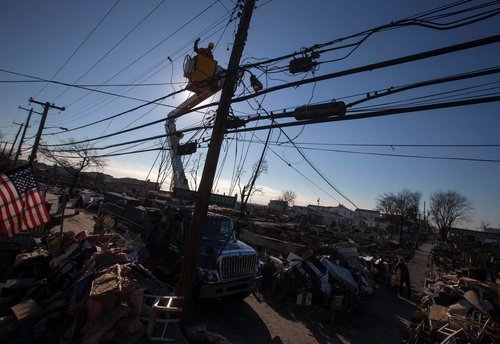
The national power supply is increasingly vulnerable to severe weather, according to a new Department of Energy study.

Duane Tilden‘s insight:

>The effects are already being felt, the report says. Power plants are shutting down or reducing output because of a shortage of cooling water. Barges carrying coal and oil are being delayed by low water levels in major waterways. Floods and storm surges are inundating ports, refineries, pipelines and rail yards. Powerful windstorms and raging wildfires are felling transformers and transmission lines.

“We don’t have a robust energy system, and the costs are significant,” said Jonathan Pershing, the deputy assistant secretary of energy for climate change policy and technology, who oversaw production of the report. “The cost today is measured in the billions. Over the coming decades, it will be in the trillions. You can’t just put your head in the sand anymore.”<

See on www.nytimes.com

Synthesis of Butanol: Towards a Better Biofuel

See on Scoop.itGreen Energy Technologies & Development

Researchers have developed a catalyst to convert ethanol into butanol with high selectivity, potentially allowing butanol to replace ethanol as a biofuel.

Duane Tilden‘s insight:

>[…] Because manufacturers can prepare ethanol from renewable sources, researchers consider the biofuel a good alternative to standard fossil fuels such as gasoline. Indeed, its production and use have increased remarkably in the last ten years; manufacturers now commonly add ethanol to gasoline fuels.

Despite this increased use, however, ethanol has several disadvantages. It has a lower calorific value than standard gasoline (19.6 vs. 32 MJ/liter); moreover, it is corrosive. For this reason, the maximum amount which can be added to standard gasoline is about 10 %; cars cannot use fuels with higher ethanol amounts without engine modifications.

Butanol: a Better Option

1-Butanol (CH3-CH2-CH2-CH2-OH), an alcohol with a longer chain, could be a better alternative to ethanol. Indeed, it has a higher calorific value (29.2 MJ/liter) and it is much less corrosive; because of this, manufacturers can add it to gasoline in higher proportions without engine modifications, and theoretically it could completely replace the gasoline. Moreover, its octane number is very similar to that of gasoline – 96 vs 91-99.

Despite these characteristics, however, we’re not yet using butanol in cars due to the difficulties in producing the alternative biofuel. […]<

See on www.decodedscience.com

Demand for DC Brushless Motors to increase over 50% in Transportation Sector by 2017

See on Scoop.itGreen & Sustainable News

Automotive systems are becoming increasingly electrically-driven and electric motor manufacturers are benefiting.

Duane Tilden‘s insight:

>“[…] Increasing sales of plug-in electric vehicles, which have powertrain and chassis systems that are electromechanically-driven, are expected to provide greater growth potential for brushless DC motor shipments than for brushed DC motors.

[…]

Although DC brushed motors usage is expanding with the increasing number of electromechanically-driven powertrain and chassis systems, DC brushless motor shipments for powertrain and chassis applications are expected to outpace those of DC brushed motors twofold from 2012 to 2017. The respective average annual growth of DC brushed and DC brushless motor shipments from 2012 to 2017 is expected to be 3.5 percent and 7 percent according to IMS Research. <

See on www.imsresearch.com

Unclean at Any Speed – IEEE Spectrum

See on Scoop.itGreen Energy Technologies & Development

Electric cars don’t solve the automobile’s environmental problems

Duane Tilden‘s insight:

>Two dozen governments around the world subsidize the purchase of electric vehicles. In Canada, for example, the governments of Ontario and Quebec pay drivers up to C $8500 to drive an electric car. The United Kingdom offers a £5000 Plug-in Car Grant. And the U.S. federal government provides up to $7500 in tax credits for people who buy plug-in electric vehicles, even though many of them are affluent enough not to need such help. (The average Chevy Volt owner, for example, has an income of $170 000 per year.)

Some states offer additional tax incentives. California brings the total credit up to $10 000, and Colorado to $13 500—more than the base price of a brand new Ford Fiesta. […]

There are other perks. Ten U.S. states open the high-occupancy lanes of their highways to electric cars, even if the car carries a lone driver. Numerous stores offer VIP parking for electric vehicles—and sometimes a free fill-up of electrons. Mayor Johnson even moved to relieve electric-car owners of the burden of London’s famed congestion fee.

Alas, these carrots can’t overcome the reality that the prices of electric cars are still very high—a reflection of the substantial material and fossil-fuel costs that accrue to the companies constructing them. And some taxpayers understandably feel cheated that these subsidies tend to go to the very rich. Amid all the hype and hyperbole, it’s time to look behind the curtain. Are electric cars really so green?

It’s worth noting that this investigation was commissioned by the U.S. Congress and therefore funded entirely with public, not corporate, money.  […]

Part of the impact arises from manufacturing. Because battery packs are heavy (the battery accounts for more than a third of the weight of the Tesla Roadster, for example), […] Electric motors and batteries add to the energy of electric-car manufacture.

In addition, the magnets in the motors of some electric vehicles contain rare earth metals. […]

The materials used in batteries are no less burdensome to the environment, the MIT study noted. Compounds such as lithium, copper, and nickel must be coaxed from the earth and processed in ways that demand energy and can release toxic wastes. […]
See on spectrum.ieee.org

Ethanol critics rev up efforts to repeal biofuel rules on gas

See on Scoop.itGreen & Sustainable News

The ethanol industry is again under fire from critics who want to eliminate the federal mandate that oil companies blend biofuels into the gasoline supply.

Duane Tilden‘s insight:

>“There will be a push in our committee by some, Republicans and Democrats, to do away with the RFS, saying that it’s just completely unnecessary today, that we have enough gas and oil, that we just don’t need another fuel source, let alone subsidizing it,” Terry said.

An Environmental Protection Agency analysis found that the renewable fuel requirements will displace billions of gallons of petroleum-based fuel consumption, reduce domestic motor fuel prices and increase U.S. farm income. But it also found the potential for higher food prices.

In 2000, ethanol accounted for about 6 percent of the nation’s corn crop. Last year, it accounted for 40 percent of the corn crop.

That’s why the standard’s critics include the grocery industry and some livestock producers that want cheaper grain to feed their animals.<

See on www.omaha.com

The Obama Administration Proposes $8 Billion in Loans for ‘Clean’ Fossil Fuel Technologies

See on Scoop.itGreen & Sustainable News

As part of President Obama’s new energy initiative, the U.S. Department of Energy has proposed $8 billion in loan guarantees for fossil fuel technology projects that are able to reduce the country’s greenhouse gas emissions.

Duane Tilden‘s insight:

> […]the U.S. Department of Energy has proposed $8 billion in loan guarantees for fossil fuel technologies to reduce the country’s greenhouse gas emissions. The proposal would fund schemes such as waste heat recovery and carbon dioxide capture, however it has unsurprisingly received criticism as it would draw focus away from green technology projects such as renewable energy and electric vehicles.

Speaking about the new proposal, Energy Secretary Ernest Moniz stated:  “Coal and fossil fuels still provide 80% of our energy and 70% of electricity, and they will remain an important part of our future, as the president noted.”<

See on inhabitat.com

Research and Markets: Global and Chinese Power Energy Storage Battery – 2013 Report – WSJ.com

See on Scoop.itGreen & Sustainable News
DUBLIN–(BUSINESS WIRE)–June 28, 2013–

Research and Markets (http://www.researchandmarkets.com/research/nblmtd/2013_deep) has announced the addition of the “2013 Deep Research Report on Global

Duane Tilden‘s insight:

>The report begins by defining the industry giving details on classification, application, industry chain, structure industry overview, international market analysis, China domestic market, Global market analysis, macroeconomic environment, economic situation analysis and influence, industry policy and plan, product specification, manufacturing process, and product cost structure.

The report then gives statistics on 21 key manufacturers including information on capacity, production, cost, price, profit, production value gross margin, products, customers, application, capacity, market position, company contact information and other company related information. […]

In the end, this report gives a SWOT analysis and discusses a 400MWh/year investment feasibility analysis project and investment return analysis and also gives related research conclusions and a development trend analysis of Chinese and Global Power Energy Storage Battery industry.<

See on online.wsj.com

Wind turbines to power Scotland’s railways

See on Scoop.itGreen & Sustainable News

A Scottish railway operating company has been given the green light to install two wind turbines at a West Lothian railway depot. They are expected to produce 14,000kWh of electricity …

Duane Tilden‘s insight:

A Scottish railway operating company has been given the green light to install two wind turbines at a West Lothian railway depot.

They are expected to produce 14,000kWh of electricity – enough to power a small station like Greenfaulds, Cumbernauld in Scotland – and save almost eight tonnes of carbon emissions every year. ScotRail also expects to save around £4,500 in energy bills per year, which it plans to reinvest in more renewable energy schemes on Scotland’s railways.

See on www.energylivenews.com

An Important, and Sometimes Overlooked, Energy Efficiency Tool

An Important, and Sometimes Overlooked, Energy Efficiency Tool.

Transactive, distributed energy markets hold promise | Intelligent Utility

See on Scoop.itGreen Energy Technologies & Development

Transactive energy markets hold the promise to achieve economic efficiency and reliability across the bulk power system and distribution networks.  This research area was identified in the Caltech Resnick Sustainability Institute’s Grid2020 report released last fall, and was the topic of the third discussion of the series in April 2013.

Duane Tilden‘s insight:

>Significant untapped potential exists to leverage a new class of flexible mixed distributed assets (e.g., distributed generation, responsive demand, storage, power electronics and electric vehicles), what has been called DR 2.0, to manage the power system. But, this requires changes in both market designs and grid operations.  […]

Current wholesale market rules are significant barriers to participation as they effectively do not distinguish a 500 MW power plant from a 5kW electric vehicle battery. This is very unfortunate, as the technology to tap these smaller resources and create significant value for customers is available today. Heather Sanders, Director, DER Policy at CAISO shared that, “a challenge is to create market participation rules that meet operators’ needs for reliability, but also facilitate customer value opportunities.” <

See on www.intelligentutility.com