Stanford researchers map out an alternative energy future for New York

See on Scoop.itGreen & Sustainable News

A study, co-authored by Stanford researcher Mark Z. Jacobson, outlines a path to statewide renewable energy conversion, and away from natural gas and imported fuel.

Duane Tilden‘s insight:

The study is the first to develop a plan to fulfill all of a state’s transportation, electric power, industry, and heating and cooling energy needs with renewable energy, and to calculate the number of new devices and jobs created, amount of land and ocean areas required, and policies needed for such an infrastructure change. It also provides new calculations of air pollution mortality and morbidity impacts and costs based on multiple years of air quality data.

To ensure grid reliability, the plan outlines several methods to match renewable energy supply with demand and to smooth out the variability of WWS resources. These include a grid management system to shift times of demand to better match with timing of power supply, and “over-sizing” peak generation capacity to minimize times when available power is less than demand.

The study’s authors are developing similar plans for other states, including California and Washington. They took no funding from any interest group, company or government agency for this study.

See on news.stanford.edu
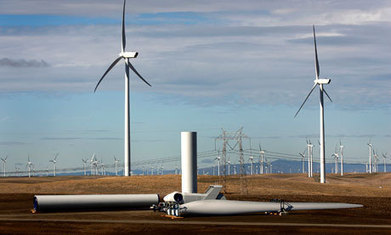
Wind power capacity grew 20% globally in 2012, figures show

See on Scoop.itGreen Energy Technologies & Development

A relative slowdown in new wind turbine construction in China was offset by increases in the US, Germany, India and the UK

Duane Tilden‘s insight:

“While China paused for breath, both the US and European markets had exceptionally strong years,” said Steve Sawyer, secretary general of the Global Wind Energy Council (GWEC), which produced the statistics. “Asia still led global markets, but with North America a close second, and Europe not far behind.”

The UK now ranks sixth in the world for installed wind power, with 8.5GW. In Europe, only Germany (31GW) and Spain (23GW) have more. China leads the world with 77GW installed and the US is second with 60GW. […]

The record year for installation in the US was driven by a rush to beat an anticipated end to tax credits: 8GW of the total 13GW were installed in the last quarter of 2012. However, the tax credit has since been extended, meaning a dramatic slowdown in the US in 2013 is less likely. […]

See on www.guardian.co.uk

Renewable energy debt issuers abound | FP Street | News | Financial Post

See on Scoop.itGreen Energy Technologies & Development

If the fixed income analysts at BMO Capital Markets have got it right, investors can expect another crop of issues by companies whose business is renewable energy, a move, they suggest will generate ‘a gust of income for your portfolio’…

Duane Tilden‘s insight:

In his view, the level of issuance in 2012 “will easily be surpassed this year,” he wrote in a 24-page report.

Laing makes that argument on the basis that across the land, there are more than 8,500 megawatts in projects at various stages of development “stemming from previous calls for green power.”

Most of those projects are based in B.C., Ontario and Quebec. According to his report, Canada’s wind energy capacity stood at 6,000MW at the end of 2012, up from 140MW in 2000.

See on business.financialpost.com

WIND ENERGY TOP SOURCE FOR NEW GENERATION IN 2012; AMERICAN WIND POWER INSTALLED NEW RECORD OF 13,124 MW …

See on Scoop.itGreen Energy Technologies & Development

The U.S. wind energy industry had its strongest year ever in 2012 […] installing a record 13,124 megawatts (MW) of electric generating capacity, leveraging $25 billion in private investment,and achieving over 60,000 MW of cumulative wind capacity.

Duane Tilden‘s insight:

In this historic year of achievement, wind energy for the first time became the number one source of new U.S. electric generating capacity, providing some 42 percent of all new generating capacity; the final tally will be released in April in AWEA’s annual report. In fact, 2012 was a strong year for all renewables, as together they accounted for over 55 percent of all new U.S. generating capacity.

“The fact that wind power grew by another 28 percent in 2012 alone and poured $25 billion of private investment into the U.S. last year demonstrates wind’s ability to scale up, and continue to serve as a leading source of energy in America,” Gramlich said.

The global wind energy industry will gather in Chicago, Ill., this May 5-8, 2013, for the world’s largest annual wind power event, WINDPOWER 2013. Thousands of workers and leaders from all sectors will attend to show their wares, attend conference sessions, and seek further solutions for success.

See on www.power-eng.com

[…] Advanced Energy Management Patent Portfolio Developed by Pacific Northwest National Laboratory

See on Scoop.itGreen Energy Technologies & Development

SEATTLE, WA–(Marketwire – Jan 29, 2013) – Calico Energy Services (www.calicoenergy.com) and the Department of Energy’s Pacific Northwest National Laboratory (PNNL, www.pnnl.gov) today announced that Calico has licensed a portfolio of advanced energy management Intellectual Property (IP) developed by PNNL.

Duane Tilden‘s insight:

PNNL’s development of the technology was funded by DOE’s Office of Electricity Delivery and Energy Reliability and the American Recovery and Reinvestment Act. The innovative Patent Portfolio is based on a single, integrated smart grid model that utilizes an economic signal to automatically balance supply and demand at the lowest possible cost.

“PNNL’s Patent Portfolio is a breakthrough that allows an electric power system to virtually balance itself,” said Jesse Berst […]

See on www.marketwire.com

10 Key Data Center Energy Management Trends for 2013

See on Scoop.itGreen Building Operations – Systems & Controls, Maintenance & Commissioning

The ways data centers consume power will continue to undergo both subtle and substantive transformations in 2013. The first three trends identified here started in 2012, when organizations began struggling with increased power demands in the face of constrained capacity caused by both inefficient equipment and stranded power…

Duane Tilden‘s insight:

[…] For example, because rates for electricity are at their lowest at night when demand is low and baseload generating capacity is under-utilized, shifting the current workload to “follow the moon” can result in considerable savings.

[…] To eliminate the stranded power that exists in virtually every data center, capacity planning efforts will also begin to include power distribution and actual consumption as critical design factors.

[…] To eliminate the considerable overlap between the DCIM and other management systems used by the IT department and the Building Management System (BMS) used by the Facility department, organizations will begin migrating to DCIM as the primary platform for managing data centers, and will integrate other systems with it. …

See on www.energymanagertoday.com

Photovoltaics vs. Biofuel

See on Scoop.itGreen Energy Technologies & Development

As facility managers and building owners prepare for another year of green pushes and renewable energy options, has research determined a winner in the photovoltaic vs. biofuel energy battle?

Duane Tilden‘s insight:

[…] in a paper titled “Spatially Explicit Life Cycle Assessment of Sun-to-Wheels Transportation Pathways in the U.S.” and published in the Dec. 26 issue of the journal Environmental Science & Technology, showed photovoltaics (PV) to be much more efficient than biomass at turning sunlight into energyto fuel a car.

“PV is orders of magnitude more efficient than biofuels pathways in terms of land use – 30, 50, even 200 times more efficient – depending on the specific crop and local conditions,” says Geyer. “You get the same amount of energy using much less land, and PV doesn’t require farm land.”

The researchers examined three ways of using sunlight to power cars: a) the traditional method of converting corn or other plants to ethanol; b) converting energy crops into electricity for BEVs rather than producing ethanol; and C) using PVs to convert sunlight directly into electricity for BEVs.

… “The cost of solar power is dropping, and our quick calculations suggests that with the federal tax credit, electric vehicles are already competitive.”

What does this mean for the future?

“What it says to me is that by continuing to throw money into biofuels, we’re barking up the wrong tree,” Geyer explains. …

See on www.buildings.com

Dynamic Energy – A Leader in Energy Solutions | Combined Heat & Power

See on Scoop.itGreen Building Design – Architecture & Engineering

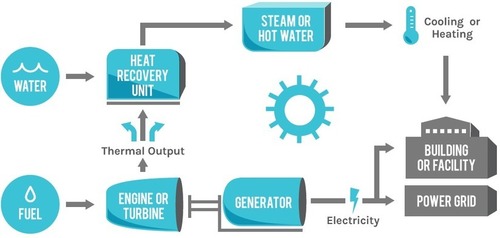
Dynamic Energy develops energy projects that reduce customers’ expenses, improve operating efficiency, provide an attractive return on investment, and help achieve sustainability goals.

Duane Tilden‘s insight:

CHP Financing – Direct Purchase

There are many reasons why now is a great time for CHP. Dynamic can provide multiple financing options including:

Purchasing a CHP system provides many benefits including:
• Traditional bank financing
• Federal 10% Investment Tax Credit
• Accelerated depreciation (MACRS)
• Aggressive state level incentives
• Locked forward natural gas contracts
• Significant thermal & electrical savings

Power Purchase Agreement
A Power Purchase Agreement (PPA) provides the host customer power and heat at a discounted rate, with no capital requirement. A third party investor owns the CHP system and eneters into a long term power contract with the host. PPAs provide the following benefits to host customers:

• No upfront cost or capital required
• Projects are cash flow positive from day one
• Predictable energy pricing & hedge against electricity prices
• No system performance or operating risk and no maintenance
• Align with organizational sustainability goals
• Press and media outreach

[For example of financing options, not intended as a corporate endorsement.]  DT

See on dynamicenergyusa.com

EU faces fresh calls to strengthen biofuel rules

See on Scoop.itGreen Energy Technologies & Development

Greenpeace-backed report argues EU can meet green transport targets without relying on controversial land-based biofuels

Duane Tilden‘s insight:

NGOs are increasingly fearful that member states’ efforts to meet the targets through an increase in the use of biofuels will have a negligible impact on greenhouse gas emissions and in some cases could lead to increased emissions as companies source biofuels made from food and energy crops that are alleged to have contributed to deforestation and food price inflation.

The EU Commission has acknowledged the risk and last year proposed a new limit on the use of biofuels made from food crops that would ensure such fuels could only count towards half of the 10 per cent target for renewable fuel use.

The proposals have encountered lobbying from some member states who have argued the binding 10 per cent goal cannot be met if limits are placed on the use of biofuels made from food crops.

But the CE Delft report argues the targets can be met through greater investment in fuel efficiency measures, waste and residue-based biofuels, and electric vehicles, alongside tighter rules to phase out the use of biofuels made from land-based food or energy crops.

See on www.businessgreen.com

Energy Efficiency in Data Centres to Lower Costs and Benefit the Environment

See on Scoop.itGreen Energy Technologies & Development

LONDON, Jan. 16, 2013 /PRNewswire/ — The data centre market is growing at an extremely high rate and its boom…

Duane Tilden‘s insight:

“Data centre managers are under constant pressure to lower the TCO [Total Cost of Ownership] and energy is one of the main components of the overall data centre operation cost.  […]

Data centres are classified as mission critical facilities and any down time will result in a significant financial loss. In order to ensure highest availability, data centre managers employ high powered UPS systems. These UPS systems consume about 7% of the total energy.   […]

See on www.prnewswire.com