Electric Vehicle Market – Nissan Tests “Demand Response” Energy Management System

Nissan is assessing the potential of electric vehicles in energy management systems. […]  is participating in the “demand response” energy supply and demand system testing together with businesses and government authorities in Japan.

Source: green.autoblog.com

>”[…]  Demand response is a strategy to make power grids more efficient by modifying consumers’ power consumption in consideration of available energy supply. Since the Great East Japan Earthquake in March 2011 the supply and demand of electricity during peak use hours in Japan has drawn attention. Under the demand response scheme, power companies request aggregators* to use energy conservation measures, and they are compensated for the electricity that they save.

Usually when energy-saving is requested consumers may respond by moderating their use of air conditioning and lighting. However, by using the storage capacity of electric vehicles and Vehicle to Home (V2H) systems, consumers can reduce their use of power at peak times without turning off lights and appliances. This is particularly useful in commercial establishments where it is difficult to turn power off to save electricity.

The demand response scheme involves assessing the usefulness of energy-saving measures using V2H systems during peak-use periods and analyzing the impact of monetary incentives on business. For example, the testing involves a LEAF and LEAF to Home system which is connected to power a Nissan dealer’s lighting system during regular business hours using stored battery energy. This reduces electricity demand on the power grid. The aggregator is then compensated for the equivalent of the total amount of electricity that is saved. Two or three tests per month will be conducted on designated days for three hours’ each time sometime between 8:00 a.m. to 8:00 p.m. from October 2014 through January 2015.

Effective use of renewable energy and improvements in the efficiency of power generation facilities will enable better energy management in the future and help reduce environmental impact. Field tests using EVs’ high-capacity batteries that are being conducted globally are proving their effectiveness in energy management. Additionally, if similar compensation schemes for energy-saving activities were applied to EV owners it could accelerate the wider adoption of EVs and reduce society’s carbon footprint.

Nissan has sold more than 142,000 LEAFs globally since launch. The Nissan LEAF’s power storage capability in its onboard batteries, coupled with the LEAF to Home power supply system, is proving attractive to many customers. As the leader in Zero Emissions, Nissan is promoting the adoption of EVs to help build a zero-emission society in the future. Along with these energy management field tests, Nissan is actively creating new value through the use of EVs’ battery power storage capability and continuing to promote initiatives that will help realize a sustainable low-carbon society.

* Aggregators refers to businesses that coordinate two or more consumers (e.g. plants and offices) and trade with utility companies the total amount of the electricity they have succeeded in curbing.”<

See on Scoop.itGreen Energy Technologies & Development

Microgrid Integration with Public Transportation

Superstorm Sandy crippled much of New Jersey’s critical infrastructure two years ago. Stuck without power at home, many also couldn’t get to work because the operations center for New Jersey Transit flooded, damaging backup power systems, emergency generation, and the computers that control train operations.

Source: theenergycollective.com

>” […] After a highly competitive grant process, NJ Transit last week received $1.3 billion in federal funds to improve the resilience of the state’s transportation system in the event of devastating future storms. The funds include $410 million to develop the NJ TransitGrid into a first-of-its-kind microgrid capable of keeping the power running when the electric grid goes down.

Microgrids are different from traditional electric grids in that they generate electricity on-site or nearby where it’s consumed. They can connect to the larger grid or island themselves and operate independently.

The NJ TransitGrid will not only generate power on-site but will incorporate a range of clean energy technologies such as renewable energy, energy storage, and distributed generation. This microgrid will also allow NJ Transit and Amtrak trains running on Amtrak’s Northeast Corridor, the country’s busiest train line, to keep operating during an outage.

Environmental Defense Fund joined state and federal stakeholders, such as New Jersey Governor’s Office of Recovery and Rebuilding and the U.S. Department of Energy, in the early stages of NJ TransitGrid planning. EDF also wrote a letter in support of New Jersey’s application for the funds from the Federal Transit Administration.

The $1.3 billion in total federal funds received by NJ Transit will go toward a range of resiliency and restoration projects across the system, including flood protection, drawbridge replacement, train storage and service restoration, and making train controls more resilient. These funds will also be used to fortify critical Amtrak substations.

Serving almost 900,000 passengers daily, NJ Transit is the third largest transit system in the country connecting travelers to the tri-state area of New York, New Jersey, and Pennsylvania. An independent microgrid for NJ Transit will prepare the state for future extreme weather events, which are happening more frequently due to climate change. Furthermore, the use of clean energy resources will make this microgrid a less polluting and more efficient operation for New Jersey’s day-to-day needs.”<


See on Scoop.itGreen & Sustainable News

Combined Heat & Power Drives Biomass Demand

New analysis from the International Renewable Energy Agency (IRENA) forecasts CHP and industrial heat demand are set to drive global bioenergy consumption over the coming decade and more.

Source: www.cospp.com

>”The trend towards modern and industrial uses of biomass is growing rapidly, the report notes, adding that biomass-based steam generation is particularly interesting for the chemical and petrochemical sectors, food and textile sectors, where most production processes operate with steam. Low and medium temperature process steam used in the production processes of these sectors can be provided by boilers or CHP plants. Combusting biogas in CHP plants is another option already pursued in northern European countries, especially in the food sector, where food waste and process residues can be digested anaerobically to produce biogas, IRENA adds. A recent IRENA analysis (2014b) estimated that three quarters of the renewable energy potential in the industry sector is related to biomass-based process heat from CHP plants and boilers. Hence, biomass is the most important technology to increase industrial renewable energy use, they conclude.

In industry, demand is estimated to reach 21 EJ in the REmap 2030, up to three-quarters of which (15 EJ) will be in industrial CHP plants to generate low- and medium-temperature process heat (about two-thirds of the total CHP output). In addition to typical CHP users such as pulp and paper other sectors with potential include the palm-oil or natural rubber production sectors in rapidly developing countries like Malaysia or Indonesia where by-products are combusted in ratherinefficient boilers or only in power producing plants.

As a result, installed thermal CHP capacity would reach about 920 GWth with an additional 105 GWth of stand-alone biomass boilers and gasifiers for process heat generation could be installed worldwide by 2030. This is a growth of more than 70% in industrial biomass-based process heat generation capacity compared to the Reference Case.

Biomass demand for district heating will reach approximately 5 EJ by 2030 while the power sector, including fuel demand for on-site electricity generation in buildings and on-site CHP plants at industry sites, will require approximately another 31 EJ for power generation (resulting in the production of nearly 3,000 TWh per year in 2030, according to IRENA.

The total installed biomass power generation capacity in Remap 2030 reaches 390 GWe. Of this total, around 178 GWe is the power generation capacity component of CHPs installed in the industry and district heating sectors.”<


See on Scoop.itGreen Energy Technologies & Development

10 Most Efficient Renewable Energy Devices

Google invests $145 million in new 82MW Southern California solar power plant

Energy Storage Solutions for the Smart Grid

In order to ramp up clean energy production, we have to figure out how to store and transmit it effectively. Companies are experimenting with new tech to figure out the best way to progress.

Source: www.techrepublic.com

>”The smart grid energy storage sector is expected to grow to $50 billion by 2020, with an annual compound growth rate of 8%, according to a recent report from Lux Research. In 2013, renewable energy accounted for only 10% of total US energy usage and 13% of electricity generation, according to the US Energy and Information Administration.

But as renewable energy generation rises, transmission and storage advancements will be necessary. Curtailment, the act of spilling renewable energy because there’s more than enough, is one issue to tackle. By changing grid transmission lines in 2010, Texas saw the curtailment in their grid drop from 9% to 4% in 2012, according to a report by the National Renewable Energy Laboratory.

The tipping point with energy storage depends on the grid and the technology used, said Sam Jaffe, an analyst at Navigant Research. Some places in the world that have extremely high penetration rates of renewable energy don’t have major problems with wasted renewables. Denmark sends its extra wind power to Sweden and Norway, while importing hydro power from those two countries when the wind isn’t blowing. Denmark’s wind penetration is now at almost 40%.

“That’s because they are interconnected to other grids that have a lot of flexibility to offtake renewable energy,” he said.”<


See on Scoop.itGreen Energy Technologies & Development

US Company Deploys Aqueous, Lithium-Ion and Flow Batteries for Grid Storage

“Batteries must do more than just work—they have to scale.”

Source: www.greentechmedia.com

>”[…] The startup is a software developer and system integrator that has attracted investment, personnel and a growing roster of turnkey energy storage projects.

[…]

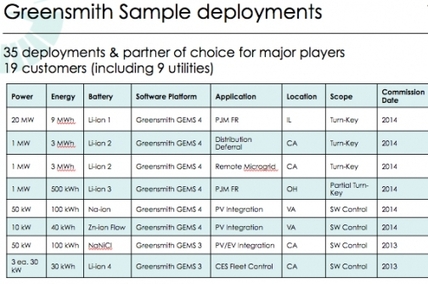
Companies like the 30-employee Greensmith are winning energy storage projects not because they are building better batteries but because they are writing software that integrates batteries with inverters and allows energy storage to work with the grid at scale. Greensmith works with a variety of battery chemistries from different vendors, as well as multiple inverters and power electronics partners.

New battery technologies and projects

Amongst other technologies, Greensmith is using Aquion Energy’s sodium-ion battery. The Pittsburgh, Penn.-based Aquion says its technology can deliver round-trip energy efficiency of 85 percent; a ten-year, 5,000-plus-cycle lifespan; energy storage capacity optimized to charge and discharge for multi-hour applications; and perhaps most notably, a price point of $250 per kilowatt-hour.

In April, Aquion closed a $55 million Series D venture capital investment, bringing total investments and grants to more than $100 million. New investors Bill Gates, Yung’s Enterprise, Nick and Joby Pritzker (through their family’s firm Tao Invest), Bright Capital, and Gentry Venture Partners joined previous investors Kleiner Perkins Caufield & Byers, Foundation Capital, and Advanced Technology Ventures in the round. Aquion is already producing its 1.5-kilowatt-hour S10 Battery Stack units, as well as an 18-kilowatt-hour system that combines twelve of its S10 units.

Greensmith is also using ViZn Energy Systems’ zinc redox flow battery energy storage technology. ViZn aims to produce a 80-kilowatt/160-kilowatt-hour system housed in a 20-foot shipping container, as well as larger systems. Other flow battery firms include American Vanadium, EnerVault, Primus Power, Imergy and ZBB Energy.

The CEO of the firm told GTM that Greensmith is developing a hybrid system using both the Aquion and ViZn storage chemistries.

Since its 2006 founding, Greensmith has deployed 30 battery energy systems for eighteen different customers, nine of them utilities, and is aiming to have 23 megawatts of systems under management by year’s end. […]”<

See on Scoop.itGreen Energy Technologies & Development

School to Combine Solar PV Modules with Battery Storage in Belgian Pilot Project

“Such an energy storage and distribution system can offer a great value, certainly for schools”, says Bert Dekeyzer of npo iD, the organization behind the ‘School of the Future’.

Source: www.solarserver.com

>'”During weekends a school consumes almost no electricity. The energy produced by the solar panels is stored in the batteries. On Monday morning there is a peak consumption: then all the computers and machines are turned on, which requires quite a lot of electricity. If the solar panels supply too little at that time, the batteries can provide the remaining energy. Moreover, a study showed that the energy consumption of a school does not stop after four o’clock in the afternoon. Schools are increasingly used in the evening for sports activities and evening classes. Also in this situation, the batteries can play their part.”

PV, storage combination offers a solution for a possible power shortage

In addition to an optimal and economic usage of solar power, the system can provide a solution for a possible power shortage in Belgium. Because of problems with the Belgian nuclear power plants, various municipalities could get disconnected from the electricity grid. In case of a power disruption, a traditional solar installation does not work anymore. The inverter of a traditional system switches off automatically because of a power failure. The owners of solar modules also have no electricity at that time, and in addition they suffer losses of the power output and any feed-in tariffs from their solar panels during the outage.

The storage system provides a solution. Such an installation combines solar modules with battery storage and intelligent software: if the grid fails, the system provides uninterrupted power for the user from the solar modules and/or batteries. […]”<


See on Scoop.itGreen Building Design – Architecture & Engineering

5 Steps to Designing a Net Zero Energy Building

traciesimmons's avatardesignrealizedblog

Net zero energy buildings are really just becoming a reality. According to a 2012 Getting to Zero Report by the New Buildings Institute (NBI) and the Zero Energy Commercial Consortium (CBC), 99 commercial buildings have been identified from around the country that are net zero energy performing, zero-energy capable, or are in construction and on their way. And this is just what they know about.

As the industry continues to embark on net zero energy buildings, architecture firms are learning a lot about what it takes to make them reality. San Francisco-based EHDD is one such firm. For nearly a decade they have been designing with net zero in mind.

Sample breakdown of a building&#039;s energy use from EHDD. Sample breakdown of a building’s energy use from EHDD.

According to Brad Jacobson, a Senior Associate at EHDD and recognized leader in sustainable design, “Working on sustainability doesn’t have to be at all about sacrifice. It’s about finding solutions that…

View original post 396 more words

Renewable Geothermal Power Expands in Nevada

Geothermal energy is a growing industry, with more plants going into Nevada’s mostly untapped resource.

Source: www.ktvn.com

Geothermal energy is a growing type of clean energy, and nowhere is that more true than in Nevada. Ormat Technologies has built a geothermal plant every year since 2005.  […]

“This is what the future is going to bring,” Gawell said. “You will see more and more of this in years ahead and it is already a boom for Reno.”

The Steamboat Complex is a binary plant that takes hot water from deep underground, to produce power.

“We convert the heat that’s in the fluid to electrical energy,” Bob Sullivan, Senior Vice President of Ormat Technologies said. “Then we put all the fluids back into the ground where it gets reheated. So, it’s a sustainable cycle.”  […]

Along with electricity, these facilities create economic development, putting hundreds of people to work, drilling wells and building the plants.   About 500 people have permanent jobs with Ormat, in the United States.  Another 500 people work for the company around the world.

“It’s a job engine,” Sullivan said. “It takes a lot of maintenance. It takes a lot of people. It takes a lot of workers, a lot of subcontractors to keep one of these facilities running.”

While the cost of fossil fuels goes up and down, geothermal stays steady. The fuel cost is upfront, in the form of drilling wells. Gawell says what is lost in capital and labor costs is saved in fuel costs. […]”<

See on Scoop.itGreen Energy Technologies & Development