Revisiting The North American Hydropower Opportunity

See on Scoop.itGreen Energy Technologies & Development

It is no secret that many renewable energy advocates are not in favor of large hydropower.

Duane Tilden‘s insight:

>[…] there exists a threat that is even more worrisome to endangered species, a threat that has the potential to cause destructive flooding and destroy ecosystems: climate change.  […]

Perhaps that’s why in May of this year, the World Bank reversed its stance on large-scale hydropower. Whereas the major international development bank was once a staunch opponent of large-scale hydro, recognition that developing regions like Africa and Southeast Asia desperately need power have forced it to reconsider.  The world needs energy to lift people out of poverty and building more fossil fuel-fired electricity plants will only serve to exacerbate the problems already associated with climate change. Hydropower is an answer.

Maybe it is time for the renewable energy industry to take a second look at hydropower development. The clean energy it can provide is a vast improvement over the dirty energy we get from fossil fuels. Hydropower already meets about 8 percent of U.S. electricity demand and with improved technologies that already exist the National Hydropower Association (NHA) estimates that we can double the amount of energy we get from hydropower without building any more dams.<

See on www.renewableenergyworld.com

Google obtains a Renewable Energy Power Purchase Agreement in Texas

See on Scoop.itGreen Energy Technologies & Development

Duane Tilden‘s insight:

>The structure of this agreement is similar to our earlier commitments in Iowa and Oklahoma. Due to the current structure of the market, we can’t consume the renewable energy produced by the wind farm directly, but the impact on our overall carbon footprint and the amount of renewable energy on the grid is the same as if we could consume it. After purchasing the renewable energy, we’ll retire the renewable energy credits (RECs) and sell the energy itself to the wholesale market. We’ll apply any additional RECs produced under this agreement to reduce our carbon footprint elsewhere.<

See on googleblog.blogspot.ca

Developing an Energy Management Program for Your Business

See on Scoop.itGreen Building Operations – Systems & Controls, Maintenance & Commissioning

Today more than ever, businesses are concerned with maximizing operational efficiency, minimizing costs, and seeking out untapped revenue streams. At the same

Duane Tilden‘s insight:

>Large energy users like many commercial, institutional, and industrial organizations have a unique opportunity to act as a “virtual power plant” while reducing their real-time demand for electricity—and opening up a new revenue stream. This strategy, known as demand response, is not only a cost-free way to reduce energy usage, but also it generates payments for participating businesses simply for being on call.

Demand response providers work with commercial, institutional, and industrial businesses to identify ways for facilities to reduce energy consumption without affecting business operations, comfort, or product quality. In turn, those facilities agree to reduce their demand during strategic times so that utilities and grid operators can improve reliability during times of peak demand. Demand response also helps increase economic efficiency in regional energy markets and integrate renewable generation capacity into generation systems.

Demand response can be considered a form of strategic energy efficiency, but what about long-term, persistent energy efficiency, a second key to a comprehensive energy management program? In even the most high-tech, LEED Platinum certified buildings, it can be very difficult to ensure efficient operation over time. […]<

See on www.dailyenergyreport.com

Scotland gives green light to Europe’s largest tidal energy project

See on Scoop.itGreen Energy Technologies & Development

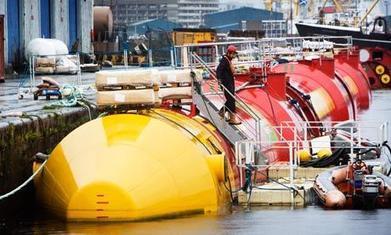
Wave power to provide electricity to 40% homes in Highlands as work on building turbines in Pentland Firth gets approved

Duane Tilden‘s insight:

>”This is a major step forward for Scotland’s marine renewable energyindustry. When fully operational, the 86 megawatt array could generate enough electricity to power the equivalent of 42,000 homes – around 40% of homes in the Highlands. This … is just the first phase for a site that could eventually yield up to 398 megawatts.”<

See on www.theguardian.com

Coal Power: One Percent Of U.S. Power Plants Produce 12 % Of U.S. Carbon Emissions

See on Scoop.itGreen & Sustainable News

The disproportionate greenhouse impact of a small portion of U.S. power plants shows how damaging inefficiency and inertia can be.

Duane Tilden‘s insight:

>That one percent is actually 50 plants, all of them coal-fired. In fact, America’s single dirtiest power plant — Georgia Power’s Plant Scherer — dumped over 21 million metric tons (MMT) of carbon dioxide into the atmosphere in 2011. That’s more than all the energy-related emissions produced by the state of Maine that year.

And the disproportionate contribution of the dirtiest plants to greenhouse gas emissions continues on down the scale: in 2011, half of all the power sector’s carbon emissions came from the 100 dirtiest plants (98 of which are coal-fired). And 90 percent of all those emissions came from just the 500 dirtiest power plants. That’s out of almost 6,000 electricity generating facilities — renewable and fossil-fuel-powered alike — in the country.<

See on thinkprogress.org

Coal opposes Senate Energy Commission Nomination

See on Scoop.itGreen & Sustainable News

Ronald J. Binz, nominated to lead the Federal Energy Regulatory Commission, is opposed by the coal industry because of his efforts to promote renewable energy.

Duane Tilden‘s insight:

>At the Electricity Consumers Resource Council, which represents large industrial customers, Marc Yacker, a vice president, said that the coal industry had some reason to be worried. The industry believes, he said, that “the whole idea of socializing the cost of new transmission necessary to get wind to population centers is anti-coal.”<

See on www.nytimes.com

Scottish Power should not sponsor fuel poverty conference, say campaigners

See on Scoop.itGreen & Sustainable News

Fuel Poverty Action says energy company with £712m profits ‘whilst people froze in their homes’ is not appropriate sponsor

Duane Tilden‘s insight:

>Scottish Power came under particular fire this summer when its annual report revealed a doubling of annual pre-tax profits to £712m barely months after it had hiked its gas and electricity prices by 7%. The same report also showed that Scottish Power had paid a dividend of £890m to its parent company, Iberdrola, and given a £129,000 bonus to chief corporate officer Keith Anderson, taking his total pay for 2012 to over half a million pounds.

Fuel Poverty Action accused Scottish Power at the time of “making a killing” while Citizens Advice also expressed concern that there were “too many families forced to choose between heating or eating” and urged companies to put customers before shareholders.<

See on www.theguardian.com

Remote Wireless Power Systems for Buildings

See on Scoop.itGreen Building Operations – Systems & Controls, Maintenance & Commissioning

Mobile Technology News and Information

Duane Tilden‘s insight:

>Ossia’s patented smart antenna technology uses phased arrays to transfer power without the use of inductive coils, ultrasonic waves, magnetic resonance, charging pads or mats. The Cota technology consists of two parts: a charger and a receiver. The Cota-powered charger automatically locates Cota receivers built into devices or batteries, and delivers signals that are sent omnidirectionally. Once they hit the charger, these signals follow the same path back to the receiver, focusing energy at the exact location of the device. Cota continuously streams power to multiple devices, even as they move around a room. The laws of physics make the Cota technology inherently safe, naturally avoiding anything that absorbs energy, such as people, pets and even plants.<

See on www.mobiletechnews.com

Canadian renewable energy output continues to fall

See on Scoop.itGreen & Sustainable News

The contribution from renewable energy sources continues to decline in Canada in comparison to conventional carbon-based fuel according to Federal statistics

Duane Tilden‘s insight:

>“While wind output dropped 14.4% and solar slipped 3.6%, Canada’s total generation of electricity declined 0.8%, which means that renewables continue to lose share” said Bill Eggertson, the Executive Director of the Canadian Association for Renewable Energies. “We’ve been warning for some time that the good news on the growth in renewables, is overshadowed by the even-greater growth in conventional energy output. The recent meeting of energy ministers in Yellowknife noted that green power capacity has grown at a rapid pace over the last decade and the trend is expected to continue, but that is not due to sources which many Canadians regard as truly renewable. Feed-in tariffs and legislated renewable portfolio standards are key, but there must be stronger efforts to curtail the growth of conventional energy sources, or the share from renewables will continue to drop.”<

See on www.renewableenergymagazine.com

U.S. Nuclear Power waning: A history of Failures

See on Scoop.itGreen & Sustainable News

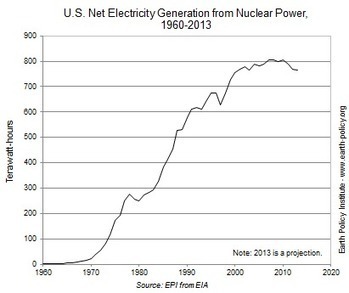
By J. Matthew RoneyNuclear power generation in the United States is falling. After increasing rapidly since the 1970s, electricity generation at U.S. nuclear plants began to grow more slowly in the…

Duane Tilden‘s insight:

>Of the 253 reactors that were ordered by 1978, 121 were canceled either before or during construction, according to the Union of Concerned Scientists’ David Lochbaum. Nearly half of these were dropped by 1978. The reactors that were completed—the last of which came online in 1996—were over budget three-fold on average.

By the late 1990s, 28 reactors had permanently closed before their 40-year operating licenses expired. […]

In 2012, the U.S. Nuclear Regulatory Commission (NRC) approved four new reactors for construction, two each at the Vogtle plant in Georgia and the Summer plant in South Carolina. These reactors are all of the same commercially untested design, purportedly quicker to build than previous plants. Both projects benefit from fairly new state laws that shift the economic risk to ratepayers. These “advanced cost recovery” laws, also passed in Florida and North Carolina, allow utilities to raise their customers’ rates to pay for new nuclear plants during and even before construction—regardless of whether the reactors are ever finished.

Construction at both sites began in March 2013. Even as the first concrete was poured at the $14-billion Vogtle project, it was reportedly 19 months behind schedule and more than $1 billion over budget. The Summer project, a $10 billion endeavor, also quickly ran into problems. […] With these delays, the earliest projected completion date for any of these reactors is some time in late 2017. […]

This year has also already witnessed the permanent shutdown of four reactors totaling 3.6 gigawatts of capacity. The first to fall was Duke’s Crystal River reactor in Florida. Although the plant was licensed to run until 2016, Duke decided to close it rather than pay for needed repairs. Then Dominion Energy’s 39-year-old Kewaunee reactor in Wisconsin closed, citing competition from low gas prices. It had recently been approved to operate through 2033. And in June, Southern California Edison shuttered its two San Onofre reactors after 18 months of being offline due to a leak in a brand new steam generator. These retirements leave the United States with 100 reactors, averaging 32 years in operation. (France is second, with 58 reactors.)

More closures will soon follow, particularly among the roughly half of U.S. reactors in so-called merchant areas […]

Dealing with nuclear waste is another expensive proposition. Over the past 30 years, the U.S. government has spent some $15 billion trying to approve a central repository for nuclear waste, and for most of that time the only site under consideration has been Nevada’s Yucca Mountain. Amid concerns about the site’s safety and its extreme unpopularity in Nevada, the Obama administration has moved to abandon the project entirely and explore other options.

A federal appeals court ruled in August 2013 that the NRC must resume reviewing the site’s suitability. In the meantime, the waste keeps accumulating. The 75,000 tons of waste now stored at 80 temporary sites in 35 states is projected to double by 2055. […]


See on grist.org