Energy Storage Technologies Will Replace Utilities Gas Fired Turbine Peaker Plants

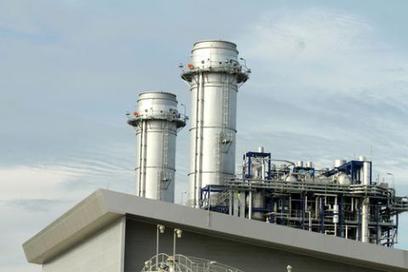
“Power grids need extra generating capacity to work properly. For example, about 20 percent of New York State’s generation fleet runs less than 250 hours a year. Because they don’t run much, “peaker plants” are by design the cheapest and least efficient fossil generators.”

Source: www.renewableenergyworld.com

>”[…] As has happened with solar PV, the costs for multi-hour energy storage are about to undergo a steep decline over the next 2 to 3 years. This cost trend will disrupt the economic rationale for gas-fired simple cycle combustion turbines (CTs) in favor of flexible zero emissions energy storage. This will be especially true for storage assets owned and operated by vertical utilities and distributed near utility substations.

Simple cycle gas-fired CTs have been a workhorse utility asset for adding new peaker capacity for decades. But times and technologies change, and the power grid’s long love affair with gas-fired CTs is about to be challenged by multi-hour energy storage. Flow batteries that utilize a liquid electrolyte are especially cost-effective because the energy they store can be easily and inexpensively increased just by adding more electrolyte.

CTs cost from $670 per installed kilowatt to more than twice that much for CT’s located in urban areas. But the economics of peaking capacity must also reflect the benefits side of the cost/benefit equation. Distributed storage assets can deliver both regional (transmission) and local (distribution) level energy balancing services using the same storage asset. This means the locational value and capacity use factor for distributed storage can be significantly higher compared to CTs operated on a central station basis.

[…]

The disruptive potential of energy storage as a substitute for simple cycle CTs has been recognized. For example, Arizona Public Service (APS) and the Residential Utility Consumer Office (RUCO) recently filed a proposed settlement which, if approved, would require that at least 10% of any new peaker capacity now being planned as simple cycle combustion turbines would instead need to be energy storage — as long as the storage meets the cost effectiveness and reliability criteria of any CTs being proposed.

[…]

Lower cost solar PV and its rising penetration in all market segments will have a profoundly disruptive effect on utility operations and the utility cost-of-service business model. This has already started to happen. Storage offers a way for utilities to replace lost revenues premised on margins from kilowatt-hour energy sales by placing energy storage into the rate based and earning low-risk regulated returns.”<
See on Scoop.itGreen Energy Technologies & Development

Grid Parity Is Accelerating the US Solar Revolution

“Solar PV installations in the U.S. increased an impressive 485% from 2010 to 2013, and by early 2014, there were more than 480,000 systems in the country. That’s 13,400 MW, enough to power about 2.4 million typical American homes.”


Source: www.pvsolarreport.com

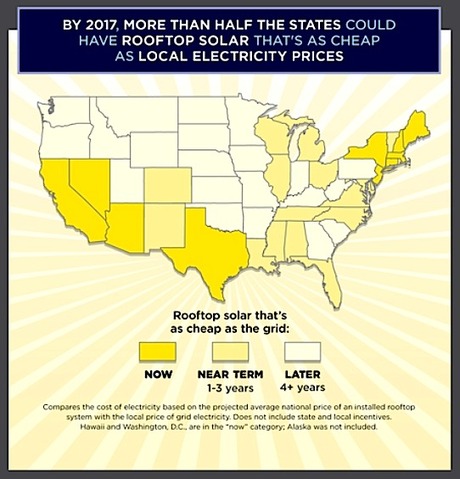
>” […] You can definitely see a correlation between electricity price and amount of solar installed, though there are exceptions. Kansas, for example, has fairly high grid prices but little solar — a testament to the fact that good policy is also a key ingredient in promoting solar. And Alaska is not exactly highly populated. For the most part, though, solar is flourishing in states with high electricity rates.

In some states like California, already one of the most expensive places for electricity in the country, residential rates will soon be going up further. Customers in the PG&E service area are looking at a 3.8% increase in electricity bills. Overall, electricity prices in the U.S. have been rising rapidly. According to the Energy Information Administration, in the first half of 2014, U.S. retail residential electricity prices went up 3.2% from the same period last year — the highest year-over-year growth since 2009. […]

The fact is, solar and other renewables just keep getting cheaper. We’ve noticed a number of stories debating this recently, many in reaction to an Economist article on how expensive wind and solar really are. But as Amory Lovins points out, the reality is that renewables are getting cheaper all the time, regardless of anyone’s arguments.

What does this mean? It means that grid parity is coming sooner than you might think […]”<

See on Scoop.itGreen Energy Technologies & Development

Solar Energy Storage Added to Eight California Schools

Burton School District, in the heart of California’s sun-drenched San Joaquin Valley, will also house combined solar and energy storage systems[…]

Source: www.pvsolarreport.com

>”In the commercial sector, the cost of energy storage is now low enough that businesses are finding it a useful addition to solar. Generally, businesses’ peak energy consumption is when electricity is most expensive, which makes energy storage especially useful.

As the cost of energy storage continues to decline, large solar companies have been integrating it into their product offerings to complement a solar system. […]

The district will install solar and DemandLogic to generate and store its own clean, renewable electricity at eight schools. This will be the largest combined solar and energy storage installation SolarCity has undertaken to date. It will allow the district schools to reduce energy costs by using stored electricity to lower peak demand.

SolarCity will install the district’s solar systems and battery storage at eight elementary and middle schools, as well as additional solar generation at a district office. The solar installations will total more than 1.4 MW of capacity, with storage providing an additional 360 kW (720 kWh) of power to reduce peak demand. The new solar systems are expected to save the district more than $1 million over the life of the contracts, and the DemandLogic battery storage systems could save thousands more on demand charges each year.

[…]

The new SolarCity systems are expected to generate 2,300 MWh of solar energy annually, and enough over the life of the contract to power more than 4,000 homes for a year. The solar systems will also offset over 43 million pounds of carbon dioxide and save more than 203 million gallons of water, an especially important environmental benefit in the drought-stricken valley. The entire storage project is expected to be completed by May 2015.”<

See on Scoop.itGreen Energy Technologies & Development

Net Zero Energy Buildings at Zero Cost

The Netherlands has found a way to refurbish existing buildings to net zero energy, within a week, with a 30-year builders’ guarantee and no subsidies.

Source: www.energypost.eu

>”Inside the house, the pounding rain stills to distant murmur. That’s thanks to the triple glazing, points out Ron van Erck, enthusiastic member of Platform31, an innovation programme funded by the Dutch government that brings together different actors for out-of-the-box thinking to crack intractable problems. One of its big successes to date is Energiesprong, an initiative that turns the building market on its head to deliver social housing with zero net energy consumption, i.e. no energy bill, at zero cost to the tenant and with no subsidies to the builder.

Starting off in 2010 with three staff, a €50 million budget and five years to come up with something to make buildings more sustainable, Energiesprong today boasts 45 staff and a deal with 27 housing associations and four big construction companies to refurbish 111,000 houses in the Netherlands. Total investment? €6 billion. The initial focus is social housing, but it’s already looking at the private market, care centres and commercial office buildings too.

How does the plan work? The basic trick is that tenants instead of paying their energy bills, pay a similar amount to the housing corporations that own the houses. With this money, the corporations pay building companies to retrofit the houses, which after renovation have net zero energy costs. The building companies have for this project developed ‘industrialised’ renovation procedures that are highly cost-effective. One important difference with existing renovation projects is that all elements that are needed for a successful move to zero-energy housing are brought together  in one plan.

Energy Post’s Sonja van Renssen met with manager Jasper van den Munckhof, to understand exactly what Energiesprong does, how it does it and why it will succeed – in the Netherlands and elsewhere.

Q: What was your starting point?

A: We started off with what we spend. The household energy bill in the Netherlands is about €13 billion. This money is available. If you spent it on a mortgage or payback on a loan of about 30 years [instead of energy], you have €225 billion to invest in the Dutch housing stock. This is substantial money: €30-40,000 per house to make it energy neutral.

“Retrofit wasn’t interesting – unless you were rich – but using the energy bill to fund it, no one had thought of that! A building and its energy system were developed as parallel, complementary but not integrated, entities.”

-Jan Kamphuis, BJW Wonen, a one-stop-shop for retrofits inspired by Energiesprong

The trick is, how to get this money flowing. We tried to imagine what owners would need to start investing. They buy kitchens and they don’t see this as an investment but good for their family. You need to get this focus on people and how they buy stuff, how they accept things. If you lose that focus and think it’s about financial arrangements, you won’t find a solution.

Q: So what will make people spend money on retrofits?

A: It needs to be very well done, like if they buy a car, they buy a decent one. It has to be fast – the problem with retrofitting (vs. buying new stuff) is that it’s usually a lot of trouble, dust and hassle. So we said one, the retrofits have to be done within a week. Two, it has to be affordable: ideally the cost to the tenant before and after should be equal. That means the energy bill converted to the mortgage or extra rent has to cover the full cost of the retrofit. Three, it has to be attractive. It needs to be something you see. […]”<

See on Scoop.itGreen & Sustainable News

Electric Vehicle Market – Nissan Tests “Demand Response” Energy Management System

Nissan is assessing the potential of electric vehicles in energy management systems. […]  is participating in the “demand response” energy supply and demand system testing together with businesses and government authorities in Japan.

Source: green.autoblog.com

>”[…]  Demand response is a strategy to make power grids more efficient by modifying consumers’ power consumption in consideration of available energy supply. Since the Great East Japan Earthquake in March 2011 the supply and demand of electricity during peak use hours in Japan has drawn attention. Under the demand response scheme, power companies request aggregators* to use energy conservation measures, and they are compensated for the electricity that they save.

Usually when energy-saving is requested consumers may respond by moderating their use of air conditioning and lighting. However, by using the storage capacity of electric vehicles and Vehicle to Home (V2H) systems, consumers can reduce their use of power at peak times without turning off lights and appliances. This is particularly useful in commercial establishments where it is difficult to turn power off to save electricity.

The demand response scheme involves assessing the usefulness of energy-saving measures using V2H systems during peak-use periods and analyzing the impact of monetary incentives on business. For example, the testing involves a LEAF and LEAF to Home system which is connected to power a Nissan dealer’s lighting system during regular business hours using stored battery energy. This reduces electricity demand on the power grid. The aggregator is then compensated for the equivalent of the total amount of electricity that is saved. Two or three tests per month will be conducted on designated days for three hours’ each time sometime between 8:00 a.m. to 8:00 p.m. from October 2014 through January 2015.

Effective use of renewable energy and improvements in the efficiency of power generation facilities will enable better energy management in the future and help reduce environmental impact. Field tests using EVs’ high-capacity batteries that are being conducted globally are proving their effectiveness in energy management. Additionally, if similar compensation schemes for energy-saving activities were applied to EV owners it could accelerate the wider adoption of EVs and reduce society’s carbon footprint.

Nissan has sold more than 142,000 LEAFs globally since launch. The Nissan LEAF’s power storage capability in its onboard batteries, coupled with the LEAF to Home power supply system, is proving attractive to many customers. As the leader in Zero Emissions, Nissan is promoting the adoption of EVs to help build a zero-emission society in the future. Along with these energy management field tests, Nissan is actively creating new value through the use of EVs’ battery power storage capability and continuing to promote initiatives that will help realize a sustainable low-carbon society.

* Aggregators refers to businesses that coordinate two or more consumers (e.g. plants and offices) and trade with utility companies the total amount of the electricity they have succeeded in curbing.”<

See on Scoop.itGreen Energy Technologies & Development

Asia-Pacific Microgrid Market on ‘threshold of exponential growth’

According to the report, the market generated revenues of US$84.2 million in 2013 and Frost & Sullivan predicts that by 2020 this will rise almost tenfold to US$814.3 million, forecasting a compound annual growth rate of 38.3%.

Source: www.pv-tech.org

>” […] This growth is expected to come from activity in establishing microgrids for rural electrification in developing countries, and from commercial microgrids in the developed ones. The report cites the examples of Australia and Japan among the developed countries.

Mining operations in remote parts of Australia are one example of reliance on microgrids, powered by on-site generation. This has come traditionally from diesel generators, which are being combined with or replaced by solar-plus-storage. According to several sources the economics for this are already compelling.

Countries with a strong recent history in rural electrification referred to by Frost & Sullivan include Indonesia, the Philippines and Malaysia. In the example of Indonesia, the country’s utilities are aiming to bring electrification to 90% of the rural population by 2025. In total the report covered the countries of Japan, South Korea, Indonesia, Malaysia, the Philippines, and Australia.

However, despite this recent activity, the report highlights several barriers that are preventing the market reaching its potential. One such example is the high capital cost of installing microgrids in tandem with energy storage systems.  […]

[…] rising electricity prices in many regions would lead utility companies away from diesel and onto renewables to run their microgrids. It could also encourage “stronger governmental support through favorable regulations, funds and subsidies”, as the use of renewable energy for microgrids would require some forms of energy storage, which are still expensive to install […]

“The utilisation of renewable energy sources, either in standalone off-grid applications or in combination with local micro-grids, is therefore recognised as a potential route for rural farming communities to develop, as well as an opportunity to tackle the health issues associated with kerosene and biomass dependence. For example, the Indian Government aims to replace around 8 million existing diesel fuelled groundwater pumps, used by farmers for irrigation, with solar powered alternatives,” according to Fox. […]”<

See on Scoop.itGreen Energy Technologies & Development

Microgrid Integration with Public Transportation

Superstorm Sandy crippled much of New Jersey’s critical infrastructure two years ago. Stuck without power at home, many also couldn’t get to work because the operations center for New Jersey Transit flooded, damaging backup power systems, emergency generation, and the computers that control train operations.

Source: theenergycollective.com

>” […] After a highly competitive grant process, NJ Transit last week received $1.3 billion in federal funds to improve the resilience of the state’s transportation system in the event of devastating future storms. The funds include $410 million to develop the NJ TransitGrid into a first-of-its-kind microgrid capable of keeping the power running when the electric grid goes down.

Microgrids are different from traditional electric grids in that they generate electricity on-site or nearby where it’s consumed. They can connect to the larger grid or island themselves and operate independently.

The NJ TransitGrid will not only generate power on-site but will incorporate a range of clean energy technologies such as renewable energy, energy storage, and distributed generation. This microgrid will also allow NJ Transit and Amtrak trains running on Amtrak’s Northeast Corridor, the country’s busiest train line, to keep operating during an outage.

Environmental Defense Fund joined state and federal stakeholders, such as New Jersey Governor’s Office of Recovery and Rebuilding and the U.S. Department of Energy, in the early stages of NJ TransitGrid planning. EDF also wrote a letter in support of New Jersey’s application for the funds from the Federal Transit Administration.

The $1.3 billion in total federal funds received by NJ Transit will go toward a range of resiliency and restoration projects across the system, including flood protection, drawbridge replacement, train storage and service restoration, and making train controls more resilient. These funds will also be used to fortify critical Amtrak substations.

Serving almost 900,000 passengers daily, NJ Transit is the third largest transit system in the country connecting travelers to the tri-state area of New York, New Jersey, and Pennsylvania. An independent microgrid for NJ Transit will prepare the state for future extreme weather events, which are happening more frequently due to climate change. Furthermore, the use of clean energy resources will make this microgrid a less polluting and more efficient operation for New Jersey’s day-to-day needs.”<


See on Scoop.itGreen & Sustainable News

Energy Storage Solutions for the Smart Grid

In order to ramp up clean energy production, we have to figure out how to store and transmit it effectively. Companies are experimenting with new tech to figure out the best way to progress.

Source: www.techrepublic.com

>”The smart grid energy storage sector is expected to grow to $50 billion by 2020, with an annual compound growth rate of 8%, according to a recent report from Lux Research. In 2013, renewable energy accounted for only 10% of total US energy usage and 13% of electricity generation, according to the US Energy and Information Administration.

But as renewable energy generation rises, transmission and storage advancements will be necessary. Curtailment, the act of spilling renewable energy because there’s more than enough, is one issue to tackle. By changing grid transmission lines in 2010, Texas saw the curtailment in their grid drop from 9% to 4% in 2012, according to a report by the National Renewable Energy Laboratory.

The tipping point with energy storage depends on the grid and the technology used, said Sam Jaffe, an analyst at Navigant Research. Some places in the world that have extremely high penetration rates of renewable energy don’t have major problems with wasted renewables. Denmark sends its extra wind power to Sweden and Norway, while importing hydro power from those two countries when the wind isn’t blowing. Denmark’s wind penetration is now at almost 40%.

“That’s because they are interconnected to other grids that have a lot of flexibility to offtake renewable energy,” he said.”<


See on Scoop.itGreen Energy Technologies & Development

Residential Battery Storage Nears Grid Parity in Germany

It’s very close, according to the German government and some industry observers.

Source: www.greentechmedia.com

>”It is now generally recognized that rooftop solar has reached “socket parity” — meaning that it is comparable to or cheaper than grid prices — in many countries over the last few years. The big question for consumers and utilities is when socket parity will arrive for solar and battery storage.

[…] Electricity prices are rising and solar PV prices are falling, which means that if battery storage falls to around €0.20 per kilowatt-hour (U.S. $0.27), parity will be achieved.

Australian investment firm Morgans, in an assessment of Brisbane-based battery storage developer Redflow, suggests that that company’s zinc-bromine flow battery may already be commercially economic in Germany, the country that leads the world in terms of household adoption and government support for renewables.

Morgans notes that in Germany, the cost of household grid power is around €0.30 per kilowatt-hour (U.S. $0.40) and that the government is now subsidizing residential energy storage systems that are connected to solar systems.

“Given Germany’s substantial adoption of solar PV…costs for solar power range from €0.10 to €0.15 per kilowatt-hour (half the grid price), so when energy storage costs reach €0.15 to €0.20, this will mean renewable energy costs will be at parity with grid prices,” Morgans concludes.  […]”<


See on Scoop.itGreen Energy Technologies & Development

US Company Deploys Aqueous, Lithium-Ion and Flow Batteries for Grid Storage

“Batteries must do more than just work—they have to scale.”

Source: www.greentechmedia.com

>”[…] The startup is a software developer and system integrator that has attracted investment, personnel and a growing roster of turnkey energy storage projects.

[…]

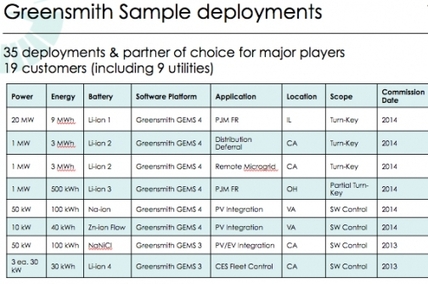
Companies like the 30-employee Greensmith are winning energy storage projects not because they are building better batteries but because they are writing software that integrates batteries with inverters and allows energy storage to work with the grid at scale. Greensmith works with a variety of battery chemistries from different vendors, as well as multiple inverters and power electronics partners.

New battery technologies and projects

Amongst other technologies, Greensmith is using Aquion Energy’s sodium-ion battery. The Pittsburgh, Penn.-based Aquion says its technology can deliver round-trip energy efficiency of 85 percent; a ten-year, 5,000-plus-cycle lifespan; energy storage capacity optimized to charge and discharge for multi-hour applications; and perhaps most notably, a price point of $250 per kilowatt-hour.

In April, Aquion closed a $55 million Series D venture capital investment, bringing total investments and grants to more than $100 million. New investors Bill Gates, Yung’s Enterprise, Nick and Joby Pritzker (through their family’s firm Tao Invest), Bright Capital, and Gentry Venture Partners joined previous investors Kleiner Perkins Caufield & Byers, Foundation Capital, and Advanced Technology Ventures in the round. Aquion is already producing its 1.5-kilowatt-hour S10 Battery Stack units, as well as an 18-kilowatt-hour system that combines twelve of its S10 units.

Greensmith is also using ViZn Energy Systems’ zinc redox flow battery energy storage technology. ViZn aims to produce a 80-kilowatt/160-kilowatt-hour system housed in a 20-foot shipping container, as well as larger systems. Other flow battery firms include American Vanadium, EnerVault, Primus Power, Imergy and ZBB Energy.

The CEO of the firm told GTM that Greensmith is developing a hybrid system using both the Aquion and ViZn storage chemistries.

Since its 2006 founding, Greensmith has deployed 30 battery energy systems for eighteen different customers, nine of them utilities, and is aiming to have 23 megawatts of systems under management by year’s end. […]”<

See on Scoop.itGreen Energy Technologies & Development