Wireless Transmission of Energy in Buildings – Building Automation

See on Scoop.itGreen Building Operations – Systems & Controls, Maintenance & Commissioning
Energy harvesting wireless technology becomes more attractive for OEMs as a basis technology for products and solutions that contribute to a building’s efficient energy management. The wireless modules gain their power from the surrounding environment…

Duane Tilden‘s insight:

>Energy harvesting technology enables batteryless automation devices and systems to make buildings more energy-efficient based on sustainable, resource-saving technologies that eliminate the need for batteries. […]

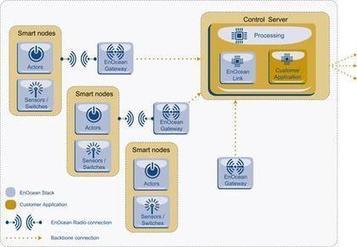
In a complex commercial building scenario, EnOcean Link can be implemented on a central device, like a control server, which controls the whole building, holds the automation intelligence, and can be physically located outside the building (in the cloud). Several gateways in the building record radio telegrams from thousands of distributed batteryless wireless sensors and relay receivers, and send back information or command data when needed. These gateways are connected to the control server by a backbone, which does not have to be based on EnOcean radio, or even be wireless. The middleware, located in the central unit, interprets all telegrams received by the gateways and provides them to the automation system.

High energy efficiency goals demand flexible automation systems for all kind of buildings that cover several areas. This particularly affects retrofit projects, where the intelligent control of energy consumption is the key factor for a building’s improved energy and carbon footprint. Energy harvesting wireless technology fulfills the demands for today’s and tomorrow’s automation and energy management systems. […]<

See on www.manufacturing.net

New Report: The Pulp and Paper Industry Can Save Jobs by Becoming More Energy Efficient

“The pulp and paper mill industry may be able to avoid large cuts in jobs by reducing energy costs.”

wklc's avatarWEST KOOTENAY LABOUR COUNCIL

http://inthesetimes.com   Saturday Jul 20, 2013 10:00 am

By Kari Lydersen

The pulp and paper mill industry may be able to avoid large cuts in jobs by reducing energy costs.   (Ann Baekken/ Flickr / Creative Commons).

The complex relationship between efficiency, productivity and employment has been debated at great length by academics and policymakers, who often come to widely differing conclusions about whether jobs will inherently be sacrificed as industry gets more efficient. A prime example is occurring in the U.S. pulp and paper industry, which, over the last decade, has seen productivity and exports grow, even as hundreds of mills closed and 100,000 workers—30 percent of the industry’s workforce—lost their jobs.

But a new report released last week by the environmental think tank World Resources Institute (WRI) proposes that by investing in overhauls that increase energy efficiency, thereby cutting costs on electricity and improving productivity, the country’s paper…

View original post 972 more words

Green Computing – Business migration to Data Centers and the Cloud

>With the cloud computing scenario, time and power savings mean everything, in these huge scales, running hardly used servers is effectively throwing money away as well as annoying the environmentalists. In this scenario resource scheduling becomes amazingly effective. so we go back to our 5:30pm shutdown, but on this occassion the technology hosting the Virtual infrastructure kicks in, instead of sitting there half used, it will begin to migrate VM’s that no longer require resources to the same host, so although as a whole they may be using quite a lot of resource, it will enable hosts to be powered down and be sat in a ‘power saving’ state awaiting resources requirements to increase and as such power up from their slumber. Again, getting to the scale of this, you could effectively save power on as an example, 100 hosts – these hosts being the beefiest and most cutting edge servers available, are going to have requirements for a large amount of power, effectively turning these off when not used, is a god send to the idea of cloud computing. Why leave the light on in the attic if you have no intention of going there?

So that is effectively how these datacentres work from a green perspective, but from the company utilising this infrastructure, what do they save?

  • Downsize or offset office space.
  • Downsize onsite infrastructure requirements.
  • Expand the ability for users to work remotely (or globally dependent on your requirements)
  • Support the mobile workforce.
  • Reduce consumables use (printing, ink, paper, file storage costs).
  • Reduce hardware (desktop computers/server systems/UPS’s/cabling)


Green Computing – Office365 #greencomputing
.

Demand for DC Brushless Motors to increase over 50% in Transportation Sector by 2017

See on Scoop.itGreen & Sustainable News

Automotive systems are becoming increasingly electrically-driven and electric motor manufacturers are benefiting.

Duane Tilden‘s insight:

>“[…] Increasing sales of plug-in electric vehicles, which have powertrain and chassis systems that are electromechanically-driven, are expected to provide greater growth potential for brushless DC motor shipments than for brushed DC motors.

[…]

Although DC brushed motors usage is expanding with the increasing number of electromechanically-driven powertrain and chassis systems, DC brushless motor shipments for powertrain and chassis applications are expected to outpace those of DC brushed motors twofold from 2012 to 2017. The respective average annual growth of DC brushed and DC brushless motor shipments from 2012 to 2017 is expected to be 3.5 percent and 7 percent according to IMS Research. <

See on www.imsresearch.com

The 21st century data center: You’re doing it wrong | ZDNet

See on Scoop.itGreen Building Design – Architecture & Engineering

Outdated designs are keeping data centers from reaching their full potential.

Duane Tilden‘s insight:

>One example of this are data centers that use raised floors for cooling. Many IT pundits have discredited this method of cooling as wasteful, including Schneider Electric’s territory manager for the Federal government and the ACT, Olaf Moon.

[…]

Cappuccio notes that engineering firms that are consulted to build data centers know about the newer and more efficient ways to do things. But rather than try something new, they prefer the stock standard cookie-cutter approach to creating data centers because it’s fast and easy, he said.

[…]

“I’ve seen a lot of data centers being built that are too big,” says Cappuccio. “We’re finding people with data centers that are three to four years old when they realise they have far too much space, and are still providing air conditioning to those areas. So they begin to shrink them, putting up walls, bringing down the ceiling so they don’t air condition the extra space.”

See on www.zdnet.com

China opens city-sized shopping mall, with fake sun

See on Scoop.itGreen & Sustainable News

If you don’t care about authenticity, the New Century Global Center has everything you could want, including an artificial Mediterranean village. Read this article by Tim Hornyak on CNET.

Duane Tilden‘s insight:

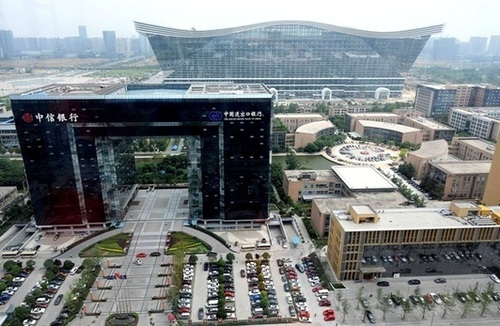
>The New Century Global Center building opened recently in Chengu, a city of more than 14 million people in southwest China’s Sichuan province. It’s described as “the world’s largest standalone structure” by Chinese officials and is 328 feet high, 1,640 feet long, and 1,312 feet wide.

While Boeing’s plant in Everett, Wash., is the world’s biggest building by volume, the Chinese mall seems to be tops in floor space. Almost the area of Monaco, its 420 acres of floor space could fit nearly three Pentagons, four Vatican Cities, or 20 Sydney Opera Houses.

The cavernous structure will feature a mix of retail outlets, a 14-screen movie theater, a university complex, offices, hotels, a water park called Paradise Island, a skating rink that’s big enough to host international competitions, a pirate ship, 15,000 parking spots, and even a fake Mediterranean village.<

See on news.cnet.com

Fire Industry Protocol – are you in the loop? – BSEE – Building Services and Environmental Engineer

See on Scoop.itGreen Building Operations – Systems & Controls, Maintenance & Commissioning

Three decades ago, the protocol debate in building automation systems (BAS) did not exist. Every element of a BAS, from the sensors to the control devices…

See on www.bsee.co.uk

Sustainable Energy and Federal Agencies | The Energy Collective

See on Scoop.itGreen Energy Technologies & Development

In his speech on Tuesday laying out a national climate action plan, President Obama called on federal agencies to lead by example in taking actions to reduce their emissions of greenhouse gases.

Duane Tilden‘s insight:

>Faced with declining budgets, federal agencies are looking for innovative ways to cut costs while meeting a growing list of sustainability mandates.  Expanding the use of information and communication technologies (ICT) – metering and energy management systems for buildings, GPS-based tools for fleets, teleconferencing, e-training, teleworking, and cloud-based data storage – offer agencies new ways to reduce their energy use, cut greenhouse gas emissions and enhance productivity.

We estimate widespread deployment of  ICT could help reduce greenhouse gas emissions by 12 percent, roughly half the amount called for under a 2009 executive order, and could save an estimated $5 billion in energy costs through 2020. […]

Using 2008 as a baseline, agencies have a goal of reducing direct emissions (Scope1 and 2) 28 percent and indirect emissions (Scope 3) 13 percent by 2020. With reductions of 7 percent through 2011, federal agencies are making good progress.  By expanding use of ICT, the federal government could go much further. […]<

See on theenergycollective.com

Research and Energy Efficiency | The Energy Collective

See on Scoop.itGreen Energy Technologies & Development

Every time energy policy is being discussed, you’ll usually find a call for more R&D spending at the top of the list of ways to solve problems. While I agree that research is great, it’s obviously not enough and, if anything, only the first step.

Duane Tilden‘s insight:

>The result of this comparison doesn’t come as a surprise to anyone who is remotely interested in energy issues. There is a massive energy efficiency gap between the US and other world economies. While this is no surprise to many, it should be a lesson for all those who tell the public that meaningful action requires yet more R&D spending. The 200 million citizens of Japan and Germany are proof that even the technology and the concepts of the past can make a huge difference.<

See on theenergycollective.com

Green Building Taking Off in Hospitality, Retail Industries

See on Scoop.itGreen Building Design – Architecture & Engineering

Green building is taking off in the hospitality and retail industries, […]  This year, retail owners that are building green for over half of their projects rose to 38%, up from just 18% in 2011. That’s expected to rise to 52% by 2015.

Duane Tilden‘s insight:

>”Green building has taken such hold in the industry that even sectors with unique challenges, such as retail and hospitality, are making stronger investments,” says Harvey Bernstein, vice president at McGraw Hill Construction. “Clearly the benefits that owners are reporting are key reasons for their green building investments, and as they find better ways to measure those impacts and quantify the value to their sales velocity and to the well-being of their staff, customers and guests, we expect even more rapid engagement in green.”

While lower operating costs are the most frequently reported reason for going green (66% of retailers, 73% of hotels), other factors are also considered very important in their decision-making process:

Utility rebates – Protecting/enhancing brand – just as important as costs for hotels

Improving ROI  […]Energy efficiency is still a key goal, recycling and waste management are also critically important. A strong majority say they require green practices from suppliers, especially on waste handling (75%). <

See on www.sustainablebusiness.com